Estimated reading time: 17 分钟
Choosing an LED stadium light is not simply a matter of finding the fixture with the highest wattage, the highest lumen output, or the narrowest beam angle.
A stadium lighting system has to work with the field dimensions, mounting positions, pole height, competition level, camera directions, surrounding environment, electrical infrastructure, and long-term maintenance plan.
The right question is not: “Which stadium light is the brightest?” It is: “Which combination of luminaires, optics, mounting positions, aiming angles, controls, and installation methods can meet the project requirements with acceptable glare, uniformity, structural loading, and long-term operating cost?”
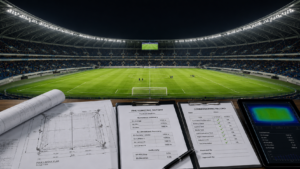
Official football lighting guidance distinguishes between broadcast and non-broadcast venue requirements and considers the needs of players, officials, spectators, broadcasters, and different mounting arrangements. Stadium lighting should therefore be evaluated as a complete system rather than as an isolated fixture specification.
Quick Answer: What Should You Check Before Choosing a Stadium Light?
Before selecting a luminaire, define seven parts of the project:
| Selection factor | Questions to answer |
| Venue requirements | Is the field used for training, competition, or professional broadcast? |
| Field geometry | What are the field dimensions, pole positions, pole heights, and setbacks? |
| Photometric targets | What illuminance, uniformity, glare, and vertical illuminance are required? |
| Optical distribution | Which areas require narrow, medium, wide, or asymmetric light distributions? |
| Fixture and structure | What weight, EPA, bracket arrangement, and driver location can the structure support? |
| Electrical and controls | What voltage, dimming, scene control, surge protection, and communication interfaces are required? |
| Installation and maintenance | How will the fixtures be installed, aimed, serviced, tested, and accepted? |
Project Requirements → Field Geometry → Photometric Targets → Optics → Fixture Structure → Controls → Verification
1. Start with the Project, Not the Fixture
The same LED stadium light will not be equally suitable for a school training field, a municipal stadium, and a professional broadcast venue. The project level determines which lighting characteristics matter most.
| Project level | Typical venues | Main selection priorities |
| Training and community use | Schools, clubs, community fields | Uniformity, cost control, simple operation, easy maintenance |
| Competition venues | Municipal stadiums, professional clubs, regional venues | Glare control, higher uniformity, flexible optics, system reliability |
| Broadcast venues | Professional stadiums and televised events | Vertical illuminance, camera-direction uniformity, color performance, flicker control, scene management |
Before contacting a supplier, the project team should define:
- The sport and level of play
- Whether the venue will host televised events
- Applicable federation, competition, municipal, or client requirements
- Current requirements and possible future upgrades
- Operating modes such as training, competition, cleaning, security, and entertainment
A community field should not be unnecessarily specified as a broadcast venue. At the same time, a venue expecting future television coverage should not select a system that cannot later support the required vertical illuminance, temporal light performance, or controls.
| FIFA Stadium Lighting Standards Explained · EN 12193 Sports Lighting: A Practical Guide · FIFA Broadcast Lighting Requirements for 4K and HDR |
2. Define the Field and Mounting Geometry
A stadium light cannot be selected accurately without understanding where it will be installed and where it must send light.
The required project information should include:
- Playing-area dimensions
- Pole quantity and locations
- Pole height
- Pole setback from the playing area
- Roof-mounted or pole-mounted arrangement
- Existing or new mounting structures
- Distance from each mounting point to the target zones
- Stands, roofs, scoreboards, camera platforms, and other obstructions
- Nearby roads, houses, properties, or sensitive boundaries
- Maintenance and lifting access
Pole height alone does not determine the beam angle
It is common to assume that a specific pole height automatically requires a specific beam angle. In practice, the decision also depends on horizontal setback, target distance, luminaire mounting position on the crossarm, aiming angle, fixture orientation, required beam overlap, and spill-light restrictions.
Two fields with 25-meter poles may therefore require different optical combinations when one has poles close to the touchline and the other has a much larger setback.
Pole quantity also affects light quality
A four-pole layout may reduce the number of foundations and electrical connection points, but each pole normally has to cover a larger portion of the field. A six- or eight-pole layout can provide more lighting directions and reduce the burden on individual mounting points, but it also increases structural, cabling, installation, and maintenance requirements.
There is no universally best layout. The correct arrangement depends on land availability, field size, stands, camera directions, structural cost, glare, and the level of play.
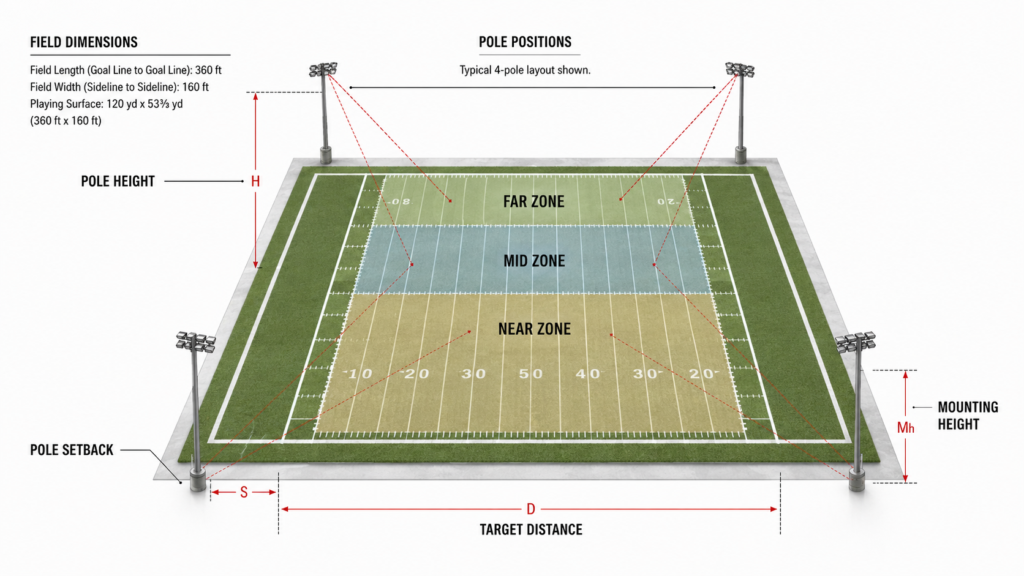
| How Engineers Determine Pole Geometry for Sports Lighting Pole Height Trade-Offs 4 vs. 6 vs. 8 Poles for Stadium Lighting Roof-Mounted vs Pole-Mounted Stadium Lighting |
3. Set the Required Lighting Performance
Once the project and geometry are known, define measurable performance requirements. Average illuminance should not be the only acceptance criterion.
| Metric | What it indicates |
| Average horizontal illuminance | General illumination across the playing surface |
| Uniformity | The relationship between darker and brighter areas |
| Vertical illuminance | Visibility of players and objects from selected viewing or camera directions |
| Glare rating | Visual discomfort or loss of visibility caused by the lighting system |
| Spill light | Light reaching areas outside the intended playing area |
| Backlight and uplight | Light emitted behind the luminaire or toward the sky |
| Color performance | The appearance of people, uniforms, field markings, and objects |
| Temporal light performance | The behavior of the lighting under human vision and camera recording |
| Maintenance factor | Expected reduction in system output over time |
Rated lumens do not prove field performance
A luminaire with a high lumen output may still produce a poor result when the optical distribution does not match the field geometry, too much light falls outside the playing area, the aiming angles create glare, the narrow beam creates bright spots, the field lacks sufficient cross-lighting, or vertical illuminance is weak in important camera directions.
Lumens describe the light leaving the luminaire. They do not show how much useful light reaches the required measurement points. Two fixtures with similar wattage and lumen output can therefore produce very different field illuminance, uniformity, glare, and spill-light results.
Consider maintained performance
The project specification should clarify whether required values are initial or maintained values. A lighting calculation may apply a maintenance factor to account for lumen depreciation, dirt accumulation, environmental conditions, cleaning intervals, and maintenance practices.
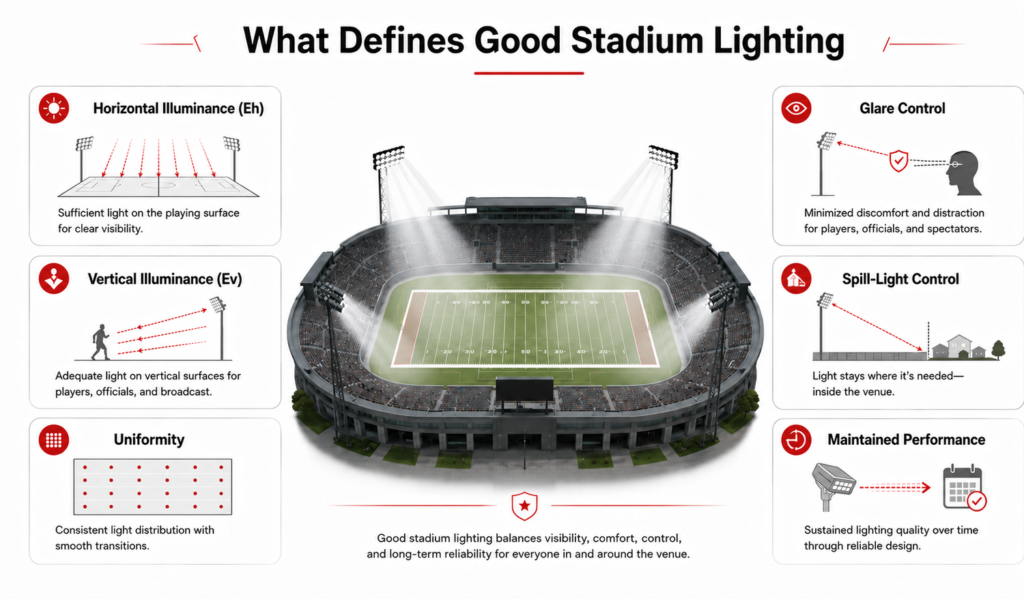
| Sport-by-Sport Lux Targets Horizontal vs. Vertical Illuminance in Stadiums Maintenance Factor in Sports Lighting GR vs. UGR vs. TI |
4. Choose the Optics Before Finalizing the Wattage
The optical distribution determines where the light goes. Wattage determines electrical input; it does not determine whether the light is delivered to the correct part of the field.
| Target area | Common optical requirement |
| Far zones | Controlled narrow or long-throw distributions |
| Intermediate zones | Medium distributions with useful overlap |
| Near zones | Wider or asymmetric distributions |
| Sidelines and boundaries | Controlled distributions that reduce overshoot |
| Camera-facing zones | Cross-lighting that supports vertical illuminance |
| Residential boundaries | Optics and shielding that control backlight and spill |
Narrower is not always better
An extremely narrow beam can provide strong center intensity, but it can also produce localized bright spots, increase sensitivity to small aiming errors, create visible contrast between adjacent beams, require more precise commissioning, and increase glare when aimed too aggressively.
Wider optics can improve coverage in some areas, but may send more light outside the target when used at the wrong mounting position. The goal is a controlled combination in which beams overlap appropriately across near, middle, and far zones.
Beam-angle names are not enough
Two products both described as “20°” do not necessarily produce the same intensity distribution. Compare photometric curves, candela distribution, symmetry or asymmetry, light outside the main beam, backlight and uplight, performance with visors or shields, and the IES or LDT file used in the project simulation.
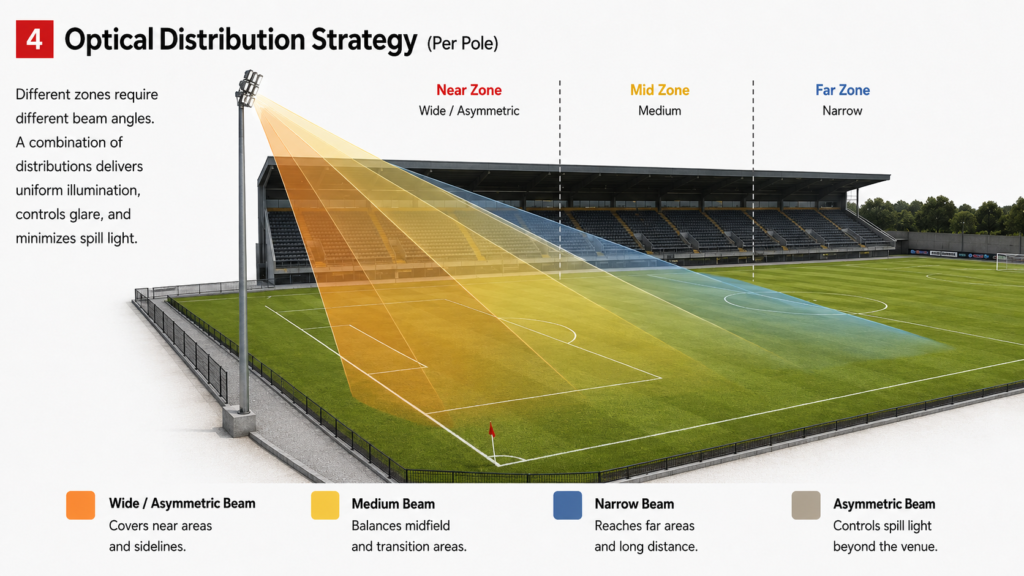
| Stadium Lighting Optics and Beam Angles Max Tilt Angle and Aiming Strategy Obtrusive Light and Spill Control Glare Control in Football Stadium Lighting |
5. Select the Appropriate Fixture Architecture
LED stadium lights are available in integrated, modular, semi-modular, and remote-driver configurations. No architecture is automatically superior; each solves a different set of project constraints.
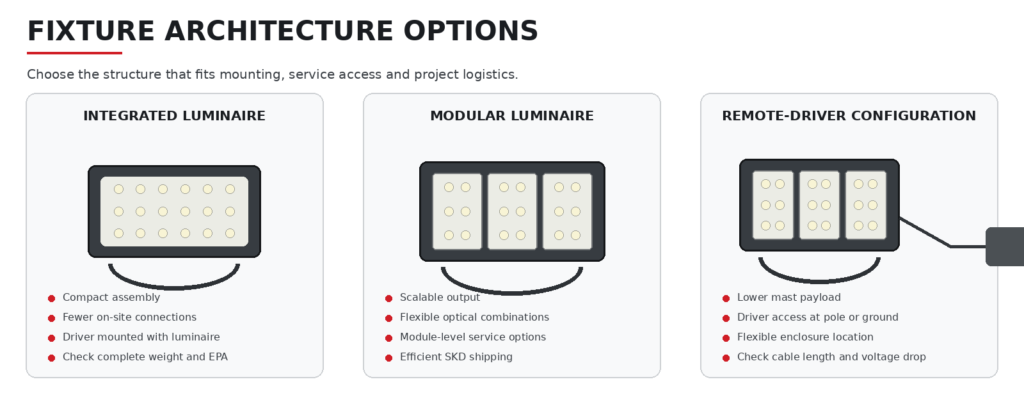
| Fixture architecture | More suitable when | Items to evaluate |
| Integrated luminaire | Compact installation and simplified assembly are priorities | Weight, service access, thermal design, driver replacement |
| Modular luminaire | Flexible output, optics, assembly, or configuration is required | Module wiring, independent operation, aiming, spare parts |
| Semi-modular system | A balance between integrated construction and scalable output is needed | Shared components, assembly method, maintenance process |
| Remote-driver configuration | Lower mast payload or easier driver access is important | Cable length, enclosure location, voltage drop, environmental protection |
| High-output single luminaire | Mounting positions are limited and long-distance coverage is required | EPA, weight, glare control, heat management, optical precision |
Consider the complete mounted assembly
Fixture weight is important, but it is not the only structural parameter. Review effective projected area, luminaire orientation, bracket and crossarm configuration, center of pressure, driver box location, visors and accessories, number of luminaires on each pole, existing pole and foundation conditions, and local wind requirements.
A lighter fixture does not automatically create a safer retrofit. A larger projected area or a different mounting position may still increase structural loading. Existing poles and foundations should be reviewed by appropriately qualified structural professionals before reuse.
| Internal link suggestions: Integrated vs. Modular Stadium Floodlights · Fixture Weight vs. EPA · Sports Lighting Pole Retrofit · How to Upgrade from HID to LED Without Replacing Poles |
6. Check Electrical and Control Compatibility
A technically suitable luminaire may still be unsuitable for the site when its electrical or control requirements are incompatible with the existing infrastructure.
| Electrical or control item | What to confirm |
| Input voltage and frequency | Compatibility with the project power supply |
| Driver configuration | Luminaire-mounted, bracket-mounted, pole-mounted, or ground-mounted |
| Inrush current | Effect on breakers, contactors, and circuit grouping |
| Power factor and harmonics | Project and utility requirements |
| Surge protection | Luminaire-level and distribution-level protection strategy |
| Cable length and voltage drop | Especially important for remote-driver systems |
| Control interface | Relay, 0–10V, DALI, DMX512, or another specified interface |
| Required scenes | Training, match, broadcast, cleaning, security, or entertainment |
| Failure behavior | Restart, emergency mode, manual override, and communication loss |
| Monitoring | Whether status or fault feedback is required |
Do not over-specify controls
A training field may only need reliable switching and a reduced-power training mode. A professional venue may require multiple operational scenes, smooth dimming, broadcast modes, or entertainment integration. Excessive complexity can create unnecessary cost, commissioning time, and maintenance difficulty.
ZC Lighting luminaires can form part of a wider venue energy or control system by providing compatible lighting and control interfaces. The luminaire should not be presented as the complete stadium automation or venue-management system.
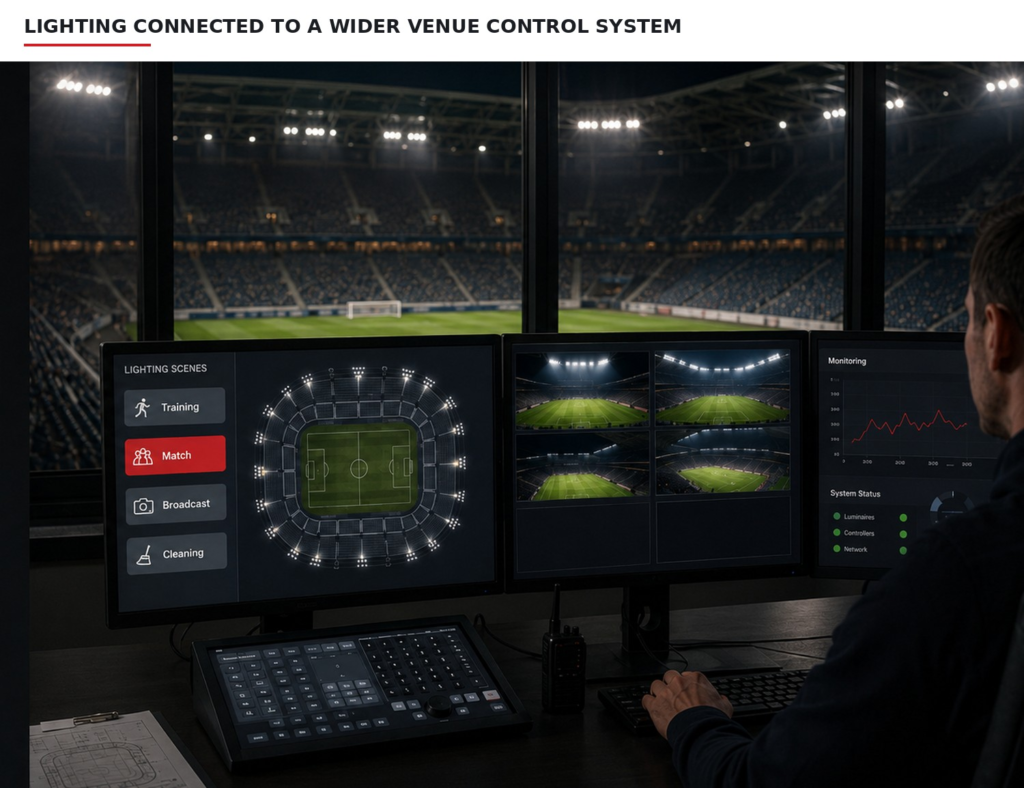
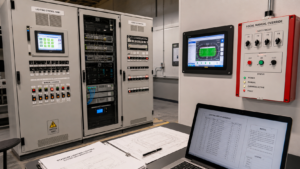
Stadium luminaires can connect to a wider venue control system through compatible interfaces and defined operating scenes.
| Essential Stadium Lighting Controls Zoning Strategy for Stadium Lighting Controls Dimming Curves and Scene Transitions RGBW in Stadium Lighting |
7. Evaluate Performance in the Actual Environment
The same luminaire may perform differently in a dry inland stadium, a coastal venue, a dusty industrial sports complex, or a high-temperature region. Product selection should reflect the actual site environment.
Coastal and corrosive environments
Review the complete corrosion-protection system, not only a salt-spray duration.
- Housing and bracket materials
- Coating system and pretreatment
- Fastener materials
- Dissimilar-metal contact
- Driver enclosure and connector protection
- Drainage, cleaning, and maintenance requirements
High-temperature locations
Review the declared operating temperature together with actual electrical and thermal conditions.
- Driver temperature limits
- LED operating conditions
- Thermal derating
- Enclosure configuration
- Expected daily operating hours
- Test conditions behind lifetime claims
Dusty or polluted sites
Check how contamination affects ingress protection, optics, heat dissipation, and cleaning.
- Ingress protection
- Lens and glass cleaning access
- Heat-sink orientation
- Dirt accumulation
- Sealing details
- Maintenance intervals
Lightning- and surge-prone locations
A coordinated surge-protection strategy may be required at several levels rather than relying only on a component inside the luminaire.
- Electrical distribution
- Grounding system
- Cable route
- Site exposure
- Luminaire-level SPD
- Distribution-level SPD and local requirements
| Coastal Corrosion for Stadium and High-Mast Lighting Surge Protection for Stadium and High-Mast Lighting What Long-Term Testing Reveals That Datasheets Don’t |
8. Consider Installation and Maintenance Before Ordering
Installation and maintenance are often considered too late in the project. Before selecting the product, confirm:
- How the luminaires will be lifted and handled
- Whether they arrive assembled or in separate modules
- How the bracket connects to the crossarm
- Whether drivers are installed on the fixture, bracket, pole, or ground
- How aiming angles will be recorded
- Whether visors can be installed before or after aiming
- How cables are routed and protected
- Which components can be replaced
- How much access is required for future servicing
- Whether the supplier provides aiming tables and luminaire IDs
A product that is easy to transport but difficult to assemble at height may increase installation time. A remote-driver design may reduce mast load and make driver servicing easier, but it requires proper cable design, enclosure placement, and installation coordination. A modular system can support flexible packaging and spare-part replacement, but installers need clear module assembly, wiring, torque, and aiming instructions.
| Sports Lighting Installation Guide Reducing On-Site Risks in Stadium Lighting Delivery Stadium Lighting Commissioning Sequence Stadium Lighting Sign-Off Pack |
9. Ask for Engineering Evidence, Not Just Specifications
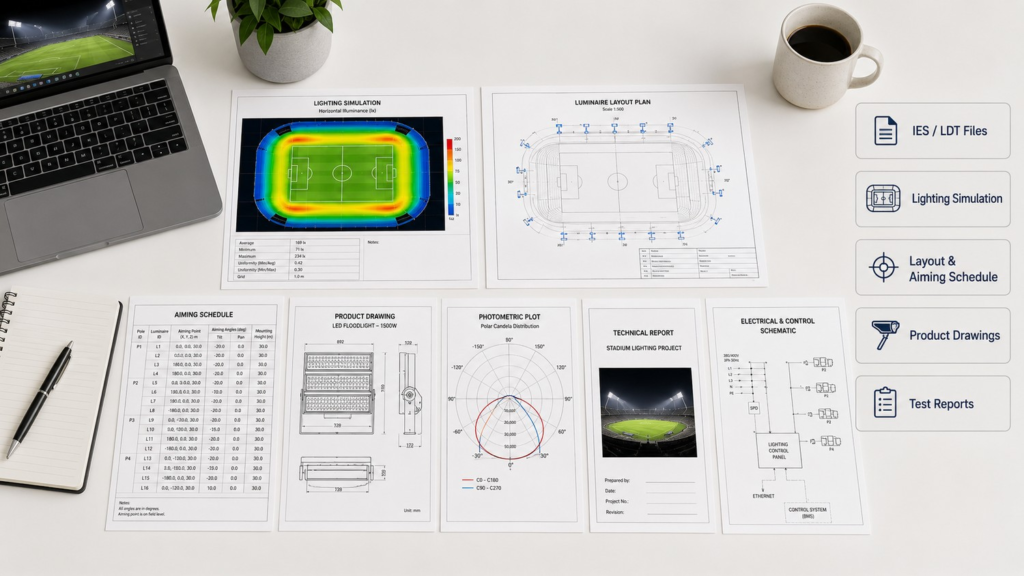
A specification sheet is useful, but it is not sufficient evidence that a product will meet the project requirements. Ask the supplier to provide the documents relevant to the actual project.
| Document | Why it matters |
| IES or LDT photometric file | Allows the exact product and optic to be used in the lighting calculation |
| Independent photometric report | Supports lumen, efficacy, power, color, and distribution claims |
| Project-specific lighting simulation | Shows expected field results for the proposed geometry |
| Luminaire layout | Identifies fixture quantities, positions, and optical distributions |
| Aiming schedule | Provides fixture IDs, target directions, and aiming angles |
| Product drawing | Supports structural, installation, and clearance review |
| Weight and EPA information | Supports mounting-structure evaluation |
| Electrical and driver data | Supports circuit and control-system design |
| Environmental test evidence | Supports protection, corrosion, thermal, and reliability claims |
| Control documentation | Confirms protocol and operating compatibility |
| Warranty terms | Defines coverage, exclusions, replacement process, and responsibilities |
| Relevant project references | Shows experience in comparable applications |
| Commissioning support plan | Clarifies how the installed system will be checked and accepted |
The submitted files must match the actual model, wattage, LED configuration, optic, driver, and control option offered for the project. A report for a similar product is not necessarily evidence for the exact configuration being supplied.
10. Common Stadium-Light Selection Mistakes
Mistake 1: Choosing by wattage alone
A 1,000W fixture is not automatically suitable for every field that previously used a 1,000W or 2,000W HID fixture. Useful performance depends on optics, geometry, aiming, and system efficiency.
Mistake 2: Comparing only maximum lumens
Maximum lumens do not show where the light goes. Compare project simulation, uniformity, glare, spill, vertical illuminance, and maintained performance.
Mistake 3: Using one beam angle across the entire field
Near, middle, and far zones usually have different optical requirements. One distribution can create hot spots, dark areas, overshoot, or unnecessary glare.
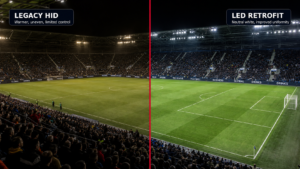
Mistake 4: Replacing HID fixtures one-for-one without recalculation
A physical one-for-one replacement does not guarantee equivalent field performance. LED and HID luminaires differ in optical distribution, dimensions, projected area, weight, and aiming behavior.
Mistake 5: Ignoring vertical illuminance
A field can appear bright from above but still provide weak visibility of players from spectator or camera directions.
Mistake 6: Reusing poles without structural review
Existing poles may have corrosion, undocumented modifications, limited capacity, or mounting configurations that are unsuitable for the proposed LED assembly.
Mistake 7: Accepting “flicker-free” without test conditions
Temporal light performance can change with driver selection, dimming level, supply conditions, and camera settings. Define the test conditions and evidence required.
Mistake 8: Selecting the lowest fixture price
Installation, structural modification, fixture quantity, energy use, driver replacement, lifting access, downtime, commissioning, and warranty execution all affect total cost.
11. Match the Fixture Type to the Project
The following table is not a product ranking. It shows how different product structures can match different project requirements. Final selection must use the latest approved datasheet and a project-specific lighting calculation.
| Project requirement | Characteristics to prioritize | ZC Lighting examples to evaluate |
| Professional and broadcast stadiums | High output, precise long-distance optics, color and temporal-light options, flexible controls | FL09, FL18, FL10 |
| Mid-sized fields and club venues | Balanced output, multiple optics, practical installation, controlled project cost | FL19, FL16, FL08, FL26 |
| Modular and scalable systems | Multiple module configurations, flexible power and optical combinations, easier shipping | FL07, FL15, FL26 |
| Existing-pole retrofit | Manageable mounted assembly, suitable EPA, flexible driver placement, compatible brackets | FL19, FL09, FL26 |
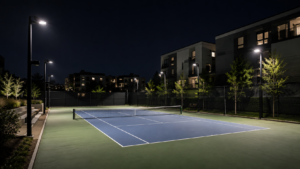
| Tennis and padel courts | Court-oriented optics, glare management, backlight and spill control | PL08 |
| Strict uplight or boundary control | Full-cutoff or tightly controlled optical distribution | FL20 |
12. LED Stadium Lighting Project Input Checklist
Providing complete project information helps the supplier recommend the correct luminaire, optic, quantity, and mounting arrangement.
| Required information | Project input |
| Sport and venue type | |
| Training, competition, or broadcast level | |
| Field dimensions | |
| Required standard or lighting class | |
| Required horizontal illuminance | |
| Required vertical illuminance | |
| Required uniformity | |
| Glare or spill-light restrictions | |
| Pole quantity and locations | |
| Pole height | |
| Pole setback | |
| Existing or new poles | |
| Roof-mounted or pole-mounted | |
| Input voltage and frequency | |
| Required control interface | |
| Required operating scenes | |
| Temperature and environmental conditions | |
| Nearby residential or sensitive areas | |
| Installation schedule | |
| Available drawings or site photos |
Frequently Asked Questions
How many watts should an LED stadium light be?
There is no standard wattage that fits every stadium. Required wattage depends on field size, target lighting level, pole height, setback, fixture quantity, optical distribution, maintenance factor, and required uniformity. Finalize wattage after a project-specific lighting simulation.
Is a higher lumen output always better?
No. Higher lumen output is useful only when the optical system delivers the light to the required areas. A lower-output fixture with a more suitable distribution may produce a better field result than a higher-output fixture with poor beam control.
What beam angle is best for stadium lighting?
Most stadium projects require more than one optical distribution. Narrow distributions may be used for distant zones, while medium, wider, or asymmetric distributions may suit near zones, intermediate areas, and sidelines.
Are modular or integrated stadium lights better?
Neither is universally better. Integrated luminaires can simplify assembly, while modular systems can provide flexible power, optics, packaging, and maintenance. The best structure depends on mounting capacity, project scale, installation method, shipping, and service requirements.
Can LED stadium lights reuse existing poles?
Possibly, but the poles, foundations, crossarms, connections, and mounting arrangement must be evaluated. Fixture weight alone is not enough; EPA, center of pressure, wind, corrosion, and structural capacity also matter.
Do professional stadium lights need flicker control?
Projects involving professional broadcast, slow-motion recording, or high-speed cameras normally require defined temporal-light performance. The specification should identify the test method, driver configuration, load condition, dimming level, and acceptance requirements.
What should be included in a stadium lighting quotation?
A useful quotation should identify the exact luminaire, wattage, optics, quantity, driver and controls, mounting accessories, dimensions, weight and EPA, photometric files, preliminary lighting results, warranty terms, exclusions, delivery, and commissioning responsibilities.
How should two stadium-lighting proposals be compared?
Compare the complete systems under the same project requirements. Review field performance, quantity, optics, glare, structural impact, controls, installation, maintenance, technical evidence, and total project cost—not only fixture price, wattage, or lumens.
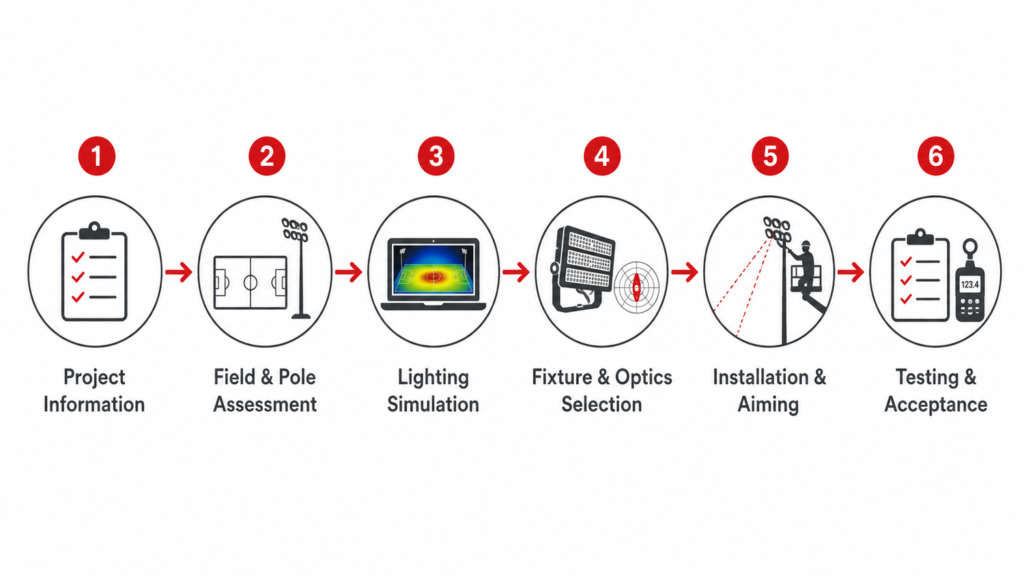
A practical selection workflow from project inputs and field assessment through simulation, fixture selection, installation, aiming, testing and acceptance.
Conclusion
Choosing an LED stadium light begins with understanding the project—not with selecting a wattage. A reliable decision connects venue level, field geometry, photometric requirements, optical distribution, fixture architecture, structural conditions, electrical and control compatibility, environmental reliability, installation and maintenance, and project-specific verification.
The best stadium light is not necessarily the product with the highest output or the longest specification sheet. It is the product—and the complete lighting layout—that delivers the required visibility, uniformity, glare control, reliability, and operating performance under the actual conditions of the venue.
| Need Help Selecting the Right Stadium Light? Send us your field dimensions, pole layout, mounting height, target lighting level, and project requirements. ZC Lighting can help evaluate suitable fixture types, optical distributions, and a preliminary lighting layout for your sports lighting project. PRIMARY CTA: Request a Lighting Recommendation SECONDARY CTA: Download the Project Input Checklist Project drawings, pole layouts, site photos, and existing lighting information can be sent to info@zcled.com. |