In many stadium lighting renovation projects, the first question is quite simple:
Have we replaced the damaged HID lights with LED lights?
However, for actual projects, a better solution is:
Can the existing light poles safely support the new lighting system?
Sports lighting poles are not merely installation points; they are structural components of the entire lighting system. When older metal halide lamps or high-intensity discharge lamps are replaced by LED sports lighting, the new system may differ in terms of fixture weight, wind load, bracket design, driver location, beam angle, and aiming requirements.
If the components of these projects are not reviewed in a timely manner, the renovations may face serious cost, installation problems, and even structural issues.
This article focuses on what needs to be checked before reusing existing light poles in sports lighting renovation projects, and how custom LED sports lights like ZC Lighting’s FL26 can support more flexible project configurations.
Table of contents
Sports lighting solutions
FL26 LED sports light
LED sports lighting upgrade
Motion Lighting Simulation Guide
Low-light sports lighting for community sports fields
Intelligent motion lighting control
Contact ZC Lighting for project support.

Why is it necessary to inspect existing utility poles first?
Reusing existing utility poles can reduce project costs, shorten installation time, and avoid large-scale civil engineering projects.
However, not every utility pole is suitable for direct reuse.
Many sports fields were built years ago. Their columns may have originally been designed for different types of equipment, different load-bearing capacities, different wind coverage areas, or different installation methods. Some columns may also have issues such as corrosion, foundation problems, undocumented modifications, or insufficient structural documentation.
Before selecting new LED lighting fixtures, the project team should review the following:
- Existing pole height
- Rod material and condition
- Basic conditions
- The number and weight of the original fixtures
- Quantity and weight of new fixtures
- Crossarm or bracket design
- EPA and wind load
- Local wind zone
- Fixed device aiming angle
- Drive installation location
- Maintenance Channel
- Local structural requirements
For renovation projects, light poles should be considered as part of the lighting system, not as background detail.
Weight of the fixture: Which components should be included?
The weight of the fixture is one of the first items to check, but there are often misunderstandings about it.
The total load on the light pole includes not only the weight of the LED lights themselves, but may also include:
- Mounting bracket
- cross arm
- drive or drive box
- Junction Box
- cable
- Surge protection device
- Illuminated accessories
- Aiming weapons
- Additional mounting plate or bracket
When multiple light fixtures are installed on the same pole, the subtle variations in product weight are very important.
Therefore, renovation projects should compare the total installation weight , not just the weight of a single device listed in the datasheet.
This is crucial for sports lighting, as fixtures are typically installed at high elevations. Heavier components on pole tops can impact structural reviews, load-bearing installation, and long-term maintenance.

The significance of EPA in outdoor sports lighting
EPA refers to the effective projected area .
In the field of outdoor lighting, the EPA (Environmental Protection Agency) specifies the windward area of luminaires or components. This helps engineers determine the dimensions that may be imposed on light poles and support systems.
The EPA’s decision to upgrade stadium lighting may be influenced by the following factors:
- Light fixture dimensions
- Shape of fixing device
- tilt angle
- Bracket position
- Horizontal arm layout
- Number of fixed devices
- Protective face shield or face shield accessories
- Drive box location
- Local wind conditions
Even if the luminaire itself is lightweight, it may still generate a greater wind load if its shape or installation angle increases the wind load. Therefore, both the weight of the luminaire and EPA ( Environmental Protection Agency) certification should be taken into consideration.
Product compliance with EPA standards should not be inferred solely from its appearance. For formal projects, refurbishment should be based on manufacturer data, local design requirements, and necessary review by qualified engineers.

Bracket position and aiming flexibility
Upgrading sports lighting is not only a structural task, but also a targeted one.
New LED lights must be installed and aimed correctly to achieve the required field performance. Even if the bracket appears robust, it may not be suitable if the correct aiming range cannot be achieved.
Width position influence:
- Fixture tilt angle
- Channel direction
- Pole load distribution
- Maintenance Channel
- Cable wiring
- Having a position
- Able to adjust lighting fixtures on-site
For sports tables, precise aiming is crucial because the tiny aiming pins on the high poles can cause the light to travel a great distance from the target area.
A good bracket design should support stable installation and precise adjustment, and should be installed by construction personnel.
For renovation projects, the installation method should be reviewed along with the lighting simulation, rather than after the luminaires have been selected.
Drive location: Why it is crucial in remodeling projects
The location of the drive unit can affect pole fatigue and maintenance.
In some systems, the driver is mounted directly on or near the light fixture. This simplifies product packaging but may increase the overall weight near the top of the light pole.
In other systems, the drive can be remotely mounted on a pole, bracket, or lower mounting location, depending on the design.
Installing a remote driver can be helpful in some projects because it supports:
- Reduce the weight at the top of the rod
- More convenient maintenance channels
- More flexible installation
- Better service planning
- Reduce heat concentration near light-duty engines
Not all projects require remote drive design. However, for large-scale sports lighting renovation projects that require electricity, it is worthwhile to consider remote drive design early on, especially when pole load or ease of maintenance needs to be taken into account.

The selection of bridge turning angles must be compatible with the existing tower layout.
The renovation project must be compatible with the existing locations of utility poles.
This means that lighting design must be adapted to the actual site, rather than an ideal new layout.
The following factors should be considered when choosing a hotspot angle:
- venue size
- High pole
- Distance between the rod and the table surface
- Position of the pole relative to the target area
- Required illuminance
- Uniformity target
- athletic
- Heat control requirements
- Nearby residential or public road areas
Using the wrong lighting angle can create dark areas, overly bright areas, excessive glare, or light spilling out of the field of vision.
Therefore, it is crucial to obtain IES files and perform lighting simulations before installation. These help confirm the number of luminaires, beam angle, aiming point, expected critical illuminance, and uniformity.
For light pole renovation projects, lighting simulation is not only a design tool but also a risk control tool.
Why does customized LED sports lighting help with light pole renovation?
Modular LED motion lighting equipment is very practical because retrofit projects are rarely exactly the same.
Some applications may require fewer high-power luminaires. Others may require more precise beam distribution control. Still others may require compact transportation solutions that facilitate overseas installation.
Modular systems offer greater flexibility to project teams.
1. Flexible configuration
Modular motion lighting can be configured according to the size of the site, the layout of the light poles, and the lighting target.
This avoids using the same fixed fixture format for every project.
2. Beam angle matching
Different sports venues may require different beam angles. Modular products with multiple optical options make it easier to match project requirements.
3. Transportation and handling
For international projects, modular structures offer the advantage of compact packaging and easier handling compared to bulky monolithic units.
4. Installation Planning
Modular products make it easier to plan fixture combinations, bracket layouts, and aiming strategies.
5. Project adaptability
Modular configurations can help lighting designs adapt to actual site conditions when existing light poles must be reused.
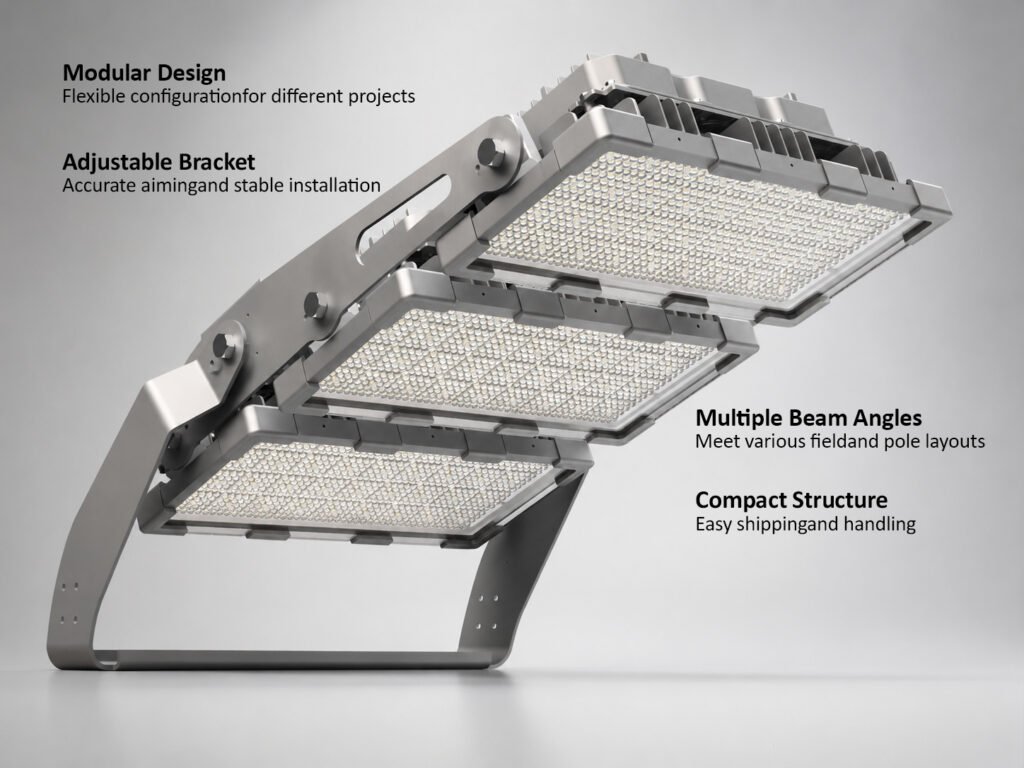

FL26 as a modular option for sports field projects
ZC Lighting’s FL26 is a modular LED sports lighting solution designed specifically for outdoor sports facilities.
It can support different project configurations based on site size, pole height, beam angle requirements, and lighting design goals. Its modular structure also supports flexible assembly and provides a more compact transportation solution for overseas projects.
For utility pole renovation projects, FL26 can be considered when the project requires the following conditions:
- Modular lighting configuration
- Flexible optical options
- Different combinations of lighting fixtures
- Adjustable installation
- compact transportation
- Project-specific lighting design
- Supports IES files and lighting simulation
The selection of the FL26 should not be based solely on power. As with other professional sports lighting, it should be chosen based on the actual pole layout, target illumination level, aiming requirements, and simulation results.
For some projects, the FL26 can be part of a complete sports lighting retrofit solution. For others, depending on factors such as pole load, output requirements, glare control, or budget, other ZC Lighting products may be more suitable.
The key is not to force the same product to be used in all areas, but to match the product configuration with the project.
What should contractors check before reusing existing utility poles?
Before installing new LED motion lights on existing light poles, contractors and project owners should review the following checklist.
1. Extreme conditions
Check for corrosion, deformation, foundation problems, or previous alterations.
2. Original pole design
If possible, please consult the original design loads, wind resistance ratings, and fixture configurations.
3. Existing fixed equipment load
Record the quantity, weight, and installation location of the old light fixtures.
4. Load of newly added fixed equipment
Calculate the total weight of the newly installed luminaires, brackets, drivers, and accessories.
5. EPA and wind load
Review the effective projected area and local wind power design requirements.
6. Bracket and crossarm design
Confirm that the brackets meet the required quantity, aiming angle, and installation stability.
7. Driver’s position
Decide whether the driver is mounted on the light fixture, on the pole, or remotely.
8. Beam angle and aiming
Use IES files and lighting simulations to confirm beam angle, aiming point, and field performance.
9. Diarrhea light and effusion light
Examine whether the new lighting layout may have an impact on nearby houses, roads, or viewers.
10. Maintenance Channel
After installation, consider how to inspect or repair the luminaires and drivers.
11. Control Requirements
Decide whether the table needs to be dimmed, training mode, competition mode, Vienna arrangement, or zone.
12. Project Review
For important or high-load projects, please consult a qualified structural engineer in accordance with local requirements.

The connection between this topic and long-term operating costs
Technical details such as luminaire weight, EPA (Environmental Protection Equipment) standards, bracket design, and driver location directly impact cost items.
If the existing utility poles cannot support the new system, the project may require:
- rod collagen
- New Foundation
- New utility poles
- Supplementary Engineering Review
- Overall installation
- High labor costs
On the other hand, a well-matched LED system can help reduce unnecessary structural changes and improve long-term planning.
Therefore, the modification of the light pole should be reviewed before the final fixing device is determined.
Energy conservation and intelligent control are important advantages to consider in rural renovation projects. However, structural infrastructure improvement is the key to success in these projects.
How does ZC Lighting support light pole renovation projects?
ZC Lighting provides product selection, IES file support, beam angle recommendations, lighting simulation support, and project-based configuration suggestions for sports lighting projects.
For light pole renovation projects, ZC Lighting can assist with the following reviews:
- Tabletop dimensions and door frame arrangement
- Required lighting level
- Existing fixed equipment replacement plan
- corridor angle selection
- Punishment configuration
- Driver installation options
- Diarrhea light and eclipse problems
- Control compatibility
- Transportation and installation requirements
For projects with priority configurations, flexible transport beam angle selection, and structural integrity, the FL26 can be evaluated as part of a lighting solution.
The best product selection depends primarily on the specific project requirements.
in conclusion
Upgrading sports lighting poles is not just about replacing old HID lights with LED lights.
Before reusing existing light poles, the project team should review the light fixture weight, EPA, wind load, bracket location, driver location, corridor angle, and maintenance access.
Standard LED motion lighting solutions such as FL26 offer greater flexibility to adapt to different site layouts and pole conditions. However, the final configuration should still be based on lighting simulations and project requirements.
A good renovation plan is more than just making the lights brighter.
It is better suited to the long-term operation of poles, fields, and sports facilities.
Frequently Asked Questions
What is stadium lighting pole renovation?
Sports lighting pole renovation refers to upgrading the sports field lighting fixtures on existing poles, usually by replacing old HID or metal halide lamps with LED sports lighting fixtures.
Can all existing stadium lighting poles be reused?
This is not always the case. The condition of existing utility poles, load-bearing capacity, wind load, light fixture weight, EPA certification, local bracketing, and structural requirements should be checked.
Why is the weight of the clamp important?
The weight of the luminaire affects the total load of the light. In sports lighting retrofits, the total weight of the installation should include the luminaire, bracket, driver, cables, and accessories.
In the field of sports lighting, what does EPA stand for?
EPA refers to Effective Projected Area. It refers to the area of a luminaire or mounting component exposed to wind and is crucial for the design of light poles and brackets.
Why is a circle important?
The location of the actuator affects the weight at the top of the rod, the height of the workpiece, the maintenance access, and the installation plan.
Why is focusing on design helpful for sports lighting renovation?
Custom designs allow for flexible configuration options, beam angles, compact transport, and better adaptability to different pole layouts and table sizes.
Is FL26 suitable for all renovation projects?
The FL26 is suitable for a variety of sports field projects, especially those requiring custom configurations and flexible beam selection. The final choice depends on the field layout, the condition of the light poles, the target lighting level, and the simulation results.
Is a lighting simulation required before installation?
Lighting simulation helps confirm the number of luminaires, beam angle, aiming point, illuminance, intensity, and possible light spill before installation.