Pole height is not ‘higher is better’. It changes aiming angles, spill distance, and maintenance access cost. Compare options with an evidence-based decision record.
- Key takeaway #1: Height changes both glare risk and spill distance—optics and tilt limits decide outcomes.
- Key takeaway #2: Retrofits must validate achievable performance with existing heights early.
- Key takeaway #3: A decision record prevents redesign and scope creep later.
Table of contents
When this applies
Use this guide when selecting new pole heights or evaluating a retrofit where pole heights are fixed.
Typical scenarios
- Neighbor-sensitive sites: spill distance matters.
- Broadcast venues: aiming geometry affects Ev and glare.
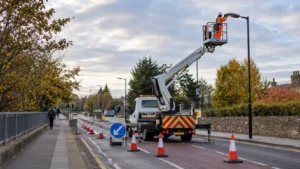
- High mast: access and service cost can dominate TCO.
Key requirements / metrics
Use these metrics to compare height options with real project risks in mind..
| Factor | What height changes | Risk if ignored | What to verify |
|---|---|---|---|
| Aiming angles | Tilt and distribution. | Glare/spill complaints. | Max tilt policy + aiming table. |
| Spill distance | How far light travels. | Neighbor impact increases. | Boundary evaluation and optics strategy. |
| Uniformity | Coverage geometry. | Hot spots/dark zones. | Calculation report and grid plan. |
| Ev support | Vertical angles. | Broadcast quality issues. | Ev calculation + camera directions. |
| Maintenance access | Service cost. | Downtime and cost increase. | Access plan + spares strategy. |
Definitions
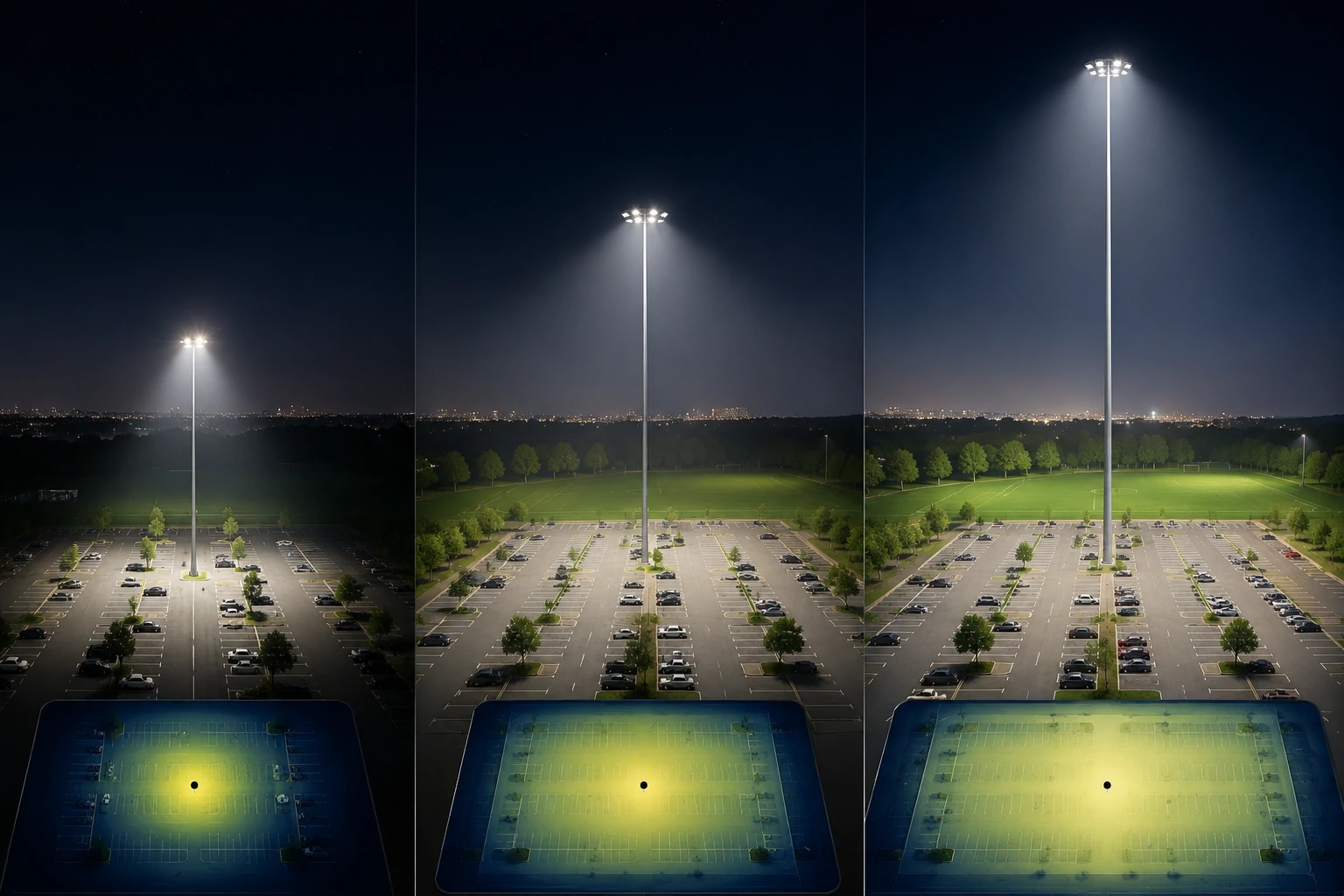
Pole height affects the geometry between luminaires and the field. It changes tilt angles, beam throw distance, and how easily spill reaches beyond the venue.
Typical target ranges
No universal “best height”. Practical approach:
- Compare multiple height options against tier and constraints.
- Use tilt limits + optics selection to manage glare/spill.
- Document why the chosen height best manages risk.
Step-by-step workflow
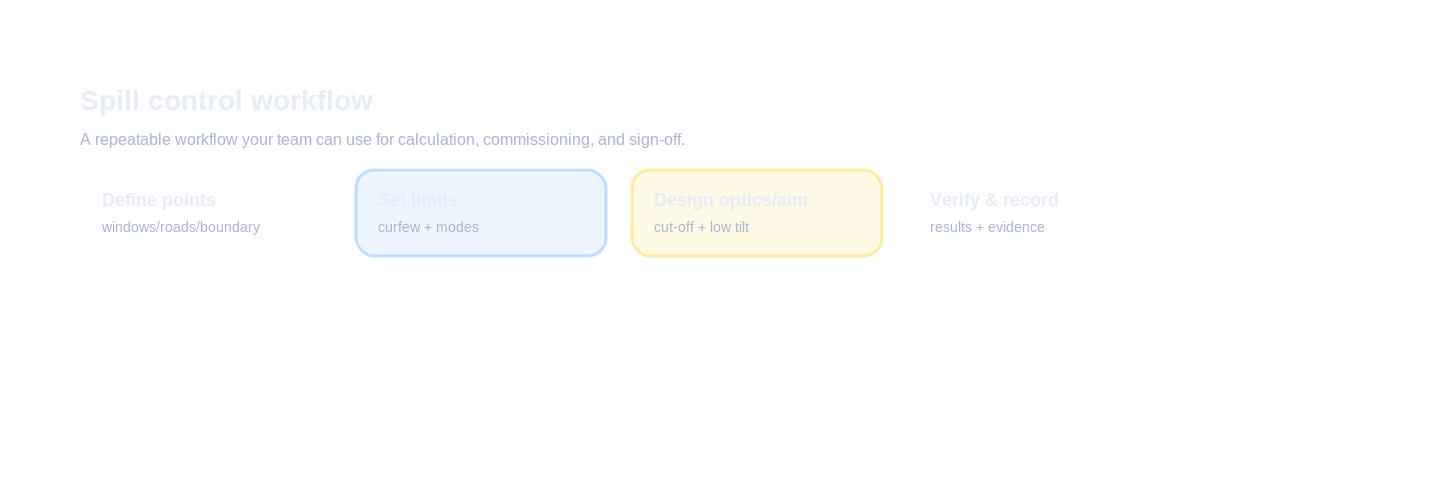
Workflow: define tier → map constraints → test 4/6/8 pole options in calculation → choose option with best risk profile → lock aiming limits and sign-off deliverables.
Inputs to collect
- Venue tier and acceptance criteria.
- Site boundaries and spill constraints.
- Available pole height options (or existing heights).
Design decisions
- Select height that balances performance and constraints.
- Define tilt policy and optics/shielding strategy.
- Define maintenance access plan for chosen height.
Verification & sign-off
- Decision record + calculation evidence + aiming table.
Common mistakes
- Assuming higher always reduces glare.
- Ignoring spill distance for neighbor-sensitive sites.
- Not documenting why a height was chosen.
Checklist / Template download
These downloads are generated in-browser (TXT/CSV) and can be replaced later with gated assets.
Pole Height Decision Record (CSV)
Compare height options against performance and constraints.
Tilt & Spill Risk Sheet (CSV)
Track how height affects tilt and spill risk.
Maintenance Access Note (TXT)
Document access implications of taller poles.