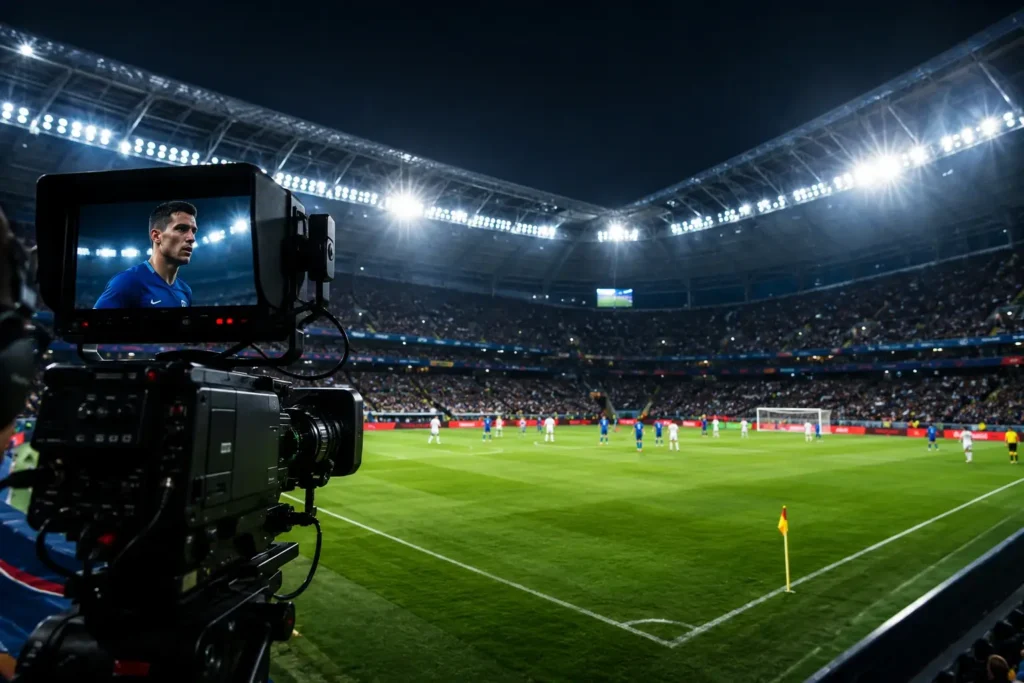
Modern football broadcasting is unforgiving, while a stadium may look bright to spectators, it can still appear flat, shadowed, or inconsistent on television.
Yet on television, the image can still appear flat, shadowed, noisy, or inconsistent.
That is the difference between simple brightness and true broadcast-quality lighting.
In modern FIFA broadcasting, cameras—not spectators—have become the real reference point. Broadcasters want sharper player visibility, cleaner ultra-slow-motion replay, stronger sponsor exposure, and better image consistency from every angle.
That is why vertical illuminance (Ev) has become one of the most important metrics in professional stadium lighting.
At ZC Lighting, we have seen one reality repeat itself across modern football projects:
The best-looking stadiums on television are not always the brightest.
They are the most intelligently balanced.
That balance starts with Ev.
What Is Vertical Illuminance (Ev)?
Vertical illuminance measures the amount of light reaching vertical surfaces.
In football broadcasting, those surfaces include:
players’ faces,
jerseys,
body movement,
the football itself,
and everything cameras actually capture.
This differs completely from horizontal illuminance (Eh), which only measures light on the field surface.
That distinction changes everything.
A pitch can meet high horizontal lux targets while still producing poor broadcast images because cameras do not mainly look downward. They look across the field.
That is why modern FIFA stadium lighting standards increasingly prioritize Ev.
Why World Cup Broadcasting Depends on Strong Ev
World Cup broadcasting today is far more demanding than traditional television.
Modern production includes:
4K broadcasting,
HDR streaming,
ultra slow-motion replay,
YouTube highlights,
TikTok clips,
Instagram Reels,
and mobile-first sports viewing.
Poor vertical lighting becomes obvious immediately.
Player Facial Visibility and Emotional Storytelling
Modern broadcasts rely heavily on emotional close-ups.
Broadcasters want:
natural skin tones,
sharp facial detail,
realistic player modeling,
and balanced shadows.
Weak Ev creates dark facial shadows and flat-looking athletes.
Strong Ev creates depth and realism.
This is one reason many modern broadcast-ready stadiums now rely on advanced optical stadium fixtures such as the
FL18 GameAres LED Stadium Floodlight, which is designed to improve long-distance player visibility while maintaining tighter beam precision for broadcast-oriented aiming.
Ball Tracking and Ultra Slow-Motion Replay
Slow-motion cameras require significantly more usable light.
Fast shutter speeds reduce motion blur, but they also reduce exposure. Poor Ev therefore creates:
noisy replay footage,
weak aerial-ball visibility,
and inconsistent tracking during long passes.
This is where fixture optics become more important than raw wattage.
For large professional venues, many designers now prefer high-output systems such as the FL12 – High-Power LED Stadium & Airfield Floodlight, especially in stadiums where long throw distances and broadcast-grade uniformity are critical.
Horizontal Illuminance vs Vertical Illuminance
Many older stadium projects focused mainly on turf brightness.
Modern broadcasting focuses on camera visibility.
Those are not the same thing.
Table 1 — Horizontal Illuminance vs Vertical Illuminance
| Factor | Horizontal Illuminance (Eh) | Vertical Illuminance (Ev) |
|---|---|---|
| Measures | Light on pitch surface | Light toward cameras |
| Main concern | Turf brightness | Broadcast image quality |
| Impacts facial visibility | Limited | Strongly |
| Critical for replay cameras | No | Yes |
| Important for sponsor visibility | Moderate | High |
This explains why some football fields appear bright in person but still look poor on television.
Why 4K, HDR, and Streaming Platforms Changed Stadium Lighting
Older television systems were forgiving.
Modern cameras are not.
4K and HDR broadcasting expose:
uneven lighting,
flicker,
glare,
shadow inconsistency,
and poor player modeling instantly.
Even worse, social media compression amplifies lighting flaws further.
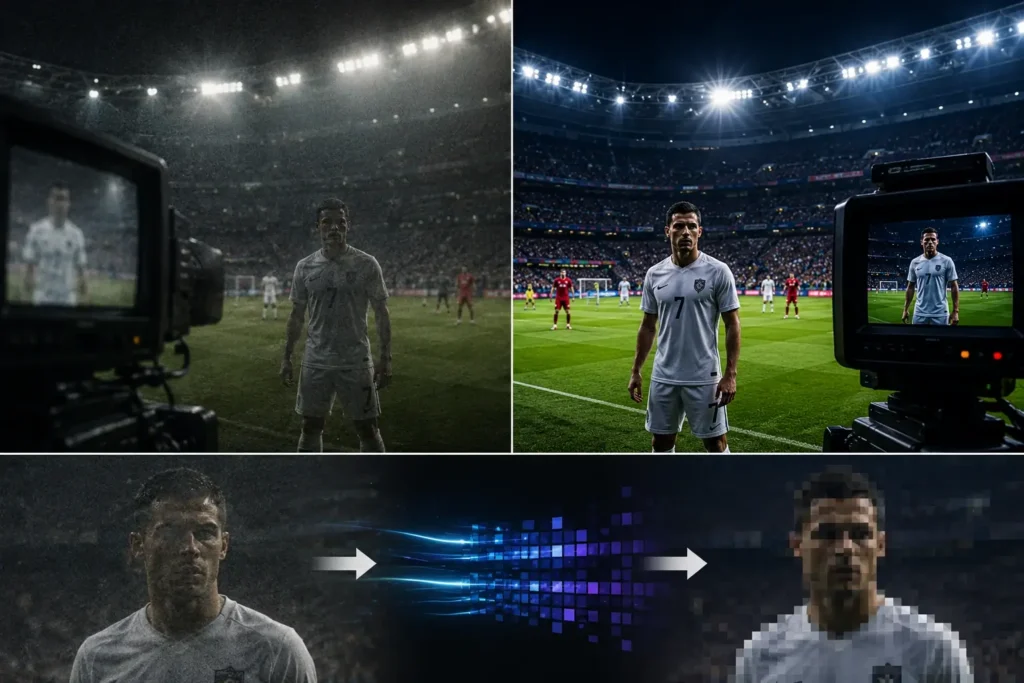
That means stadium lighting today must perform not only for television but also for:
YouTube,
TikTok,
Instagram,
Facebook clips,
and mobile streaming platforms.
Flicker-Free Lighting Is Now Essential
One of the biggest mistakes in sports lighting is ignoring flicker.
To spectators, flicker may seem invisible.
To ultra slow-motion cameras, it becomes catastrophic.
Poor flicker performance causes:
image pulsing,
replay instability,
camera banding,
and inconsistent frame exposure.
That is why modern broadcast venues increasingly use precision LED systems with stable driver technology and optical control.
For projects that require more flexible modular deployment, the
FL08 Series – Modular LED Sports & Outdoor Floodlight is often preferred because modular stadium fixtures simplify aiming adjustments while maintaining flicker-free operation for high-frame-rate broadcasting.
What Is the FIFA Quality Programme for Floodlights?
The FIFA Quality Programme for Floodlights focuses on much more than brightness.
Modern football lighting must support:
player visibility,
camera clarity,
replay quality,
glare reduction,
sponsor exposure,
and broadcast consistency.
This is why FIFA-level stadium lighting increasingly emphasizes:
vertical illuminance,
uniformity,
glare control,
and camera-oriented lighting geometry.
Why Uniformity Matters as Much as Lux
Average Ev alone is not enough.
Poor uniformity creates:
dark replay zones,
inconsistent player brightness,
unstable camera pans,
and distracting contrast transitions.
That is why modern stadium lighting projects evaluate:
U1v,
U2v,
MAUR,
and vertical illuminance gradients.
Good broadcast lighting feels smooth.
Not patchy.
Table 2 — Important Broadcast Lighting Metrics
| Metric | Why It Matters |
|---|---|
| Average Ev | Broadcast brightness |
| U1v / U2v | Vertical uniformity |
| GR | Glare control |
| Flicker % | Slow-motion compatibility |
| MAUR | Smooth camera transitions |
What Is the 5’7″ Lighting Rule?
The “5’7″ lighting rule” is often referenced as a practical aiming concept in football field lighting.
Its broader principle is simple:
Good football lighting is not about forcing light downward.
It is about directing light toward the viewing and camera angles.
That principle directly aligns with vertical illuminance strategy.
Which Lamp Type Is Most Effective in a Football Stadium?
Today, the answer is overwhelmingly clear:
Advanced LED stadium floodlights outperform traditional HID systems in nearly every broadcast-related category.
Modern LED systems provide:
stronger optical precision,
flicker-free performance,
better Ev control,
faster scene transitions,
and significantly lower energy consumption.
For professional sports venues seeking tighter glare control and stronger multi-directional coverage, many designers now prefer radial optical systems such as the
SP02 Radial Stadium LED Floodlight because radial beam distribution can improve camera-facing vertical coverage while reducing unnecessary spill light.
How Stadium Geometry Directly Impacts Ev
Lighting fixtures alone do not create good broadcast lighting.
Geometry matters.
Pole-Mounted vs Roof-Mounted Systems
Roof-mounted systems often provide:
smoother vertical coverage,
better player modeling,
and more balanced camera visibility.
Pole-mounted systems can still perform extremely well, but fixture aiming becomes more critical.
Higher mounting heights generally improve:
camera-facing illumination,
replay consistency,
and vertical uniformity.
Fixture Aiming and Cross-Lighting
One-sided lighting creates harsh shadows.
Cross-lighting creates balance.
That is why professional stadiums rely heavily on:
multi-direction aiming,
asymmetric optics,
and precision beam overlap.
Contact ZC Lighting, we often see projects fail not because of insufficient wattage—but because of poor optical strategy.
Better aiming frequently outperforms higher power.
Common Stadium Lighting Mistakes
Over-Focusing on Horizontal Lux
This remains the most common mistake in football field lighting.
A stadium can exceed horizontal lux targets while still producing weak television images because vertical coverage is insufficient.
Trying to Solve Ev Problems With More Wattage
More power is not always better.
Poor optics combined with excessive wattage often create:
stronger glare,
more spill light,
and worse replay conditions.
Precision always beats brute force.
Ignoring Social Media Broadcasting
Football broadcasting is no longer limited to television.
Your stadium lighting now affects:
TikTok clips,
Instagram highlights,
YouTube replays,
mobile viewing quality,
and sponsor visibility on compressed video platforms.
Weak Ev becomes even more visible after video compression.
Different Venue Types Need Different Ev Strategies
Not every football field requires World Cup-level lighting.
But every venue should understand where it wants to go.
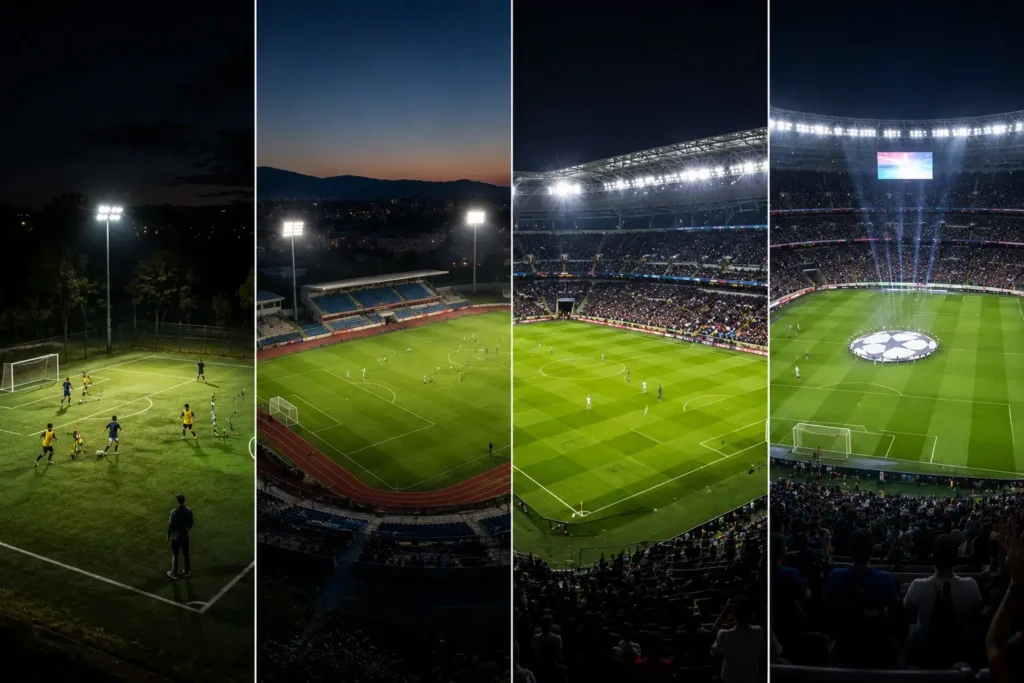
School and Community Fields
Schools increasingly livestream matches online.
Even moderate improvements in Ev can dramatically improve:
streaming quality,
recruitment visibility,
and event professionalism.
Municipal Stadiums
Municipal projects usually balance:
budget,
flexibility,
and public visibility.
Good Ev design allows venues to host:
regional tournaments,
broadcast-ready matches,
and multi-purpose entertainment events.
Professional Sports Parks
Professional sports parks require stronger commercial performance.
That means:
sponsor-ready lighting,
premium replay quality,
and future-proof broadcasting infrastructure.
Broadcast quality increasingly affects venue competitiveness and investment value.
Table 3 — Broadcast Lighting Priorities by Venue Type
| Venue Type | Main Priority | Recommended Ev Strategy |
|---|---|---|
| School Field | Budget efficiency | Moderate Ev |
| Municipal Stadium | Multi-use flexibility | Balanced Ev |
| Professional Stadium | Broadcast quality | High uniform Ev |
| FIFA-Level Venue | Global broadcasting | Elite multi-directional Ev |
How ZC Lighting Approaches Broadcast-Grade Stadium Lighting
At ZC Lighting, we approach stadium lighting from the camera outward—not from the lux meter downward.
That means prioritizing:
vertical illuminance,
optical precision,
flicker-free operation,
glare reduction,
and broadcast-grade uniformity.
Modern football lighting is no longer just infrastructure.
It is media infrastructure.
Final Thoughts
The future of World Cup broadcasting depends heavily on vertical illuminance.
Because cameras judge lighting differently than spectators do.
They evaluate:
facial visibility,
replay clarity,
motion sharpness,
sponsor exposure,
and image consistency across every platform.
That is why Ev has become one of the defining metrics of modern FIFA stadium lighting.
The brightest stadium is not always the best broadcast stadium.
The best broadcast stadium is the one where light is shaped intelligently.