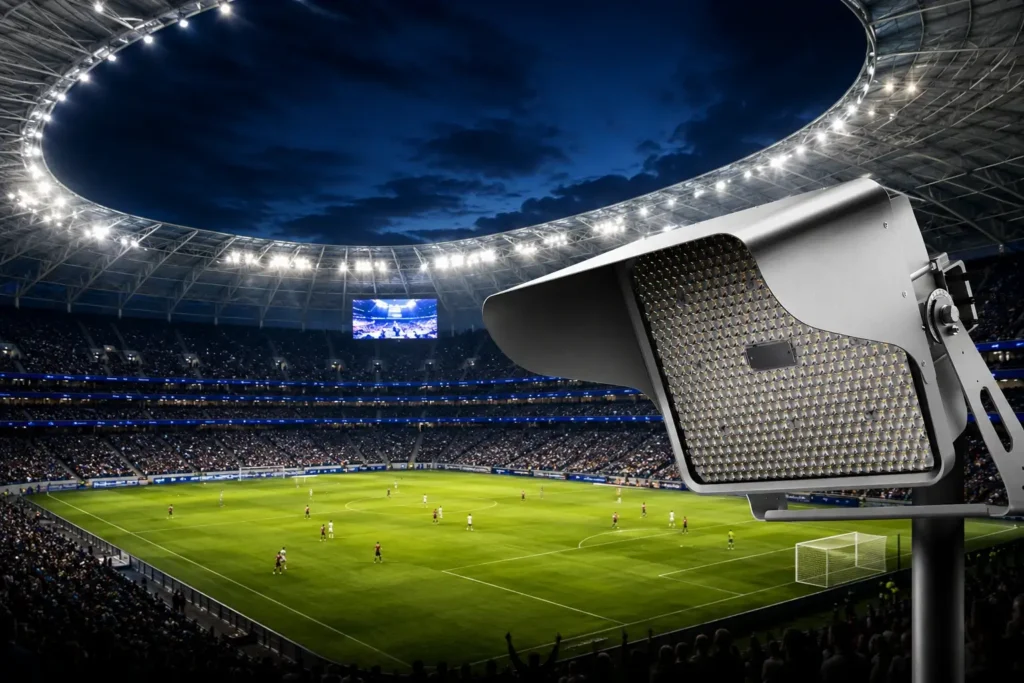
Modern World Cup stadiums are evolving far beyond traditional sports venues. Today’s football stadiums must support ultra-HD broadcasting, immersive fan experiences, smart energy systems, and stricter sustainability targets. Stadium lighting is no longer just about brightness. It has become a critical part of stadium infrastructure and global sports broadcasting.
That is why more football stadiums are switching to LED lighting systems. Compared with traditional metal halide fixtures, modern LED stadium lighting delivers lower energy consumption, better broadcast performance, reduced maintenance costs, improved glare control, and significantly longer lifespan. From FIFA venues to municipal sports parks, LED technology is rapidly becoming the new standard for modern sports lighting
As a professional outdoor sports lighting manufacturer, ZC Lighting provides advanced LED stadium lighting solutions for football fields, sports parks, municipal projects, and large entertainment venues worldwide.
Table of Contents
- Why Traditional Stadium Lighting Is No Longer Enough
- Why FIFA Stadiums Require Advanced Artificial Lighting
- Why LED Lighting Became the Standard for World Cup Stadiums
- How Sports Broadcasting Accelerated LED Adoption
- Smart Stadiums and Multi-Use Venue Economics
- Sustainability and Energy Efficiency Advantages
- What Stadium Owners Should Evaluate Before Upgrading
- The Future of Stadium Lighting
- FAQ
Why Traditional Stadium Lighting Is No Longer Enough
For decades, stadiums relied heavily on metal halide floodlights. These systems were powerful for their time, but modern football environments require far more precision, flexibility, and efficiency. Today’s sports venues must support 4K and 8K broadcasting, HDR production, ultra slow-motion replay, smart lighting controls, dynamic entertainment scenes, and sustainability regulations.
Traditional stadium lighting systems struggle to meet these expectations. Metal halide fixtures commonly operate at 1000W, 1500W, or even 2000W per fixture. A large football stadium may use 250 to 500 fixtures, creating extremely high energy demand and maintenance costs.
Main Problems With Traditional Stadium Lighting
- 10–20 minute warm-up times
- 15–30 minute restrike delays after power interruption
- Higher energy consumption
- Uneven light distribution
- Frequent maintenance requirements
- Limited dimming capability
| Feature | Metal Halide | LED Stadium Lighting |
|---|---|---|
| Startup Time | 10–20 minutes | Instant |
| Restrike Time | 15–30 minutes | Instant |
| Energy Efficiency | 70–90 lm/W | 140–190 lm/W |
| Lifespan | 6,000–15,000 hours | 50,000–100,000 hours |
| Maintenance Frequency | High | Low |
| Dimming Capability | Limited | Excellent |
Why FIFA Stadiums Require Advanced Artificial Lighting
Many people ask: why did FIFA mandate that all hosting facilities must have artificial lights? The answer is consistency. Modern football broadcasting depends on stable and uniform lighting conditions. Natural daylight alone cannot provide the reliability required for global television production.
Cloud movement, changing sunlight angles, rain, and stadium shadows can create major visibility problems for broadcast cameras. Artificial lighting ensures consistent exposure, stable replay quality, better player visibility, uniform field illumination, and reliable HDR broadcasting.
Why Stadiums Keep Lights On During the Day
Cameras see differently from the human eye. Even under strong sunlight, a stadium can still have dark facial areas, unstable exposure, and inconsistent replay visibility. LED stadium lighting helps balance these conditions for:
- 4K and HDR broadcasting
- Ultra slow-motion replay systems
- Player tracking technology
- Facial detail visibility
- Broadcast consistency during cloudy conditions
Professional World Cup venues commonly require 1500–2500 lux for HDTV broadcasting, high vertical illuminance for player visibility, and flicker rates below 1%.
Why LED Lighting Became the Standard for World Cup Stadiums
LED lighting is not simply brighter. It is more precise, more efficient, more controllable, and more adaptable than older technologies. Instead of flooding the entire stadium with uncontrolled brightness, modern LED systems deliver targeted illumination where it is needed most.
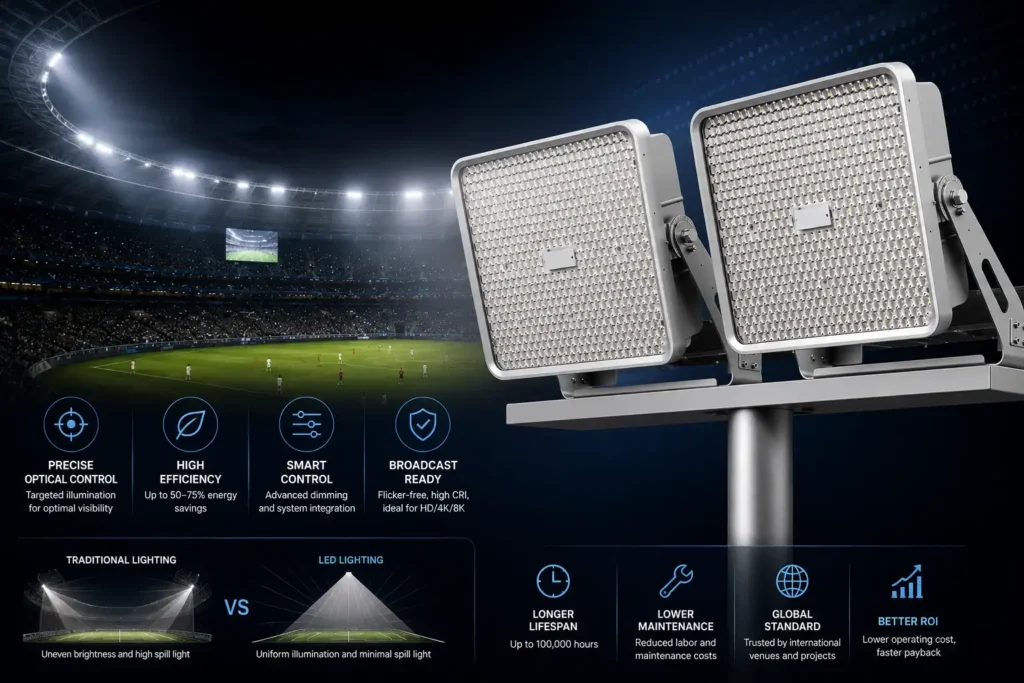
Professional venues increasingly rely on systems like the FL18 GameAres LED Stadium Floodlight because advanced optical control and broadcast-ready illumination are essential for international football environments.
Key Benefits of LED Stadium Lighting
- 50%–75% lower energy consumption
- Up to 100,000-hour lifespan
- Lower maintenance costs
- Instant startup and restrike
- Better glare and spill light control
- Improved broadcast visibility
- Advanced smart lighting integration
For high-mast and long-distance projection projects, the FL12 stadium and airfield floodlight is suitable for large-area applications that require strong beam control and high uniformity.
| Lighting System | Average Lifespan | Typical Energy Savings |
|---|---|---|
| Metal Halide | 6,000–15,000 hours | Baseline |
| High-Pressure Sodium | 12,000–24,000 hours | Moderate |
| LED Stadium Lighting | 50,000–100,000 hours | 50%–75% |
How Sports Broadcasting Accelerated LED Adoption
Broadcasting is one of the biggest reasons World Cup stadiums are switching to LED lighting. Older television systems were more forgiving. Modern 4K, 8K, HDR, and ultra slow-motion cameras expose every lighting flaw, including flicker, glare, uneven brightness, poor player modeling, and inconsistent shadows.
High-speed sports cameras may operate at 1000 fps, 3000 fps, or even higher. Traditional lighting can create visible flicker artifacts under these conditions. Professional LED sports lighting systems can reduce flicker to below 1%, and in some cases below 0.5%, creating smoother slow-motion footage and cleaner replay.
| Broadcast Requirement | Traditional Lighting | LED Stadium Lighting |
|---|---|---|
| Flicker Control | Weak | Excellent |
| HDR Compatibility | Limited | Excellent |
| Replay Visibility | Moderate | Superior |
| Vertical Illuminance | Lower | Higher |
| Beam Accuracy | Moderate | Advanced |
| Uniformity | Lower | Higher |
Smart Stadiums and Multi-Use Venue Economics
Modern stadiums are no longer football-only venues. They also host concerts, esports tournaments, ceremonies, festivals, community events, and entertainment productions. Each event requires different lighting conditions, which makes flexibility more valuable than ever.
LED systems allow operators to adjust brightness, beam direction, scene transitions, and dynamic lighting effects much faster than traditional lighting systems.
Modular systems like the FL08 Series sports floodlight are useful for multi-purpose sports venues because they support scalable configurations, flexible layouts, and easier maintenance access.
Modern Smart Stadium Features
- DALI and DMX smart controls
- IoT monitoring systems
- Remote diagnostics and scheduling
- Dynamic lighting scenes
- Adaptive brightness control
- Integrated energy management
Sustainability and Energy Efficiency Advantages
Environmental pressure is reshaping modern stadium development. Cities, schools, and sports organizations are increasingly expected to reduce carbon emissions, energy waste, maintenance costs, and light pollution.
LED stadium lighting supports these goals more effectively than traditional technologies.
| Sustainability Factor | LED Advantage |
|---|---|
| Energy Savings | 50%–75% |
| Fixture Lifespan | Up to 100,000 hours |
| Carbon Emissions | Much lower |
| Maintenance Waste | Reduced |
| Spill Light | Lower |
| Smart Energy Control | Advanced |
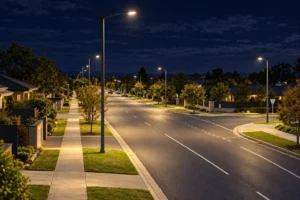
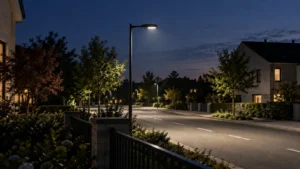
Around stadium infrastructure, systems such as the AL03 high-performance area light can improve parking lot visibility, pedestrian safety, and roadway illumination while reducing unnecessary spill light.
What Stadium Owners Should Evaluate Before Upgrading
Not all LED stadium lighting systems perform equally. Poor lighting design can still create uneven visibility, excessive glare, poor broadcast performance, and difficult maintenance access.
Important Factors Before Upgrading
- Pole height and mounting positions
- Beam angle selection
- Vertical and horizontal illuminance
- Glare control performance
- Broadcast requirements
- Future expansion capability
- Maintenance accessibility
Professional simulation is especially important for large venues. Lighting design software can help predict lux levels, uniformity ratios, glare risk, spill light, and camera-facing visibility before installation begins.
The Future of Stadium Lighting
The transition toward LED lighting is accelerating globally. Future sports venues will increasingly include AI-assisted lighting systems, adaptive brightness control, sensor-based automation, smart-city integration, and digital twin infrastructure.
Lighting will become more connected to broadcasting, crowd management, sustainability systems, entertainment technology, and security infrastructure.
Need Professional Stadium Lighting Solutions?
Whether you are planning a football stadium upgrade, municipal sports project, training facility, or large sports park, ZC Lighting provides professional LED sports lighting systems designed for broadcasting performance, energy efficiency, and long-term reliability.
FAQ
1. Why are World Cup stadiums switching to LED lighting?
World Cup stadiums are switching to LED lighting because LED systems provide lower energy consumption, flicker-free broadcasting, better glare control, improved player visibility, and significantly lower maintenance costs compared with traditional metal halide lighting.
2. Why did FIFA require artificial lighting in stadiums?
FIFA requires artificial lighting because modern broadcasting standards depend on stable illumination for HDTV, HDR, and ultra slow-motion replay systems.
3. Why do stadiums keep lights on during daytime matches?
Stadium lights help stabilize shadows and improve camera exposure during daytime matches, especially for 4K and HDR sports broadcasting.
4. What are the main benefits of LED stadium lighting?
The main benefits include lower energy consumption, instant startup, longer lifespan, reduced maintenance costs, better optical precision, and improved broadcast quality.
5. Can smaller football fields use professional LED stadium lighting systems?
Yes. Many schools, municipal football fields, training facilities, and sports parks now use professional LED stadium lighting systems because they provide better efficiency and lower operating costs
Disclaimer
FIFA and UEFA are referenced solely as sources of industry and project-design guidance. ZC Lighting is not affiliated with, endorsed by or certified by FIFA or UEFA. Final compliance depends on the complete project design, selected product configuration, installation, measurement and approval by the relevant project authority.