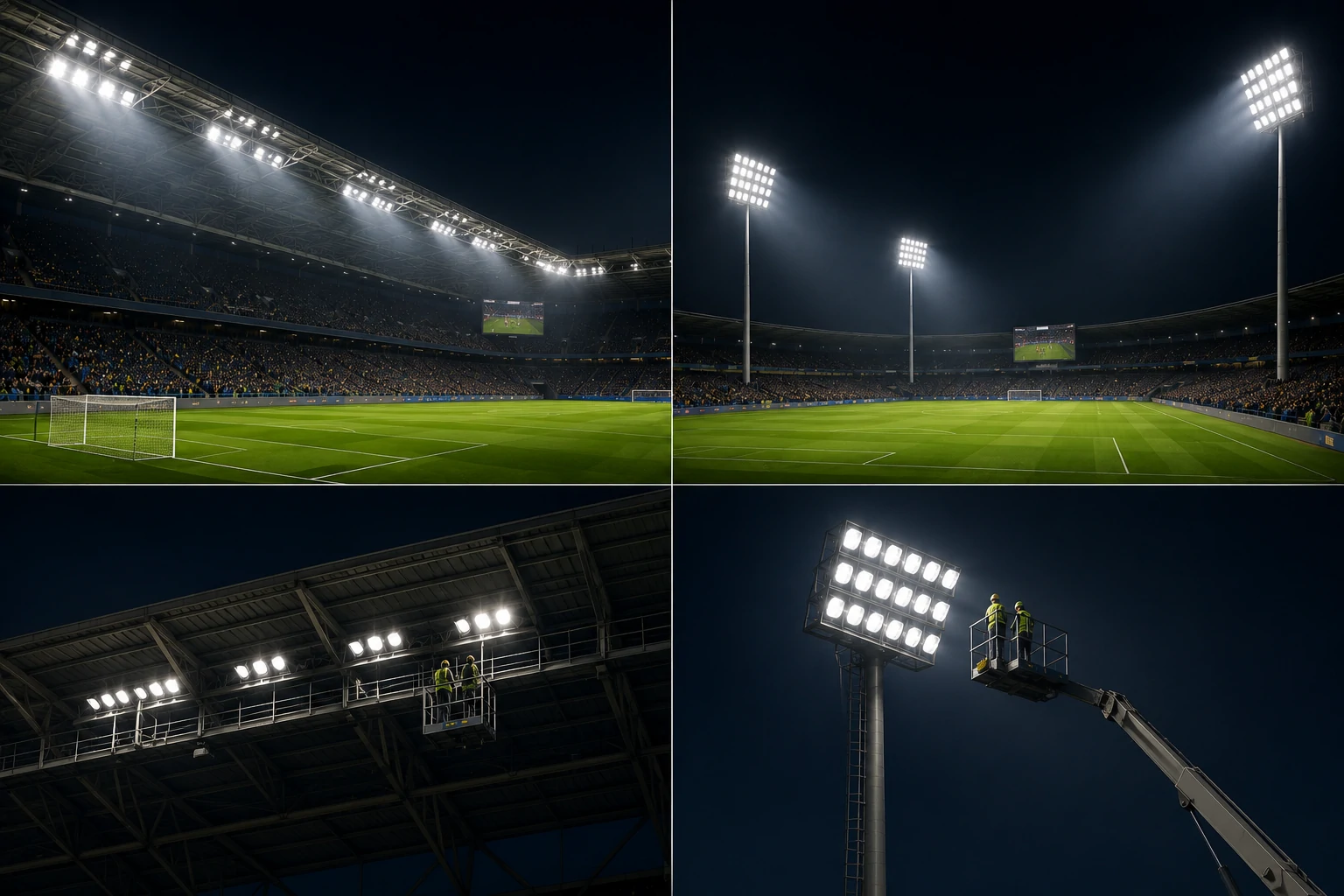
Mounting choice affects everything: structure, aiming, spill control, and long-term maintenance cost. This guide gives a fair comparison framework and the evidence to request so the project remains buildable and maintainable.
- Key takeaway #1: Roof-mount can be elegant but can hide structural and access risks.
- Key takeaway #2:Pole-mount often wins on aiming flexibility and serviceability.
- Key takeaway #3:Define evidence early to avoid redesigns and handover disputes.
When this applies
Use this guide when selecting mounting strategy for new stadiums or retrofits with existing grandstand/roof structures.
Typical scenarios
- New builds: you can design structure and routes for the lighting from day one.
- Retrofits: roof capacity and cable paths may be constrained.
- Neighbor-sensitive sites: mounting geometry affects glare/spill angles.
- High access cost: maintenance strategy can dominate TCO.
Key requirements / metrics
Use these metrics to compare mounting options in a buildable and maintainable way.
| Factor | What it affects | Why it matters | What to verify |
|---|---|---|---|
| Structural capacity | Safety and approvals. | Roof structures require verification. | Structural confirmation / check request. |
| Aiming geometry | Glare/spill risk. | Bad geometry forces high tilt. | Max tilt policy + aiming table. |
| Cable routing | Buildability. | Hidden routes create delays. | As-built route records and diagrams. |
| Maintenance access | Lifecycle cost. | Access is the real cost driver. | Access plan + SOP + spare strategy. |
| Commissioning evidence | Acceptance and disputes. | Fixed poles limit options. | Aiming table + photos + deviation log. |
Definitions
Roof-mounted lighting attaches to roof/truss structures; pole-mounted lighting uses standalone poles around the field. The best choice depends on structure, aiming geometry, and lifecycle maintenance access.
Practical targets
Typical guidance (always follow tender text):
- Roof-mount must have confirmed structural capacity and defined cable pathways
- Pole-mount must validate spill/glare and aiming within defined tilt limits.
- Both need an access/maintenance plan and an auditable sign-off pack.
Step-by-step workflow
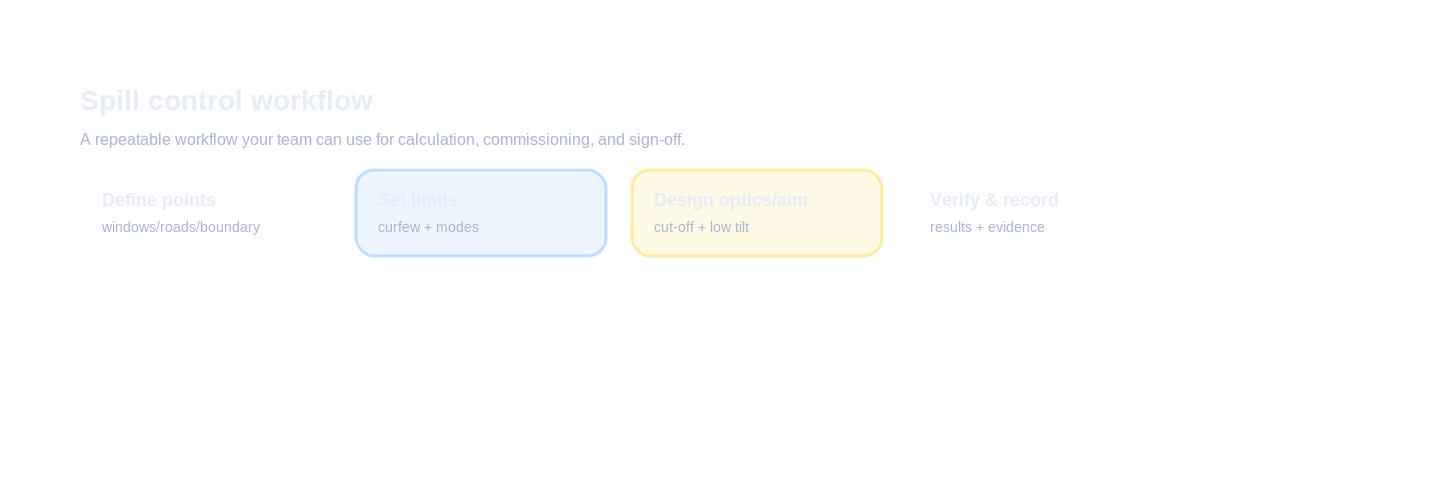
Workflow: define tier → map constraints → test 4/6/8 pole options in calculation → choose option with best risk profile → lock aiming limits and sign-off deliverables.
Inputs to collect
- Roof structure drawings (if roof-mount) or pole constraints (if pole-mount).
- Site boundaries and spill/glare constraints.
- Access method and safety rules.
Design decisions
- Select mounting option based on buildability and maintenance, not only aesthetics.
- Define aiming policy and verify through calculation.
- Define evidence pack requirements at handover.
Verification & sign-off
- Structural confirmation (roof-mount), aiming table, as-built routes, and SOP.
Common mistakes
- No structural confirmation for roof-mounted projects
- No access plan (maintenance becomes a crisis later).
- Ignoring glare angles created by roof geometry.
- No as-built route documentation.
Checklist / Template download
These downloads are generated in-browser (TXT/CSV) and can be replaced later with gated assets.
Roof vs Pole Decision Checklist (CSV)
Compare structure, lighting, and O&M impacts.
As-built Route Record (CSV)
Record cable/route pathways for maintainability.