A practical market and engineering analysis for professional sports lighting suppliers, consultants, contractors and venue owners.
Core argument: In a selective market, the suppliers that reduce project uncertainty create more value than suppliers that only offer available products.
The Lighting Market Is Not Moving in One Direction
The global lighting market is not simply strong or weak. It is becoming more selective.
Standard products sold through inventory-led distribution channels continue to face weak demand, price comparison and slower replacement cycles. At the same time, professional project activity can be more resilient where lighting is connected to infrastructure, safety, energy management, venue operation or a clearly defined performance requirement.
Signify’s Q2 2026 presentation provides a useful view of this market split. The company reported quarterly sales of EUR 1.332 billion, comparable sales growth of -3.6% and operational profitability of 6.1%. Its Professional business recorded EUR 886 million in sales, comparable sales growth of -2.5% and an adjusted EBITA margin of 7.0%. Signify also reported growth in Professional projects in the United States and Rest of World, while weakness persisted in Professional stock-and-flow business and Europe. [1]
For sports lighting buyers and suppliers, this does not mean that every stadium or sports-field project is growing. It means that projects with a clear technical requirement, operational value and verifiable outcome are more defensible than products competing mainly on availability and unit price.
Q2 2026 Market Signal
| Metric | Signify Group | Professional | Interpretation |
| Sales | EUR 1.332bn | EUR 886m | Large market, but overall demand remained soft |
| Comparable sales growth | -3.6% | -2.5% | Professional declined less than the group |
| Operational / adj. EBITA margin | 6.1% | 7.0% | Professional profitability remained relatively more resilient |
| Portfolio signal | Mixed market | Projects grew in US and Rest of World | Stock-and-flow and Europe remained weak |
A Soft Market Does Not Affect Every Lighting Business Equally
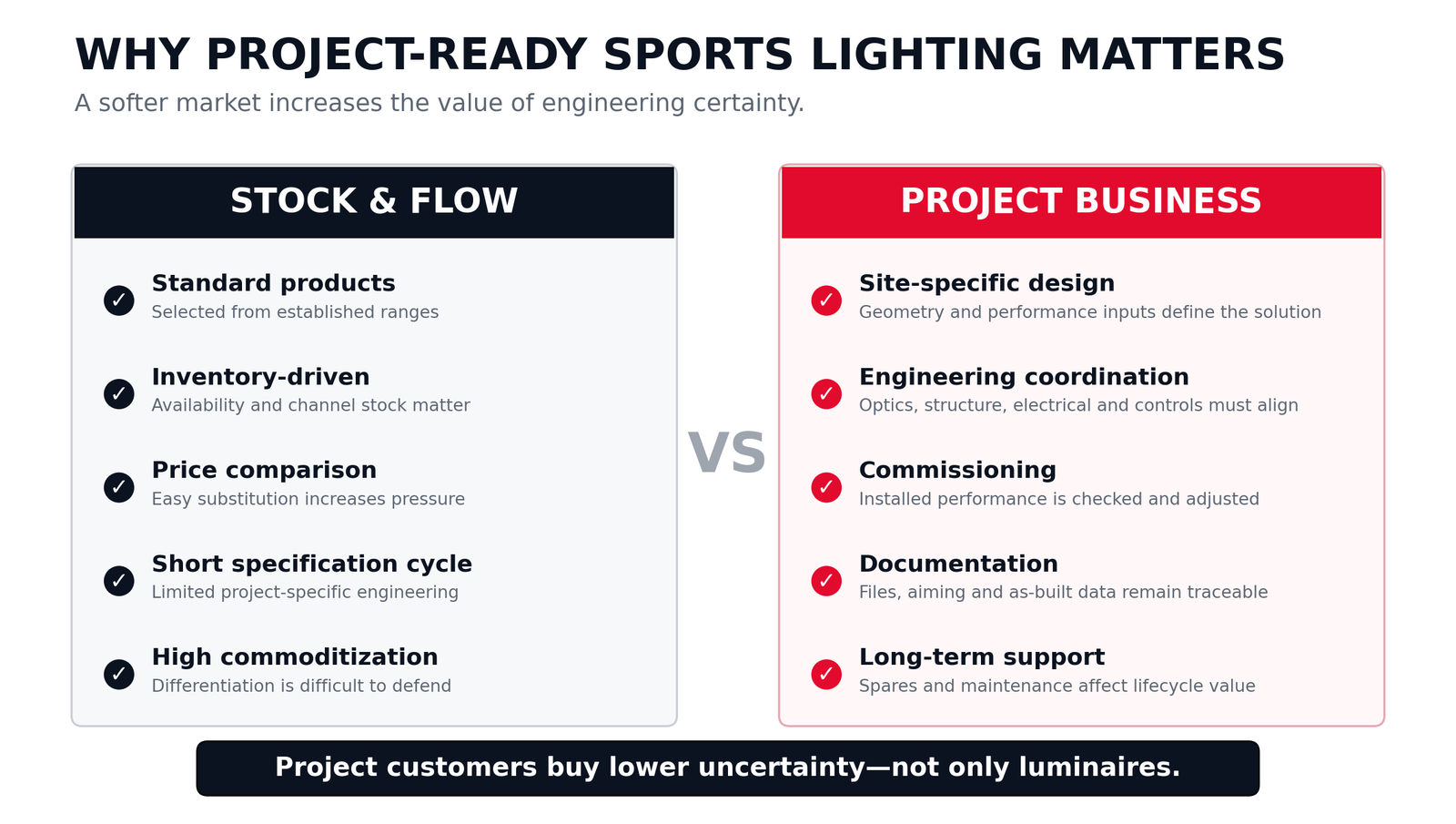
Stock-and-flow lighting and project lighting operate under different commercial conditions.
Stock-and-flow products are generally selected from established ranges, held in inventory and purchased through distributors for routine replacement or standard construction work. The selection process often focuses on wattage, lumen output, price, availability, basic certification and delivery time.
These products remain important, but they are easier to compare and substitute. As a result, suppliers face greater price pressure and lower differentiation.
Professional project lighting follows a different process. A stadium, municipal sports complex, school athletic field or high-mast retrofit may require the project team to evaluate site geometry, mounting conditions, optical performance, glare, electrical infrastructure, control modes, access, commissioning and measurement.
A product cannot be separated from these conditions. Professional sports lighting should therefore be treated as a project-dependent engineering system—not simply a larger version of ordinary outdoor lighting.
Project Resilience Does Not Mean Easy Sales
Professional projects may be more defensible than routine inventory business, but they are not automatically easy to win. They usually involve longer sales cycles, more technical review, multiple decision makers, stronger documentation requirements and greater local-service expectations.
A supplier may have a high-output luminaire and still fail to enter the project because it cannot provide the information required by the consultant, contractor or owner.
This is where project readiness becomes important. A project-ready supplier does not simply have a product available. It provides enough technical, commercial and operational information for the product to be evaluated, integrated, installed, commissioned and verified.

1. Project Readiness Starts with a Defined Application
The first question should not be “How many watts does the customer need?” It should be “What must the venue achieve?”
A project may be designed for recreational use, school training, municipal competition, professional competition, television broadcasting, multi-purpose events or community use near residential areas.
Each application creates a different balance of illuminance, uniformity, glare, spill light, vertical visibility, control and operating time. A community football field near homes may place greater emphasis on boundary light and curfew. A professional stadium may require multiple camera-facing vertical illuminance calculations, flicker performance and separate competition and entertainment modes. A retrofit may be constrained by existing poles, crossarms, cabling and distribution panels.
Project readiness therefore begins with a structured project input form—not a product quotation.
2. Photometric Files Must Be Engineering-Ready
Providing an IES or LDT file is necessary, but it is not enough. The project team must know exactly what the file represents: luminaire model, power level, LED configuration, optical distribution, driver, color temperature, test conditions, file revision and shield configuration.
A photometric file that cannot be matched to the ordered product creates risk during design and commissioning.
For a professional sports lighting portfolio, product configuration, photometric file, datasheet, optical code, power setting, driver configuration and accessory combination should be managed as one controlled set.
AI can support this work by identifying inconsistent wattages, incorrect optical codes, duplicate filenames, outdated specifications and missing reports. AI should support document control—not approve the final photometric design.
3. Retrofit Projects Require Structural Data
One of the strongest opportunities in sports lighting is the replacement of older HID systems under existing pole conditions. But a lower-weight LED luminaire cannot automatically be assumed to be structurally acceptable.
The project may need to compare luminaire weight, effective projected area, center of gravity, bracket position, crossarm loading, wind load, remote driver boxes, cable routing, corrosion and maintenance load.
A luminaire with a lower total weight may have a larger projected area or a different center of gravity. This can change the moment applied to the crossarm and pole.
A project-ready supplier should provide accurate dimensions, weight, mounting geometry and EPA data. The final structural decision must remain with a qualified project engineer.
4. Control-Ready Is More Credible Than “Smart”
Demand for connected and data-enabled lighting is increasing, but connected capability should not be reduced to a line such as “DALI / DMX / 0–10V optional.”
The DesignLights Consortium’s NLC V5.2 requirements take effect on August 17, 2026. The update emphasizes reliable performance, measurable energy impacts, cybersecurity, configuration reporting and external-system integration. [2]
A sports lighting project needs more specific answers: What is being controlled? Can luminaires be individually addressed? What is the dimming range? What happens after a power interruption or communication loss? Is manual override available? Who supplies the controller, gateway and network? Who programs the scenes and stores the final configuration?
Not every luminaire supplier needs to provide the complete smart-stadium platform. A more credible role is to provide reliable luminaires, compatible drivers, defined interfaces, electrical data, channel information, fail-safe requirements and integration documentation.

5. Commissioning Is Part of Product Performance
A simulation predicts the expected result. The installed project may differ because of pole tolerances, bracket positions, aiming errors, wrong optical configurations, changed power settings, wiring differences, obstructions or measurement methods.
A project-ready delivery should include a structured commissioning path: confirm installed configuration; check circuits and driver settings; assign luminaire or group IDs; complete initial aiming; test modes and communication-failure behavior; conduct nighttime fine aiming; measure the field; record adjustments; and produce final as-built documentation.
This is particularly important in phased retrofit projects, where old and new systems may operate together temporarily. Each completed phase should be treated as an operational system and independently checked.
6. Project Documentation Creates Long-Term Value
A stadium owner may operate the lighting system for 15 years or more. During that period, the original installation team may change. Drivers may be replaced. Fixtures may be re-aimed. Control scenes may be updated.
Without accurate documentation, future maintenance becomes slower and more expensive.
A useful as-built record should include pole ID, luminaire ID, product model, optical distribution, power setting, driver location, circuit number, control address, tilt angle, azimuth, target point, installation date, commissioning status and measurement result.
This information also creates a foundation for future AI-assisted maintenance. AI can help search records, identify repeated faults and compare operating hours—but only when the original project data is structured and reliable.
7. Commercial Readiness Also Matters
Engineering performance alone does not complete the project. Professional buyers also need commercial certainty.
This includes realistic lead time, packaging dimensions, gross and net weight, container-loading data, spare-part strategy, replacement-driver availability, optical accessory availability, warranty process, quotation validity and technical-response time.
This is particularly important for high-power sports luminaires, where logistics, access equipment and replacement components can materially affect total installed cost.
A modular or SKD-ready product may create value by reducing shipping volume or inventory complexity. These benefits should be supported with actual packaging and loading data—not general claims such as “easy to transport.”
What This Means for ZC Lighting
ZC Lighting should not attempt to copy the business model of a complete global stadium-system provider.
At the highest level of international sport, companies such as Musco combine field-of-play lighting, sport presentation, broadcast support, system delivery and long-term services. Musco’s appointment as the Official Sport Presentation and Broadcast Lighting Provider for the LA28 Olympic and Paralympic Games illustrates the scale of this system-level position. [3]
ZC’s more realistic competitive position is to be a flexible professional lighting manufacturer and engineering-support partner for school and university facilities, municipal sports complexes, training fields, mid-sized professional venues, existing-pole retrofits, contractor-led projects, distributor programs and high-mast venue-perimeter applications.
| Priority | What ZC Can Strengthen | Practical Output |
| 1 | Reliable product platforms | Clear role for FL18, FL19, FL20, FL21 and FL26 |
| 2 | Engineering-ready data | Controlled photometric, electrical, structural and control files |
| 3 | Flexible project support | Input forms, optical selection and configuration support |
| 4 | Clear integration boundaries | Control-ready products without overstating platform capability |
| 5 | Partner enablement | Selection guides, packing data, spares, checklists and training |
What Sports Lighting Buyers Should Ask
- Can the photometric files be matched to the exact product configuration?
- Are weight, EPA and mounting dimensions documented?
- Can the optics work with the existing pole geometry?
- Are control interfaces and failure states clearly defined?
- Can the supplier support commissioning documentation?
- Are spare drivers, optics and accessories available?
- Can the supplier provide an as-built data structure?
- Are performance claims supported by test or project evidence?
- Is the supplier clear about what it does—and does not—provide?
Conclusion
The current lighting market is not simply strong or weak. It is becoming more selective.
Routine products remain under pressure, while professional projects continue to reward suppliers that reduce engineering, integration and delivery risk.
For sports lighting, the next competitive advantage is not another wattage level or another broad “smart” claim. It is project readiness: the ability to move from site information to product configuration, from configuration to installation, and from installation to a documented, verifiable result.
That is how a sports luminaire becomes dependable venue infrastructure.
| ZC positioning: reliable luminaires, engineering-ready data and clear control interfaces—supporting the lighting execution layer without overstating full smart-stadium capability. |
FAQ
What is project-ready sports lighting?
Project-ready sports lighting combines suitable luminaires with photometric data, structural information, electrical configurations, control interfaces, commissioning support and final project documentation.
Is a high-output sports light automatically suitable for a stadium?
No. Product suitability depends on pole geometry, mounting height, setback, optics, structural conditions, target illuminance and environmental requirements.
Does ZC Lighting provide a complete smart-stadium platform?
ZC Lighting’s current role is to provide professional lighting hardware, project data and control-ready interfaces. Controllers, networks, software platforms and wider venue integration may be provided by specialist partners.
Why is commissioning important?
Commissioning confirms that installed products, aiming angles, power settings and control modes match the approved design.
How can AI support sports lighting projects?
AI can assist with document checking, file management, data comparison, fault analysis and project knowledge retrieval. Final photometric, structural and electrical decisions still require qualified professionals.
Planning a Sports Lighting Project?
| Share the field dimensions, pole layout, mounting height, existing system information and target lighting level. ZC Lighting can help organize the product and project inputs required for an initial technical review. |