A lighter stadium floodlight may reduce gravity load and installation effort. It does not, by itself, prove that an existing pole, crossarm or foundation can safely support the new system.
Engineering note: This article is a project-planning guide, not a structural calculation. Pole reuse, wind loading, foundation capacity and final mounting details must be checked by qualified professionals under the governing local code.
uring an LED sports-lighting retrofit, one of the first questions is often: How much does the new fixture weigh?
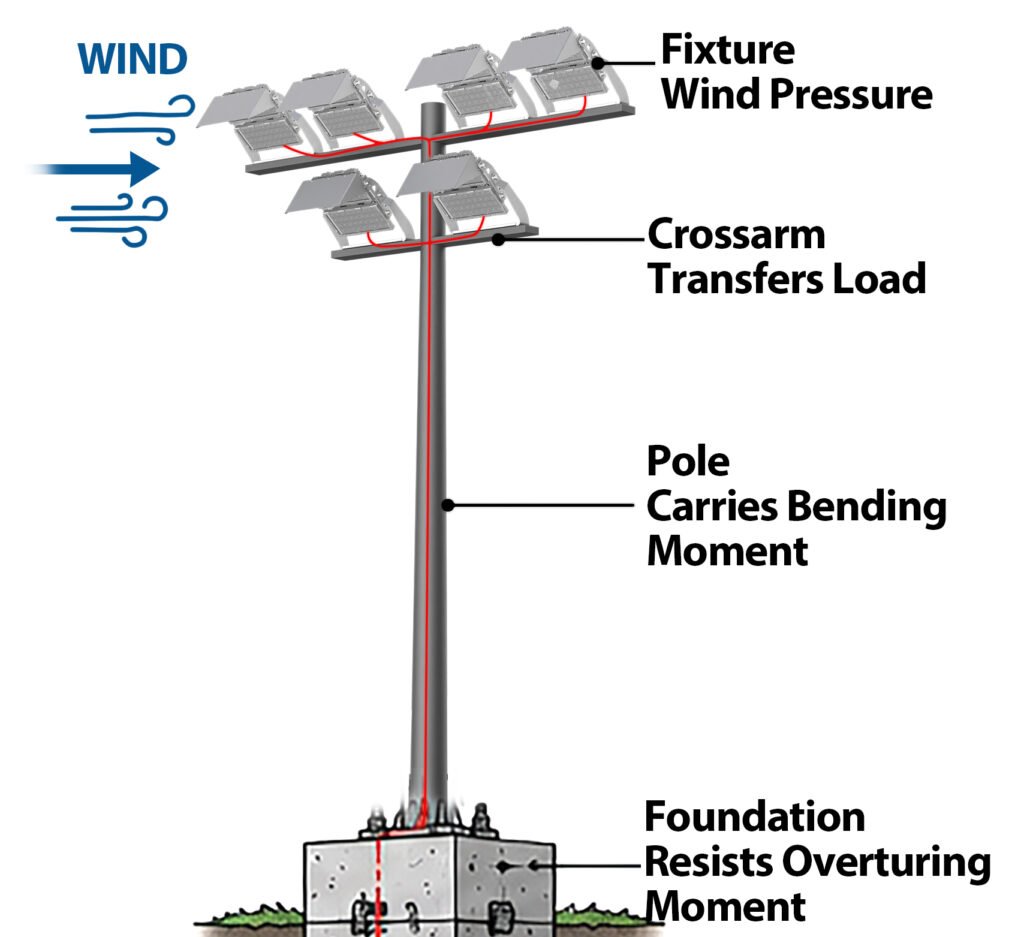
Weight matters. It affects handling, lifting, crossarm loading and the gravity forces carried by the structure. But a sports-lighting pole is also exposed to wind. The wind acts on the luminaires, brackets, driver enclosures, visors and other equipment mounted high above the ground. Those forces are transferred through the crossarm and pole into the base and foundation.
That is why comparing floodlights by kilograms alone can lead to the wrong conclusion. A proper review needs to consider weight, effective projected area, installation orientation, lever arm, total mounted equipment and the condition of the existing structure together.
1. Weight Is Only One Part of the Structural Picture
WeightPrimarily describes the downward gravity load of the installed equipment.EPARepresents wind-related loading through projected area and aerodynamic effect.Structural momentDepends on the applied force and its distance from the point being assessed. EPARepresents wind-related loading through projected area and aerodynamic effect.Structural momentDepends on the applied force and its distance from the point being assessed.

A luminaire can be relatively light but have a broad profile that presents more area to the wind. Another unit may be slightly heavier but more compact. Neither observation is enough to approve a retrofit without the rest of the structural inputs
2. What Is EPA?
EPA stands for Effective Projected Area. In practical pole selection, it is used as a wind-loading input for equipment mounted on a pole. It is not simply the product’s overall width multiplied by its height.
EPA reflects the projected area presented to the wind together with an aerodynamic factor associated with the shape. Open frames, solid boxes, deep heat sinks, brackets and shields can behave differently even when their external dimensions appear similar.
It is also important not to treat EPA as a complete wind calculation. The final wind force still depends on the applicable wind criteria, exposure, height, direction and structural design method. ASCE-based calculations for pole-mounted equipment use projected area, aerodynamic coefficients and site wind parameters to determine force and moment; pole manufacturers therefore publish allowable EPA values only for defined pole configurations and wind conditions. citeturn312336search3turn312336search11turn312336search29
3. Why Equal-Weight Floodlights Can Produce Different Wind Loads
Consider two stadium floodlights that each weigh 25 kg. One has a large, deep housing with a broad rear profile. The other uses a more compact arrangement. Their gravity loads may be similar, but the area and shape exposed to wind can differ considerably.
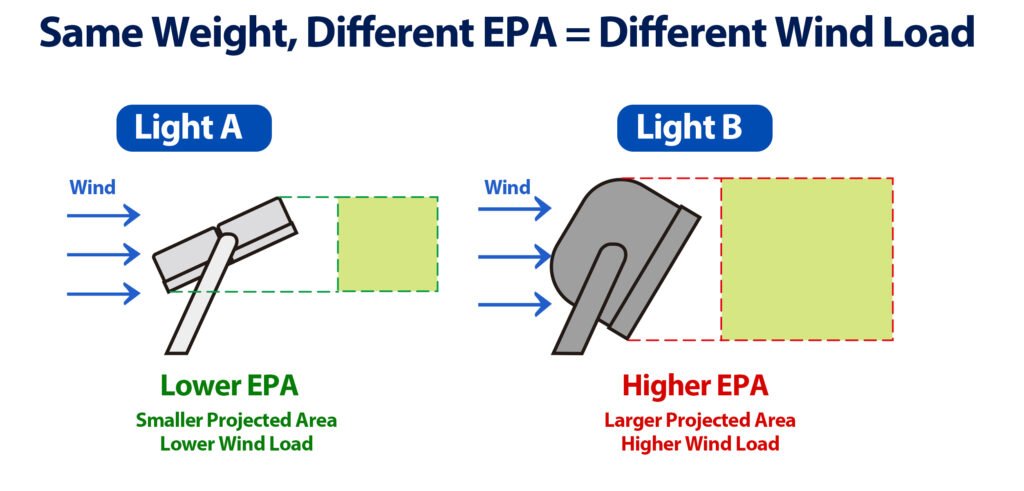
Several design features can influence the wind-related profile:
- overall luminaire width, height and depth;
- open or solid heat-sink geometry;
- integrated driver compartments;
- external driver boxes;
- visors and spill-light shields;
- mounting brackets and aiming hardware;
- the orientation of the complete assembly.
This does not mean that one housing style is automatically safer. The correct comparison uses verified EPA data for the relevant mounting orientation and the complete installed assembly.
4. Weight, EPA and Bending Moment Are Not Interchangeab
Weight acts downward. Wind force acts primarily sideways. The resulting effects on a crossarm, pole shaft, base plate and foundation depend on where those forces are applied.
A fixture mounted farther from the pole centerline can create a larger moment than the same fixture mounted closer to the shaft. A longer bracket, wider crossarm or asymmetric mounting arrangement can therefore change structural demand without changing the luminaire itself.
Sports-lighting retrofits may also introduce torsional effects when luminaires are installed on one side of a crossarm or aimed in different directions. This is another reason that a single “maximum fixture weight” value cannot describe the entire structural problem.
5. Why Fixture Shape and Accessories Matter
The luminaire body is only part of the pole-mounted system. A structural equipment schedule should include every component that remains aloft:
- luminaires and mounting brackets;
- drivers and driver enclosures;
- visors, shields and aiming devices;
- junction boxes and cable supports;
- cameras, speakers, antennas or scorekeeping equipment;
- maintenance platforms or other permanent accessories.
Compact modular luminaires can be useful where an existing crossarm has limited space, and modular output options may provide more flexibility when matching fixture quantity to the lighting design. Products such as the ZC Lighting FL26 can be considered in this context. The final module count, brackets, driver arrangement and accessories still need to be assessed as one installed assembly.
Do not infer low EPA from the word compact alone. Use a verified value from the manufacturer for the proposed configuration.
6. Why Retrofit Projects Require a Complete Pole Review
An existing pole may have supported heavy HID floodlights for many years, but that history does not automatically confirm its suitability for a new LED arrangement.
The retrofit may change:
- the number of luminaires per pole;
- crossarm spacing and eccentricity;
- fixture tilt and orientation;
- driver-box locations;
- the overall projected area;
- the position of the center of mass;
- control boxes and additional equipment.
The existing pole, welds, base plate, anchor bolts and foundation may also have lost capacity through corrosion, cracking, movement or previous modifications. Original drawings and old wind ratings should be reviewed against the proposed installation and the currently applicable project requirements.
For a broader site-survey process, link this article to the existing ZC Lighting guide: Sports Lighting Pole Retrofit: What to Check Before Reusing Existing Poles.
7. Does Fixture Tilt Change EPA?
Potentially, yes. Tilting or rotating a luminaire changes the profile presented to different wind directions. A shield that is relatively narrow in one view may present a larger surface in another.
The critical orientation is not always the front elevation shown on a product drawing. For multi-fixture crossarms, different aiming directions can also cause the combined projected profile to change depending on wind direction.
Manufacturers should therefore state clearly whether an EPA value applies to a specific orientation, a maximum orientation or another defined test/calculation condition. Project engineers can then apply the data correctly.
8. How Driver Location Changes the Loading Arrangement
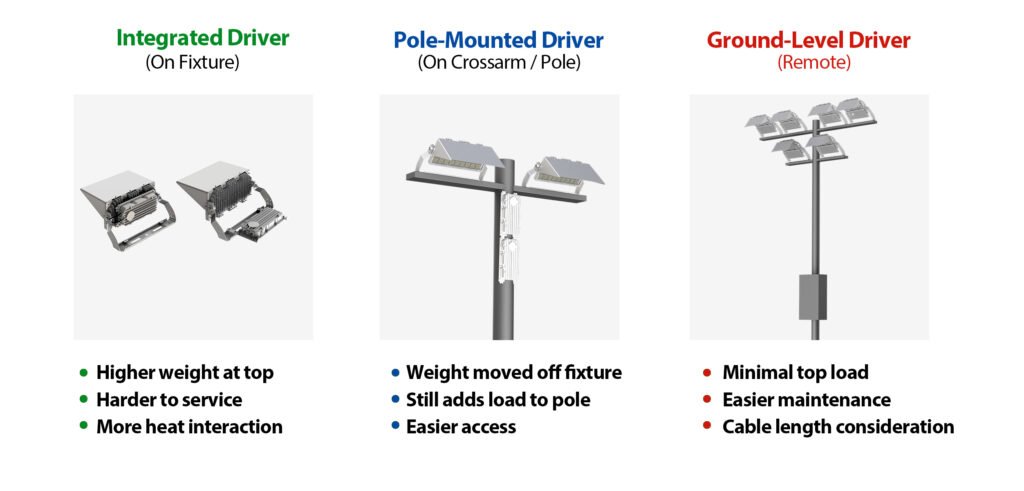
Sports-lighting drivers may be integrated into the luminaire, mounted separately on the crossarm or pole, or installed near ground level.

Integrated driver
This creates a self-contained luminaire but places the driver mass and enclosure at fixture level. The complete unit weight and EPA should be used.
Pole- or crossarm-mounted driver
Separating the driver from the LED head may change heat management and maintenance access, but the enclosure remains part of the pole-mounted loading.
Ground-level remote driver
This can reduce some equipment carried at the top of the mast and may simplify driver access. It also introduces electrical design questions involving cable distance, voltage drop, surge protection, enclosure protection, disconnection and control wiring.
Remote-driver configurations available for platforms such as FL26 or FL09 can support different retrofit strategies. The choice should follow the lighting, structural, electrical and maintenance assessment—not a universal rule that one driver location is always better.
9. What Engineers Actually Check
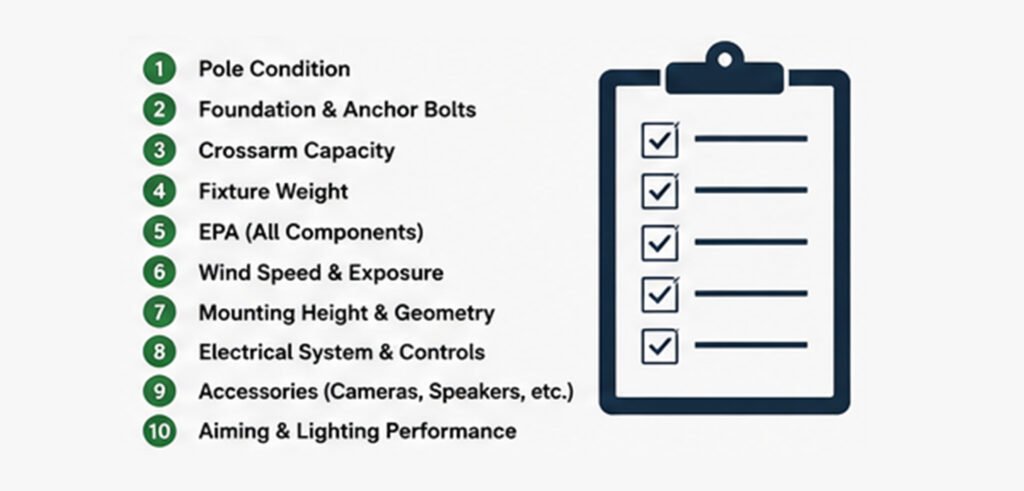
| Input | Why it matters | Common mistake |
| Pole and foundation condition | Existing damage can govern the decision before the new fixture is considered. | Assuming age or visual appearance alone proves capacity. |
| Site wind criteria | Wind speed, exposure, terrain and code affect design force. | Comparing EPA values without confirming the wind basis. |
| Complete equipment schedule | All luminaires, brackets, drivers and accessories contribute load. | Checking only the LED head. |
| Mounting geometry | Crossarm width, bracket length and orientation affect moment and torsion. | Using fixture weight without its installed position. |
| Verified EPA | Provides a defined wind-loading input for the equipment. | Estimating EPA from a product photograph. |
| Photometric design | Determines final quantity, optics and aiming. | Approving structure before the lighting arrangement is finalized. |
10. Common Comparison Errors
“The new LED is lighter, so the pole is safe.”
Lower weight may be beneficial, but the new EPA, orientation, quantity and mounting geometry can still increase structural demand.
“The old HID fixture was larger, so the new LED must have lower EPA.”
External dimensions alone do not provide a verified aerodynamic value. Compare documented data for the complete assemblies.
“The pole has an allowable EPA, so we can use it directly.”
Confirm the wind speed, code basis, pole height, configuration and condition associated with that rating. Pole tables are conditional, not universal.
“A ground driver removes the driver from the structural calculation.”
Only equipment actually removed from the pole is removed from the pole-mounted equipment schedule. Pole-mounted cabinets, cables and brackets still need to be included.
Frequently Asked Questions
Is EPA the same as frontal area?
No. Frontal projected area is a geometric area. EPA incorporates the aerodynamic effect associated with the object’s shape. The exact convention and reported orientation should be confirmed with the data provider.
Does a lighter stadium light always create less pole load?
No. It normally reduces gravity load, but wind force and moment may still be higher if the unit has a larger EPA or is mounted farther from the pole.
Can a visor or spill-light shield increase EPA?
Yes. A shield can add projected surface and change aerodynamic behavior. Its weight and EPA contribution should be included in the final configuration.
Does fixture tilt affect wind loading?
It can. Tilt and rotation change the surface presented to the wind. Use data that reflects the relevant installed orientation.
Should driver-box EPA be added separately?
Yes, when the driver enclosure is mounted separately and its EPA is not already included in the luminaire value.
Can several fixture EPAs simply be added together?
Simple summation may be used as an early equipment total, but shielding, spacing, orientation and the governing structural method can affect the final assessment. Follow the pole supplier’s and structural engineer’s requirements.
Can an existing pole’s original EPA rating still be used?
Only after confirming the rating basis, original configuration, current condition and applicable project criteria. Corrosion, modifications and code changes may affect the decision.
Is EPA enough to approve a sports-lighting retrofit?
No. EPA is one input. Pole condition, foundation, wind criteria, weight, geometry, total equipment, structural moment and lighting design must be assessed together.
Who should approve pole reuse?
A qualified structural professional familiar with the applicable local requirements and the actual site information.
Conclusion
Never compare stadium floodlights by weight alone.
Weight affects gravity loading and installation. EPA helps describe wind-related equipment loading. Structural moment depends on the force, mounting position and complete pole system. None of these should be reviewed in isolation.
A reliable retrofit process finalizes the photometric arrangement, documents all pole-mounted components, obtains verified product loading data and assesses the existing pole, crossarm and foundation under the applicable site criteria.
Technical Sources
Structural design must follow the governing code and project-specific calculations. Background references used for this article include ASCE/SEI 7 wind-load provisions, a public light-pole structural calculation applying ASCE wind procedures to a pole and fixture, and Acuity Brands’ pole-sizing guidance explaining the relationship between wind criteria, pole configuration and allowable EPA.
Planning an Existing-Pole Sports Lighting Retrofit?
Send ZC Lighting the field dimensions, pole heights and coordinates, crossarm photographs, existing fixture arrangement, project location and target lighting level. We can support the preliminary luminaire configuration and photometric design for subsequent structural review.