Modern football broadcasting is less forgiving than ever. A stadium can look bright to spectators, yet still look uneven, flat, or flickering on 4K and HDR cameras.
In this guide, we explain how FIFA broadcast lighting requirements affect stadium owners, EPC contractors, lighting consultants, broadcasters, and sports venue investors. You will learn what matters most: vertical illuminance, uniformity, flicker control, glare reduction, color quality, smart control, and long-term reliability.
What Are FIFA Broadcast Lighting Requirements?
FIFA broadcast lighting requirements are designed to make football matches look clear, consistent, and professional on television. They are not only about making the pitch bright. They are about helping cameras capture players, ball movement, grass color, sponsor boards, and crowd atmosphere with fewer visual problems.
For 4K and HDR broadcasting, the lighting system must perform better than standard sports lighting. It needs stronger vertical illuminance, better uniformity, lower flicker, tighter glare control, and more stable color. A brighter light is not always a better light. A more controlled light is usually more valuable.
For professional stadium projects, ZC Lighting recommends evaluating lighting performance as a complete broadcast system, not as individual floodlights only. This is especially important for venues targeting FIFA stadium projects, Olympic sports venues, municipal infrastructure projects, or future smart city sports facilities.
| Metric | Why It Matters for Broadcast | Common Project Risk |
|---|---|---|
| Horizontal Illuminance | Provides base field brightness | Field looks bright but players still look dark |
| Vertical Illuminance | Improves player visibility for cameras | Poor facial visibility and weak player modeling |
| Uniformity Ratio | Reduces hotspots and dark zones | Camera exposure changes across the pitch |
| CRI / TLCI | Improves color rendering and camera color accuracy | Jerseys, skin tones, and grass look unnatural |
| Flicker Control | Protects slow-motion replay quality | Visible flicker during high-frame-rate replay |
| Glare Control | Improves athlete, spectator, and camera comfort | Lens flare, discomfort, and poor visual experience |
Why 4K and HDR Change Stadium Lighting
Older HD broadcasting was more tolerant. Modern 4K and HDR broadcasting is sharper, brighter, and more sensitive. That makes every lighting weakness easier to notice.
4K cameras reveal more detail. HDR cameras reveal stronger contrast. HFR slow-motion cameras reveal flicker that the human eye may never see. This means a stadium lighting system must be more stable, more precise, and more camera-friendly than before.
4K Cameras Show More Detail
In 4K football broadcasting, poor lighting becomes more visible because image resolution is higher. Small shadows look stronger. Uneven beam overlap becomes clearer. Weak player modeling becomes easier to notice.
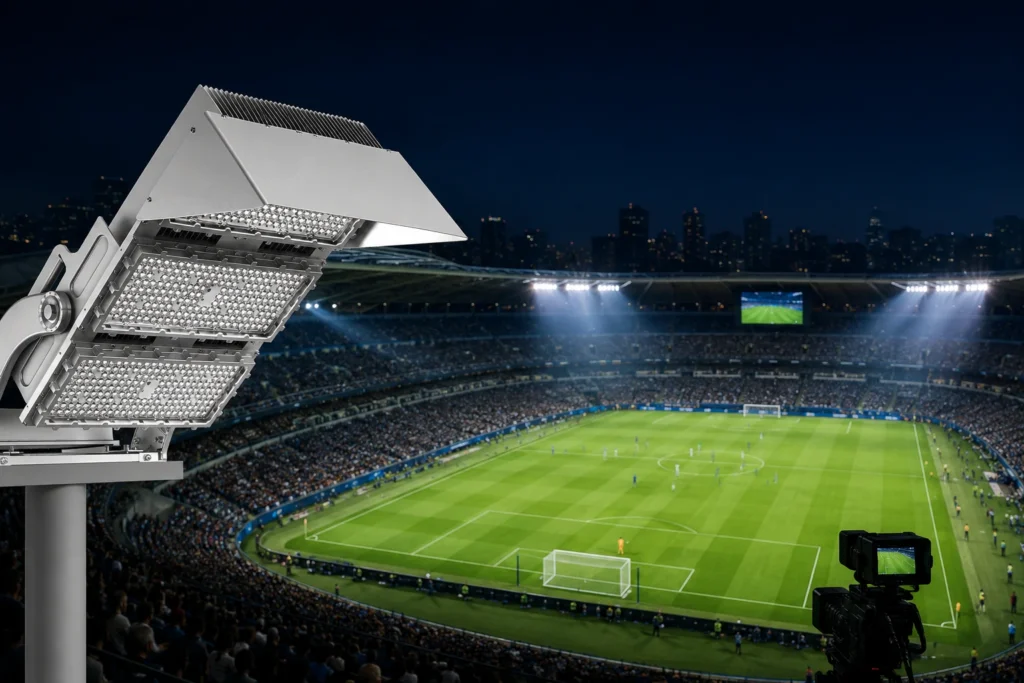
This is why fixtures such as the FL18 GameAres LED Stadium Floodlight are better suited to professional sports environments than ordinary outdoor floodlights. Stadium lighting must support both visibility and broadcast image quality.
HDR Makes Contrast More Demanding
HDR broadcasting captures brighter highlights and deeper shadows. The result can be more realistic and more immersive. But the lighting requirement is also stricter.
If the field has bright hotspots and dark corners, HDR will not hide them. It will expose them. If glare is too strong, HDR screens may make it feel harsher. If player faces are underlit, the broadcast image may look flat and less professional.
Slow-Motion Replay Requires Better Flicker Control
Slow-motion replay is where weak LED systems often fail. A light may look steady to spectators, yet flicker badly under high-speed cameras.
Professional broadcast-ready LED stadium lighting should use stable drivers, low ripple design, and flicker-free control. For demanding replay environments, products such as the SP02 Radial Stadium LED Floodlight can be considered where optical control and broadcast performance are project priorities.
Technical Requirements for Broadcast Stadium Lighting
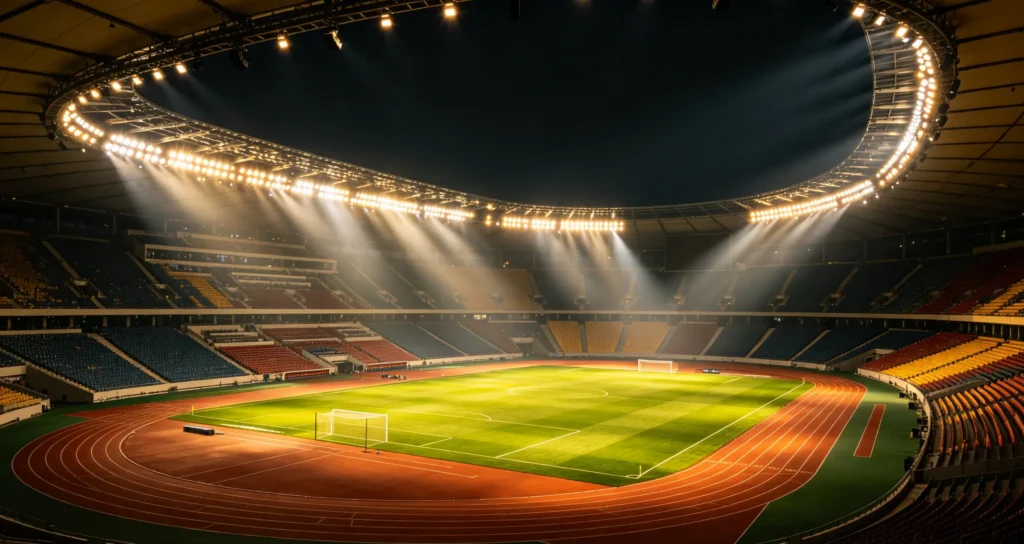
Broadcast stadium lighting is a technical system. It combines photometry, illuminance, luminous flux, candela, spectral distribution, electrical protection, thermal engineering, and optical design. Good performance comes from system balance, not only high wattage.
Vertical Illuminance and Player Modeling
Vertical illuminance is one of the most important factors for FIFA broadcast lighting. Cameras do not only capture the grass. They capture players from the front, side, and diagonal angles.
Better vertical illuminance improves facial visibility, jersey readability, athlete recognition, and depth perception. Poor vertical lighting makes players look darker, flatter, and less separated from the background.
Uniformity and Shadow Control
Uniformity is what makes the picture feel smooth. A field with poor uniformity may look bright in one zone and dull in another. The camera must constantly adjust. The viewer notices the difference.
Better beam overlap creates softer transitions. Better aiming reduces harsh shadows. Better optical planning improves replay clarity. Modular systems such as the FL08 Series Modular LED Sports & Outdoor Floodlight can support flexible beam distribution for different stadium geometries.
Color Quality: CRI, TLCI, and CCT
CRI is important, but it is not enough. CRI measures color rendering for human vision. TLCI is more relevant to television cameras.
For broadcast stadium lighting, color consistency matters across the entire field. A stable CCT, often around 5000K or 5700K depending on the project, helps cameras maintain better white balance. Strong spectral distribution also helps jerseys, grass, skin tones, and sponsor boards appear more natural.
Glare, Spill Light, and Environmental Control
Glare is more than discomfort. It can reduce player performance, disturb spectators, and create camera flare. Spill light can also affect nearby communities.
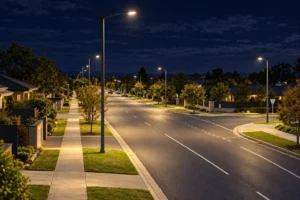
For municipal stadiums and urban sports parks, glare control, DarkSky compliance, light pollution reduction, and sky glow control are becoming more important. A better lighting system sends light where it is needed. A weaker system wastes light where it is not wanted.
| Standard / Concept | Article Relevance | Best Use in Content |
|---|---|---|
| FIFA Lighting Guidelines | Football broadcast authority | Use for stadium lighting requirements |
| EN12193 | Sports lighting lux, uniformity, and glare | Use for European sports lighting reference |
| CIE | Photometry and glare science | Use for technical credibility |
| IEC 61000 | EMC and surge immunity | Use for electrical protection topics |
| DALI / DMX512 | Smart lighting control | Use for stadium scenes and control systems |
| LM-80 / TM-21 | LED lumen maintenance | Use for lifespan and long-term reliability |
Stadium Lighting Design and Control Strategy
A good broadcast lighting design starts with geometry. Pole height, pole position, mounting structure, beam angle, aiming angle, and camera location all affect the final broadcast image.
Pole Layout and High-Mast Lighting
A 4-pole system may be simpler and lower cost. A 6-pole or 8-pole system may provide smoother coverage and better camera angles. Roof-mounted systems can reduce pole obstruction but may create different aiming challenges.
For larger venues, training grounds, ports, airports, and large-area sports complexes, High-Mast & Large Area LED Lighting Solutions can provide useful design logic for uniformity, wind resistance, maintenance access, and glare reduction.
Optics and Aiming Strategy
Beam angle selection changes everything. Narrow beams reach farther but may create harder contrast. Wider beams are smoother but may reduce intensity. Asymmetric optics can improve control by directing light more efficiently toward the target area.
For broadcast projects, aiming should protect camera sightlines, reduce direct glare, improve vertical illuminance, and avoid excessive spill light. Better aiming is cheaper than redesigning the whole system after failure.
Smart Control: DALI, DMX512, and IoT Monitoring
Modern stadium lighting is becoming smarter. DALI, DMX512, IoT lighting controls, adaptive lighting systems, and remote monitoring allow venues to create different scenes for matches, training, ceremonies, emergency modes, and broadcast production.
A complete Stadium LED Lighting Solution should consider not only fixtures, but also controls, dimming, reliability, maintenance, and future broadcast needs.
Project Workflow: From Simulation to Sign-Off
Broadcast stadium lighting should follow a clear workflow. Without structure, even high-quality products can perform poorly after installation.
Step 1: Simulation and Photometric Planning
Before procurement, the project should use IES files, Dialux simulation, AGi32 analysis, NEMA beam patterns, and camera-angle review. This helps predict lux levels, vertical illuminance, glare, and uniformity before installation begins.
Step 2: Product Selection
Product selection should consider optical control, driver quality, surge protection, IP66 or IP67 weather resistance, IK08 or IK10 impact resistance, thermal design, and corrosion resistance.
For demanding stadiums, airfields, and large outdoor facilities, the FL12 High-Power LED Stadium & Airfield Floodlight can be considered where high output, structural reliability, and long-distance projection are needed.
Step 3: Installation, Aiming, and Testing
Installation quality is as important as product quality. The team should verify tilt angles, aiming points, pole alignment, electrical isolation protection, surge protection, and lightning protection.
After installation, testing should include horizontal illuminance, vertical illuminance, uniformity ratio, flicker performance, camera replay checks, and glare observation. A project should not be accepted only because the field “looks bright.”
Reliability, Sustainability, and ROI
Stadium lighting is a long-term investment. A cheaper fixture may look attractive during purchasing, but it can become more expensive through maintenance, downtime, failed broadcast tests, and early lumen depreciation.
Thermal Engineering and Lifespan
Good thermal design protects LED chips, drivers, lenses, and housing components. LM-80, TM-21, L70, and L80 are important concepts when evaluating long-term lumen maintenance.
Better thermal management means slower lumen depreciation. Slower depreciation means more stable camera exposure. More stable exposure means better broadcast quality over time.
Electrical and Weather Protection
Outdoor stadium lights face rain, heat, dust, vibration, wind, corrosion, and lightning risk. That is why IP rating, IK rating, EPA rating, wind resistance, marine-grade coating, surge protection standards, and IEC 61000 references matter.
For coastal stadiums, humid regions, mining areas, airports, and industrial sports campuses, corrosion resistance can be more important than buyers first expect.
Energy Efficiency and ESG Value
LED stadium lighting is usually more efficient, faster to restart, easier to control, and more suitable for smart energy management than metal halide systems.
| Item | Metal Halide System | LED Stadium Lighting |
|---|---|---|
| Energy Efficiency | Lower | Higher lm/W performance |
| Restart Speed | Slow warm-up | Instant on/off |
| Control | Limited | Dimming, scenes, IoT control |
| Maintenance | More frequent | Lower maintenance demand |
| Broadcast Performance | Less flexible | Better flicker control and optics |
For multi-purpose venues that combine sports areas with warehouses, logistics zones, or training halls, Industrial & High-Bay LED Lighting Solutions may also support a broader lighting upgrade plan.
How to Choose Broadcast-Ready LED Stadium Lights
If you are planning a FIFA-level stadium lighting project, do not compare wattage alone. Wattage tells you power consumption. It does not tell you broadcast quality.
You should ask suppliers for photometric files, flicker reports, driver information, beam angle options, thermal data, surge protection details, IP/IK ratings, and simulation support.
Key Questions to Ask Before Buying
- Can the supplier provide IES files for simulation?
- Can the system support vertical illuminance requirements?
- Is the driver suitable for flicker-free broadcasting?
- Can the optics reduce glare and spill light?
- Is the fixture suitable for wind, rain, heat, and corrosion?
- Can the lighting system support DALI, DMX512, or smart control?
- Can the supplier support stadium aiming and commissioning?
At ZC Lighting, we focus on outdoor sports lighting, large-area lighting, and professional LED solutions for demanding projects. If your stadium, sports park, municipal field, or EPC project needs technical support, you can request instant quotes for lighting solutions during the early planning stage.
Conclusion
FIFA Broadcast Lighting Requirements for 4K & HDR are not just about brightness. They are about precision. They are about camera performance. They are about creating a stable, vivid, and professional viewing experience.
Compared with traditional sports lighting, broadcast stadium lighting needs better vertical illuminance, lower flicker, stronger uniformity, more accurate color, better glare control, and smarter system management. The difference is clear. A basic system lights the field. A broadcast-ready system supports the match, the camera, the viewer, and the venue brand.
As 4K, HDR, HFR, and future 8K broadcasting continue to grow, stadium lighting will become even more important. EPC contractors, stadium owners, municipalities, and sports investors should treat lighting as a strategic infrastructure decision, not a simple product purchase.
FAQs
1. What are FIFA Broadcast Lighting Requirements for 4K & HDR?
They are lighting performance requirements designed to support professional football broadcasting. They focus on vertical illuminance, horizontal illuminance, uniformity, flicker control, glare reduction, color quality, and camera-friendly lighting performance for 4K, HDR, and slow-motion replay.
2. Why is vertical illuminance important for stadium broadcasting?
Vertical illuminance helps cameras capture players clearly from the front and side. It improves facial visibility, jersey readability, player modeling, and replay quality. A field can have enough horizontal brightness but still look poor on TV if vertical illuminance is weak.
3. Can ordinary LED floodlights meet FIFA broadcast lighting standards?
Usually not. Ordinary floodlights may provide brightness, but broadcast lighting needs better optics, lower flicker, stronger uniformity, accurate color rendering, stable drivers, and professional aiming. Broadcast-ready stadium lights are designed for cameras, not only for human eyes.
4. What causes flicker in LED stadium lighting?
Flicker is often caused by poor driver design, unstable current, PWM dimming issues, or low-quality electrical components. It may not be visible to spectators, but it can appear clearly during high-frame-rate slow-motion replay.
5. How should I choose LED lights for a 4K HDR stadium project?
Choose lights based on simulation data, IES files, vertical illuminance, uniformity, flicker reports, CRI/TLCI, glare control, surge protection, IP/IK ratings, and smart control compatibility. Supplier engineering support is also important for aiming, testing, and final sign-off.
Disclaimer
FIFA and UEFA are referenced solely as sources of industry and project-design guidance. ZC Lighting is not affiliated with, endorsed by or certified by FIFA or UEFA. Final compliance depends on the complete project design, selected product configuration, installation, measurement and approval by the relevant project authority.