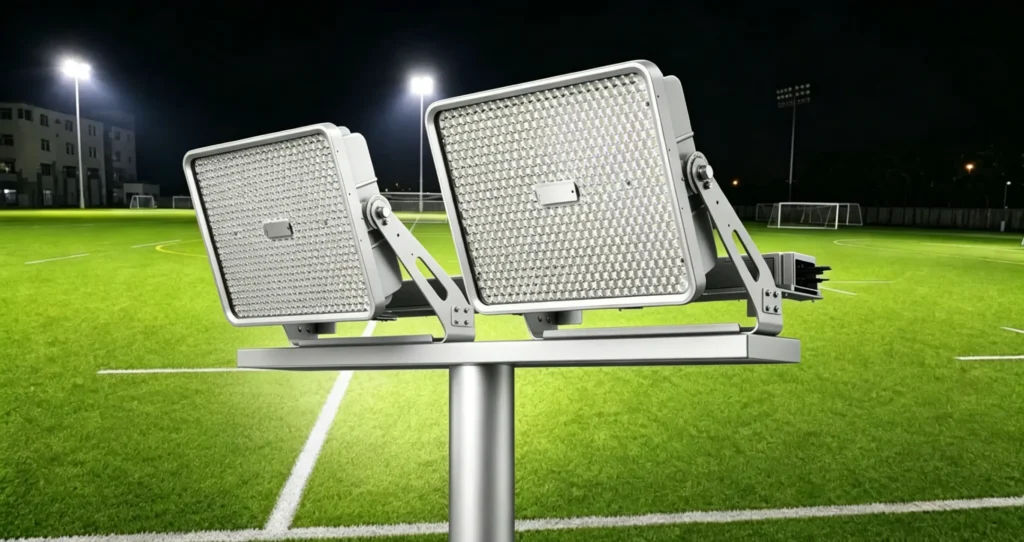
 A 1000W LED flood light usually produces about 120,000 to 170,000 lumens, depending on LED efficiency, optical design, driver quality, and heat control. But for stadiums, football fields, schools, and municipal projects, lumens are only the starting point.
You also need to consider lux, beam angle, uniformity, glare control, flicker performance, and long-term lumen maintenance. A brighter light is not always a better light. A more controlled light is often the smarter choice.
At ZC Lighting, we focus on outdoor LED lighting systems that help sports facilities and large-area projects achieve better visibility, lower energy costs, and more reliable performance.
Typical Lumen Output of a 1000W LED Flood Light
The lumen output of a 1000W LED flood light depends mainly on luminous efficacy, measured in lumens per watt. A basic fixture may produce fewer usable lumens, while a professional stadium-grade flood light can deliver much stronger and cleaner illumination.
| Flood Light Type | Typical Lumens | Typical Efficiency | Best Use |
|---|---|---|---|
| Basic Outdoor LED Flood Light | 110,000–130,000 lm | 110–130 lm/W | General outdoor lighting |
| Commercial High-Power Flood Light | 130,000–150,000 lm | 130–150 lm/W | Parking lots, yards, schools |
| Professional Stadium LED Flood Light | 150,000–170,000+ lm | 150–170+ lm/W | Football fields, stadiums, sports parks |
For high-performance sports projects, products such as the FL18 GameAres LED Stadium Floodlight are designed for stronger optical control, lower glare, and better field uniformity.
Why Wattage Alone Is Not Enough
A 1000W label only tells you how much power the fixture consumes. It does not tell you how much useful light reaches the ground. Two lights can use the same wattage but perform very differently.
The better fixture usually has better chips, a more efficient driver, stronger thermal design, and more accurate lenses. It wastes less light. It performs longer. It is more valuable for large-area projects.
Lumens vs Lux: What Really Matters?
Lumens measure total light output. Lux measures the light that actually reaches a surface. For football fields and stadiums, lux is more practical than lumens.
A high-lumen flood light with poor optics may create bright spots, dark corners, and glare. A lower-lumen system with better optical design can deliver smoother and safer visibility.
Simple Explanation
- Lumens: total light produced by the fixture.
- Lux: light received on the field or working area.
- Uniformity: how evenly the light spreads across the surface.
This is why professional buyers often ask for IES files, Dialux simulations, or AGi32 lighting calculations before purchasing. These tools show real lighting results, not just catalog numbers.
How Much Light Do Sports Facilities Need?
Different projects need different brightness levels. A school football field does not need the same lighting level as a broadcast stadium. A municipal sports park may need lower energy use and better community glare control.
| Venue Type | Recommended Lux Range | Main Requirement |
|---|---|---|
| Training Field | 200–300 lux | Basic visibility and safety |
| School Football Field | 300–500 lux | Balanced cost and performance |
| Semi-Professional Stadium | 500–750 lux | Better uniformity and player visibility |
| Broadcast Stadium | 1000–2000 lux | HDTV/HDR broadcast quality |
For large football fields and stadium projects, the Stadium LED Lighting Solution from ZC Lighting can help you plan pole layout, beam angle, lux targets, and glare control more professionally.
Why Uniformity Is Critical
Uniformity makes the field easier to see. It reduces dark zones. It improves player comfort. It also helps cameras capture cleaner images.
This is especially important for football field operators, schools, municipal projects, and sports real estate investors. Better uniformity means fewer complaints and stronger long-term value.
Beam Angle, Optics, and Pole Height
Beam angle controls how light spreads. A narrow beam reaches farther. A wide beam covers more area. Asymmetric optics help direct light onto the field while reducing spill light.
Common Beam Angle Choices
- 15°–25°: long-distance projection from high poles.
- 30°–45°: balanced coverage for many sports fields.
- 60° or wider: large-area coverage at shorter distances.
- Asymmetric beam: better control for stadium edges and pole-mounted systems.
The FL08 Series Modular LED Sports & Outdoor Floodlight is suitable for projects that need flexible beam options and better optical matching.
How Pole Height Changes the Result
Pole height affects aiming, glare, and light distribution. Higher poles can improve coverage, but they also require stronger structure, better wind resistance, and more accurate aiming.
| Pole Height | Typical Use | Lighting Concern |
|---|---|---|
| 18m | School fields and small sports parks | Glare control and local uniformity |
| 25m | Municipal football fields | Beam overlap and spill control |
| 35m | Professional stadiums | Long-distance aiming and wind load |
For a real project reference, you can review the Dubai Football Stadium LED Lighting Project.
LED vs Metal Halide Replacement
Many buyers search for terms like “convert metal halide to LED,” “400w metal halide LED equivalent,” or “250 watt metal halide LED equivalent.” The reason is simple. LED systems are more efficient, faster to start, and easier to maintain.
Metal halide fixtures lose brightness over time. They also need warm-up time. LED flood lights turn on instantly and keep more stable output when properly designed.
Common Metal Halide to LED Equivalents
| Traditional Metal Halide | Typical LED Replacement | Common Search Intent |
|---|---|---|
| 70W metal halide | 20–30W LED | Small outdoor area lighting |
| 175W metal halide | 60–80W LED | Wall pack or small pole light replacement |
| 250W metal halide | 80–120W LED | Parking lot or area lighting |
| 400W metal halide | 150–200W LED | Commercial outdoor lighting |
| 1000W metal halide | 400–600W LED | High mast and sports lighting |
For general outdoor flood lighting upgrades, the FL03 Adjustable Smart Flood Light
can support more flexible aiming and efficient replacement planning.
Key Factors That Affect Real Performance
Luminous Efficacy
Luminous efficacy tells you how many lumens a fixture produces per watt. Higher efficacy usually means lower electricity cost and better system efficiency.
For example, if you ask, “How many watts is a 10,000 lumen LED light?” the answer depends on efficiency. At 150 lm/W, it may need about 67W. If you ask, “How many watts is a 2000 lumen light?” many modern LED fixtures use about 15W to 25W.
Thermal Management
Heat reduces LED performance. Better cooling helps the fixture maintain brightness for a longer time. This is why L70, L80, LM-80, and TM-21 are useful concepts for evaluating LED lifespan.
Flicker-Free Performance
Sports lighting must support modern cameras. Flicker can damage the viewing experience, especially in slow-motion replay, HDTV, and HDR broadcasting.
A better driver is faster, cleaner, and more stable. It helps players see clearly and helps cameras capture sharper movement.
Outdoor Protection
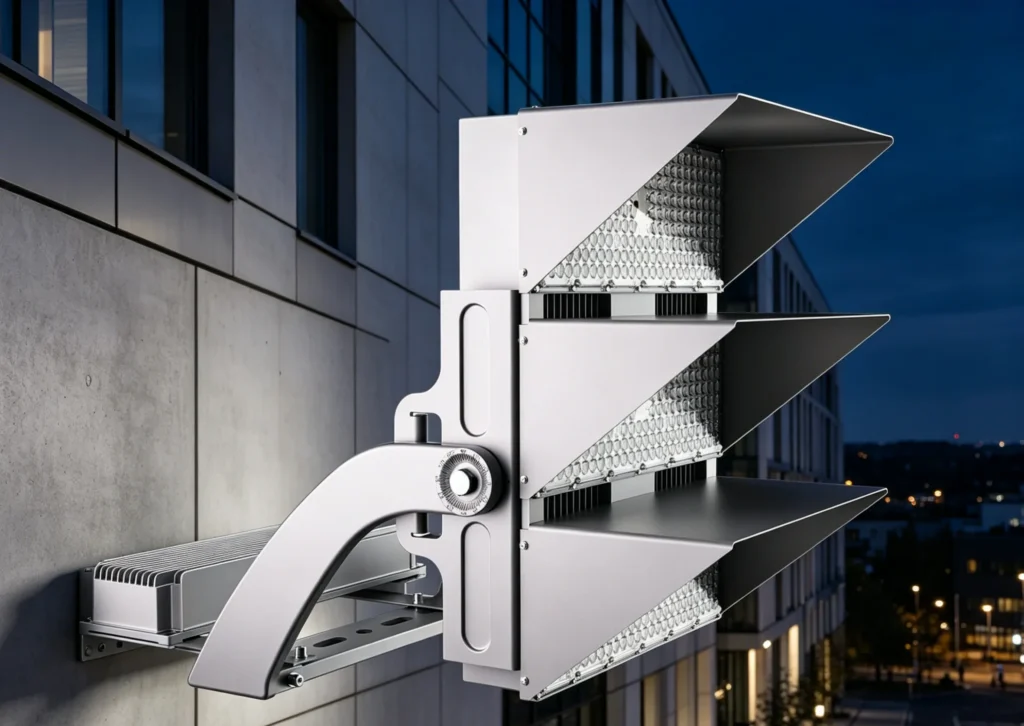
For outdoor LED flood lights, protection is essential. Look for waterproof housing, impact resistance, surge protection, wind resistance, and corrosion-resistant coating.
Common engineering references include IP66/IP67, IK08/IK10, IEC surge protection concepts, EPA wind load ratings, and DarkSky-friendly spill light control.
How to Choose the Right 1000W LED Flood Light
Before you buy, do not compare wattage only. Compare usable performance.
Check These Specifications
- Lumen output and luminous efficacy
- Lux level and uniformity ratio
- Beam angle and optical distribution
- Driver quality and flicker control
- CRI and CCT, such as 5000K or 5700K
- Surge protection and weather resistance
- IES files and lighting simulation reports
- Warranty and maintenance support
For high-power stadium or airfield applications, the FL12 High-Power LED Stadium & Airfield Floodlight is a strong option when long-distance projection and professional outdoor reliability are required.
Ask for a Lighting Plan
A serious project should not depend on guesswork. You need a layout. You need simulations. You need a clear comparison between wattage, lumens, lux, and field coverage.
For project support, you can request instant quotes for lighting solutions from ZC Lighting.
Conclusion
A 1000W LED flood light can deliver very powerful illumination, but the best lighting system is not defined by brightness alone. For sports and outdoor projects, the stronger choice is the system that gives you better lux distribution, lower glare, higher uniformity, and more efficient long-term operation.
If you operate a football field, manage a school sports facility, plan a municipal project, or invest in a sports park, you should look beyond simple wattage. A professional lighting plan will help you reduce wasted energy, improve player visibility, protect nearby communities from spill light, and lower maintenance costs.
At ZC Lighting, we help outdoor lighting buyers choose smarter LED systems for stadiums, sports fields, roads, industrial areas, and large public spaces.
FAQs
How many lumens is a 1000W LED light?
Most 1000W LED flood lights are designed for high-output outdoor applications, but the actual result depends on fixture efficiency, optics, and thermal design.
How many lumens is a good floodlight?
A good floodlight depends on the application. A small outdoor area may need only a few thousand lumens, while a stadium or football field requires much higher output with careful beam control.
Is a 1000W LED flood light suitable for a football field?
Yes, but one fixture is not enough for a full field. You need multiple fixtures, correct pole height, proper beam angles, and a lighting simulation to confirm lux and uniformity.
What is better for stadium lighting, high lumens or better optics?
Better optics are usually more important. High lumens can waste energy if the beam is poorly controlled. Good optics place more usable light on the field and reduce glare.
Can LED flood lights replace metal halide fixtures?
Yes. LED flood lights are more efficient, start instantly, last longer, and reduce maintenance compared with traditional metal halide systems.