Modern stadium lighting is no longer just about making the pitch brighter. It is about making the game clearer, safer, more broadcast-ready, and more comfortable for every viewer.
In this guide, we explain Horizontal vs Vertical Illuminance in FIFA Stadiums, why both matter, and how EPC contractors, stadium owners, lighting consultants, and broadcasters can design better FIFA-level lighting systems.
Why Illuminance Matters in FIFA Stadiums
Football lighting used to be simpler. If the pitch was bright, the job was mostly done. Today, that is not enough. Modern stadiums must support players, referees, spectators, broadcast cameras, replay systems, and digital media at the same time.
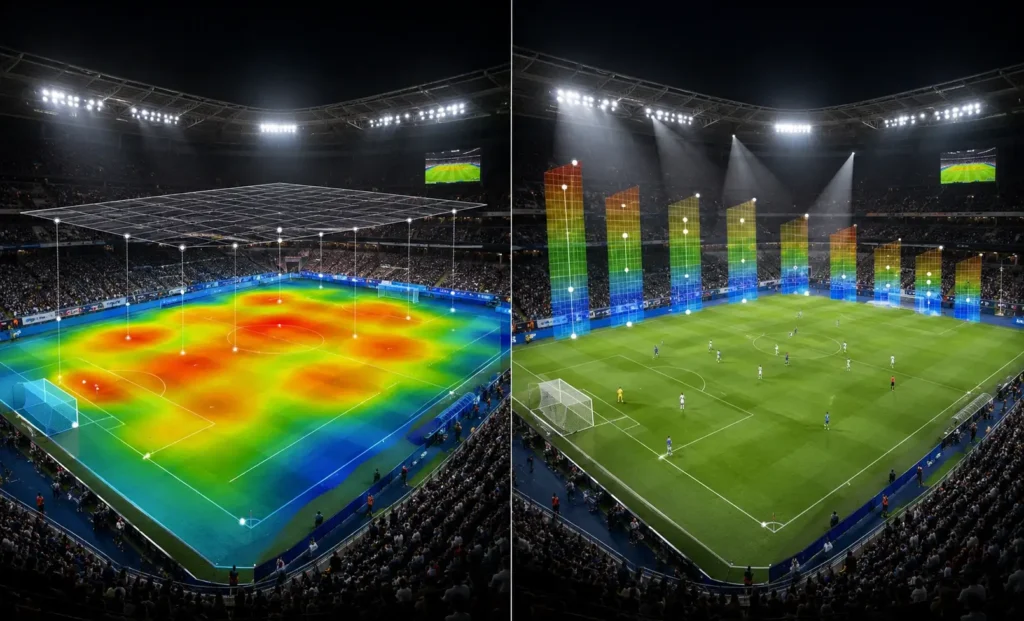
This is why Horizontal vs Vertical Illuminance in FIFA Stadiums is now a critical design topic. Horizontal illuminance helps players see the ball and the field. Vertical illuminance helps cameras see players, faces, uniforms, and motion.
The difference is bigger than many buyers expect. A stadium can look bright in person but still look poor on television. Faces may appear dark. Jerseys may lose detail. Shadows may look harsh. HDR cameras may expose uneven lighting faster than the human eye.
For this reason, professional projects often start with a complete stadium LED lighting solution rather than a simple floodlight replacement plan.
What Is Horizontal Illuminance?
Horizontal illuminance, usually called Eh, measures light on the playing surface. It is measured in lux on a horizontal plane across the football pitch.
In simple words, it answers one question: how bright is the ground?
Horizontal illuminance supports the most basic football needs. Players need it to track the ball. Referees need it to judge movement. Spectators need it to follow the match. A weak horizontal lighting level makes the field look dull and uneven.
Where Horizontal Illuminance Matters Most
Horizontal illuminance is especially important for field visibility, player movement, ball tracking, referee decisions, and general safety. It is the foundation of sports lighting.
However, it is not the whole system. Higher horizontal lux does not automatically mean better broadcast quality. More brightness can even create more glare if the optical design is poor.
| Venue Type | Typical Horizontal Lux Range | Main Lighting Goal |
|---|---|---|
| Training Field | 200–500 lux | Basic visibility and safety |
| School / Amateur Field | 500–750 lux | Clearer play and better uniformity |
| Professional Stadium | 1000–2000 lux | Competition-level performance |
| FIFA World Cup-Level Venue | 2000+ lux | Broadcast-ready lighting quality |
What Is Vertical Illuminance?
Vertical illuminance, usually called Ev, measures light on a vertical plane. In FIFA stadium lighting, this often means the light reaching players from the direction of the main broadcast cameras.
It answers a different question: how clearly can cameras see the players?
This is where modern stadium lighting becomes more technical. Vertical illuminance affects facial visibility, jersey recognition, player modeling, contrast, camera depth, and replay clarity.
For broadcast football, vertical illuminance is often more important than buyers first realize. It makes the image richer, sharper, and more natural. Poor Ev makes players look flat. Strong Ev makes them stand out.
Why Cameras Need Vertical Illuminance
The human eye adapts quickly. Cameras do not. HDR, HDTV, 4K, and slow-motion systems show every weak spot. If vertical lighting is uneven, the broadcast image looks weaker than the real stadium experience.
This is why modern FIFA lighting design must consider camera positions from the beginning. Main cameras, reverse cameras, corner cameras, and replay systems all need usable vertical light.
Advanced fixtures such as the FL18 GameAres LED Stadium Floodlight are designed for sports venues where beam control, glare reduction, and camera-friendly illumination matter more than simple wattage.
Horizontal vs Vertical Illuminance Comparison
The core difference is simple. Horizontal illuminance lights the field. Vertical illuminance lights the players for cameras.
Both are essential. But they solve different problems.
| Factor | Horizontal Illuminance | Vertical Illuminance |
|---|---|---|
| Measurement Plane | Ground surface | Camera-facing vertical plane |
| Main Purpose | Gameplay visibility | Broadcast visibility |
| Main Users | Players, referees, spectators | Cameras, broadcasters, TV viewers |
| Design Driver | Pole spacing and field coverage | Aiming angle and camera direction |
| Common Problem | Dark zones on the pitch | Flat players and weak facial detail |
| Broadcast Impact | Moderate | Very high |
A good stadium lighting system is not simply brighter. It is more balanced. It uses stronger optical control, better pole geometry, lower glare, and more accurate camera-axis lighting.
FIFA, UEFA, and Sports Lighting Standards
Professional football lighting is influenced by several authority sources and standards. These include FIFA lighting guidelines, UEFA broadcast expectations, EN12193, CIE photometry principles, IEC electrical standards, and IES sports lighting recommendations.
The phrase “fifa lighting” is often used broadly, but real projects require more than one document. Stadium owners also need to consider the UEFA guide to quality stadiums, local electrical codes, spill light regulations, and broadcaster requirements.
Important Standards and Concepts
| Standard / Concept | Why It Matters |
|---|---|
| FIFA Lighting Guidelines | Defines professional football and broadcast lighting expectations |
| EN12193 | Covers sports lighting lux, uniformity, glare, and competition levels |
| CIE Photometry | Supports accurate measurement of illuminance, glare, and visual comfort |
| HDR / HDTV Broadcasting | Requires better vertical illuminance and flicker control |
| DALI / DMX512 | Supports smart lighting control and event scene management |
| IP66 / IP67, IK08 / IK10 | Improves outdoor durability and impact resistance |
FIFA stadium categories also affect lighting strategy. A local football field, a professional arena, and a FIFA World Cup stadium do not need the same design depth. Larger venues need stronger vertical illuminance, better camera planning, and tighter uniformity.
Even arena vs stadium capacity can change the design. A larger stadium usually has longer camera distances, taller poles, stronger glare risks, and more complex aiming requirements.
How Engineers Balance Eh and Ev
Balancing horizontal and vertical illuminance is difficult because the two do not always improve together. More light on the ground does not always mean more useful light on the player’s face.
Better design comes from precision, not just power.
Pole Height and Layout
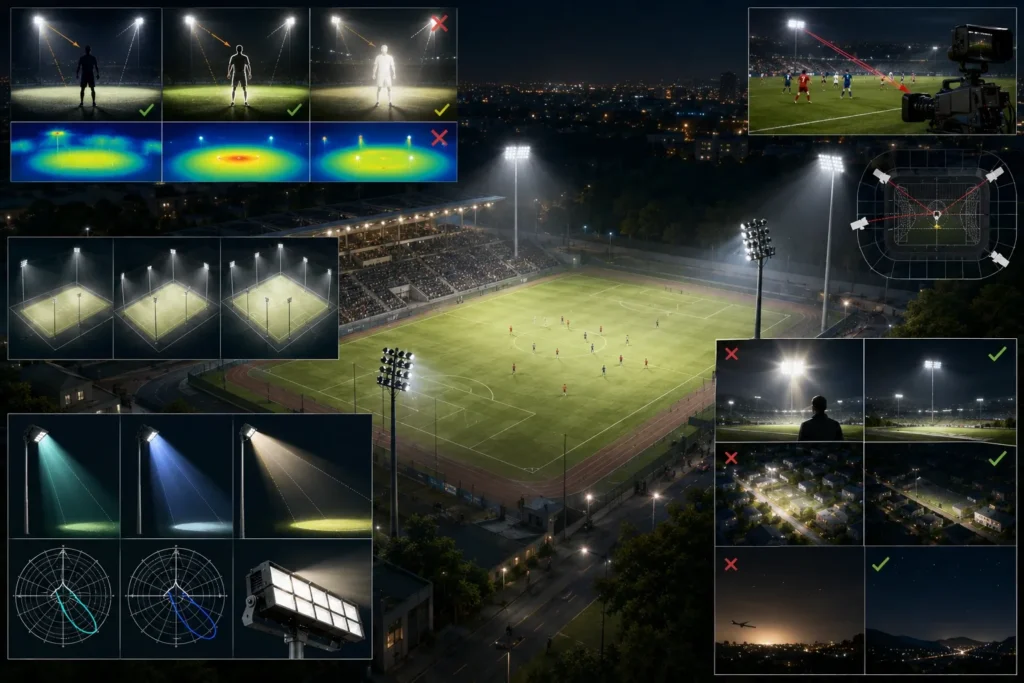
Pole height affects uniformity, glare, spill light, and vertical lux. Higher poles can spread light more evenly, but poor aiming can still create dark faces or strong glare.
Engineers often compare 4-pole, 6-pole, and 8-pole layouts. More poles can improve uniformity, but they also increase cost and structural complexity.
Beam Angle and Optical Control
Optics matter more than wattage. A lower-wattage fixture with better beam control can outperform a higher-wattage fixture with poor optics.
Narrow beams help long-distance aiming. Medium beams improve coverage. Asymmetric optics reduce waste and improve usable light. NEMA beam patterns and IES files help engineers simulate these effects before installation.
For projects requiring flexible beam planning, the FL08 Series modular sports floodlight can support more practical stadium-specific aiming strategies.
Camera-Side Lighting
Camera-side lighting is often the missing piece. Designers must understand where the main camera sits, where reverse cameras operate, and how replay systems capture motion.
If the main camera sees players from a poorly lit direction, the broadcast image will look weaker. This is why vertical illuminance should be designed around camera axes, not only pitch grids.
Glare and Spill Light Control
More tilt often creates more glare. More uncontrolled light often creates more complaints. A professional design controls both.
Glare control protects players and spectators. Spill light control protects nearby roads, homes, airports, and urban spaces. DarkSky thinking, sky glow control, and light pollution reduction are increasingly important for municipal projects.
LED Technology, Controls, and Reliability
Modern LED sports lighting has several advantages over older metal halide systems. It starts faster, saves more energy, delivers better optical control, and supports smarter control systems.
But not all LED stadium lights are equal.
Flicker-Free Broadcasting
Slow-motion cameras expose flicker quickly. Poor drivers can create rolling bands, unstable brightness, and replay artifacts.
For FIFA-level stadiums, flicker-free performance is not optional. It is part of broadcast quality.
Smart Controls
DALI, DMX512, IoT controls, and remote monitoring allow stadium operators to manage different scenes. A match can use one lighting mode. Training can use another. Concerts and events can use dynamic scenes.
For surrounding infrastructure, parking zones, or large exterior areas, a complete high-mast and large area LED lighting solution can improve consistency across the entire sports complex.
Outdoor Reliability
Outdoor stadium lights face wind, rain, heat, dust, corrosion, and electrical surges. Important specifications include IP66 or IP67 protection, IK08 or IK10 impact resistance, IEC 61000 surge immunity, thermal design, LM-80, TM-21, L70, and L80 lifetime data.
For demanding stadium and airfield-style projects, the FL12 high-power stadium and airfield floodlight is relevant where high output, durability, and long-distance illumination are required.
Common Stadium Lighting Mistakes
Many stadium lighting problems are not caused by low wattage. They are caused by poor planning.
Designing Only for Horizontal Lux
This is the most common mistake. A pitch can meet horizontal lux targets and still fail broadcast expectations. Strong Eh without strong Ev is incomplete.
Ignoring Camera Positions
Camera locations should be part of the design from the beginning. If they are added later, vertical illuminance may be uneven or impossible to correct without re-aiming fixtures.
Using the Wrong Optics
Parking lot floodlights are not stadium floodlights. General optics create more spill, weaker beam control, and poorer uniformity.
Over-Tilting Fixtures
Over-tilting can increase glare, sky glow, and light trespass. It may also reduce useful light on the pitch.
Skipping Simulation and Commissioning
DIALux, AGi32, Relux, photometric testing, and accurate IES files reduce project risk. Final commissioning then confirms whether the installed system matches the simulation.
Choosing the Right Stadium Lighting Partner
For EPC contractors, stadium owners, and lighting consultants, supplier selection should not be based only on price or wattage. A better supplier understands photometry, optical engineering, thermal management, electrical protection, and real stadium installation conditions.
When comparing suppliers, you should ask:
- Can they provide IES files and lighting simulation support?
- Can they optimize both horizontal and vertical illuminance?
- Can their fixtures support flicker-free broadcasting?
- Can they control glare, spill light, and sky glow?
- Can their products meet outdoor durability requirements?
- Can they support OEM or private-label projects?
ZC Lighting supports professional LED outdoor lighting projects with sports lighting, high-mast lighting, industrial lighting, and large-area illumination products. For stadium applications, our team focuses on practical optical performance, stable engineering support, and project-specific lighting solutions.
If you need an instant quote or project consultation, you can contact our team through the ZC Lighting contact page.
Conclusion
Horizontal vs Vertical Illuminance in FIFA Stadiums is not just a technical comparison. It is the core of modern football lighting design.
Horizontal illuminance makes the pitch playable. Vertical illuminance makes the match broadcastable. One supports the game. The other supports the screen.
For FIFA World Cup-level venues, professional clubs, municipal stadiums, schools, sports parks, and broadcast-ready arenas, the best lighting systems are not simply brighter. They are more precise, more efficient, more controlled, and more camera-friendly.
As HDR broadcasting, smart stadiums, and stricter environmental expectations grow, vertical illuminance will become even more important. The future belongs to lighting systems that balance visibility, comfort, compliance, and long-term operating value.
FAQs
How often should stadium lighting be tested after installation?
Professional stadium lighting should be tested after installation, after major maintenance, and before important competitions. For broadcast venues, regular photometric checks help confirm that lux levels, uniformity, glare control, and aiming angles still match the original design.
Does LED color temperature affect FIFA stadium broadcasting?
Yes. Color temperature affects camera image quality, player visibility, and viewer comfort. Many professional stadium projects use neutral or cool white light, often around 5000K to 5700K, because it gives a clearer and more natural broadcast image.
Why do stadium lighting projects need IES files?
IES files provide accurate photometric data for each fixture. Engineers use them in DIALux, AGi32, or Relux to simulate beam distribution, lux levels, glare risk, and uniformity before installation. Without IES files, the lighting design is much less reliable.
Can smart controls reduce stadium lighting costs?
Yes. Smart controls allow operators to use different lighting scenes for training, matches, maintenance, concerts, or security. This can reduce energy use, extend fixture life, and make the stadium more flexible for different events.
What should buyers check before choosing FIFA-level stadium lights?
Buyers should check optical design, flicker-free performance, surge protection, IP and IK ratings, thermal management, IES files, simulation support, warranty terms, and supplier project experience. A lower-price fixture may cost more later if it causes glare, poor uniformity, or broadcast problems.