 Stadium lighting is no longer only about making a field bright. It now affects player safety, broadcast quality, glare control, energy cost, and long-term maintenance.
When you compare EN12193 vs FIFA Lighting Standards, you see one clear difference. EN 12193 sports lighting focuses more on safe play and visual comfort. FIFA lighting standards focus more on broadcast performance, vertical illuminance, flicker control, and camera visibility.
What Is EN12193?
EN12193 is a European sports lighting standard. It defines lighting requirements for sports fields, stadiums, training grounds, and other athletic facilities. The standard helps designers create safer and more comfortable playing environments.
EN 12193 sports lighting mainly focuses on human vision. It helps players see the ball, read the field, and react faster. It also helps spectators enjoy a clearer view of the game.
Core EN12193 Lighting Parameters
| Parameter | Purpose | Why It Matters |
|---|---|---|
| Horizontal Illuminance | Measures light on the field surface | Improves player visibility |
| Uniformity | Controls bright and dark areas | Reduces visual fatigue |
| Glare Rating | Limits discomfort glare | Improves safety and comfort |
| CRI | Measures color rendering | Improves natural color appearance |
| Maintenance Factor | Predicts future light loss | Supports long-term compliance |
EN12193 is often enough for schools, universities, community fields, training centers, and municipal sports parks. These projects need reliable visibility, lower glare, and efficient operation. They do not always need full broadcast-grade lighting.
What Are FIFA Lighting Standards?
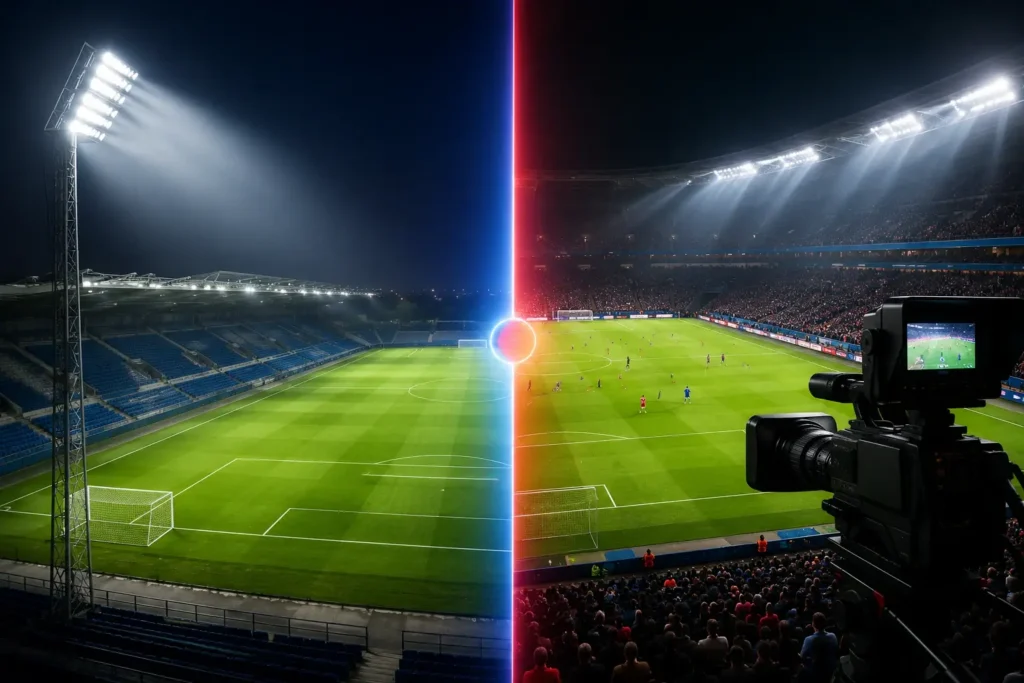
FIFA lighting standards are more demanding because football is often broadcast to large audiences. A stadium can look bright to spectators but still look poor on camera. FIFA stadium requirements solve this problem by focusing on camera performance.
The FIFA lighting Guide considers HDTV, HDR, slow-motion replay, vertical illuminance, and flicker-free performance. These requirements make the lighting system more complex than basic led lighting standards for stadiums.
Core FIFA Lighting Requirements
FIFA-level lighting usually requires stronger vertical illuminance. Cameras need enough light on players’ faces, bodies, and uniforms. The field surface also needs good horizontal illuminance, but player visibility on camera is more important.
FIFA lighting also requires better flicker control. High-speed cameras expose weak LED drivers quickly. Poor drivers can create banding, unstable exposure, and visible flicker during slow-motion replay.
Professional venues often need a complete stadium LED lighting solution rather than a simple fixture replacement plan.
EN12193 vs FIFA Lighting Standards: Key Differences
The main difference is simple. EN12193 focuses more on how people see the field. FIFA focuses more on how cameras see the players.
| Item | EN12193 | FIFA Lighting Standards |
|---|---|---|
| Main Goal | Safe and comfortable sports play | Broadcast-quality stadium lighting |
| Main Metric | Horizontal illuminance | Vertical illuminance |
| Camera Focus | Limited | High priority |
| Flicker Control | Basic project requirement | Critical for HDTV and slow motion |
| Typical Use | Community and school fields | Professional and televised stadiums |
| Design Difficulty | Moderate | Higher and more technical |
Horizontal Illuminance vs Vertical Illuminance
Horizontal illuminance measures light on the ground. It helps athletes see the field surface. EN12193 uses this metric heavily because it supports safe play.
Vertical illuminance measures light on vertical surfaces. It helps cameras capture faces, movement, jerseys, and ball tracking. FIFA standards use vertical illuminance more heavily because cameras need cleaner images.
This difference changes the entire design. A brighter field is not always a better field. A more balanced lighting system usually performs better than a higher-wattage system.
Camera-Side Lighting
FIFA-level projects must consider camera direction. Main cameras, side cameras, reverse cameras, and replay cameras all see the field differently. A player may look bright from one angle and dark from another.
Better camera-side lighting creates more natural player modeling. It also reduces harsh shadows and improves broadcast consistency.
Broadcast Performance, Flicker, and Camera Quality
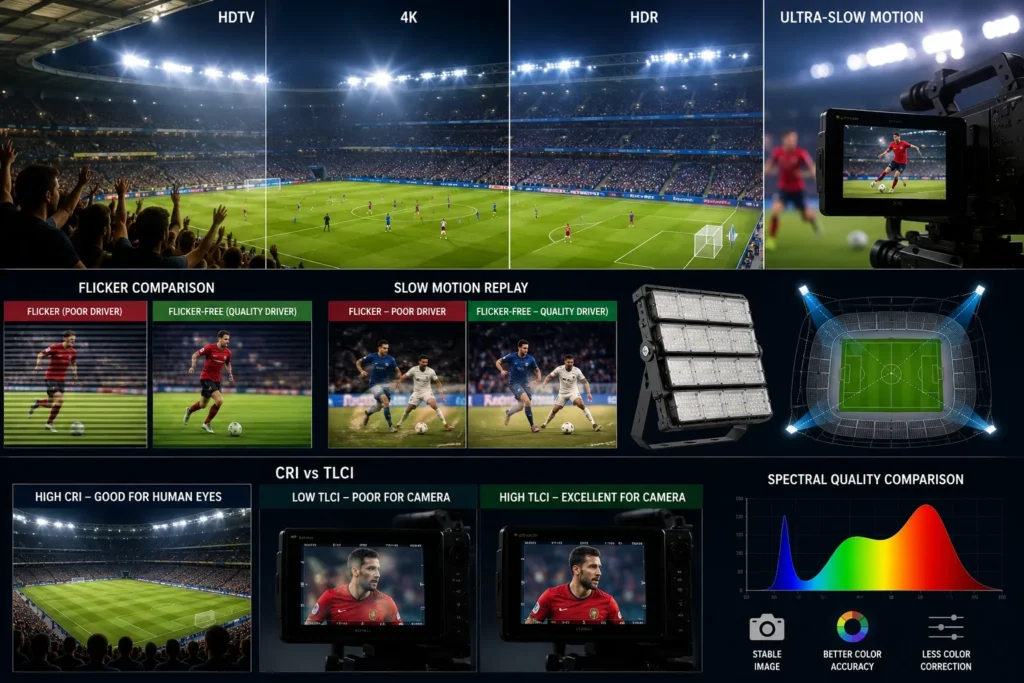
Modern broadcast systems are less forgiving than older TV systems. HDTV, 4K, HDR, and ultra-slow-motion replay reveal lighting problems faster and more clearly.
Flicker-Free LED Drivers
Weak LED drivers often cause flicker. The human eye may not notice it, but cameras will. Slow-motion replay can make flicker look worse. That problem can damage broadcast quality and delay project approval.
For projects that need modular aiming and stronger control, a product such as the FL08 modular sports floodlight can support more flexible stadium lighting layouts.
CRI vs TLCI
CRI measures how humans see color. TLCI measures how cameras reproduce color. This distinction matters more in HDR broadcasting. A light source can look acceptable to spectators but still create poor skin tones or grass color on camera.
Better spectral quality creates more stable images. It also reduces color correction work for broadcasters.
Common Broadcast Lighting Problems
| Problem | Likely Cause | Project Impact |
|---|---|---|
| Dark player faces | Weak vertical illuminance | Poor broadcast quality |
| Camera banding | Driver flicker | Failed replay quality |
| Harsh shadows | Poor aiming strategy | Lower visual comfort |
| Color inconsistency | Weak spectral control | Unstable HDR images |
Glare, Spill Light, and Environmental Control
Glare control is often more important than raw brightness. Excessive light can make a stadium uncomfortable. It can also create complaints from nearby residents.
Why Glare Happens
Glare usually comes from excessive tilt angles, poor optical control, wrong pole height, or weak shielding. A higher-output fixture may create more problems if the beam is not controlled well.
Large stadiums often need fixtures with stronger optical precision. Products such as the SP02 radial stadium floodlight are designed for large-area sports lighting where beam control matters.
Spill Light and Sky Glow
Municipal authorities now care more about light trespass, sky glow, and environmental impact. A sports lighting system should light the field, not the neighborhood.
High-mast projects, airports, ports, and large sports parks often require broader high-mast and large-area LED lighting solutions to improve coverage while reducing wasted light.
Engineering Design, Simulation, and Testing
Good stadium lighting starts before installation. Engineers should use photometric data, IES files, DIALux, AGi32, aiming tables, and on-site testing to reduce risk.
Why Simulation Matters
Simulation predicts lux levels, uniformity, glare, spill light, and vertical illuminance. It also shows whether the lighting design can meet EN12193 or FIFA requirements before equipment is installed.
A professional simulation costs less than a failed installation. Re-aiming fixtures, adding poles, or changing drivers after installation can cost far more.
Commissioning and Acceptance Testing
Commissioning confirms whether the installed system matches the design. Engineers should test lux levels, aiming angles, flicker performance, and uniformity. They should also verify the maintenance factor and final field performance.
Large venues may need high-power products such as the FL12 stadium and airfield floodlight when long-distance aiming and stronger output are required.
Which Standard Should Your Project Follow?
Your project goal should decide the standard. A small training field does not need the same lighting system as an international broadcast stadium.
Use EN12193 When
You can usually follow EN12193 when the project serves schools, municipal fields, training grounds, or community sports facilities. These venues need safe play, better comfort, and reasonable energy cost.
Use FIFA-Level Lighting When
You should move toward FIFA lighting standards when the venue hosts televised matches, professional football, international events, or HDR broadcast production. These projects need stronger vertical illuminance, better flicker control, and more advanced testing.
Future-Proofing Matters
Some stadiums start as municipal venues and later upgrade to professional events. In that case, a stronger design can reduce future retrofit costs. Better drivers, better optics, and smarter control systems create more room for future upgrades.
How to Choose the Right Stadium Lighting Partner
A stadium lighting supplier should provide more than fixtures. You should expect engineering support, photometric files, lighting simulation, thermal design, surge protection, and commissioning guidance.
ZC Lighting supports outdoor and sports lighting projects that require practical design, stable performance, and long-term reliability. For project evaluation, you can request instant quotes for lighting solutions based on your site conditions and lighting goals.
Buyer Checklist
- Does the supplier provide IES files?
- Can the design team support DIALux or AGi32 simulation?
- Does the driver support flicker-free performance?
- Can the optics control glare and spill light?
- Does the luminaire have strong thermal management?
- Can the system support future smart controls?
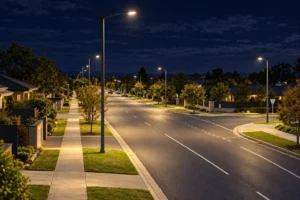
Mixed-use sports parks, logistics areas, and municipal campuses may also combine outdoor stadium lighting with municipal LED street lighting or industrial lighting systems. This approach can improve consistency across the full site.
Conclusion
EN12193 vs FIFA Lighting Standards is not only a comparison of lux levels. It is a comparison of project goals. EN12193 supports safe play and visual comfort. FIFA standards support professional broadcasting, stronger camera visibility, and higher technical control.
If your project is a school field or municipal sports park, EN12193 may be enough. If your project involves televised football, HDR production, or international competition, FIFA-level design becomes more important.
The better choice depends on your venue type, broadcast needs, budget, and future upgrade plan. A stronger design may cost more at first, but it can reduce glare complaints, failed inspections, maintenance problems, and expensive retrofits later.
FAQ
What is the biggest difference between EN12193 and FIFA lighting standards?
EN12193 focuses more on safe play, horizontal illuminance, uniformity, and visual comfort. FIFA lighting standards focus more on broadcast performance, vertical illuminance, camera visibility, flicker control, and HDTV or HDR compatibility.
Is EN12193 enough for a football stadium?
EN12193 is usually enough for schools, training fields, community venues, and municipal sports parks. It may not be enough for professional stadiums that host televised matches or international competitions.
Why does FIFA care more about vertical illuminance?
FIFA cares about vertical illuminance because cameras capture players, faces, uniforms, and movement from vertical angles. Stronger vertical illuminance creates clearer broadcast images and better player modeling.
Can LED flicker affect stadium broadcasting?
Yes. LED flicker can create camera banding, replay artifacts, unstable exposure, and poor slow-motion footage. Professional stadiums need high-quality flicker-free drivers to support modern broadcast systems.
What should buyers check before choosing stadium lights?
Buyers should check optical design, flicker performance, thermal management, surge protection, IES files, DIALux or AGi32 simulation support, glare control, warranty, and commissioning guidance.
Disclaimer
FIFA and UEFA are referenced solely as sources of industry and project-design guidance. ZC Lighting is not affiliated with, endorsed by or certified by FIFA or UEFA. Final compliance depends on the complete project design, selected product configuration, installation, measurement and approval by the relevant project authority.