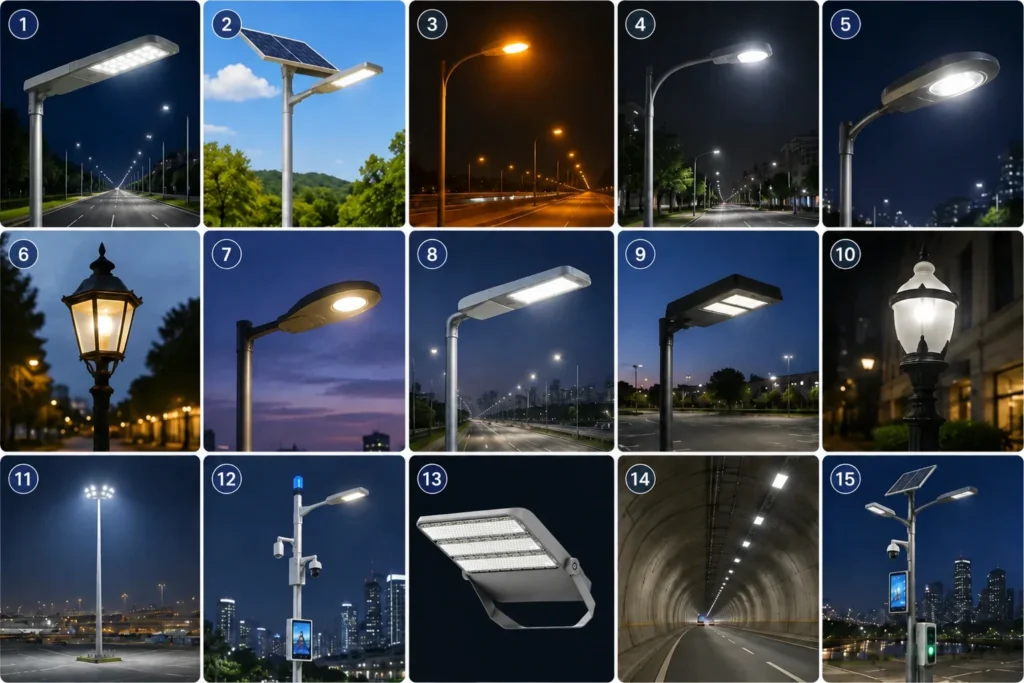
Modern cities use many different types of street lights. Each lighting system serves a different purpose. Some lights improve highway visibility. Some reduce residential glare. Some support smart city infrastructure. Others improve energy efficiency or simplify maintenance.
Choosing the right street light is not only about brightness. Optical distribution, pole height, color temperature, driver quality, IP rating, glare control, and smart controls all affect long-term performance. A better roadway lighting design reduces energy waste, lowers maintenance costs, and improves safety.
In this guide, we explain 15 types of street lights and their uses, including traditional street lamps, modern LED roadway lights, solar systems, smart street lighting, decorative fixtures, and high-mast solutions.
15 Types of Street Lights and Their Uses
| No. | Type of Street Light | Main Features | Common Uses |
|---|---|---|---|
| 1 | LED Street Lights | High efficiency, long lifespan, low maintenance, smart control compatible. | Municipal roads, highways, parking lots, smart cities. |
| 2 | Solar Street Lights | Off-grid operation with solar panel, battery, and LED module. | Rural roads, parks, remote areas, low-grid locations. |
| 3 | High-Pressure Sodium Street Lights | Orange-yellow light, older technology, moderate efficiency. | Legacy municipal roads and older street lighting networks. |
| 4 | Metal Halide Street Lights | White light, better color rendering than HPS, higher maintenance. | Older commercial areas, sports districts, parking areas. |
| 5 | Mercury Vapor Street Lights | Older discharge lamp, low efficiency, environmental concerns. | Legacy roads and outdated public lighting systems. |
| 6 | Incandescent Street Lights | Warm light, very low efficiency, short lifespan. | Historic districts, decorative lighting, special restoration projects. |
| 7 | Halogen Street Lights | Brighter than incandescent, high heat output, lower efficiency than LED. | Older decorative lighting and limited legacy applications. |
| 8 | Cobra Head Street Lights | Curved roadway fixture, strong forward light distribution. | Municipal streets, urban roads, residential roads, highways. |
| 9 | Shoebox Street Lights | Rectangular fixture, wide beam coverage, flexible mounting. | Parking lots, campuses, logistics parks, commercial roads. |
| 10 | Decorative Post-Top Street Lights | Architectural appearance, pedestrian-friendly design. | Parks, historic streets, commercial districts, walkways. |
| 11 | High-Mast Street Lights | Tall poles with high-output luminaires for large-area coverage. | Airports, ports, interchanges, stadium areas, industrial yards. |
| 12 | Smart Street Lights | LED lighting with sensors, dimming, remote monitoring, and IoT control. | Smart cities, urban corridors, municipal infrastructure. |
| 13 | Floodlight-Based Street Lighting | High-output beam, long throw distance, flexible aiming. | Ports, stadium districts, industrial roads, large outdoor zones. |
| 14 | Tunnel Street Lights | Uniform illumination, glare control, fast visual adaptation. | Road tunnels, underpasses, enclosed traffic routes. |
| 15 | Hybrid Street Lighting Systems | Combines solar, grid power, sensors, cameras, or EV systems. | Smart city roads, remote infrastructure, modern urban projects. |
1. LED Street Lights
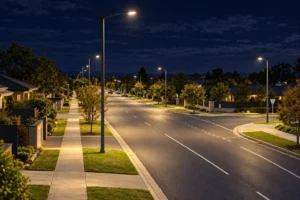
LED street lights are now the most widely used roadway lighting system in modern cities. They consume less power and produce more usable light than traditional street lamps. They also support dimming, adaptive lighting, and remote monitoring.
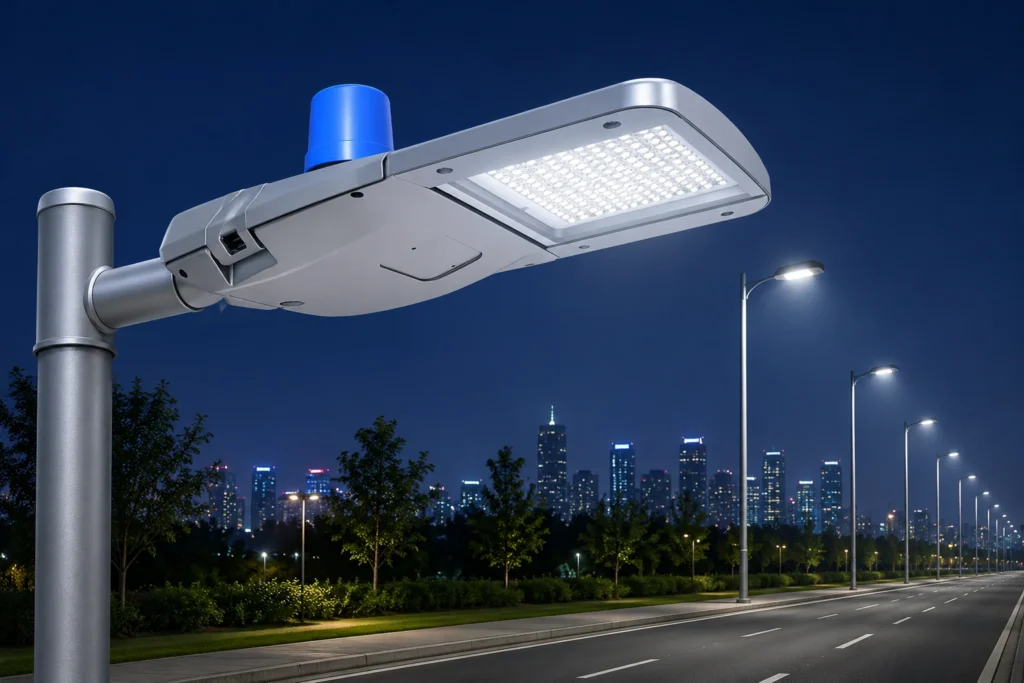
LED systems usually provide:
- Higher luminous efficacy
- Longer lifespan
- Lower maintenance
- Better optical control
- Lower energy consumption
- Better glare reduction
Municipal roads, highways, parking lots, industrial parks, and smart city projects now use LED roadway lighting more frequently than older HPS or metal halide systems.
For urban infrastructure projects, the SL05 Series LED Street Light for Municipal & Urban Road Lighting supports roadway visibility, smart controls, and long-term municipal operation.
2. Solar Street Lights
Solar street lights use solar panels, batteries, LED modules, and charge controllers to operate independently from the electrical grid.
These systems work especially well in:
- Remote roads
- Rural highways
- Parks
- Coastal projects
- Low-grid infrastructure
All-in-one solar lights simplify installation. Split solar systems offer more flexible battery and panel placement.
Compared with grid-powered lights, solar street lights reduce trenching cost and lower electricity consumption. However, battery sizing and weather conditions remain critical.
3. High-Pressure Sodium (HPS) Street Lights
HPS street lights produce the familiar orange-yellow roadway glow seen in older cities. These systems were once popular because they offered relatively good efficiency compared with earlier technologies.
However, HPS systems have major limitations:
- Poor color rendering
- Weak smart control compatibility
- Higher maintenance pressure
- Less visual clarity
Modern LED roadway lighting now outperforms HPS systems in most categories.
4. Metal Halide Street Lights
Metal halide lights generate whiter light than HPS lamps. They were once common in sports districts, commercial centers, and parking lots.
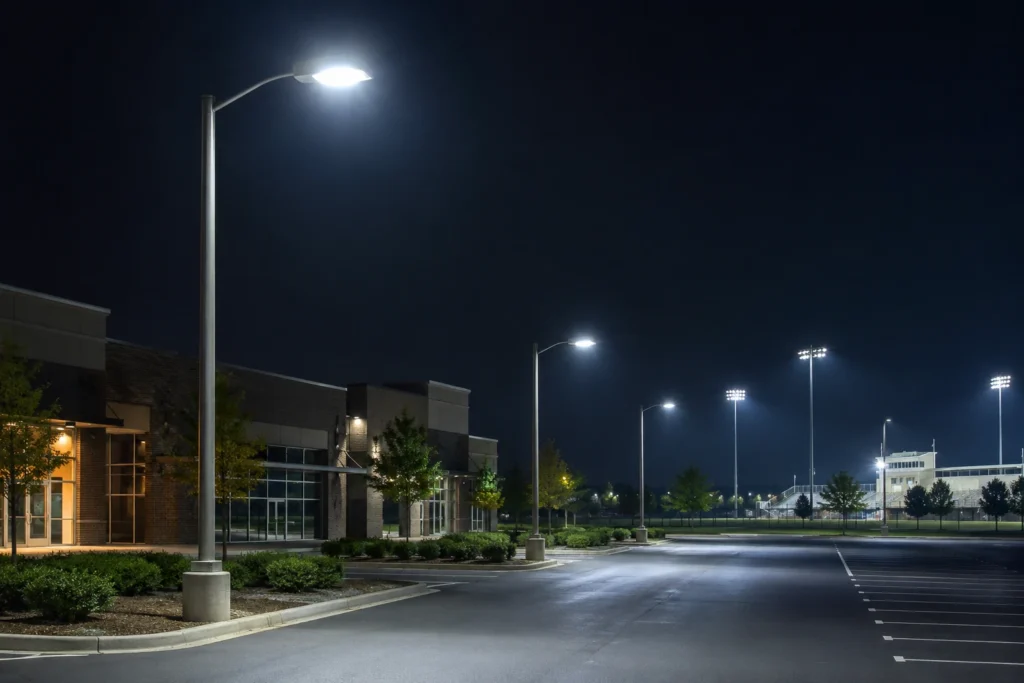
Compared with LED street lights, metal halide systems:
- Consume more power
- Lose brightness faster
- Require more maintenance
- Generate more heat
Many older sports and commercial facilities now retrofit metal halide fixtures with LEDs.
5. Mercury Vapor Street Lights
Mercury vapor street lamps are older roadway lighting systems that use mercury vapor discharge technology.
These fixtures were once common because they lasted longer than incandescent lamps. However, they now struggle to meet modern energy-efficiency standards.
Main disadvantages include:
- Lower efficiency
- Poor environmental performance
- Weak optical control
- Higher operating cost
Many countries now phase out mercury vapor systems completely.
6. Incandescent Street Lights
Incandescent street light systems use heated filaments to generate light. These lamps were widely used before modern discharge lighting technologies became popular.
Incandescent lights create warm illumination, but they waste large amounts of energy. Their lifespan is also much shorter than modern LEDs.
Today, incandescent street lights mostly appear in:
- Historic districts
- Decorative applications
- Special architectural projects
7. Halogen Street Lights
Halogen street lights improve slightly on traditional incandescent technology by using halogen gas inside the lamp.
Compared with incandescent lamps, halogen systems provide:
- Brighter light
- Better efficiency
- Sharper color appearance
However, halogen lights still consume more power and produce more heat than LED systems.
8. Cobra Head Street Lights
Cobra head fixtures are one of the most recognizable street light designs in the world. Their forward-projecting shape helps distribute light efficiently across road surfaces.
These fixtures work especially well for:
- Municipal roads
- Urban streets
- Residential areas
- Highways
Cobra head LED systems now dominate many municipal roadway projects.
9. Shoebox Street Lights
Shoebox street lights use a rectangular housing shape and broader beam distribution. They are more common in parking lots, campuses, logistics parks, and commercial properties.
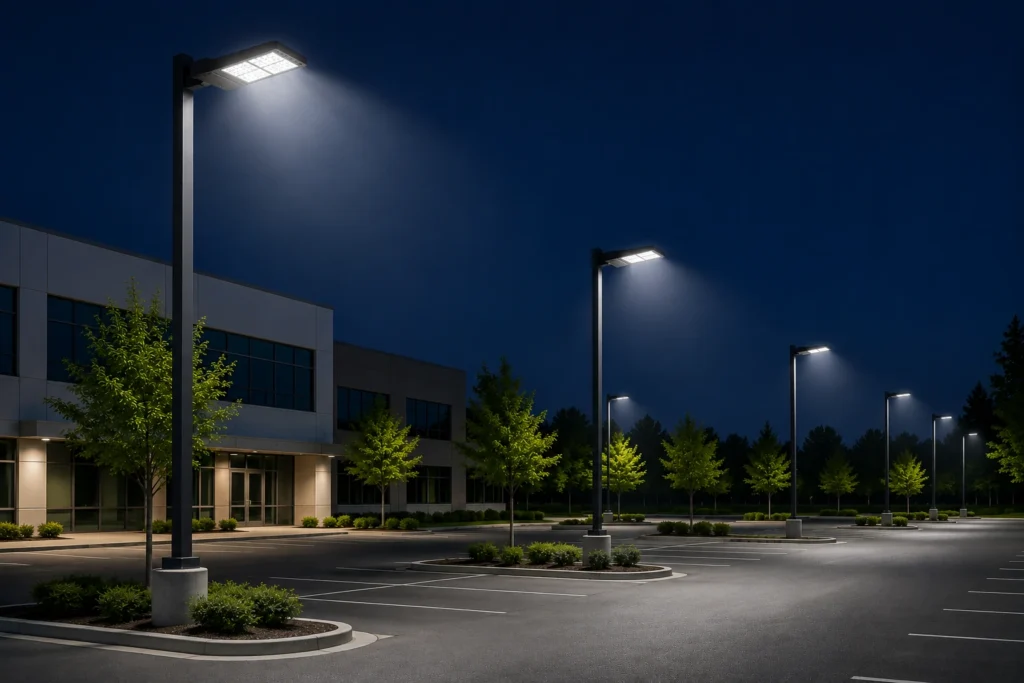
Compared with cobra head fixtures, shoebox lights often provide:
- Wider coverage
- Stronger area illumination
- More flexible mounting
For mixed outdoor infrastructure projects, the AL03 High-Performance 3-in-1 Area Light supports parking areas, circulation roads, and commercial outdoor zones.
10. Decorative Post-Top Street Lights
Decorative post-top lights focus more on urban appearance and pedestrian comfort. Cities often install them in:
- Parks
- Historic districts
- Commercial streets
- Pedestrian zones
- Campus walkways
These fixtures usually prioritize aesthetics more than maximum roadway efficiency.
11. High-Mast Street Lights
High-mast street lighting uses tall poles and high-output luminaires to illuminate large outdoor areas.
These systems work better for:
- Airports
- Ports
- Interchanges
- Logistics parks
- Stadium surroundings
- Industrial yards
Compared with lower poles, high-mast systems cover larger areas using fewer structures.
For large infrastructure projects, high-mast and large area LED lighting solutions help improve uniformity and simplify maintenance planning.
12. Smart Street Lights
Smart street lights combine LED technology with sensors, communication systems, and centralized controls.
Modern smart lighting systems can:
- Dim automatically
- Detect traffic
- Monitor failures remotely
- Reduce energy waste
- Support adaptive lighting
Many smart city projects now integrate:
- DALI controls
- LoRaWAN
- NB-IoT
- Remote lighting monitoring
- Environmental sensors
13. Floodlight-Based Street Lighting
Some roads, stadium districts, ports, and industrial facilities use floodlights instead of traditional roadway luminaires.
Floodlights provide:
- Longer throw distance
- Stronger beam concentration
- Higher mounting flexibility
For roadway surroundings and sports infrastructure, modular systems such as the FL08 Series Modular LED Sports & Outdoor Floodlight support more flexible optical planning.
14. Tunnel Street Lights
Tunnel lighting systems require specialized optical control because the human eye must adapt quickly between daylight and darker tunnel conditions.
Tunnel street lights usually prioritize:
- Uniform illumination
- Reduced glare
- Fast visual adaptation
- High reliability
Compared with standard roadway lighting, tunnel systems often use stronger ingress protection and more stable driver systems.
15. Hybrid Street Lighting Systems
Hybrid street lighting combines multiple technologies inside one infrastructure system.
Examples include:
- Solar + grid-powered systems
- Street lighting + surveillance
- Lighting + EV charging
- Lighting + environmental monitoring
Hybrid systems support modern smart city infrastructure more effectively because they centralize multiple urban functions into fewer installations.
How to Choose the Right Type of Street Light
The best type of street light depends on the application. Residential roads require lower glare and warmer color temperatures. Highways require longer visibility. Industrial parks require stronger durability. Airports and ports require higher wind resistance and corrosion resistance.
You should also compare:
- Beam distribution
- Luminous efficacy
- Color temperature
- CRI
- IP rating
- IK rating
- Surge protection
- Driver quality
- Thermal management
- Maintenance strategy
For municipal and infrastructure projects, street and roadway LED lighting solutions can help engineers optimize roadway visibility, energy efficiency, and long-term operating performance.
If you need project support, you can request instant quotes for lighting solutions and share your roadway layout, pole height, lux target, and control requirements.
Conclusion
Modern roadway lighting includes far more than traditional street lamps. Cities now use many kinds of street lights for different environments, budgets, and infrastructure goals.
LED street lights, solar street lights, smart roadway lighting, high-mast systems, decorative fixtures, and floodlight-based systems all solve different engineering problems. Compared with older incandescent street lights, mercury vapor lamps, and halogen street lights, modern LED systems provide lower energy use, better optics, stronger control, and longer lifespan.
The right street light improves safety, reduces maintenance, lowers operating cost, and supports smarter infrastructure planning for the future.
FAQs About Types of Street Lights
What are the most common types of street lights today?
LED street lights are now the most common roadway lighting solution because they provide higher efficiency, longer lifespan, lower maintenance, and better smart control compatibility.
What type of street light is best for residential roads?
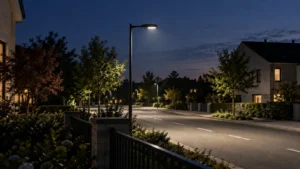
Warm-white LED Type II street lights usually work best for residential roads because they reduce glare and improve nighttime comfort.
Why are LED street lights replacing HPS lights?
LED systems consume less power, provide better visibility, last longer, and support smart controls more effectively than HPS systems.
Are solar street lights reliable for public infrastructure?
Yes. Properly designed solar street lights can perform reliably when engineers correctly size the solar panels, batteries, and autonomy capacity.
What specifications should buyers compare before choosing street lights?
Buyers should compare lumens, efficacy, beam distribution, color temperature, IP rating, IK rating, surge protection, driver quality, and thermal management before approving a roadway lighting system.