 LED stadium lights cost is not only about fixture price. You also need to consider poles, foundations, wiring, controls, installation, photometric design, maintenance, and long-term energy savings.
In this guide, I will help you understand the real cost structure, compare different project types, and avoid common buying mistakes. If you are planning a football field, stadium, airport apron, port yard, school sports field, or industrial high-mast project, this article will help you budget more clearly.
1. How Much Do LED Stadium Lights Cost?
The average LED stadium lights cost depends on field size, lighting level, pole height, fixture wattage, and installation conditions. A small school field costs much less than a professional broadcast stadium. A simple retrofit costs less than a complete new installation with poles and foundations.
For most buyers, the best way to estimate cost is to separate fixture cost from total project cost. LED fixtures may represent only 30% to 50% of the full budget. Poles, foundations, electrical work, controls, and commissioning can add a large amount.
| Project Type | Typical Cost Range | Main Cost Driver |
|---|---|---|
| School sports field | $40,000–$120,000 | Basic lux level and limited pole height |
| Community football field | $80,000–$250,000 | Uniformity, pole layout, and installation |
| College stadium | $250,000–$800,000 | Higher lux, stronger optics, and controls |
| Professional stadium | $800,000–$2,500,000+ | Broadcast lighting, vertical illuminance, and flicker-free drivers |
| Airport, port, or logistics yard | $150,000–$1,200,000+ | High-mast structures, wind resistance, and corrosion protection |
If you want a project-specific estimate, you can request instant quotes for lighting solutions based on your pole height, field size, target lux, and operating hours.
1000W vs 1500 Watt vs 2000W LED Stadium Lights
Many buyers compare wattage first. That is understandable, but wattage is not the same as lighting performance. A well-designed 1000W LED stadium light can perform better than a weaker 1500 watt LED stadium light with poor optics.
| Fixture Power | Common Use | Cost Meaning |
|---|---|---|
| 500W–800W | Small courts and training areas | Lower fixture cost, shorter throw distance |
| 1000W LED Stadium Lights | Community football fields and school fields | Balanced cost and performance |
| 1500 Watt LED Stadium lights | College stadiums and larger sports venues | Higher output for taller poles |
| 2000W LED stadium lights | Professional stadiums and high-mast areas | Higher cost, stronger long-distance aiming |
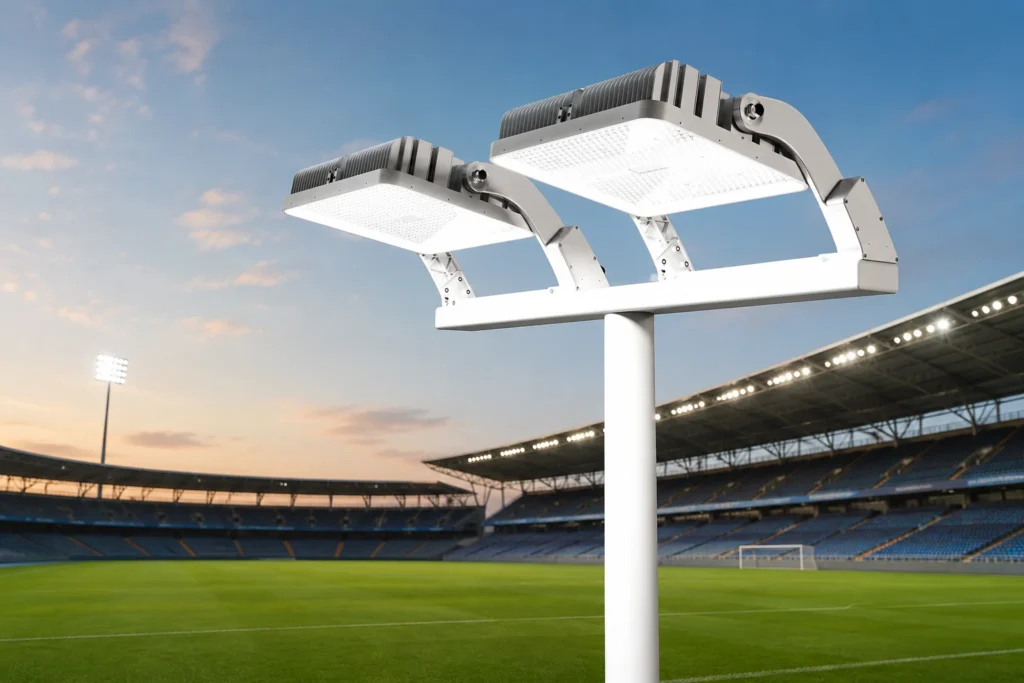
For professional sports projects, a high-output fixture such as the FL18 GameAres LED Stadium Floodlight can support stronger beam control and more demanding stadium layouts.
2. What Factors Affect LED Stadium Lighting Cost?
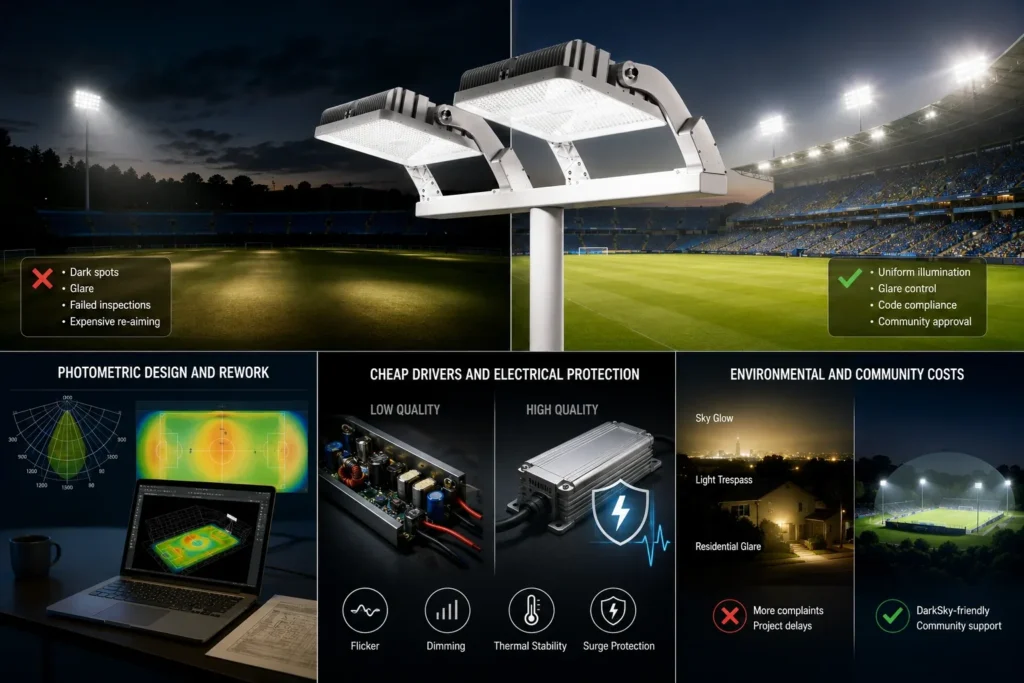
Several factors change the final football stadium lights price. Some factors are obvious, such as fixture quantity. Others are easier to miss, such as glare control, surge protection, pole foundation design, and commissioning time.
Lighting Standards and Competition Level
A recreational field needs lower light levels. A professional venue needs higher and more consistent illumination. Standards such as FIFA lighting guidelines, EN12193, IES RP-6, and CIE photometry concepts help engineers define lux, uniformity ratio, glare control, horizontal illuminance, and vertical illuminance.
Broadcast projects need more demanding performance. HDTV, HDR broadcasting, and slow-motion replay expose flicker, uneven lighting, poor CRI, and weak player modeling faster than human eyes do.
Pole Height and Structural Engineering
Pole height changes cost quickly. A 35-meter high-mast pole needs stronger foundations, deeper anchoring, better wind resistance, and heavier lifting equipment than an 18-meter pole.
Airports, ports, mining areas, coastal stadiums, and logistics parks also need stronger corrosion resistance, IP66 or IP67 protection, IK08 or IK10 impact resistance, and lightning protection. These details increase upfront cost, but they reduce failure risk.
For wide outdoor sites, a complete high-mast and large-area LED lighting solution can make the design more stable than a fixture-only approach.
Optical Design and Glare Control
Optics often decide whether a lighting project is efficient or wasteful. Narrow beams throw light farther. Asymmetric optics reduce spill light. Better shielding reduces glare. Cleaner beam patterns improve usable lux.
This is why two fixtures with the same wattage can perform very differently. One system may waste light into the sky. Another system may place more light on the field. The second system is usually more efficient, more comfortable, and more cost-effective.
For flexible sports layouts, the FL08 Series modular sports floodlight can help engineers match beam angles to pole positions and field geometry.
Controls, Dimming, and Smart Operation
Smart controls increase the initial budget, but they can reduce long-term operating cost. DALI, DMX512, IoT lighting controls, adaptive lighting systems, and remote monitoring help operators create training mode, match mode, maintenance mode, and event mode.
For smart city projects, controls also support energy reporting, carbon reduction, and ESG goals. This matters more for municipalities, universities, sports parks, and commercial property groups.
3. Retrofit vs New Installation Cost
A retrofit project usually costs less than a full new installation because you may reuse existing poles, wiring, and electrical panels. However, you should not assume that every old system can support new LED fixtures.
LED Retrofit Cost
A retrofit may include fixture replacement, driver upgrades, aiming adjustment, and control integration. It is faster than new construction. It also creates less disruption for schools, stadium operators, and municipal venues.
However, engineers must check pole strength, EPA rating, wiring capacity, grounding, surge protection, and aiming geometry. A weak pole can create safety risk. Old wiring can increase electrical risk. Poor aiming geometry can reduce lighting quality.
New Installation Cost
A new installation costs more, but it gives you better design freedom. Engineers can choose pole height, pole quantity, foundation position, trenching routes, power supply, and control zones from the beginning.
For a new stadium, this is often the better choice. It produces cleaner uniformity, lower glare, and fewer long-term compromises.
4. LED Stadium Lights vs Metal Halide Cost
LED systems usually cost more upfront than metal halide systems. However, LEDs are more efficient, faster to start, easier to control, and less expensive to maintain.
| Cost Area | Metal Halide | LED Stadium Lighting |
|---|---|---|
| Energy use | Higher | 50%–75% lower in many projects |
| Startup time | Slow warm-up | Instant on/off |
| Maintenance | Frequent lamp and ballast replacement | Lower maintenance with quality drivers |
| Control | Limited | Dimming, scheduling, and smart control ready |
| Broadcast quality | Less stable | Better flicker-free performance |
LEDs also support better CCT choices, such as 5000K or 5700K, and better CRI for sports visibility and camera performance. LM-80, TM-21, L70, and L80 data also help buyers understand lumen maintenance and long-term performance.
In large sports complexes, indoor and outdoor lighting often work together. For example, warehouses and support facilities may use the HB06 high-bay light with dual driver options while outdoor fields use high-power stadium fixtures.
6. How to Reduce Stadium Lighting Cost
You can reduce cost without lowering quality. The key is better engineering, not weaker specifications.
Use Better Optics Instead of More Wattage
More wattage creates higher energy use. Better optics create higher usable light. This difference matters. A well-aimed system can be brighter on the field and darker outside the field at the same time.
Optimize Pole Layout Early
A 4-pole layout may cost less, but it may create stronger shadows. A 6-pole or 8-pole layout may improve uniformity, but it adds structural cost. The best layout balances budget, glare, uniformity, and maintenance access.
Choose Modular Fixtures
Modular designs simplify driver replacement, optical maintenance, and spare part planning. This benefit matters more for EPC contractors, distributors, airports, ports, and large stadium owners.
Plan Controls Before Installation
Adding controls later usually costs more. If you need dimming, scheduling, scene switching, remote monitoring, or smart city integration, you should include those needs in the first design stage.
For sports venues, a complete stadium LED lighting solution is usually more reliable than buying fixtures first and solving controls later.
7. How to Compare Stadium Lighting Quotes
Two quotes can show the same fixture wattage but deliver very different results. You should compare performance, not only price.
What a Professional Quote Should Include
- Fixture model and wattage
- IES files and photometric report
- Lux and foot-candle calculations
- Uniformity ratio
- Vertical and horizontal illuminance
- Glare control method
- Driver brand and surge protection
- IP, IK, UL, CE, RoHS, or FCC compliance where relevant
- Warranty terms
- Installation and commissioning scope
Questions You Should Ask Before Buying
- Can the existing poles be reused safely?
- Does the system support flicker-free broadcasting?
- Does the design meet the required competition level?
- Does the supplier provide DIALux or AGi32 simulation?
- What happens if the field fails inspection?
For long-throw stadium, airfield, and high-mast projects, the FL12 high-power LED stadium and airfield floodlight is suitable when you need stronger output, durable structure, and precise beam control.
As a professional outdoor lighting manufacturer, ZC Lighting helps EPC contractors, stadium owners, municipalities, and industrial clients evaluate fixture selection, photometric design, and long-term operating cost.
Conclusion
LED stadium lights cost depends on much more than fixture price. A reliable project needs better optics, strong drivers, proper pole design, professional simulation, smart controls, and long-term maintenance planning.
A cheaper system may look attractive at first, but it can become more expensive if it causes glare, flicker, failed inspections, high maintenance, or early driver failure. A better system usually costs more upfront, but it delivers lower energy use, fewer service calls, better visual comfort, and stronger long-term value.
If you want to control cost, you should compare total lifecycle value instead of wattage alone. You should ask for photometric proof. You should check standards, certifications, controls, and warranty terms. Most importantly, you should design the system around the real use of the venue.
8. FAQs About LED Stadium Lights Cost
How much does it cost to run stadium lights per hour?
The hourly cost depends on total system wattage, electricity rate, and operating mode. A large stadium can consume several hundred kilowatts per hour. LED systems usually lower hourly energy cost by 50% to 75% compared with metal halide lighting.
Are 1000W LED Stadium Lights enough for a football field?
1000W LED Stadium Lights can work well for many school and community football fields. Larger venues may need 1500 Watt LED Stadium lights or 2000W fixtures. Pole height, beam angle, lux target, and uniformity requirements decide the final choice.
Why is football stadium lights price different between suppliers?
Prices differ because suppliers use different drivers, LED chips, optics, housings, surge protection, controls, and warranties. Some quotes include photometric simulation and commissioning. Others only include fixtures. You should compare total system value, not only unit price.
Can existing metal halide poles be reused for LED stadium lights?
Existing poles can sometimes be reused, but engineers must check wind load, EPA rating, pole condition, wiring capacity, foundation strength, and aiming angles. Reusing weak or poorly positioned poles can create safety and performance problems.
What is the best stadium LED light cost strategy?
The best stadium LED light cost strategy is to reduce waste, not quality. You should use accurate photometric design, efficient optics, proper pole layout, reliable drivers, and smart controls. This
approach lowers energy use, maintenance cost, and rework risk.
https://zcled.com/products/
How LED Lighting Enhances the FIFA Fan Experience
ZC Lighting Shines at Hong Kong Lighting Fair & Airport Lighting Exhibition
Sport-by-Sport Lux Targets (Football/Tennis/Baseball/Rugby)
10 Best LED Stadium Lights in 2026