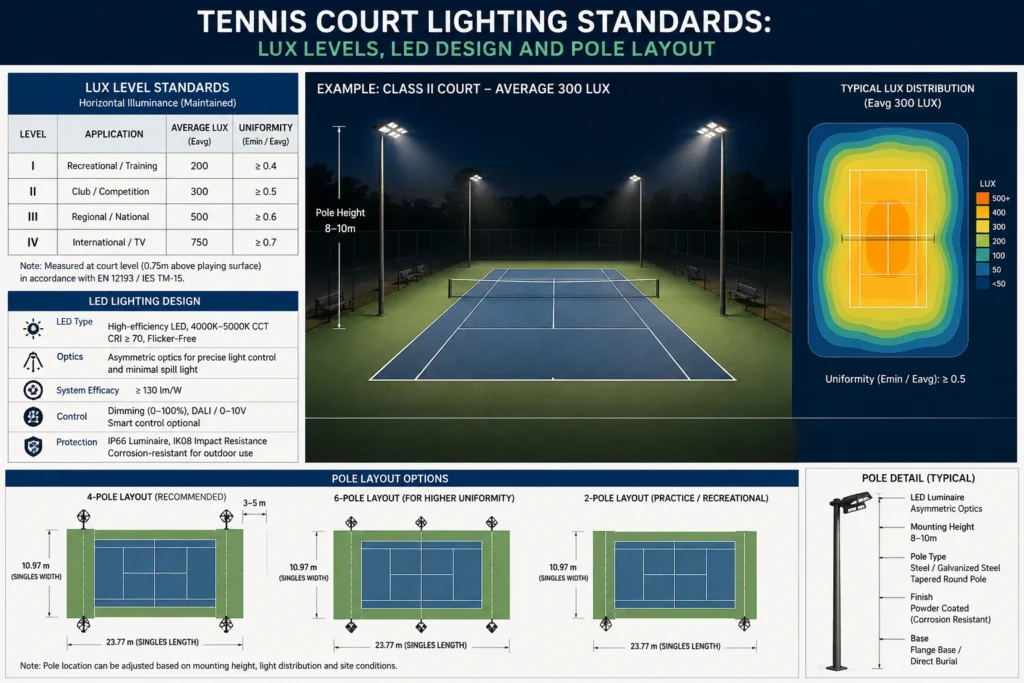
 Tennis is a fast-paced, highly competitive sport with little room for error. A ball can cross the entire court in a single second. Dim, uneven, or glaring lighting will immediately cause discomfort to players. Therefore, tennis court lighting standards are more important than simply brightness.
This guide will show you how to evaluate illuminance, uniformity, glare, pole height, LED floodlight specifications, smart controls, and retrofitting options. If you are planning a school stadium, municipal sports park, club facility, or broadcast venue, this article will help you make clearer and more reliable lighting decisions.
What are the lighting standards for tennis courts?
Tennis court lighting standards define the brightness, uniformity, comfort, and safety of the court. These standards go beyond just illuminance. Better lighting systems can also control glare, reduce light spill, aid in ball tracking, and protect nearby residents from light pollution.
Commonly used reference standards include ITF guidelines, EN12193 requirements for sports lighting, IES RP-6 recommendations, IEC electrical standards, and CIE photometric concepts. These standards enhance the reliability of engineering designs because they cover key sports lighting metrics such as horizontal illuminance, vertical illuminance, glare control, uniformity, and visual comfort.
For professional projects, I recommend treating standards as benchmarks, not the ultimate goal. A course that merely meets the minimum standards may still feel unsatisfactory in actual matches. A better course design should be brighter where light is needed, softer where softness is needed, and more harmonious at the course boundaries.
ZC Lighting specializes in outdoor LED sports lighting systems that combine optical control, high efficiency, and long-term reliability, making them suitable for tennis courts, stadiums, and large outdoor areas.
Key Performance Indicators
- Horizontal illuminance: Measures the light intensity on the surface of the sports field.
- Vertical illuminance: The light received by players, cameras, and spectators.
- Uniformity: The degree to which light is evenly distributed.
- Glare control: The degree to which the system protects the player’s eyesight.
- Flicker control: critical for HDTV, HDR, streaming, and slow-motion playback.
Recommended illuminance levels for tennis courts
The appropriate illuminance depends on the intended use of the field. School fields require less illuminance than competitive fields. Broadcast fields require significantly more illuminance than recreational fields. Higher illuminance is not always better. Excessive light can mean more glare, more light spillage, and higher costs if the optical system is inadequate.
| Court Type | Luxury Series Recommended | Typical uniformity | Best Use |
|---|---|---|---|
| recreational courts | 200–300 lux | 0.5–0.6 | Schools, parks, recreational games |
| Club matches | 300–500 lux | 0.6–0.7 | Clubs, colleges, local events |
| Professional Championship | 750–1000+ Lux | 0.7–0.8 | Regional and national events |
| Broadcast Court | 1200–2000 lux | 0.8+ | High-definition television, HDR, slow-motion broadcasting |
Uniformity is generally more important than maximum brightness. The experience of having one bright spot and one dark spot on a court is far inferior to having a slightly lower but more uniform court. Players see faster, cameras perform better, and there are fewer complaints.
For stadiums that require enhanced optical performance, a complete stadium LED lighting solution can help designers achieve illuminance, glare, and broadcasting objectives within a single system.
Lighting standards for indoor and outdoor tennis courts
Indoor and outdoor tennis court lighting standards address different issues. Indoor courts primarily consider factors such as ceiling height, reflection, shadows, and fixture placement. Outdoor courts, on the other hand, mainly consider issues such as rain, wind, corrosion, light spill, and the impact on the surrounding environment.
Indoor tennis lighting
Indoor courts typically require more gentle glare control because ceilings and walls reflect light back into the players’ eyes. Lighting fixtures must avoid harsh contrasts. Color reproduction is also crucial, as the ball, the court surface, and player movements must all be clearly visible under artificial light.
Outdoor tennis court lighting
Outdoor courts require greater weather resistance. Common specifications include IP66 or IP67 protection ratings, IK08 or IK10 impact resistance ratings, surge protection, corrosion resistance, and marine-grade coatings suitable for coastal areas. These details are not just for decoration, but to protect your investment.
For demanding outdoor sports fields, modular lighting fixtures (such as the FL08 series modular LED sports floodlights) are very useful because they allow for flexible beam selection, better aiming, and durable outdoor performance.
Core technical requirements for tennis court lighting
Uniformity and visual comfort
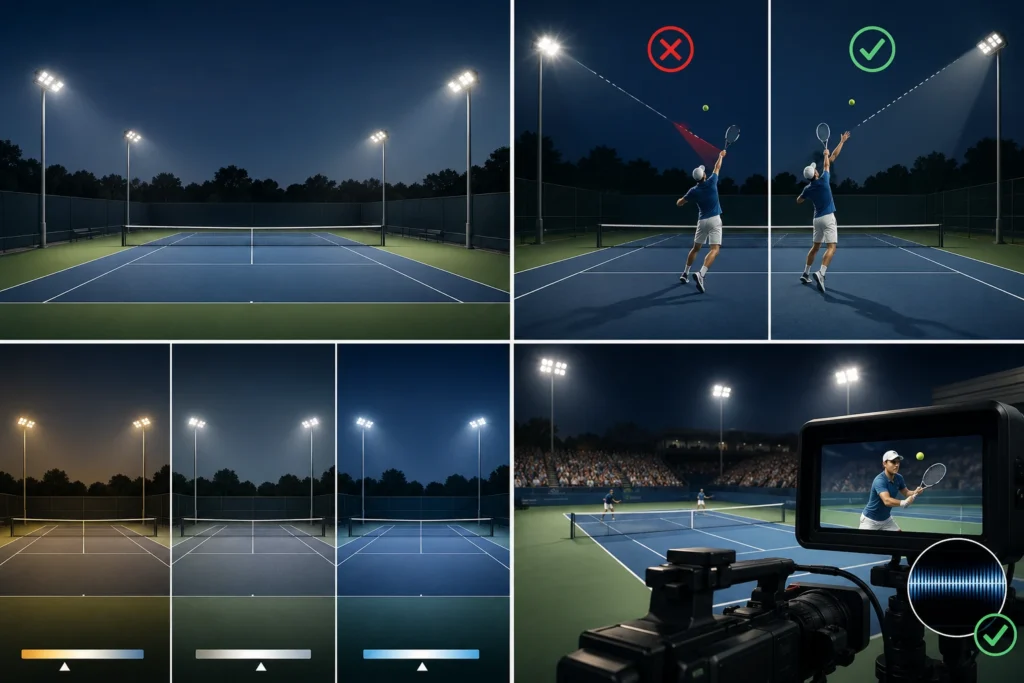
A good tennis court should feel balanced. The lighting shouldn’t be inconsistent. Even lighting improves depth perception, making the ball’s trajectory easier to track. Better optical design is more effective than simply increasing power.
Glare control
Even when the illumination seems acceptable, glare can ruin the entire course. Inaccurate aiming affects tee shots, high balls, and baseline shots. Lowering the tilt angle, adopting an asymmetrical optical design, adding a shading, and adjusting the club position can all make this system more comfortable and professional.
Color temperature and color rendering index
Most modern tennis lighting projects use a color temperature between 4000K and 5700K. Warm-toned light feels softer, while cool-toned light appears sharper. For broadcast or high-end venues, the color rendering index (CRI) and spectral distribution should be carefully evaluated, as cameras detect color issues much faster than the human eye.
flicker-free performance
Flicker-free lighting is now crucial for professional sports. High-definition television, HDR broadcasting, streaming, and slow-motion replay all require stable LED drivers. Poor flicker control can make the stadium look great, but it will still look terrible on camera.
High-power sports lighting fixtures such as the FL18 GameAres LED stadium floodlights are designed for demanding projects that require stronger illumination, long-range aiming, and consistent performance.
| Require | Why this is important | Best Practices |
|---|---|---|
| Uniformity ratio | Reduce shadows and improve sphere tracking | Please test using a photometric simulation before installation. |
| Glare control | Ensure player comfort and vision | Using asymmetric optics and control aiming |
| Central Research Institute | Improve color visibility for players and cameras. | Choose a higher CRI value for broadcast or premium courts. |
| flicker-free drive | Supports streaming playback and slow-motion replay | Specified professional-grade LED driver |
| Surge protection | Improve outdoor system reliability | Compliant with IEC 61000 standards and project-level protection requirements |
Tennis court lighting layout, light poles and simulation
The lighting poles in a tennis court largely determine the overall design of the court. Shorter poles are less expensive but typically result in sharper beams and more glare. Taller poles allow for more even light distribution but increase wind load, foundation costs, and structural requirements.
Commonly used pole layout
The four-pole system is simple and economical. The six-pole system is more balanced. The eight-pole system can better control high-level venues or broadcast venues. The optimal solution depends on the number of venues, surrounding boundaries, target illumination, and the level of the competition.
| layout | strength | limitation | Best application |
|---|---|---|---|
| 4 poles | Lower cost and easier installation | It has low uniformity and poor aiming flexibility. | recreational courts |
| 6 poles | Better balance and lower risk of glare | medium cost | clubs and schools |
| 8 bars | Optimal optical control | Higher structural complexity | Professional or Broadcast Court |
Photometric simulation
Professional tennis lighting systems should be validated through IES documentation, DIALux simulations, AGi32 reports, isolux maps, and point-by-point calculations. Simulation results can show whether the court meets horizontal illuminance, vertical illuminance, glare control, and illuminance uniformity targets before investment in installation.
For multi-course complexes or large sports facilities, high-pole, large-area LED lighting solutions can support a wider coverage range while maintaining more precise optical control.
Comparison of LED tennis court lighting and metal halide lamp lighting
LED technology has revolutionized tennis court lighting. Compared to metal halide lamps, LED lights start up faster, are cleaner, more efficient, and easier to control. Metal halide lamp systems are slower to start, more difficult to dim, less precise, and have higher maintenance costs.
LED lighting fixtures also support intelligent control functions such as DALI, DMX512, IoT lighting control, adaptive dimming, and remote monitoring. This is especially important for municipal courts, schools, logistics parks, sports real estate projects, and smart city operators.
For professional outdoor stadiums and large sports facilities, products such as the FL12 high-power LED stadium floodlights can provide stronger output for long-distance aiming and large-area sports applications.
Why LEDs perform better
- Reduce energy consumption
- Quick Start
- More precise beam control
- Lower maintenance costs
- Better compatibility with smart controllers
- Enhanced flicker-free broadcast performance
For smaller tennis courts or flexible recreational areas, adjustable systems like the FL03 Adjustable Smart Floodlight can meet practical floodlighting needs and are easier to aim and control.
Costs, ROI, supplier selection and future trends
The cost of tennis court lighting depends on factors such as pole height, number of lights, wattage, control system, installation labor, trenching work, and expected performance level. Lighting costs for recreational tennis courts are significantly lower than for broadcast-grade courts. However, in the long run, the cheapest system is often not the most economical.
LED systems typically offer higher returns on investment because they reduce energy consumption and maintenance costs. They also have longer lifespans if thermally engineered properly. Concepts such as LM-80, TM-21, L70, and L80 help buyers understand luminous flux maintenance and long-term degradation.
What aspects should buyers check?
- IES files and photometric reports
- Illuminance and uniformity calculation
- Surge protection and grounding design
- IP66/IP67 and IK08/IK10 protection ratings
- Thermal management and driver quality
- Warranty terms and failure rate support
- Intelligent control compatibility
- DarkSky, Overflow and Sky Glow Controls
The lighting of future tennis courts will be smarter and more adaptable. AI-based control, remote lighting monitoring, solar energy integration, environmental, social, and governance (ESG) goals, carbon reduction, and smart city lighting systems will become more prevalent. For public sector and commercial facilities, this shift makes lighting a long-term infrastructure decision, rather than simply a product purchase.
If you require project support, you can request a lighting solutions quote from ZC Lighting immediately . Better design begins with the right standards, the right analog, and the right optics.
Frequently Asked Questions
What is the standard lighting level for a tennis court?
Recreational tennis courts typically require around 200-300 lux of illumination. Club and tournament courts typically require 300-500 lux. Professional and broadcast courts may require 750-2000 lux of illumination, depending on the tournament level, camera requirements, and uniformity objectives.
What is the optimal height for tennis court lighting poles?
Most tennis court lighting poles are between 6 and 12 meters high. Lower poles are cheaper but may cause more glare. Higher poles generally improve light uniformity but also increase wind load and foundation costs. The optimal height should be determined through photometric simulation.
What are the key specifications for tennis court floodlights?
Key specifications include luminous efficacy, beam angle, color rendering index (CRI), color temperature (CCT), flicker-free driver, IP66/IP67 protection rating, IK08/IK10 shock resistance rating, surge protection, corrosion resistance, and available IES files. These details affect performance, safety, and long-term maintenance.
How to reduce glare on a tennis court?
Glare can be reduced by optimizing the position of the light pole, lowering the aiming angle, using asymmetric optical elements, adding shading accessories, and performing precise photometric design. Generally, a higher quality optical system is more effective than simply reducing power.
Are LED tennis court lights better than metal halide lamps?
Yes. Compared to metal halide lamps, LED tennis court lights are more efficient, start up faster, are easier to control, and have lower maintenance costs. They also offer more precise beams, stronger flicker-free performance, and better compatibility with smart lighting systems.
Other high-quality content
https://zcled.com/how-led-lighting-enhances-the-fifa-fan-experience/
https://zcled.com/case-sl05-150w-led-street-light/
https://zcled.com/led-sports-light-pl08/
https://zcled.com/led-sports-light-pl08/
https://zcled.com/case-fl10-1000w-led-flood-light/