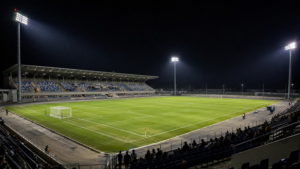

Modern stadium lighting is no longer just about brightness. In 2026, buyers care more about optical precision, flicker-free broadcasting, smart controls, energy savings, and long-term reliability. A stadium may look bright to spectators, but poor beam control can still create glare, dark zones, and broadcast problems.
That is why professional buyers now compare much more than wattage.
Whether you manage a football stadium, sports park, airport, logistics center, university, or municipal project, choosing the right Best LED Stadium Lights can dramatically affect operating cost, visual comfort, maintenance efficiency, and future scalability.
Professional manufacturers such as ZC Lighting now focus heavily on optical engineering, smart controls, and broadcast-ready stadium lighting systems rather than simple high-wattage fixtures.
What Makes a Great LED Stadium Light in 2026?
Many buyers still compare stadium lights based only on wattage. That approach often creates expensive mistakes. A better stadium lighting system focuses on optical engineering, not raw power.
Optical Performance Matters More Than Wattage
A 1000W LED stadium light with poor optics may perform worse than a lower-wattage fixture with better beam control.
Modern LED stadium lights outdoor should provide:
- Better uniformity
- Lower glare
- More usable lux
- Better vertical illuminance
- Reduced spill light
Professional sports venues now rely heavily on asymmetric optics and precision beam control. These technologies improve player visibility and reduce wasted light.
Many stadium consultants now prefer modular systems like the FL08 Series modular sports floodlight because flexible optics simplify beam planning for football fields, athletics tracks, and sports parks.
Flicker-Free Performance Is Essential
Older lighting systems often create visible flicker during slow-motion broadcasting. Modern HDTV and HDR cameras expose lighting flaws instantly.
Professional venues now prioritize:
- Flicker-free LED drivers
- Stable current output
- High TLCI performance
- Broadcast-compatible lighting
Broadcast companies and sports associations increasingly require these features.
For professional football stadiums and televised sports venues, fixtures such as the FL18 GameAres LED Stadium Floodlight provide stronger flicker control and better vertical illuminance for modern camera systems.
Smart Lighting Controls Are Becoming Standard
Modern stadiums demand more flexibility. Smart control systems allow operators to:
- Adjust brightness remotely
- Create lighting scenes
- Reduce energy consumption
- Monitor fixture health
- Schedule events automatically
Protocols like DALI and DMX improve system integration for large projects.
Many smart city and municipal buyers now combine sports lighting with broader infrastructure planning, including street and roadway LED lighting solutions for surrounding roads, parking zones, and pedestrian areas.
Quick Comparison Table — Best LED Stadium Lights in 2026
| No. | Light | Best For |
|---|---|---|
| 1 | FL18 GameAres Stadium Floodlight | Professional Football Stadiums |
| 2 | FL12 High-Power Stadium Floodlight | Airports & Mega Venues |
| 3 | FL08 Modular Sports Floodlight | Flexible Optical Design |
| 4 | SP02 Radial Stadium Floodlight | Broadcast Applications |
| 5 | Musco TLC for LED™ System | Smart Stadium Management |
| 6 | Philips OptiVision LED Gen3 | Municipal Sports Venues |
| 7 | LED Light Expert Shoebox Stadium Series | Budget Sports Projects |
| 8 | Valmont Structures High-Mast LED System | Large Outdoor Areas |
| 9 | GE Evolve LED Sports Lighting Retrofit | Retrofit Projects |
| 10 | Cree Lighting OSQ Series | OEM & Commercial Projects |
10 Best LED Stadium Lights in 2026
1. FL18 GameAres Stadium Floodlight — Best for Professional Football Stadiums
The FL18 GameAres LED system delivers excellent broadcast performance and precise beam control. The fixture reduces glare more effectively than many traditional floodlights.
Key advantages include:
- Flicker-free drivers
- Multiple beam angles
- Strong thermal management
- Excellent vertical illuminance
- Lower spill light
Professional football stadiums often prefer this type of fixture because it balances brightness and visual comfort more effectively.
2. FL12 High-Power Stadium Floodlight — Best for Airports and Mega Venues
Large venues require stronger long-distance lighting. The FL12 high-power stadium and airfield floodlight performs especially well in airports, ports, and high-mast applications.
Compared with smaller fixtures, this system offers:
- Higher lumen output
- Better long-range aiming
- Stronger structural durability
- Better wind resistance
Airports and ports often choose this category of lighting because reliability matters more than appearance alone.
Projects with large-area outdoor requirements also frequently combine these systems with high-mast LED lighting solutions to improve coverage efficiency.
3. FL08 Modular Sports Floodlight — Best for Flexible Optical Design
Modular systems provide more flexibility than fixed optical systems.
The FL08 series supports:
- Multiple beam combinations
- Easier maintenance
- Lower replacement cost
- More flexible aiming strategies
Lighting consultants often prefer modular systems for sports parks and multi-use stadiums.
4. SP02 Radial Stadium Floodlight — Best for Broadcast Applications
Broadcast lighting demands higher optical precision. The SP02 Radial Stadium LED Floodlight performs especially well in slow-motion broadcasting environments.
The fixture improves:
- Camera visibility
- Color consistency
- Vertical lux performance
- Flicker control
Professional broadcasting companies increasingly require these features.
5. Musco TLC for LED™ System
Smart stadium infrastructure continues to expand rapidly in 2026. Systems like the Musco TLC for LED™ platform support more intelligent lighting management for sports venues, municipal complexes, and smart city projects.
Modern smart stadium systems now support:
- Cloud-based monitoring
- Predictive maintenance
- Energy analytics
- Wireless dimming
- Event automation
Municipal authorities and smart city operators increasingly prefer centralized lighting platforms because they reduce operating cost and simplify long-term maintenance management.
6. Philips OptiVision LED Gen3
Public sports facilities require balanced performance, lower operating cost, and long-term durability. The Philips OptiVision LED Gen3 system is widely used in municipal sports venues because it focuses more on lifecycle value than extreme output.
Municipal projects usually prioritize:
- Energy savings
- Maintenance reduction
- Environmental compliance
- Lower glare near residential areas
Many cities now combine sports lighting with larger smart infrastructure planning to create more scalable public lighting systems.
7. LED Light Expert Shoebox Stadium Series
Not every sports venue requires professional broadcast lighting. Budget-focused systems like the LED Light Expert Shoebox Stadium Series work well for smaller sports projects and amateur venues.
These systems are commonly used for:
- Training fields
- School sports grounds
- Community parks
- Amateur competitions
Lower-cost systems usually reduce upfront investment, but they may also sacrifice optical precision, advanced glare control, and long-term durability.
8. Valmont Structures High-Mast LED System
Large-area outdoor projects need stronger structures, longer beam distance, and better environmental durability. The Valmont Structures high-mast LED lighting system performs well in demanding infrastructure projects.
High-mast systems are widely used in:
- Ports
- Airports
- Logistics parks
- Industrial zones
These systems typically provide:
- Long-distance beam control
- Better structural durability
- Higher surge protection
Industrial operators usually prioritize reliability and maintenance access more heavily than decorative appearance.
9. GE Evolve LED Sports Lighting Retrofit
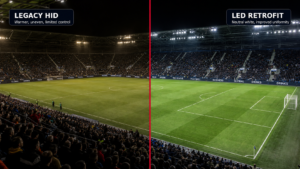
Many older sports venues still use metal halide systems. Retrofit platforms like the GE Evolve LED Sports Lighting system help facilities reduce energy consumption and maintenance cost without rebuilding the entire stadium infrastructure.
| Feature | LED Retrofit | Metal Halide |
|---|---|---|
| Energy Efficiency | Higher | Lower |
| Startup Time | Instant | Slow |
| Maintenance Cost | Lower | Higher |
| Flicker Control | Better | Poor |
| Lifespan | Longer | Shorter |
Retrofit projects also help facilities improve sustainability targets, reduce downtime, and support ESG-focused infrastructure upgrades.
For retrofit projects that require flexible optical control and smart dimming integration, fixtures such as the FL03 adjustable smart flood light can provide more adaptive beam positioning.
10. Cree Lighting OSQ Series
OEM and private-label buyers increasingly require stronger technical support and flexible production capabilities. Systems like the Cree Lighting OSQ Series are often referenced in large commercial outdoor lighting portfolios because they support scalable infrastructure planning.
Professional OEM suppliers should provide:
- Private labeling
- Photometric support
- Dialux simulations
- Warranty support
- Technical customization
Distributors often prefer suppliers with stronger engineering support instead of simple trading capabilities.
Many distributors also expand into roadway and parking projects using systems such as the SL05 municipal LED street light and the AL03 high-performance area light to create integrated outdoor lighting portfolios.
How to Choose the Right LED Stadium Lighting System
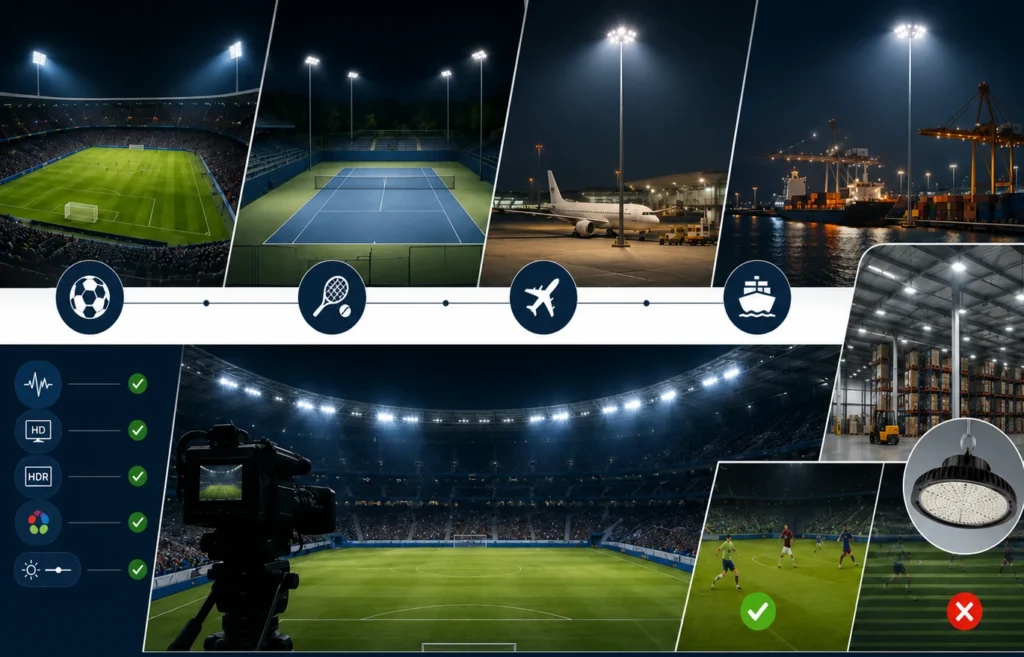
Choose Based on Venue Type
Different sports require different lighting strategies.
Football stadium lighting requires stronger vertical illuminance because cameras track players over long distances.
Tennis court lighting usually demands lower glare and more controlled aiming.
Airports and ports prioritize high-mast coverage and structural durability.
Warehouses and logistics facilities may also integrate indoor systems such as the HB06 high-bay light with dual driver options to create more unified lighting management across the entire site.
Choose Based on Broadcast Requirements
Professional broadcasting creates stricter standards.
Modern stadiums increasingly require:
- Flicker-free drivers
- HDTV compatibility
- HDR support
- Better color rendering
- Stable dimming systems
A stadium may look acceptable to spectators but still perform poorly on camera.
Choose Based on Maintenance Strategy
Maintenance costs can become enormous over time.
Better systems reduce:
- Driver replacement frequency
- Fixture downtime
- Maintenance labor
- Lift equipment requirements
Modular systems usually simplify long-term maintenance more effectively.
Common Stadium Lighting Problems Buyers Often Ignore
Poor Beam Selection
Incorrect beam angles often create dark zones and uneven lighting.
Better optics improve usable light more effectively than higher wattage alone.
Excessive Glare
Glare ruins athlete visibility and spectator comfort.
Lower tilt angles and better optical shielding reduce glare more effectively.
Spill Light Complaints
Residential areas increasingly enforce stricter environmental regulations.
Modern stadiums now focus heavily on:
- Dark sky compliance
- Uplight reduction
- Spill light control
Municipal authorities care more about this issue than before.
Overheating and Driver Failures
Poor thermal design shortens LED lifespan dramatically.
Professional fixtures use:
- Larger heat sinks
- Better airflow
- Higher-quality drivers
- Stronger thermal management
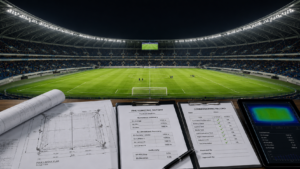
Stadium Lighting Simulation and Engineering
Professional projects rarely rely on guesswork.
Lighting consultants now use software like:
- Dialux
- AGi32
- Photometric simulation platforms
These tools calculate:
- Lux levels
- Uniformity
- Spill light
- Vertical illuminance
- Pole geometry performance
IES files help engineers simulate real fixture performance before installation.
Smart Stadium Lighting Trends in 2026
The stadium lighting industry continues evolving rapidly.
AI-Based Lighting Optimization
AI systems now adjust lighting automatically based on:
- Weather
- Event type
- Crowd conditions
- Energy demand
Solar Hybrid Stadium Lighting
Solar-assisted systems reduce operational cost more effectively for remote facilities.
Smart cities increasingly explore hybrid energy systems.
Dynamic Event Lighting
Modern stadiums now use lighting for entertainment as well as sports.
Dynamic scene lighting improves:
- Fan experience
- Event atmosphere
- Sponsorship visibility
Cost Analysis of Stadium Lighting Projects
Typical Stadium Lighting Cost Factors
| Cost Area | Main Considerations |
|---|---|
| Fixtures | Wattage, optics, driver quality |
| Poles | Height, wind load, structure |
| Installation | Labor, lifts, wiring |
| Controls | DALI, DMX, IoT systems |
| Maintenance | Accessibility, modularity |
Projects with better optical efficiency often reduce total fixture count and lower long-term operating cost.
For fast project evaluation and lighting recommendations, buyers can request instant lighting solution quotes from experienced engineering teams before finalizing specifications.
Why Optical Engineering Matters More Than Wattage
Many buyers still chase higher wattage numbers. That strategy often wastes money.
A better lighting design focuses on:
- Beam precision
- Uniformity
- Visual comfort
- Glare reduction
- Usable lux
More lumens do not always create better lighting.
Professional optical engineering usually delivers better results than simply adding more power.
Final Thoughts
The best LED stadium lights in 2026 do much more than illuminate a field. Modern systems support broadcasting, smart infrastructure, sustainability goals, and long-term operational efficiency.
Different projects require different solutions.
A football stadium requires different optics than a logistics park. A professional broadcast venue requires stronger flicker control than a training field.
That is why smart buyers evaluate optical engineering, maintenance strategy, broadcast performance, and lifecycle cost instead of focusing only on wattage.