<!doctype html>
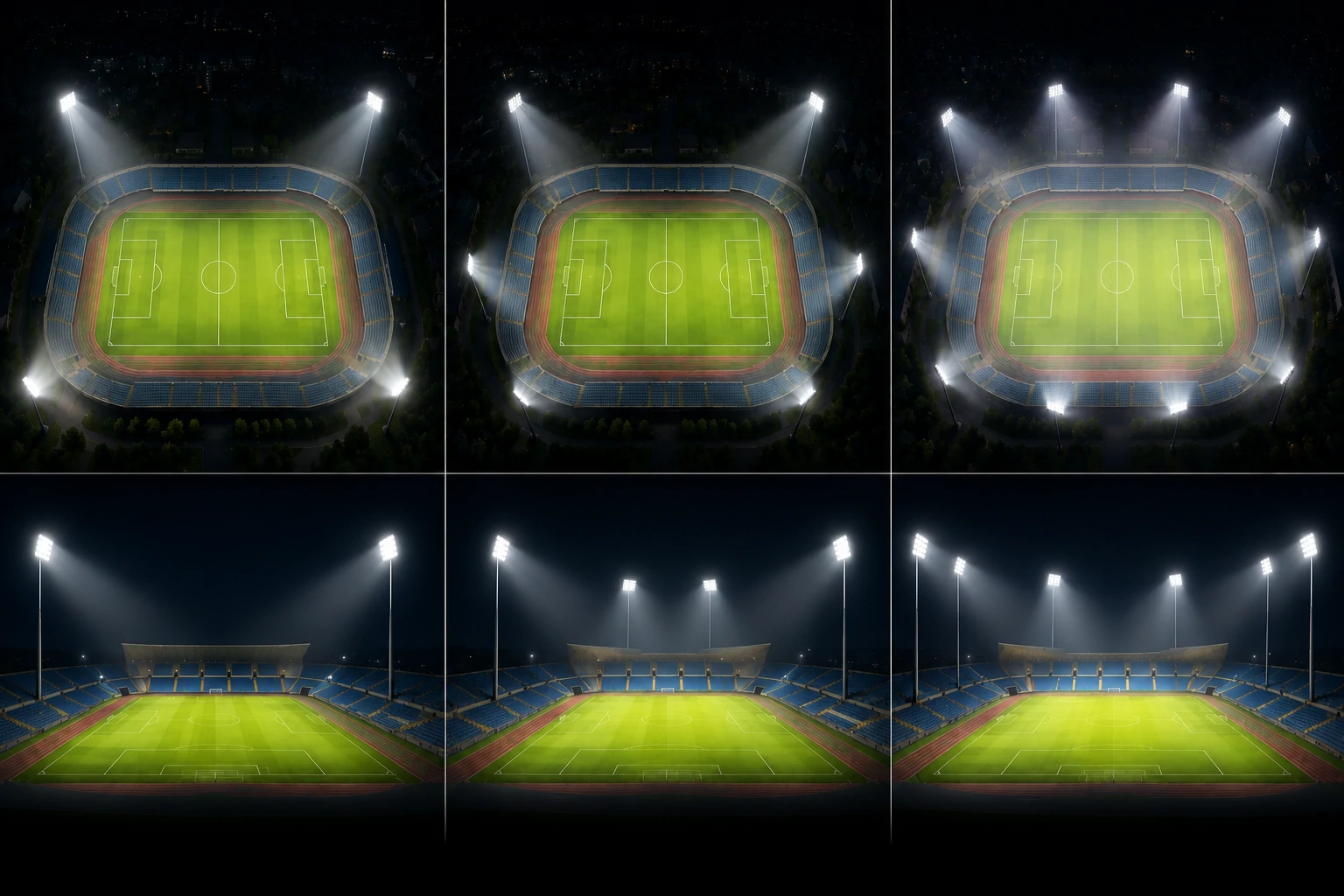
Pole layout is a performance decision, not just a budget line. This guide compares 4/6/8-pole layouts by venue tier and constraints, then shows what to verify so acceptance is predictable.
Choosing the right number of lighting poles is one of the most important decisions in stadium lighting design.
A 4-pole system may reduce initial costs, while a 6-pole or 8-pole layout can provide better uniformity, lower glare, and improved broadcast performance.
However, more poles do not always mean better results.
The ideal pole configuration depends on several factors, including the sport type, competition level, lighting requirements, viewing experience, and project budget.
In this guide, we compare 4-pole, 6-pole, and 8-pole stadium lighting layouts to help engineers and project owners select the most suitable solution.
Answer: Choose 4/6/8 poles based on venue tier + constraints: 4-pole often fits training fields, 6-pole improves uniformity and glare control, and 8-pole supports higher tiers and stricter Ev/glare/spill requirements.
Make layout decisions auditable with a calculation report, aiming limits, and a commissioning aiming table tied to acceptance criteria.
- Key takeaway #1: Define tier and acceptance method first—layout follows requirements.
- Key takeaway #2: More poles mainly buys lower tilt angles, better aiming flexibility, and better control of glare/spill.
- Key takeaway #3: Retrofits must validate achievable targets using existing pole geometry.
Table of contents
1) When this applies
2) Key requirements / metrics (table)
3) Step-by-step workflow
4) Common mistakes
5) Checklist / Template download
6) FAQ
Related reads:
• Pole height explained
• Training Fields and Match Fields
• Energy Savings & ROI Analysis
When this applies
Use this guide when you are planning a new stadium/training field, upgrading from HID, or retrofitting an existing venue with fixed pole positions.
Typical scenarios
- Training fields: performance targets are lower and cost sensitivity is high.
- Match venues: uniformity and glare control become more demanding.
- Broadcast venues: Ev, glare/spill, and aiming limits often drive layout choice.
- Retrofits: existing poles constrain aiming and spill control.
Key requirements / metrics
Use these decision metrics to compare layouts in an engineering way (not a brochure way).
| Decision factor | What it affects | Why it matters | What to verify |
|---|---|---|---|
| Venue tier | Targets and acceptance method. | Layout should follow tier. | Define Eh/uniformity + Ev if required. |
| Tilt/aiming limits | Glare/spill risk. | High tilt increases uplight and glare. | Max tilt policy + aiming table. |
| Uniformity | Playability and broadcast quality. | Poor uniformity causes complaints. | Calculation + measurement grid plan. |
| Spill boundaries | Neighbors/roads compliance. | Off-site impact drives approvals. | Boundary checks and shielding strategy. |
| Retrofit constraints | Achievable performance. | Fixed poles limit options. | Validate achievable targets with existing geometry. |
Definitions
EhPole layout is the geometry of mounting points around the field. Layout choice changes aiming freedom, maximum tilt angles, and how well the design can control glare and spill while meeting illuminance and uniformity targets.
Typical target ranges
Typical guidance (always follow tender text):
- Training tier: 4 poles often adequate if spill/glare constraints are modest.
- Match tier: 6 poles often improves uniformity and reduces tilt angles.
- Broadcast/high-tier: 8 poles can reduce glare and better support Ev requirements.
When no Ev target is stated in the tender, define an Ev acceptance method (height + directions) early to reduce disputes.
Step-by-step workflow
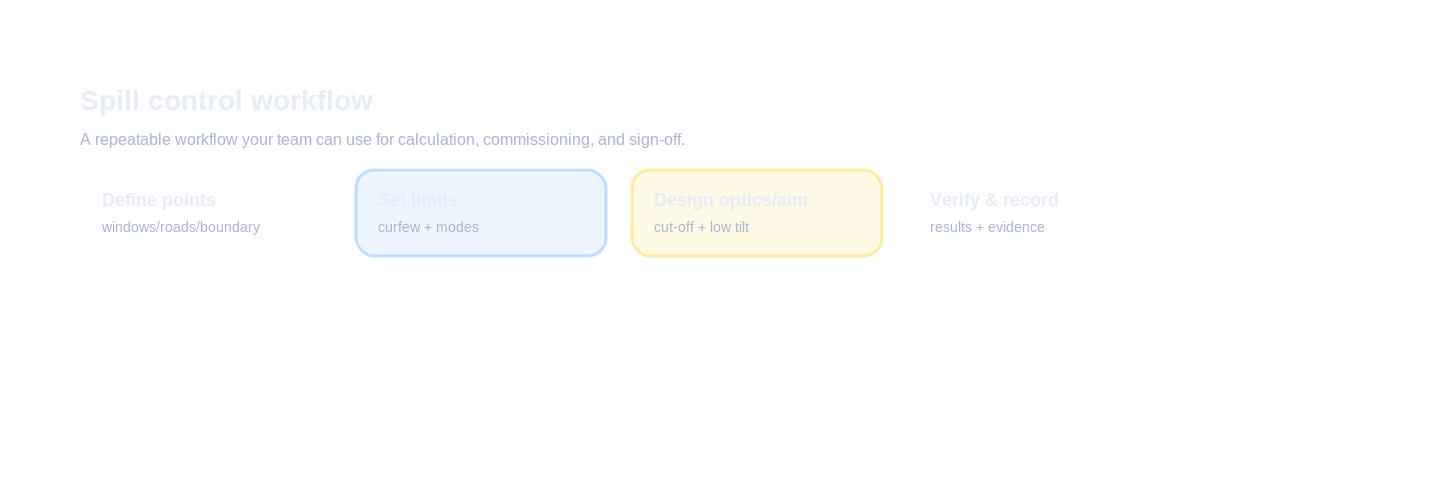
Workflow: define tier → map constraints → test 4/6/8 pole options in calculation → choose option with best risk profile → lock aiming limits and sign-off deliverables.
Inputs to collect
- Field dimensions and sports use cases.
- Pole height options (or existing pole data for retrofits).
- Neighbor/road boundaries and spill constraints.
- Any broadcast camera directions (if Ev is required).
Design decisions
- Select layout based on tier and constraints.
- Define tilt limits and shielding policy for sensitive directions.
- Define acceptance method and evidence pack.
Verification & sign-off
- Define acceptance method and evidence pack.
- Commissioning aiming table and as-built confirmation.
Common mistakes
- Choosing 4 poles for a high-tier broadcast requirement without validating Ev/glare constraints.
- Ignoring max tilt angles until commissioning.
- No spill boundary plan.
Checklist / Template download
These downloads are generated in-browser (TXT/CSV) and can be replaced later with gated assets.
Layout Decision Matrix (CSV)
Compare 4/6/8 poles against performance and constraints.
Download
Request full pack
Pole Position Survey Sheet (CSV)
Capture as-built pole locations and heights.
Download
Request full pack
Constraint Map Checklist (CSV)
Document neighbors/roads and spill/glare constraints.
Download
Request full pack
Tender Clause (TXT)
Tender-ready layout and verification language.
Download
Request full pack
Request the full pack
Start your lighting solutions
Privacy: we use your details only for document delivery and technical follow-up about this request.
FAQ
Is 4-pole always the best choice for a football field?
Not always. 4-pole can work well for training fields, but professional/broadcast venues may need 6 or 8 poles to meet uniformity, glare, and Ev requirements.
When does 6-pole make sense?
When you need better uniformity or improved glare/spill control without moving to a full 8-pole design.
What usually drives 8-pole layouts?
Higher performance tiers, broadcast vertical illuminance needs, strict glare/spill constraints, or complex multi-sport requirements.
Can I keep existing pole locations in a retrofit?
Because good camera images depend on light coming from useful directions. High Eh with weak Ev can produce poor modelling, low facial recognition, and inconsistent exposure.
How do I avoid over-engineering?
Define the venue tier and acceptance method first; only add poles if the metrics and constraints require it.
Ready to move from “requirements” to a passable design?
Get a calculation report + IES/LDT + tender-ready spec clauses (plus aiming table).
Get the Calculation / IES / Spec Pack
Back to ZCLED.com