Pole height is one of the most misunderstood parameters in stadium lighting design. Many decision-makers assume that “higher is always better” or that pole height mainly affects brightness. In reality, pole height influences optics selection, uniformity, vertical illuminance, glare risk, spacing, and even project cost.
This long-form guide explains how LED stadium lighting behavior changes at 12 m, 18 m, 25 m, and 35 m. It is written for project owners, consultants, and contractors who want to understand what really changes — and what does not — as mounting height increases.
1. Why Pole Height Matters More Than Most Specifications
Pole height determines the geometry of the lighting system. It defines beam throw distance, aiming angles, and how light intersects the playing surface and players’ line of sight.- Lower poles shorten throw distance but increase glare risk if optics are too wide.
- Higher poles increase throw distance and vertical coverage but require tighter beam control.
- Changing pole height often forces a complete rethink of optics and layout.
2. 12 m Poles: Compact Training Fields
12 m poles are common for small training pitches, school fields, and community sports grounds.
Key characteristics
- Short beam throw distance.
- Higher glare sensitivity if luminaires are directly visible.
- Fewer luminaires required.
At this height, optics in the 40°–60° range are often used to cover the near field effectively. However, careful aiming is critical — excessive tilt quickly leads to direct glare for players.
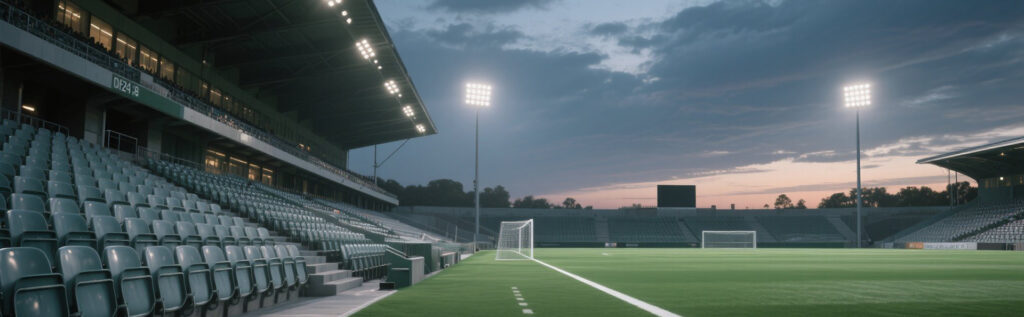
3. 18 m Poles: Balanced Training & Amateur Competition
18 m is one of the most versatile mounting heights in sports lighting.- Good balance between coverage and glare control.
- Suitable for advanced training and amateur matches.
- Allows moderate vertical illuminance without broadcast-level complexity.
4. 25 m Poles: Entry Level Professional Stadiums
25 m poles mark the transition from training-oriented design to professional stadium lighting.What changes at 25 m?
- Longer throw distances require narrower optics.
- Vertical illuminance becomes a design target.
- Mixed beam strategies become necessary.
5. 35 m Poles: Broadcast-Oriented Stadium Lighting
35 m and above is typical for major stadiums with broadcast requirements.- Strong vertical illuminance toward multiple camera angles.
- Tighter glare control becomes mandatory.
- Higher structural and wind-load considerations.
6. Pole Height vs Uniformity
Uniformity does not automatically improve with height. While higher poles can help smooth distribution, poor optics selection or spacing can still create dark zones.| Pole height | Uniformity potential | Design risk |
|---|---|---|
| 12 m | Moderate | Glare and hot spots |
| 18 m | Good | Over-wide optics |
| 25 m | Very good | Insufficient beam control |
| 35 m | Excellent | Aiming and commissioning errors |
7. Glare Considerations at Different Heights
Glare risk shifts with pole height:- Lower poles: direct view glare dominates.
- Higher poles: high-angle intensity and spill glare dominate.
8. Cost & Structural Implications
Higher poles increase more than lighting cost:- Stronger foundations.
- Higher wind load (EPA) requirements.
- More complex installation and maintenance.
9. How to Choose the Right Pole Height
- Define competition and broadcast needs.
- Check existing infrastructure and zoning limits.
- Run lighting simulations for at least two height scenarios.
- Compare performance gain vs added CAPEX/OPEX.