“눈부심 감소”는 야외 스포츠 조명 분야에서 가장 흔히 내세우는 주장 중 하나입니다.
그러나 눈부심은 조명기구만으로 결정될 수 있는 고정된 특성이 아닙니다.
최종적인 시각적 및 환경적 결과는 다음 요소들 간의 관계에 따라 달라집니다:
- 조명기구
- 광 분배
- 폴 포지션
- 장착 높이
- 조준 각도
- Observer
- Field surface
- Surrounding properties
- 운행 시간표
This makes glare control a project-level design task.
Product-Level Optical Control
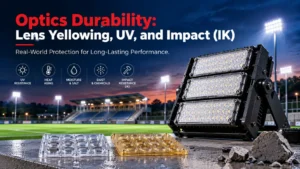
A luminaire can provide useful tools for controlling unwanted light, including:
- Precise lenses
- Reflector systems
- Recessed light sources
- Visors
- Shields
- Reduced high-angle intensity
- Reduced backlight
- Asymmetric distributions
These features can improve project performance, but they do not guarantee a low-glare installation.
The same luminaire can produce different results when installed at different heights or aiming angles.
Pole Height and Setback Matter
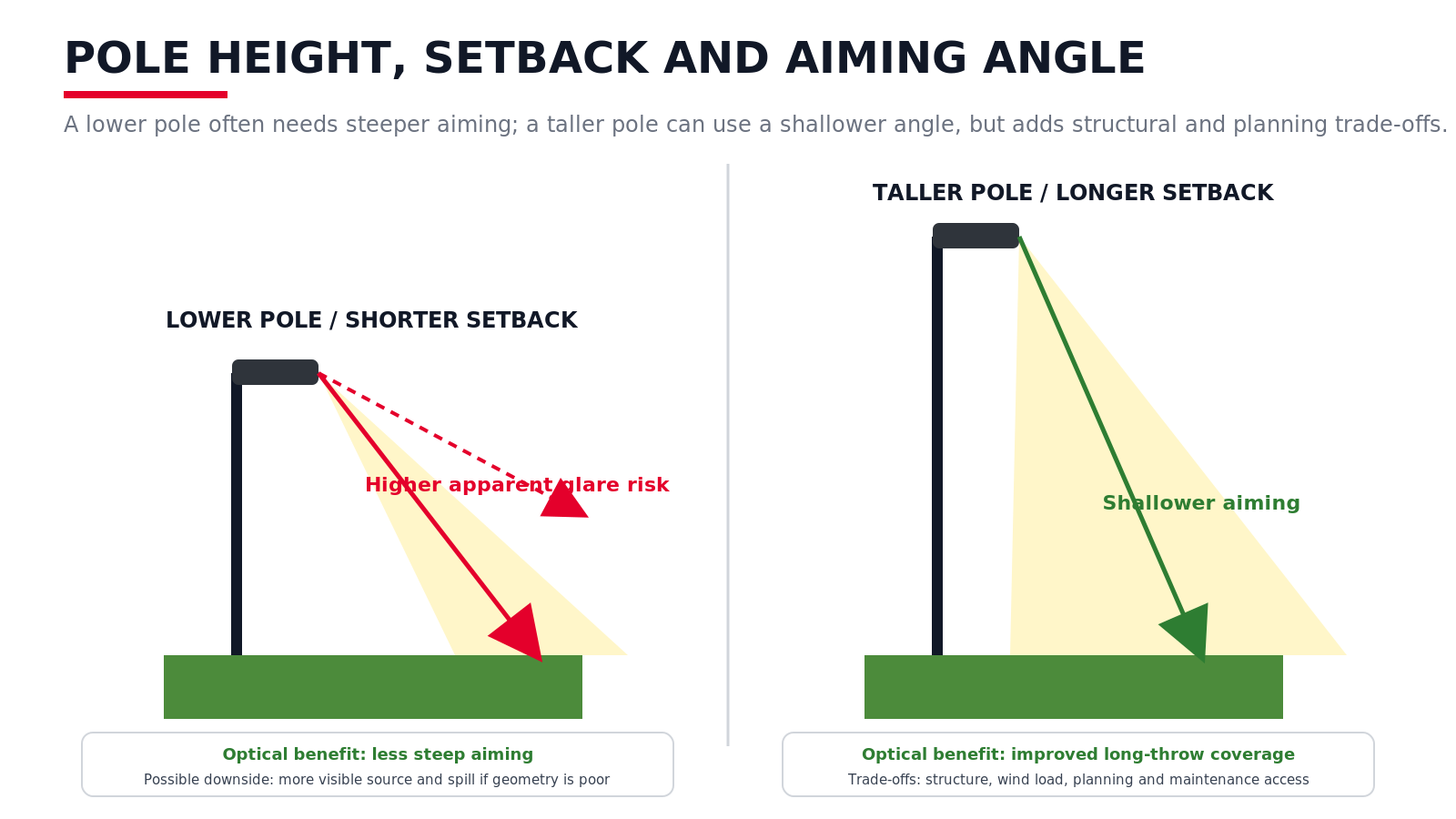
Lower poles usually require steeper aiming to reach distant areas of the field.
Steeper aiming can increase:
- High-angle intensity
- Direct visibility of the light source
- 산란광
- Glare toward players or spectators
Increasing pole height may reduce the required tilt, but it may also affect:
- Structural cost
- Wind load
- Planning approval
- 유지보수 접근 권한
- Neighborhood visibility
The design should therefore balance optical, structural and environmental requirements.
Spill Light, Backlight and Uplight Are Different
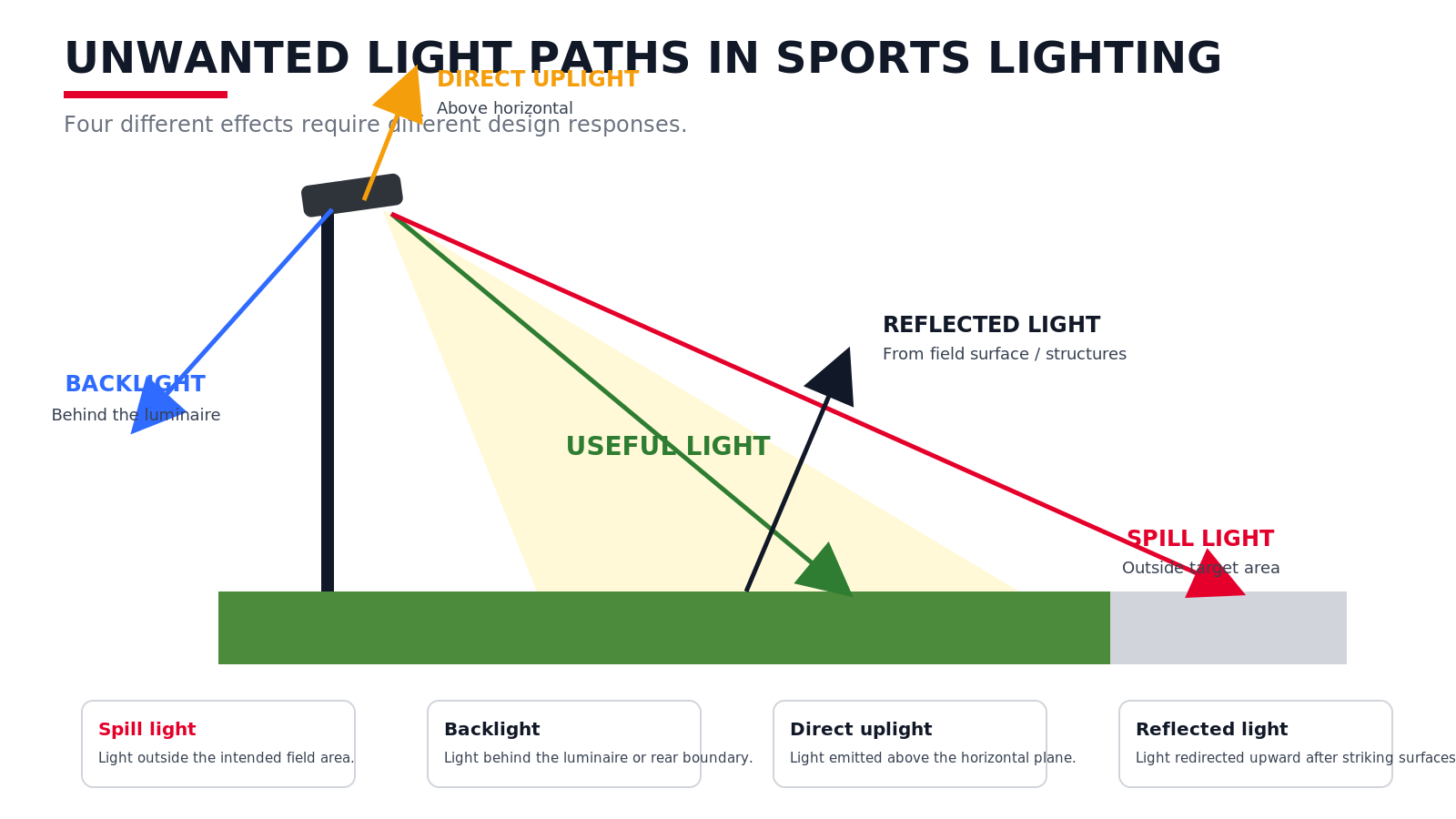
스필 라이트
Light reaching areas outside the intended target.
Backlight
Light emitted behind the luminaire or toward an unintended rear zone.
업라이트
Light emitted directly above the horizontal plane.
Reflected Light
Light that reaches the sky or surrounding areas after reflecting from the field, track, seating or buildings.
A project may have very low direct uplight but still create skyglow through reflection and excessive total illumination.
“Zero uplight” therefore does not mean zero environmental impact.
Color Temperature and Operating Time Also Matter
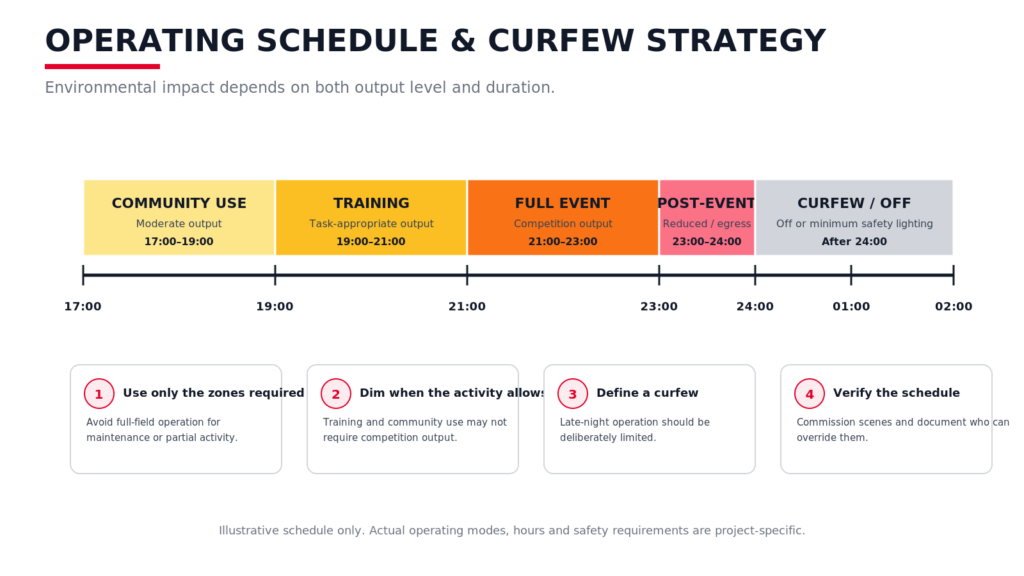
Environmental lighting impact is affected by more than illuminance.
Important factors include:
- 상관 색온도
- Spectral distribution
- Total installed lumens
- Duration of operation
- 통금
- Late-night dimming
- Event schedules
A well-controlled system that operates only when required may create less overall impact than a lower-output system that remains at full power throughout the night.
Boundary Calculations Should Be Included Early

Sensitive sites may be close to:
- Residential properties
- Roads
- Hotels
- Wildlife habitats
- 공항
- Observatories
- Other sports fields
The design should evaluate boundary conditions before equipment is installed.
Useful calculations include:
- Vertical illuminance at property boundaries
- Horizontal illuminance outside the field
- Luminaire intensity toward observers
- 고각 조명
- Backlight
- 눈부심 등급
- Operating-mode comparison
This allows the project team to adjust pole position, optics, shielding and aiming before construction.
Field Verification Remains Necessary
Lighting simulations rely on assumptions.
After installation, the project should verify:
- Luminaire orientation
- Actual aiming
- Boundary illuminance
- Visible glare
- Shield position
- 운행 시간표
- Dimming scenes
If the field result differs from the design, adjustments may include:
- 목표 재조정
- Changing optics
- Adding shielding
- Reducing selected output levels
- Revising operating times
A Three-Level Low-Glare Strategy
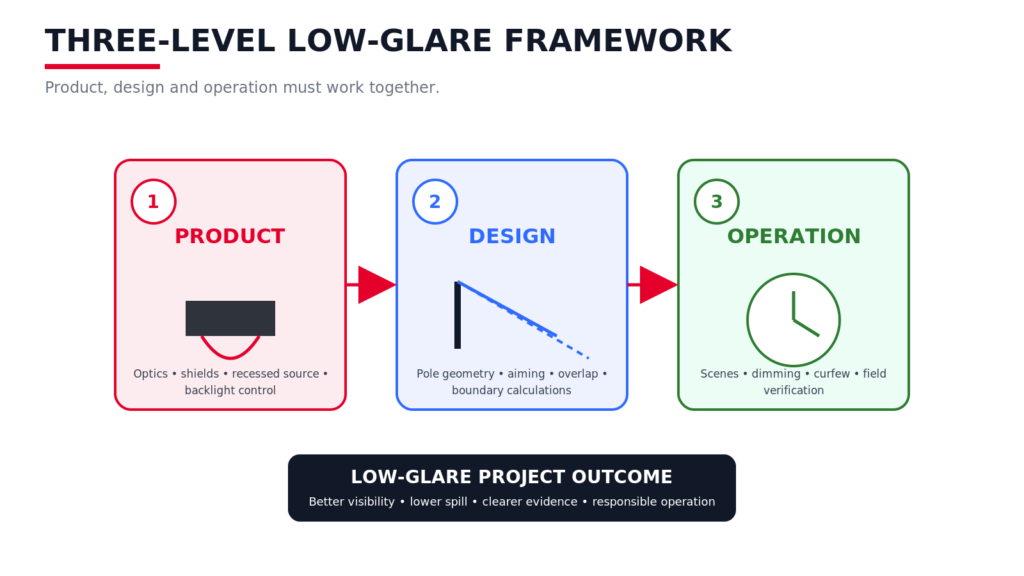
Product Level
- 광 분배
- High-angle light control
- 차폐
- Backlight control
Design Level
- 극의 기하학적 구조
- 차질
- 장착 높이
- 조준
- Boundary calculation
- Total installed output
Operating Level
- 통금
- 조명 조절
- Training mode
- Event scheduling
- Field verification
Low-glare performance is strongest when all three levels support one another.
자주 묻는 질문
Does a visor guarantee low glare?
No. A visor can reduce light in selected directions, but pole geometry, aiming, optical intensity and observer position still affect glare.
Does zero direct uplight eliminate skyglow?
No. Light reflected from the playing surface and surrounding structures can still contribute to skyglow.
| For sensitive sports sites, ZC Lighting recommends evaluating optics, pole geometry, aiming and boundary conditions together before confirming the final luminaire configuration. |