
Modern sports venues are no longer designed as collections of isolated electrical systems. Field lighting, broadcast infrastructure, scoreboards, HVAC, security, on-site generation, battery storage and building management increasingly share the same operational environment. This does not mean that every sports-lighting supplier must become a stadium-automation company. It does mean that the lighting package must be specified so that it can operate reliably inside a wider venue system.
The distinction matters. A high-output floodlight can meet photometric targets and still create operational problems when zoning, startup current, fallback logic, control ownership or event scheduling are addressed too late. Conversely, a well-defined control-ready lighting package can support energy reduction, faster event changeovers, more predictable maintenance and clearer commissioning without relying on exaggerated claims about “AI lighting.”
This article explains the engineering decisions that should be made before a sports-lighting system is connected to a wider venue-control or energy-management platform.
1. Why this topic is becoming more important
Electricity demand is rising across industry, transport, buildings and data centres. The International Energy Agency forecasts average annual global electricity-demand growth of 3.6% from 2026 to 2030. At the same time, grid capacity is becoming a bottleneck in many markets. For venue owners, the practical implication is not simply “use less electricity.” It is to use electrical loads more deliberately, document how they behave and avoid unnecessary peaks.
Sports lighting is particularly suitable for structured control because it already operates in defined time blocks. A stadium may require different conditions for security checks, cleaning, training, competition, television broadcast and entertainment. These scenes are predictable, but only when they are designed into the electrical and control architecture.
The European Commission is also accelerating electrification in buildings and industry while continuing to address high energy costs. This policy direction reinforces demand for controllable, interoperable equipment. For lighting manufacturers, the market opportunity is therefore moving from standalone efficacy claims toward evidence of system compatibility, operating flexibility and project documentation.
2. Start with operating modes, not with a protocol
A common mistake is to begin by asking whether a project needs DALI, DMX, 0-10 V or another protocol. The protocol is only the transport mechanism. The more important first question is: what must the venue be able to do?
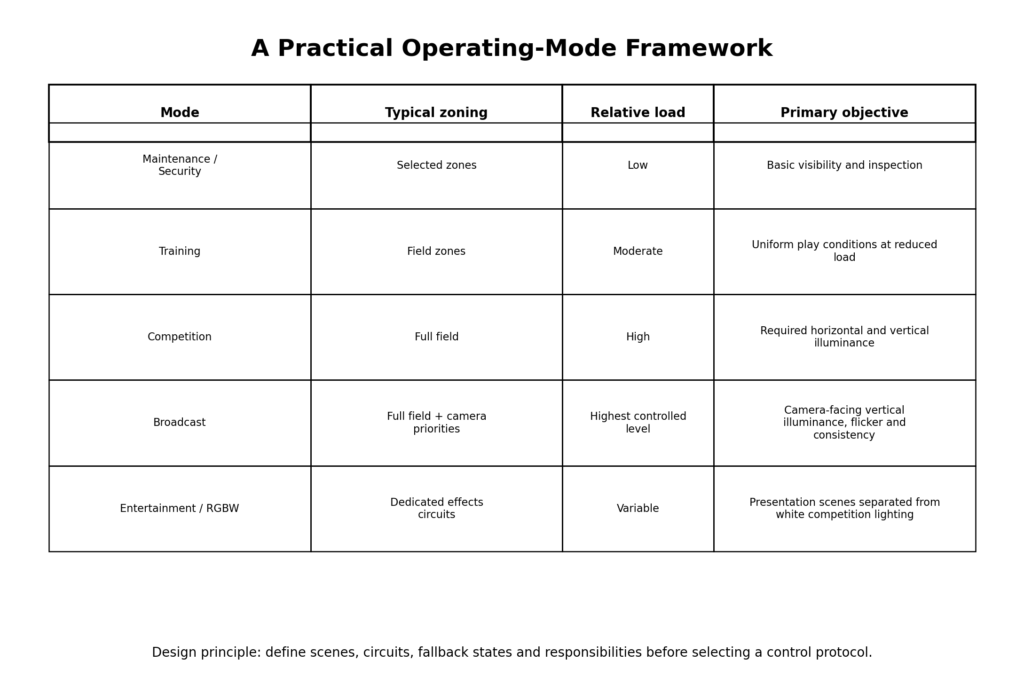
A practical sports-venue control narrative normally starts with five operating modes.
Maintenance and security mode uses selected luminaires or perimeter zones. The goal is safe access, inspection and basic visibility rather than full playing conditions.
Training mode provides sufficient and reasonably uniform illumination for regular use while reducing installed load. The exact level depends on the sport, competition class and local standard; it should not be selected as a generic percentage without checking uniformity and visual conditions.
Competition mode activates the circuits required for the relevant competition class. This may involve a higher horizontal illuminance, tighter uniformity and stricter glare control than training mode.
Broadcast mode is not simply “100% output.” It must consider the camera directions, vertical illuminance, flicker performance, colour consistency and the relationship between the field, spectator areas and background brightness.
Entertainment or RGBW mode should be treated as a separate presentation layer. Dynamic effects can support introductions, celebrations and non-sport events, but they should not compromise the reliability or compliance of the white competition-lighting system.
Once these scenes are defined, the project team can determine circuits, addresses, dimming ranges, transition times, permissions and fallback states. Protocol selection then becomes a technical decision rather than a marketing label.
3. Zoning is an engineering decision
Good zoning follows the way the venue is operated and maintained. It is not always the same as the physical arrangement of poles or luminaires.
For a community field, zoning may separate the full field, half-field training areas and security lighting. A multi-court facility may require each court to operate independently. A broadcast stadium may need groups associated with camera priorities, roof sections, mast locations or emergency circuits. A venue used for concerts may add presentation and audience-lighting zones.
Three checks are essential.
First, each reduced-load scene must be assessed photometrically. Switching off every second luminaire may lower power but destroy uniformity.
Second, circuits should avoid a single point of failure that removes an excessive portion of the field illumination. The appropriate redundancy depends on the project risk level and local requirements.
Third, the zoning schedule must match the control database, distribution boards, cable labels, aiming schedule and commissioning report. Inconsistent naming is a frequent cause of handover problems.
4. Installed load is only one part of energy performance
Installed power is easy to compare, but annual energy use depends on operating hours and control behaviour.
A credible energy assessment should distinguish the hours spent in maintenance, training, competition, broadcast and entertainment modes. It should also include driver losses, expected dimming levels and any practical restrictions on switching or warm-up. LED systems usually allow rapid scene changes, but the electrical design must still account for inrush current, breaker selection and simultaneous startup.
For larger venues, the lighting team should provide at least:
- total connected load;
- load by circuit and operating scene;
- normal startup sequence;
- dimming range and control method;
- inrush-current information;
- emergency or fallback state;
- expected annual operating profile.
This information allows the venue’s energy manager or integrator to coordinate lighting with other large loads. The lighting manufacturer does not need to control HVAC, storage or solar generation, but it should provide the electrical data required by the people who do.
5. Control-ready does not mean universally compatible
“DALI-ready,” “DMX-ready” or “0-10 V dimmable” can be useful descriptions, but they are incomplete unless the project identifies the exact interface and responsibility boundary.
The following questions should be answered before approval:
- Is the control device integrated in the driver, installed in a remote cabinet or supplied by a third party?
- Does one address control one luminaire, one driver channel or a group?
- What happens if communication is lost?
- Is local manual control available?
- Which party supplies gateways, repeaters, network switches and software?
- Who creates scenes and user permissions?
- Which signals are read-only and which can issue commands?
- How will the system be tested before and after installation?
For RGBW sports lighting, channel definition is especially important. White competition lighting and colour effects may use different drivers, circuits or control logic. The design should prevent an entertainment command from unintentionally altering the approved competition scene.
6. The role of networked and remote control
Networked lighting controls can provide scheduling, status monitoring, fault notification and usage data. The DesignLights Consortium has documented additional energy-saving potential from networked controls beyond a standard LED retrofit in commercial and industrial applications. The exact savings for a stadium cannot be copied from a general study because usage profiles differ, but the principle is relevant: controls create value when they reduce unnecessary operating time and make operation visible.
For sports facilities, remote access can be particularly useful where fields are distributed across a school district, municipality or club network. It can reduce unnecessary site visits and help identify whether a reported “lighting failure” is a luminaire issue, a control issue or an electrical-supply issue.
Remote access also introduces cybersecurity and governance questions. Credentials, network ownership, software updates, logging and user permissions should be defined by the venue or integrator. A luminaire manufacturer should not imply that a wireless control feature alone constitutes a complete smart-stadium solution.
7. Coordination with on-site solar, batteries and backup power
On-site generation and storage are increasingly visible in stadium sustainability programmes, but the lighting design should remain grounded in electrical reality.
Solar generation may offset annual electricity consumption, yet evening events occur when direct solar output is low. A battery may support peak management or selected backup functions, but its capacity, discharge rate and emergency duration must be calculated by the electrical engineer.
The sports-lighting package contributes by providing accurate load data, controllable scenes and a defined startup sequence. It should also identify which circuits are essential during an outage. Full broadcast lighting is rarely the same requirement as safe evacuation or emergency egress lighting.
The key message is simple: renewable-energy claims and lighting-performance claims should be documented separately, then coordinated at system level.
8. Commissioning is where the control strategy becomes real
A system is not complete when the luminaires turn on. Commissioning should confirm both photometric performance and operational behaviour.
A useful handover process includes:
- verification of luminaire type, optic, tilt and aiming;
- circuit and address checks;
- confirmation of every operating scene;
- dimming and transition tests;
- communication-loss and fallback tests;
- measurement of horizontal and, where required, vertical illuminance;
- flicker and camera tests for broadcast applications;
- user-permission and local-override checks;
- export of the final settings and point list;
- training for venue staff.
The commissioning record should show the final installed condition, not only the design-stage intention. A change in aiming, driver configuration or circuit grouping can affect performance even when the product itself is unchanged.
9. Where AI can help – and where it should not be overstated
AI can improve the workflow around a controlled sports-lighting project. It can help organise site data, compare operating scenarios, detect inconsistencies between circuit schedules and control databases, summarise alarm histories and support predictive maintenance when sufficient data exists.
AI should not be used as a substitute for photometric calculation, structural verification, electrical protection design or on-site commissioning. A system that automatically proposes a scene still requires validated limits and human approval. The credible position is to use AI as an analysis and workflow layer built on reliable lighting hardware, accurate data and defined control permissions.
10. A practical responsibility model
A clear project boundary protects all parties.
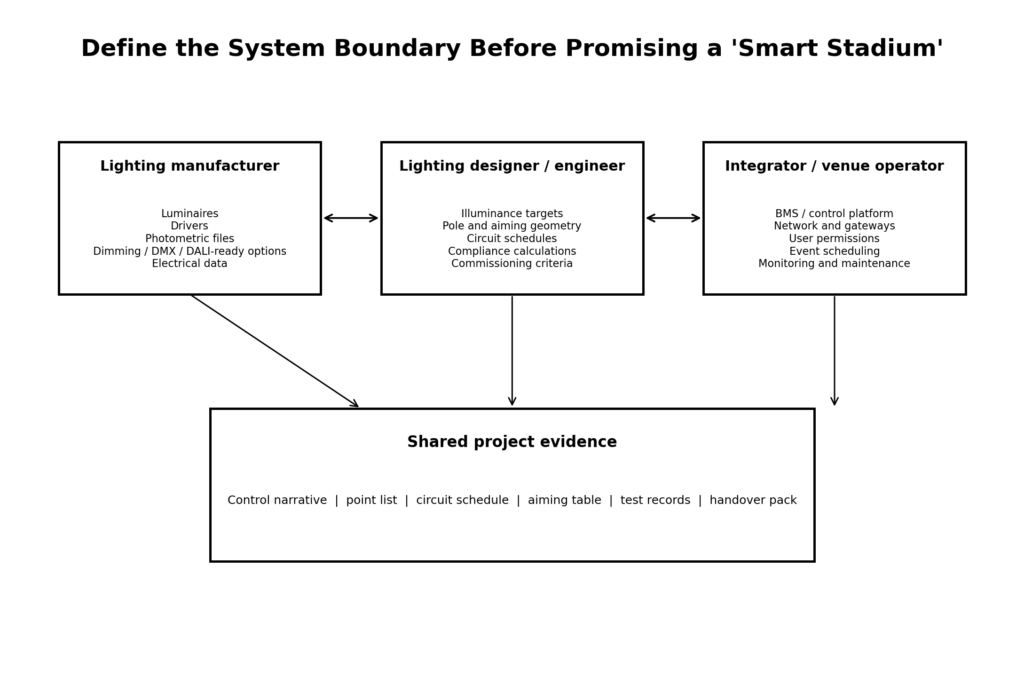
The lighting manufacturer is normally responsible for luminaires, drivers, optical data, electrical characteristics and documented control options.
The lighting designer or engineer defines performance targets, geometry, aiming, circuit intent, compliance calculations and commissioning criteria.
The system integrator connects gateways, networks, software, user interfaces and other venue systems.
The venue operator owns the operational policy: who can activate each scene, when remote access is allowed and how alarms are handled.
On some projects one contractor may perform several of these roles. The responsibilities still need to be written down.
11. Procurement checklist
Before approving a control-ready sports-lighting package, ask for the following:
1. A control narrative listing every operating mode.
2. A circuit and zoning schedule linked to the photometric design.
3. Driver and protocol details, including failure behaviour.
4. Connected load, inrush current and startup sequence.
5. A point list or interface schedule for the integrator.
6. Clear separation between white competition lighting and RGBW effects.
7. Local override and fallback requirements.
8. Commissioning procedures and acceptance criteria.
9. Final documentation and training responsibilities.
10. A statement of what the lighting supplier does not provide.
Conclusion
The next generation of sports lighting will not be defined by adding the word “smart” to a floodlight. It will be defined by whether the lighting package can be designed, controlled, commissioned and maintained as a dependable part of the venue.
For manufacturers such as ZC Lighting, the strongest and most credible position is not to claim ownership of the entire stadium-automation stack. It is to provide high-performance lighting, accurate photometric and electrical data, flexible control interfaces and disciplined project documentation. That is how a lighting product becomes a reliable infrastructure component in a modern sports venue.