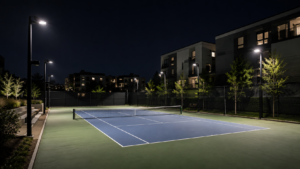
The phrase “smart sports lighting” is widely used, but it can describe very different levels of capability.
In one project, it may mean basic 0–10V dimming.
In another, it may involve:
- Individual luminaire control
- DALI addressing
- DMX entertainment scenes
- Energy monitoring
- Building management integration
- Automated scheduling
- Remote diagnostics
- A professional specification should therefore explain the actual control architecture rather than relying on a general smart-lighting label.
Start by Defining the Control Object
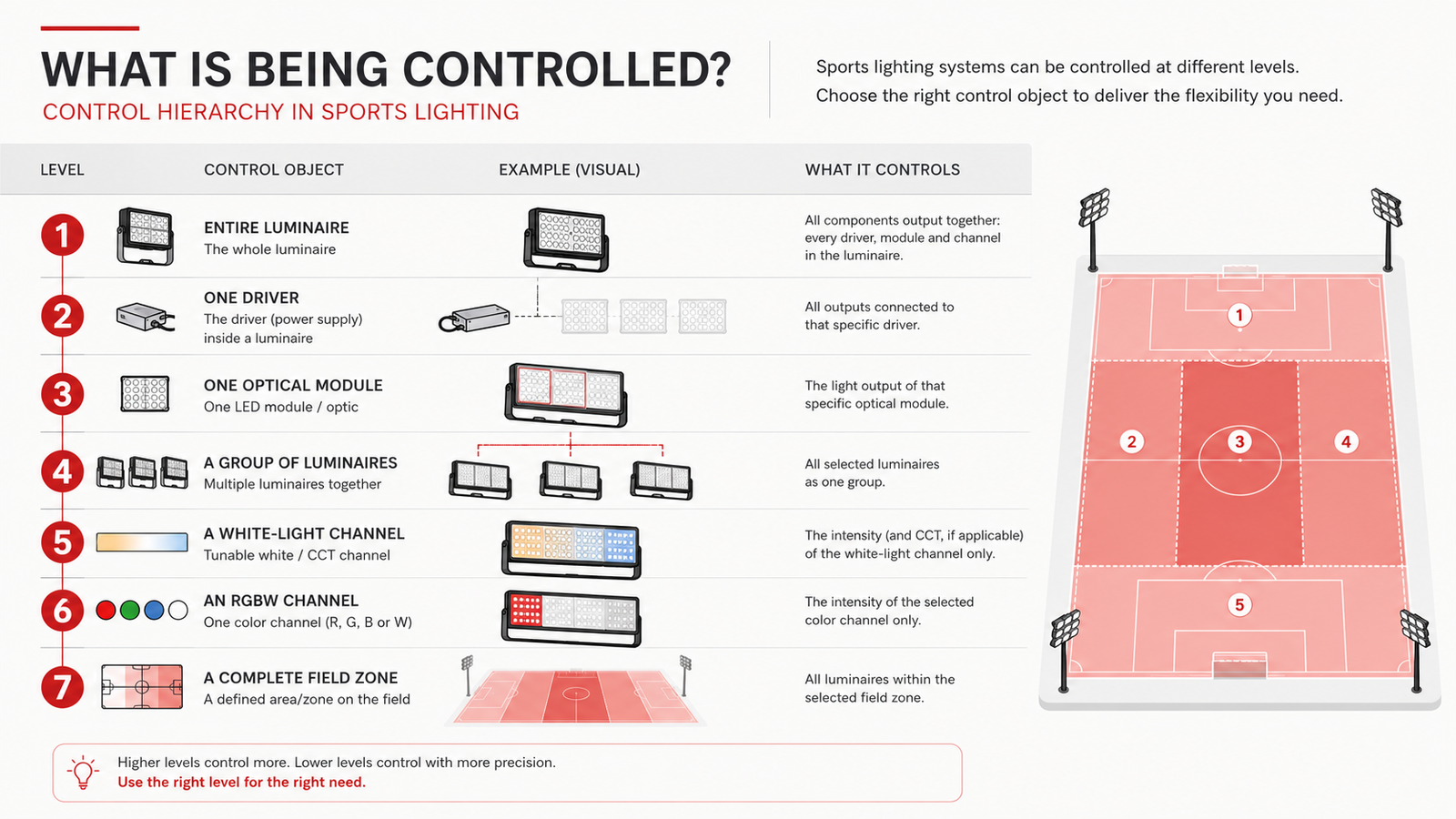
The first question is: what is being controlled?
Possible control units include:
- An entire luminaire
- One driver
- One optical module
- A group of luminaires
- A white-light channel
- An RGB or RGBW channel
- A complete field zone
This distinction affects:
- Address quantity
- Cabling
- Programming
- Commissioning time
- Fault isolation
- Future maintenance
For example, an RGBW stadium luminaire may require separate control logic for competition white light and entertainment effects.
Protocol Support Must Be Specific
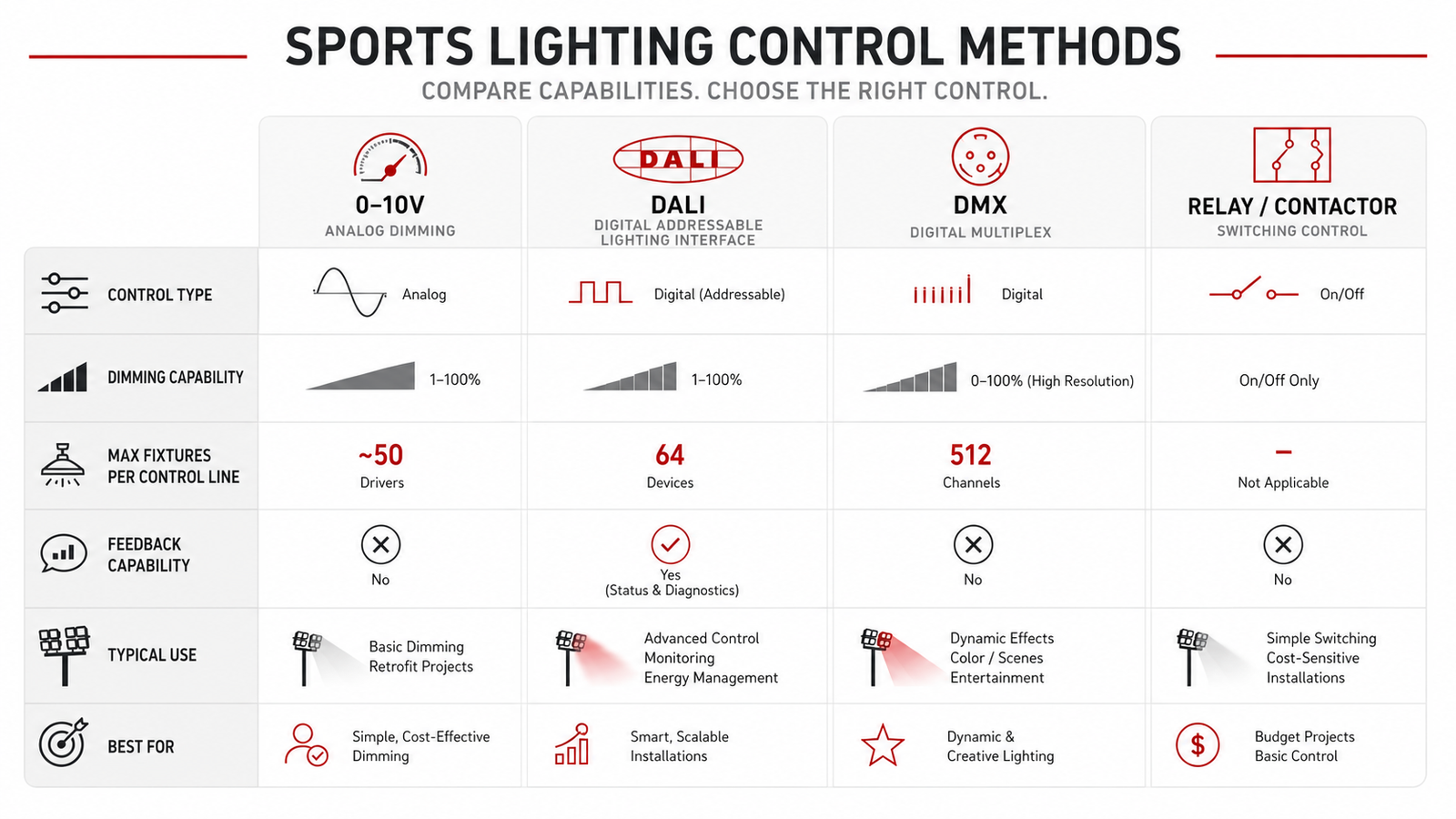
0–10V
Suitable for relatively simple dimming applications. It is widely understood but normally provides limited feedback and addressing capability.
DALI
Supports digital addressing, grouping and scene configuration. The actual system capability depends on the driver, controller and DALI implementation.
DMX
Commonly used for dynamic entertainment lighting because it supports rapid channel-based control. It requires careful addressing, network design and show programming.
Relay or Contactor Control
Still used for basic switching, emergency operation or legacy systems.
Writing “DALI/DMX optional” does not tell the project team how the system will work.
The product and project documentation should identify:
- Driver model
- Protocol version
- Dimming range
- Channel count
- Addressing method
- Required controller
- Required gateway
- Maximum cable distance
- Control wiring requirements
Fail-Safe Behavior Is a Safety Issue
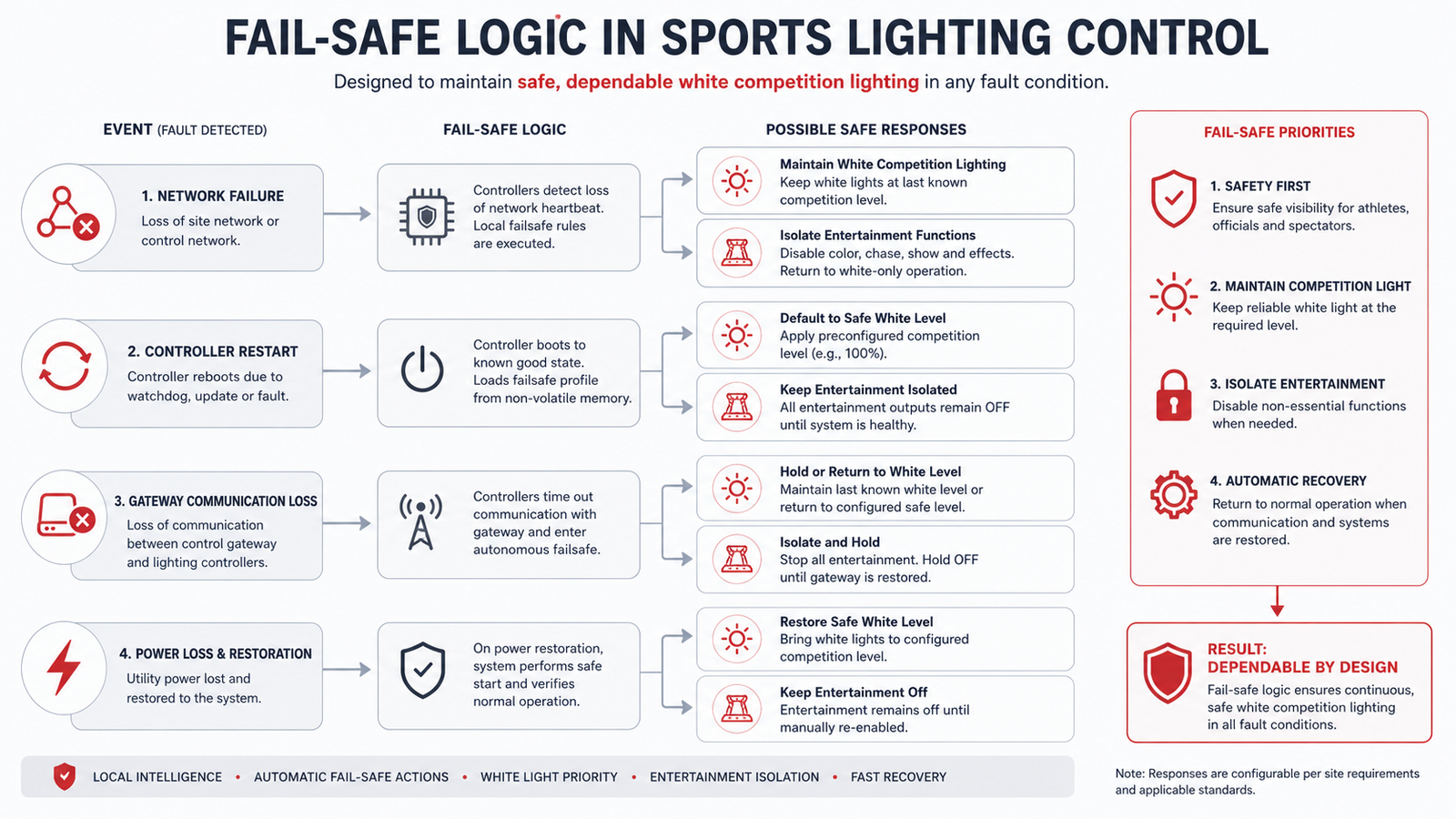
Sports lighting is part of venue infrastructure.
A communication fault should not create an uncontrolled or unsafe condition.
The design team should define what happens when:
- The control network fails
- The controller restarts
- A gateway loses communication
- Power returns after an outage
- A DMX signal disappears
- A scheduled command is missed
Possible responses include:
- Return to full output
- Maintain the last level
- Move to a preset level
- Switch to local control
- Shut down selected entertainment channels
The correct response depends on the venue and operating mode.
For competition lighting, maintaining safe white-light operation is normally more important than preserving an entertainment scene.
Local Manual Override Remains Essential
Even a highly connected venue should retain an appropriate local control method.
Manual override may be required during:
- Network maintenance
- Emergency response
- Controller failure
- Commissioning
- Temporary events
- System testing
The project should define:
- Where manual controls are located
- Which zones they operate
- Whether they override schedules
- How control is restored
- Who is authorized to use them
Clarify the Integration Boundary
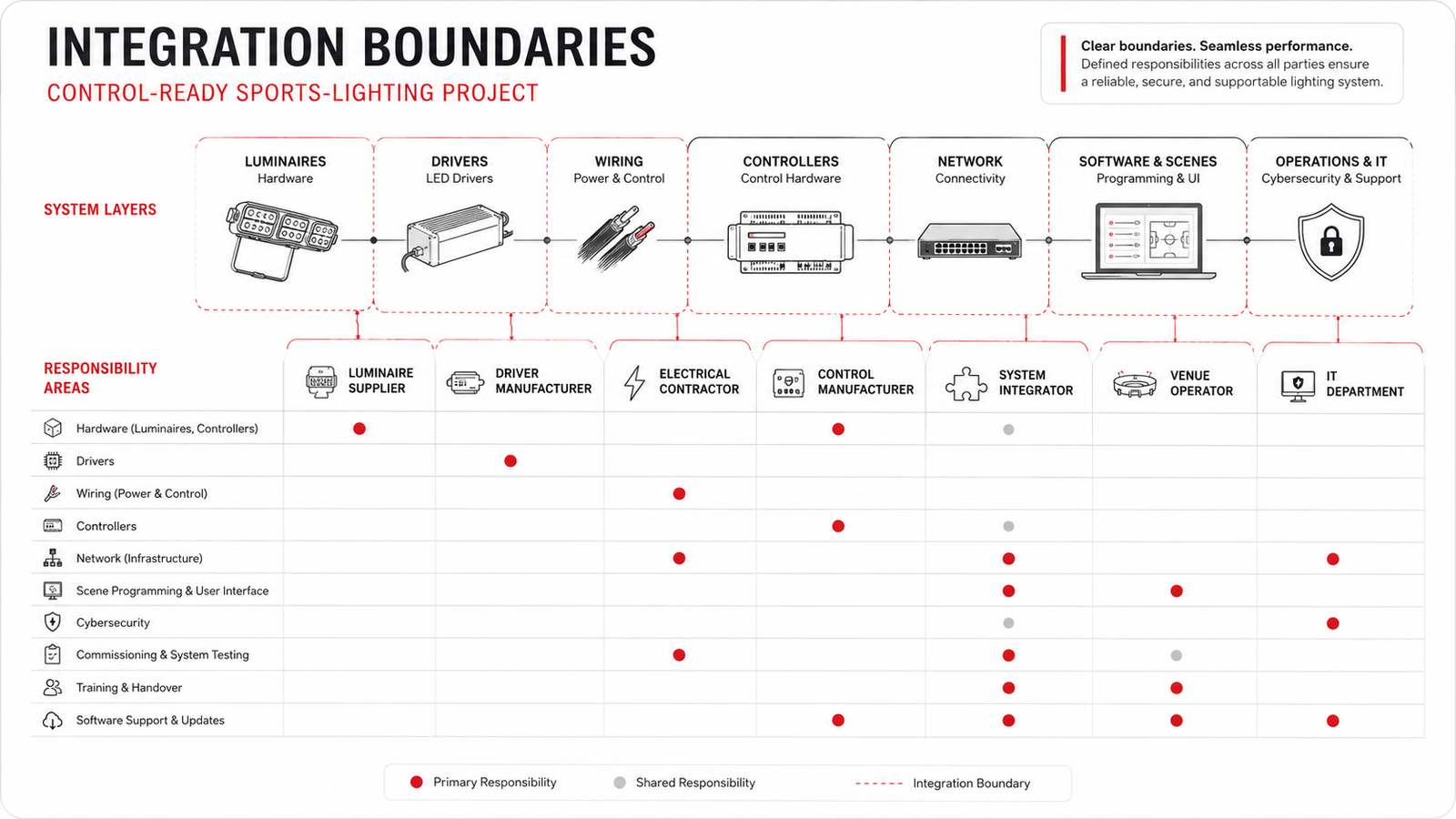
A luminaire manufacturer does not automatically provide the entire venue automation platform.
Responsibility may be divided between:
- Luminaire supplier
- Driver manufacturer
- Control manufacturer
- System integrator
- Electrical contractor
- Venue operator
- IT department
- The project should state who is responsible for:
- Luminaire hardware
- Drivers
- Control wiring
- Controllers
- Gateways
- Network infrastructure
- Scene programming
- Cybersecurity
- Commissioning
- User training
- Data storage
- Long-term software support
- Clear boundaries reduce disputes and prevent important tasks from being omitted.
Control-Ready Is a Credible Position
A lighting supplier does not need to claim that it provides a complete smart-stadium platform.
A more credible and useful role is to provide:
- Reliable luminaires
- Compatible drivers
- Defined control interfaces
- Electrical data
- Address schedules
- Failure-state information
- Commissioning support
- Third-party integration documentation
This allows the lighting system to function as a dependable execution layer within a larger venue management system.
AI Should Support, Not Replace, Engineering Decisions
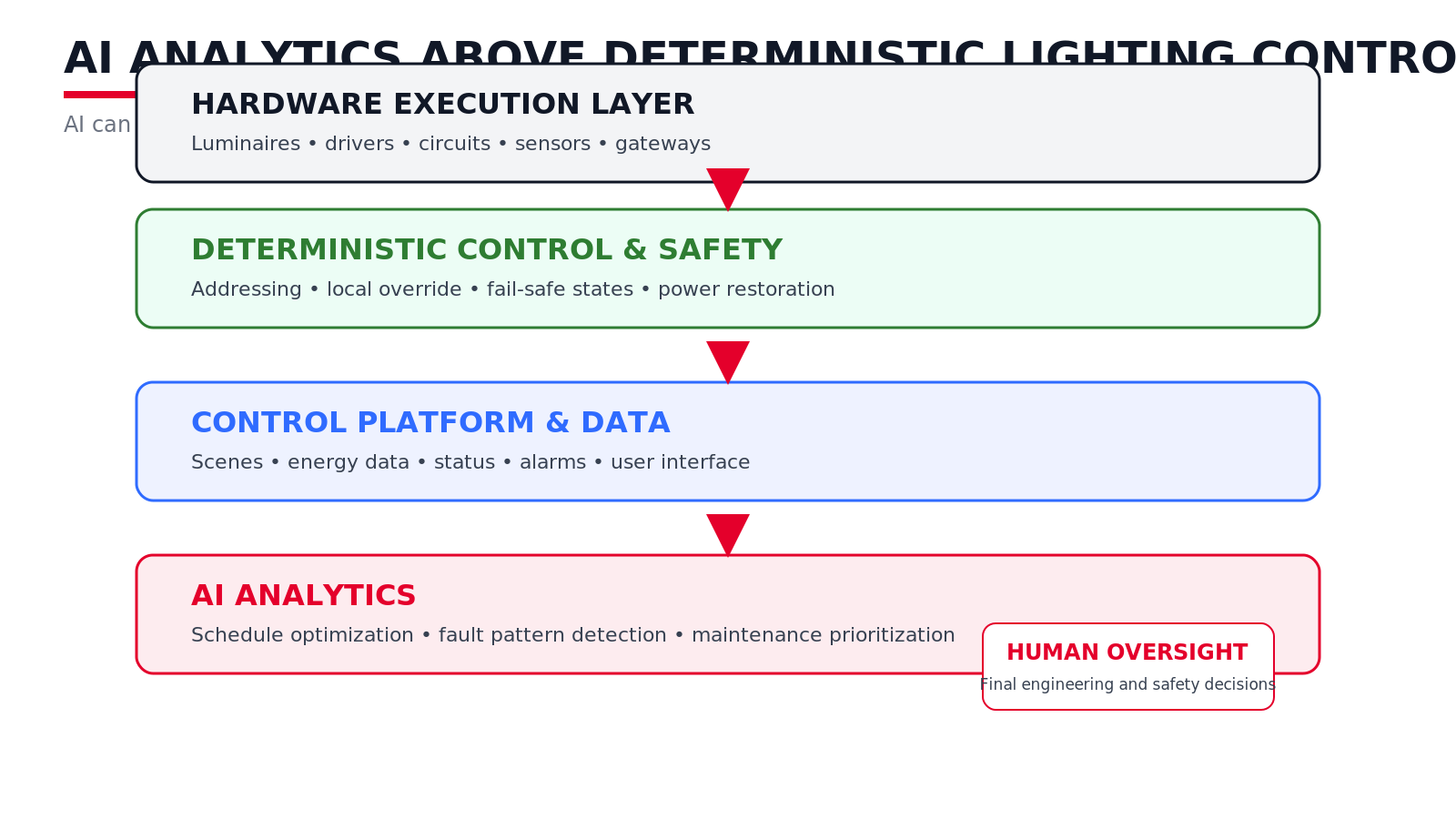
AI may help venue teams analyze:
- Operating schedules
- Energy use
- Fault patterns
- Maintenance records
- Occupancy trends
- Event requirements
However, AI should not independently determine safety-critical operating modes without verified rules and human oversight.
The lighting system still requires deterministic control behavior for:
- Competition
- Emergency response
- Communication failure
- Power restoration
- Maintenance
The most useful AI applications are therefore built on top of clearly defined hardware, control logic and project data.
FAQ
Does DALI or DMX support automatically make a luminaire smart?
No. The complete system also requires compatible drivers, controllers, addressing, programming, commissioning and failure-state planning.
Why should white light and RGBW effects be separated?
Separation helps ensure that competition lighting remains reliable even if the entertainment control system or network fails.
| ZC Lighting provides control-ready luminaire options for selected sports lighting products. Final control architecture should be confirmed with the project integrator before ordering. |