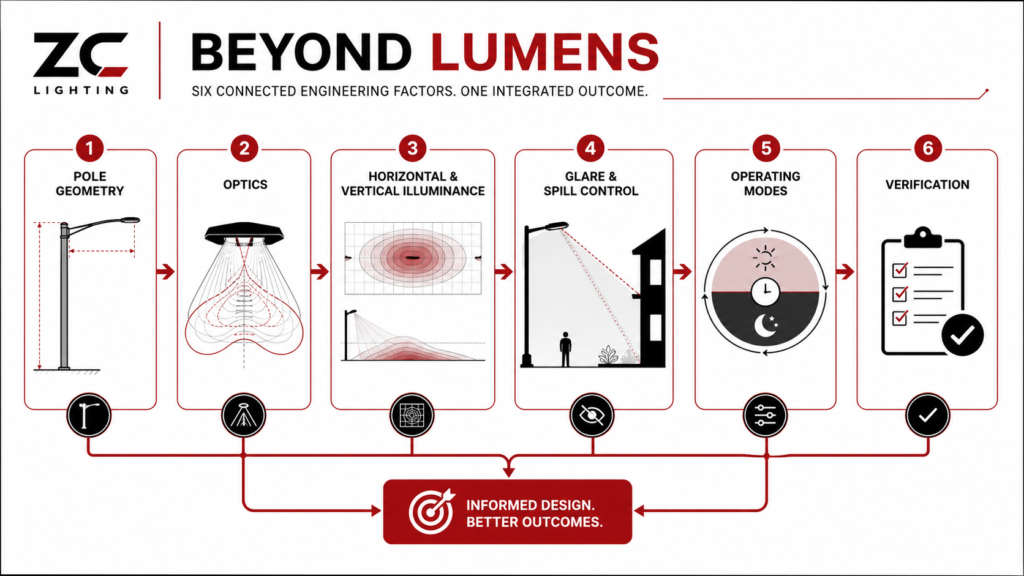
For a modern sports venue, the real question is not simply how much light a luminaire can produce. The more important questions are:
- Where does the light go?
- How does the beam interact with the pole layout?
- Can players, spectators and cameras see clearly?
- Can glare and spill light be controlled?
- Can the system operate reliably in different venue modes?
- Can the final result be measured and verified?
These factors are gradually redefining how professional sports lighting systems are designed, specified and evaluated.
Lumens Are Only the Starting Point
Lumens describe the total quantity of visible light emitted by a luminaire. They are useful when comparing products, but they do not explain how effectively that light reaches the required target.
Two luminaires with similar lumen output can produce very different project results because of differences in:
- Optical distribution
- Peak intensity
- Beam shape
- Light loss outside the field
- Aiming accuracy
- Mounting position
- Shielding
- Pole geometry
A luminaire with a higher lumen package may still require more fixtures if its optical distribution does not match the field dimensions and pole locations.
Conversely, a carefully selected beam may achieve the required illuminance with better uniformity, lower glare and less spill light.
The correct unit of evaluation is therefore not the luminaire alone. It is the complete lighting system.
Pole Geometry Determines Optical Performance
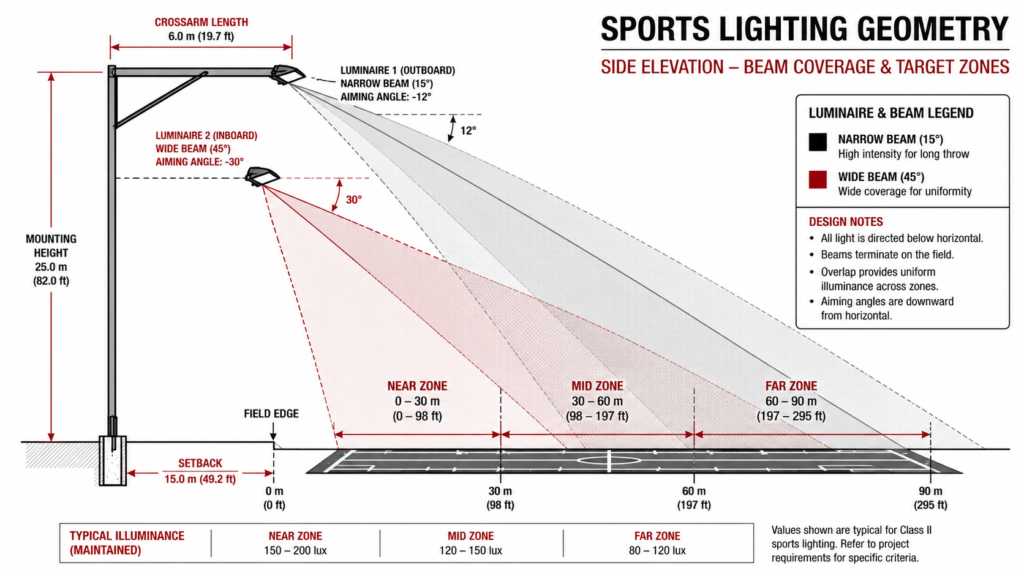
Every sports lighting design begins with the physical relationship between the field and the mounting structure.
Important inputs include:
- Pole height
- Pole setback
- Pole spacing
- Crossarm width
- Fixture mounting position
- Field dimensions
- Target points
- Spectator and camera locations
A narrow beam installed on a low pole may create intense bright areas and poor uniformity. A wide beam installed too far from the field may waste light outside the playing surface.
The same luminaire can perform well in one pole arrangement and poorly in another.
This is why wattage and beam angle should not be selected before the site geometry has been reviewed.
Horizontal Illuminance Is Not Enough
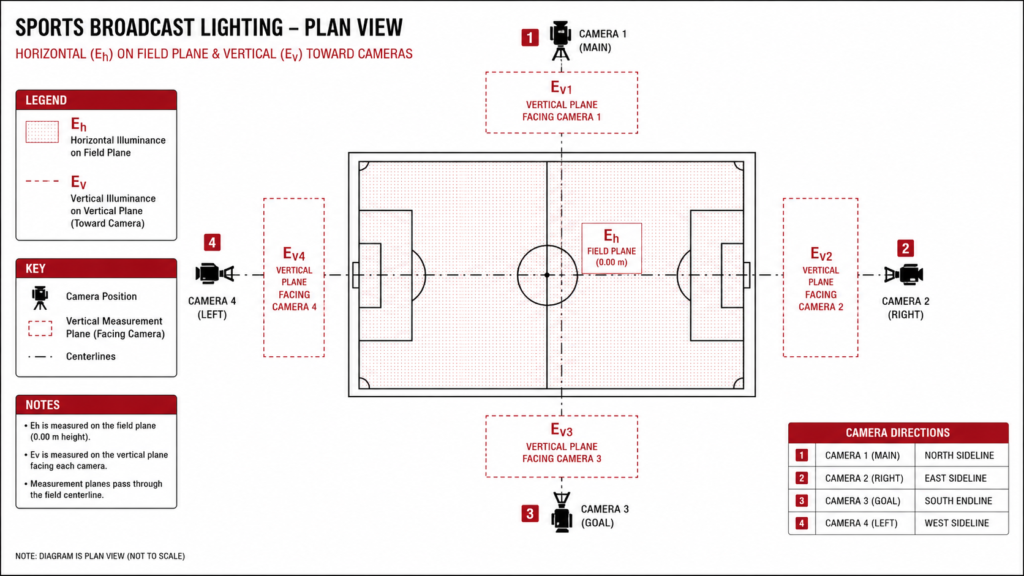
Horizontal illuminance remains one of the basic criteria in sports lighting. It affects the visibility of field markings, playing surfaces and objects close to the ground.
However, many sports also require sufficient vertical illuminance.
Vertical illuminance helps players, spectators and cameras see:
- Athletes’ faces
- Balls moving through the air
- Player movement
- Uniform colors
- Objects viewed from different directions
For broadcast venues, vertical illuminance must often be evaluated toward multiple camera positions.
A field may have a high average horizontal illuminance and still appear flat or poorly balanced on camera if the vertical lighting is insufficient.
Professional sports lighting therefore requires a coordinated evaluation of:
- Average horizontal illuminance
- Horizontal uniformity
- Vertical illuminance
- Camera-facing illuminance
- Glare
- Color quality
- Flicker performance
Glare and Spill Light Are System Outcomes
Glare cannot be controlled by a product label alone.
It is influenced by:
- Luminaire intensity
- Aiming angle
- Pole height
- Setback
- Observer position
- Shielding
- Beam overlap
- Background brightness
The same principle applies to spill light and backlight.
A visor or cutoff accessory can help reduce unwanted light, but the final result still depends on the complete installation.
A credible low-glare claim should therefore be supported by project-level information, including:
- Luminaire position
- Aiming data
- Boundary calculations
- Glare evaluation
- Site measurements
- Operating schedules
Modern Venues Need Multiple Operating Modes
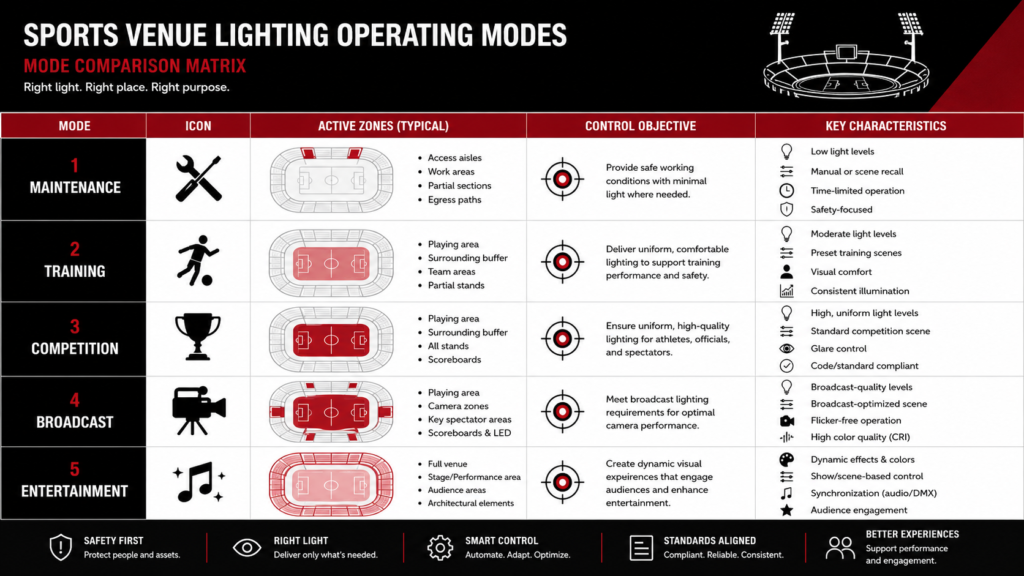
Sports venues rarely operate at full output during every hour of use.
A typical facility may require separate settings for:
- Maintenance
- Community use
- Training
- Competition
- Broadcast
- Entertainment
- Emergency operation
A well-designed control strategy can reduce unnecessary energy use while preserving the required lighting performance for each activity.
However, control capability should be described in practical engineering terms.
A project team needs to understand:
- What is being controlled
- Which protocol is used
- Whether luminaires are controlled individually or in groups
- What happens during communication failure
- How local manual control is provided
- Who is responsible for programming and commissioning
“Smart control available” is not enough information for a professional project.
Verification Completes the Design Process
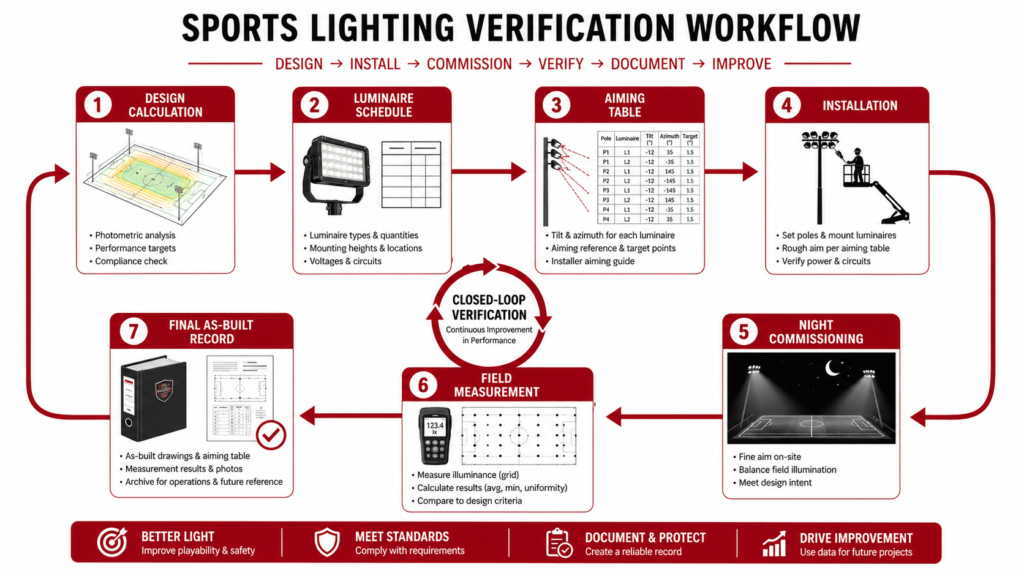
A simulation report predicts how a lighting system should perform. It does not prove that the installed system matches the design.
Differences may result from:
- Installation tolerances
- Incorrect aiming
- Changed fixture positions
- Different optical configurations
- Supply voltage
- Site obstructions
- Surface reflectance
- Measurement methods
A complete sports lighting project should therefore include:
- Design calculations
- Luminaire and optical schedules
- Aiming tables
- Installation records
- Nighttime commissioning
- Field measurements
- Final as-built documentation
This creates a traceable connection between the original design and the completed project.
The New Standard of Professional Sports Lighting
The next stage of sports lighting competition will not be determined by who offers the highest wattage or the largest lumen figure.
It will be determined by which supplier can provide:
- Reliable luminaires
- Suitable optical distributions
- Engineering-ready data
- Clear control interfaces
- Accurate commissioning information
- Verifiable field performance
- Long-term maintenance support
Professional sports lighting is no longer simply a product purchase.
It is a piece of venue infrastructure that must be designed, integrated, commissioned and maintained throughout its operating life.
FAQ
Are more lumens always better for sports lighting?
No. More lumens do not automatically improve uniformity, glare control or vertical illuminance. Optical distribution and site geometry are equally important.
Why should installed lighting be measured after commissioning?
Field measurement confirms whether the actual installation matches the design and helps identify aiming, configuration or installation errors.