Hero Summary
Ask most people what determines the performance of a sports lighting system, and the answer is usually straightforward:
→ Pole height.
It seems logical. A taller pole should illuminate a larger area, while a shorter pole should reduce installation costs.
However, experienced lighting engineers rarely begin with pole height.
Instead, they start with a much broader question:
→ What is the geometry of the lighting system?
Pole height is only one part of that geometry.
The horizontal distance between the pole and the playing field, the number of poles, the position of each mast, the aiming direction of every luminaire and even the surrounding environment all influence how light reaches the field.
Two stadiums with exactly the same 25-metre poles can deliver completely different lighting performance if their pole positions are different.
This is why professional sports lighting design is not about selecting the tallest pole.
It is about creating the correct lighting geometry.
Introduction
When planning a football field, stadium or training ground, one of the earliest engineering decisions is where the lighting poles should be installed.
This decision is often made before luminaires are selected, before photometric simulations begin and sometimes even before the final field layout is confirmed.
Unfortunately, many projects simplify the discussion into one question:
→ How tall should the poles be?
In reality, pole height alone tells us very little.
Imagine two identical football fields.
Both use four poles, each 25 metres high.
At first glance, the two projects appear identical.
But there is one difference.
In the first project, the poles are installed only two metres behind the touchline.
In the second project, the poles are positioned eight metres behind the touchline.
Everything else remains the same.
The lighting performance, however, will be completely different.
The reason is simple.
Lighting design is governed by geometry, not by a single dimension.
This article explains how professional engineers evaluate pole geometry and why pole setback, field proportions and luminaire aiming are often more important than pole height itself.
How Engineers Determine Pole Geometry for Sports Lighting
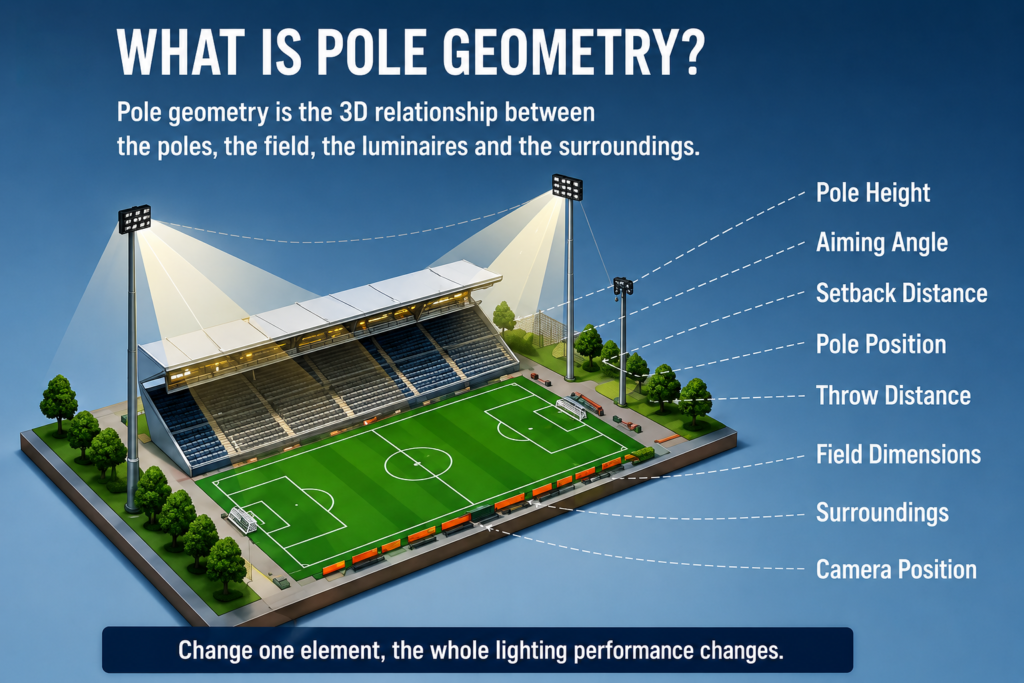
1. What Is Pole Geometry?
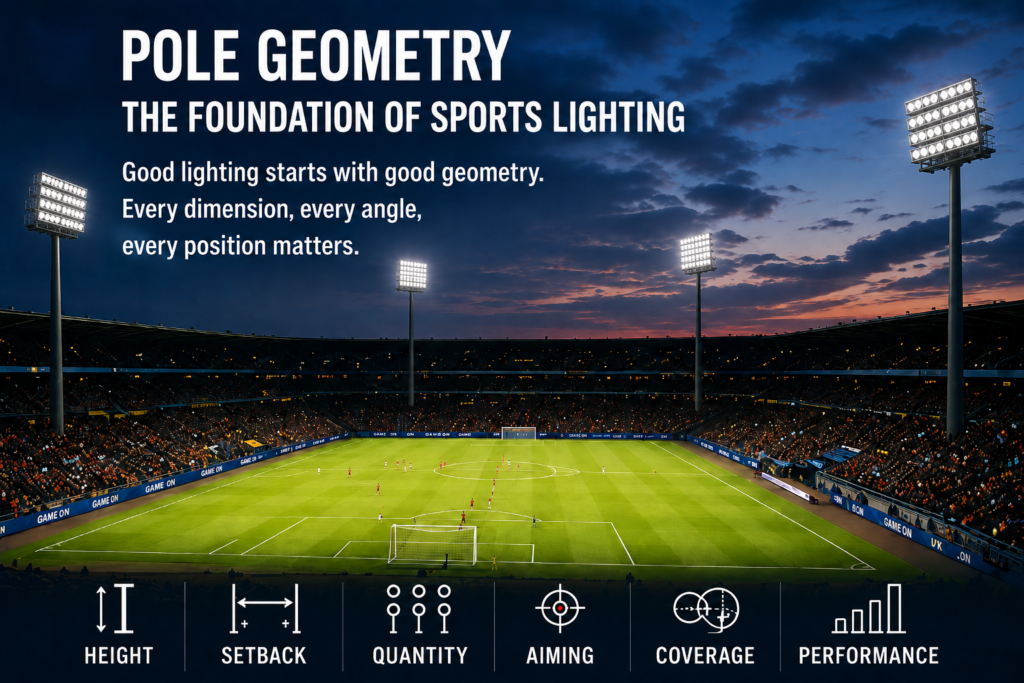
Pole geometry describes the spatial relationship between:
- Pole height
- Pole setback
- Pole spacing
- Field dimensions
- Luminaire aiming directions
- Throw distance
- Camera positions
- Spectator locations
These elements work together to determine how light reaches the playing surface.
Changing any one of them changes the performance of the entire system.
A common mistake is to optimise one parameter—such as pole height—without considering the rest of the geometry.
Professional lighting design treats the entire system as a three-dimensional problem.
2. Pole Height Is Only One Dimension
Pole height defines the vertical position of the luminaires.
It influences:
- Throw angle
- Beam selection
- Maintenance strategy
- Structural loading
- Wind exposure
But height does not determine lighting quality by itself.
A higher pole does not automatically provide:
- Better uniformity
- Lower glare
- Higher broadcast quality
- Better energy efficiency
Those outcomes depend on how the rest of the geometry is designed.
In practice, pole height is often constrained by:
- Local planning regulations
- Airport restrictions
- Budget
- Existing structures
- Wind requirements
Engineers therefore optimise the remaining geometry rather than simply increasing height.
3. Why Pole Setback Changes Everything
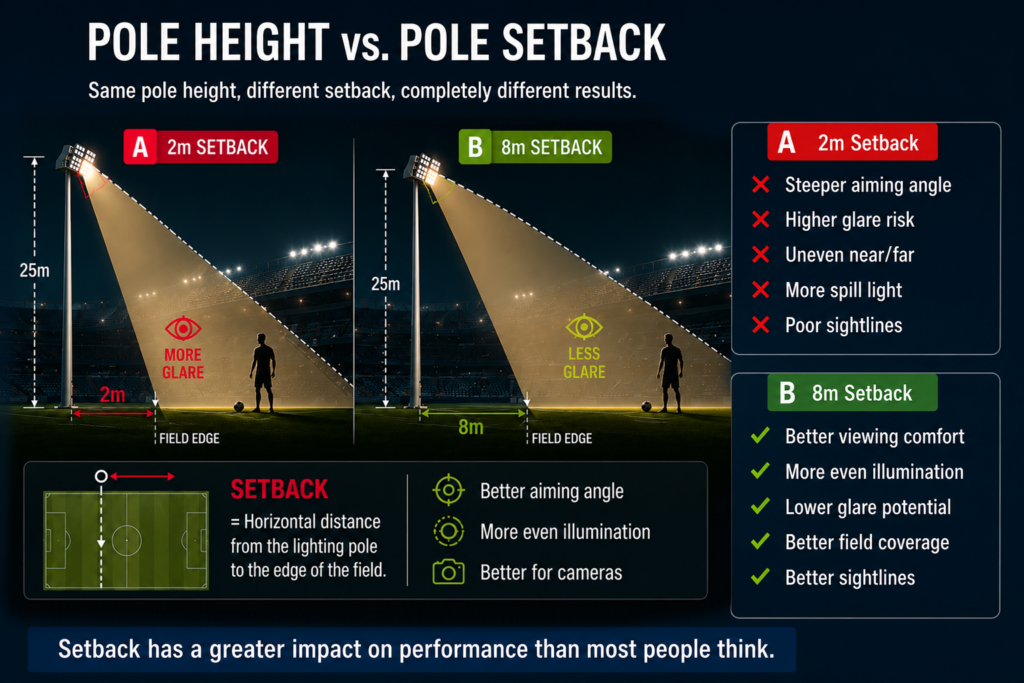
It is one of the most underestimated variables in sports lighting.
Consider two examples:
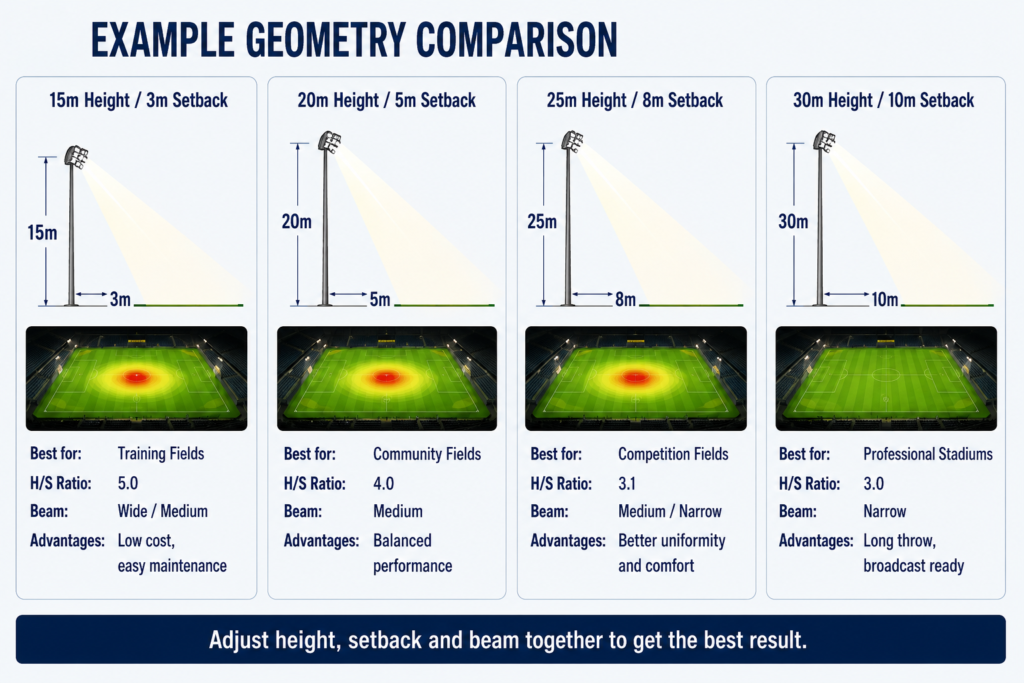
Layout A
- Pole height: 25 m
- Setback: 2 m
Layout B
- Pole height: 25 m
- Setback: 8 m
Although both systems use identical poles, the second layout requires:
- Longer throw distances
- Narrower beam distributions
- Different aiming angles
- Different overlap between luminaires
At the same time, the increased setback may:
- Improve player sightlines
- Reduce direct glare
- Create more space around the field
- Reduce interference with spectator circulation
Conversely, placing poles too close to the field may shorten the throw distance but increase glare because luminaires remain within the player’s upward field of view.
For this reason, engineers rarely discuss pole height without discussing setback.
The two variables should always be evaluated together.
4. The Height-to-Setback Ratio
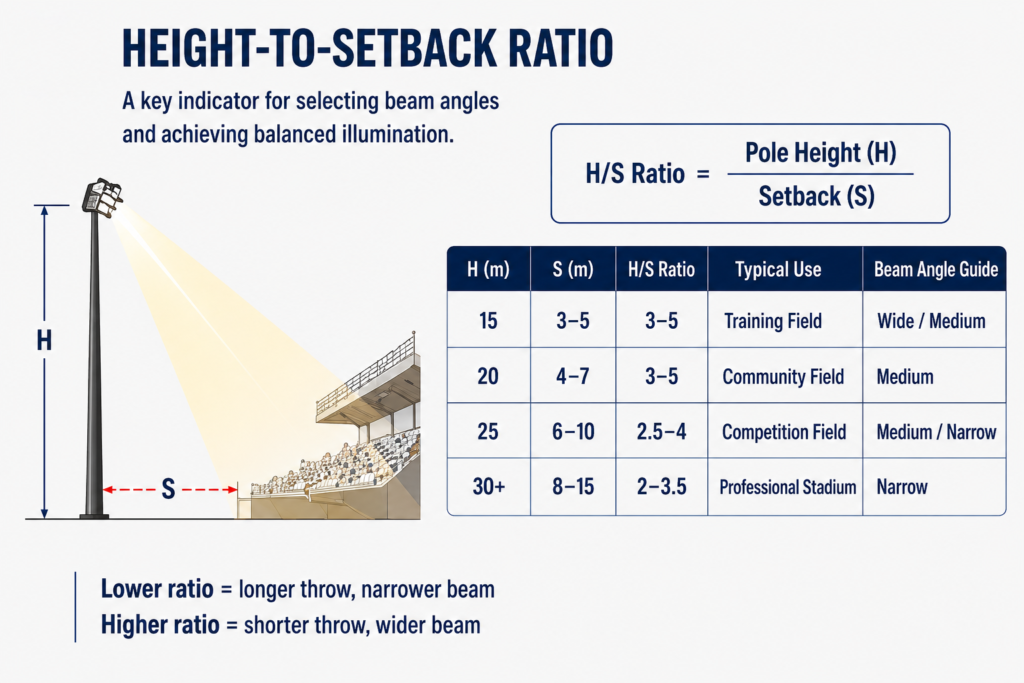
Rather than asking,
→ How high should the poles be?
A more useful engineering question is:
→ What is the relationship between pole height and setback?
This ratio determines:
- Viewing angles
- Beam coverage
- Luminaire tilt
- Near-field brightness
- Long-throw performance
A balanced height-to-setback ratio allows luminaires to illuminate the field efficiently without excessive tilt or wasted light.
It also provides greater flexibility when selecting beam angles.
5. Pole Quantity Changes the Geometry
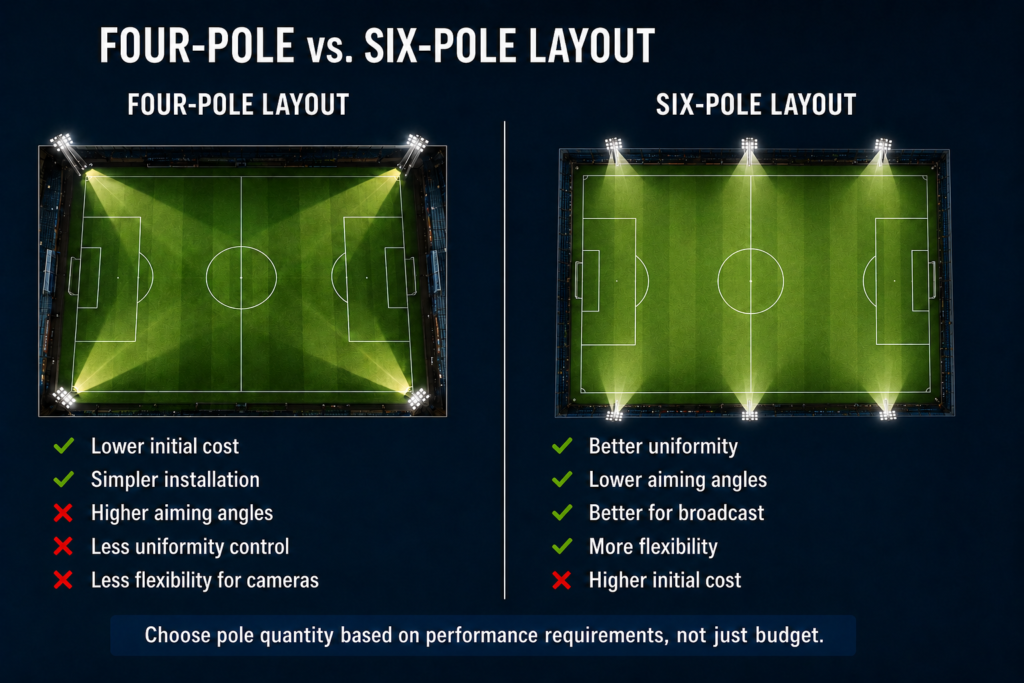
Pole geometry is not only about where one pole stands.
It also depends on how many poles are used.
A four-pole layout creates a very different lighting pattern from a six-pole or roof-mounted system.
Instead of asking,
→ Four poles or six poles?
Professional designers ask,
→ Which layout best matches the required lighting class, field size and surrounding constraints?
The answer depends on geometry—not preference.
6. Geometry Determines Luminaire Aiming
Every luminaire should illuminate a specific target zone.
This means aiming angles are defined by geometry.
If the geometry changes, every aiming angle changes.
This is why copying aiming angles from another project rarely produces the same results.
Even two football fields with identical dimensions may require completely different aiming if:
- The poles are located differently.
- The spectator stand is higher.
- The roof blocks certain angles.
- The broadcast cameras are positioned elsewhere.
Good lighting begins with good geometry.
7. Camera Geometry Is Part of Pole Geometry
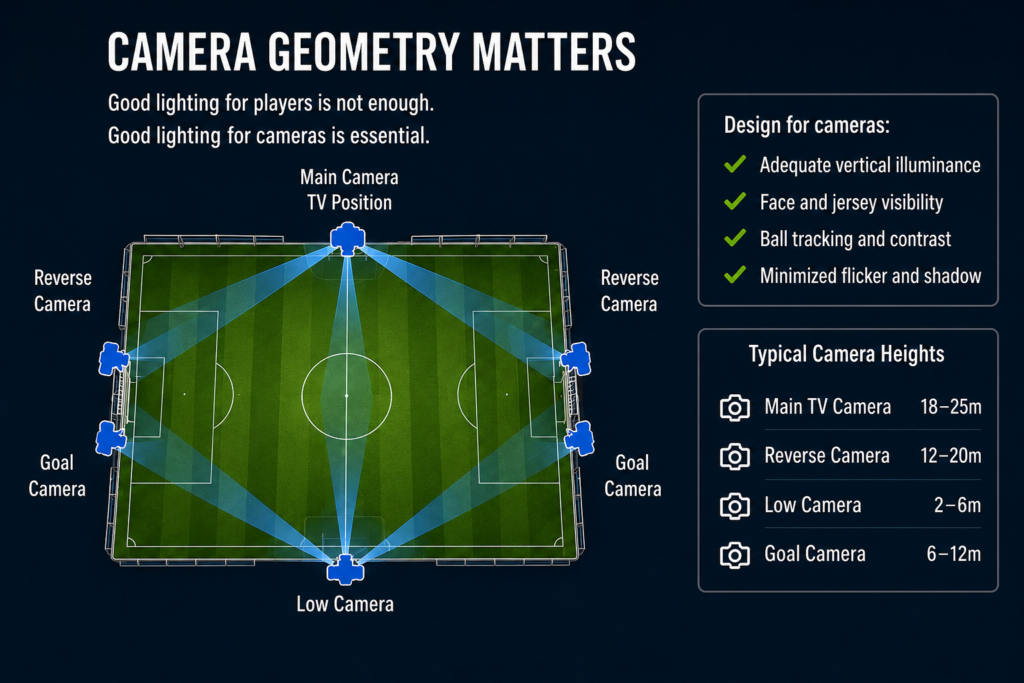
Modern sports lighting must also consider cameras.
Broadcast cameras view the field from fixed locations.
Lighting should therefore illuminate not only the playing surface but also the vertical planes visible to those cameras.
Changing pole position changes the direction from which players are illuminated.
This directly affects:
- Facial visibility
- Ball tracking
- Slow-motion replay
- Image contrast
For broadcast venues, camera geometry is just as important as field geometry.
8. Geometry Influences Maintenance
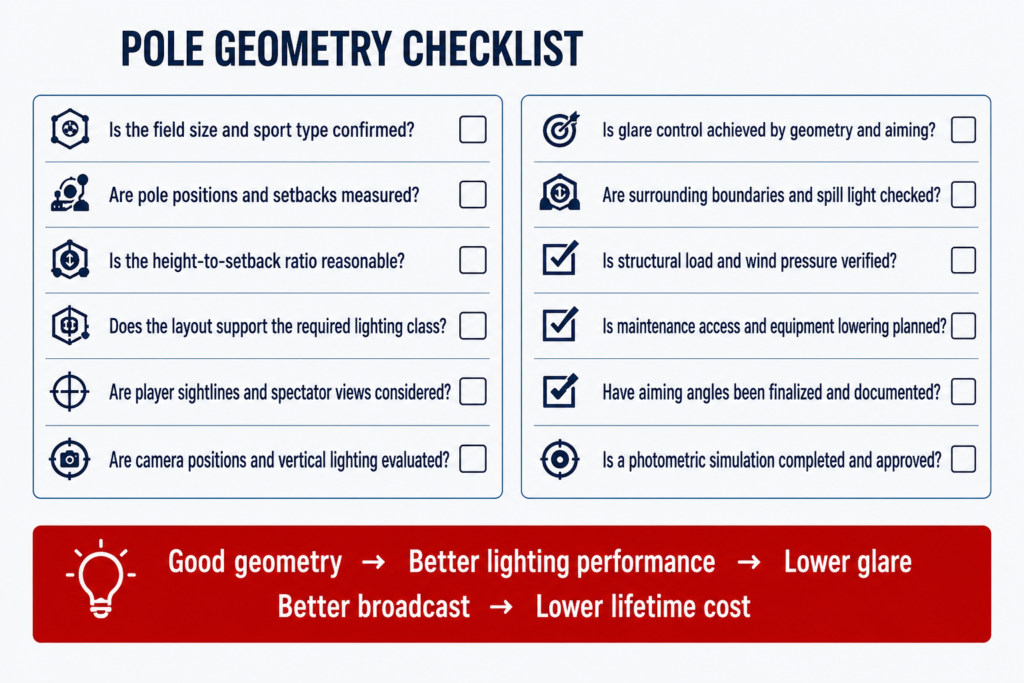
Pole geometry also affects long-term operation.
Questions include:
- Can maintenance vehicles reach the poles?
- Is there enough clearance behind the stands?
- Can luminaires be lowered safely?
- Is roof access easier than mast access?
A technically excellent lighting design can become expensive if maintenance geometry is ignored.
9. A Practical Pole Geometry Workflow
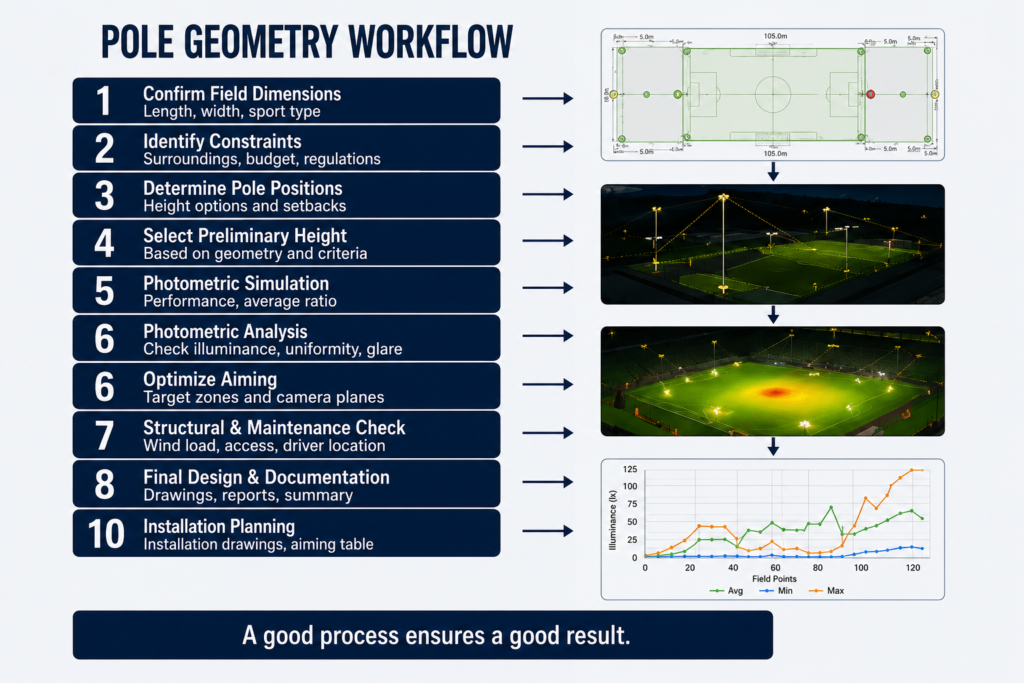
Professional engineers typically follow this sequence:
- Confirm field dimensions.
- Identify surrounding constraints.
- Determine possible pole locations.
- Evaluate setback distances.
- Select preliminary pole heights.
- Simulate lighting performance.
- Optimise luminaire aiming.
- Check maintenance access.
- Review structural loading.
- Finalise the installation layout.
Notice that pole height is only one step in the process—not the starting point.
Conclusion
The question should never be:
→ How tall should the lighting poles be?
Instead, ask:
→ What pole geometry will deliver the required lighting performance?
Professional sports lighting is the result of geometry, optics and engineering working together.
Pole height is important.
Pole setback is equally important.
Pole quantity, aiming, maintenance access and camera positions complete the picture.
When these elements are considered as one integrated system, the result is better lighting, lower glare, improved broadcast quality and a more efficient installation.
That is why experienced lighting engineers design geometry—not just poles.