
introduce
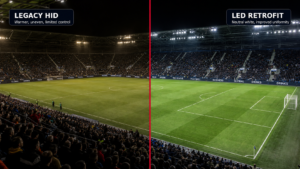
Replacing aging stadium floodlights with LED lights is often considered a simple upgrade. However, successful sports lighting renovation projects rarely begin with selecting new fixtures; rather, they start with understanding the existing lighting system.
Many retrofit projects fail to achieve their intended results because existing lighting systems are simply treated as replacements. Existing light poles are reused without structural assessment, beam angles are copied from previous installations, and luminaire selection is based solely on electrical automation standards. While these projects may reduce brightness, the lighting quality often falls short of modern standards.
Incomplete retrofit assessments can lead to common consequences such as uneven lighting, excessive glare, insufficient vertical illuminance for broadcasts, increased wind load on existing buildings, and increased installation costs.
Modern sports lighting design has seen significant advancements over the past decade. Today’s LED sports lighting systems offer higher optical efficiency, more precise beam control, more flexible power configurations, smarter control systems, and longer lifespans. However, these advantages are only truly realized when the retrofit process is based on engineering analysis and simple luminaire replacement.
Whether it’s upgrading and renovating a municipal football field, a school sports center, a professional stadium, or a multi-functional gymnasium, all successful renovations follow the same principle:
First, assess the existing system, then select a lighting solution.
This guide explains the engineering parameters that should be reviewed before replacing existing floodlights in sports stadiums and provides a formulaic approach for planning successful LED sports stadium lighting retrofit projects.
The page you need
- ports Lighting Solutions
- Football Field Lighting
- Stadium Lighting Design Guide
- FL19 Product Page
- FL18 Product Page
- FL26 Product Page
- Stadium Lighting Project Cases
- Contact ZC Lighting
1. Start with the existing structure, rather than starting with new devices.
The first step in any renovation project is to understand the existing infrastructure.
Many sports stadiums have been in use for two or three decades, employing metal halide floodlights mounted on steel poles or corrosion-resistant concrete towers. While these facilities may still appear to be in good condition, it is absolutely wrong to assume they can still withstand such structural strength.
A comprehensive assessment typically includes:
- High pole
- Rod material and type
- Structural status
- crossarm configuration
- Number of existing fixed installations
- Fixture weight
- Effective projected area (EPA)
- Wind exposure
- Basic conditions
- Maintenance Channel
Replacing a 30-kilogram metal halide lamp with a lighter 18-kilogram LED lamp does not automatically reduce the structural weight. The new lamp may have a larger frontal area, and an increased number of lamps may be needed to meet modern lighting standards.
Similarly, some retrofit projects increase the number of light fixtures while reducing the wattage of individual fixtures. While this approach may improve illumination more evenly, it can also alter the load distribution across the arm and pole.
Therefore, structural assessment should precede the selection of lighting fixtures.
2. Assess the performance of existing lighting.

A successful upgrade is not simply replacing old equipment with new equipment.
It is achieved by improving measurable lighting performance.
Before commencing any design work, the existing installation should be evaluated through on-site measurements or historical lighting design documents.
Key parameters include:
- Average illuminance
- Minimum Illumination
- Uniformity ratio
- Vertical illuminance
- Network distribution
- Color temperature
- Color rendering index
- Enhanced features
- Existing weapon angles
Many older facilities are no longer designed to meet current standards for employee comfort, television broadcasting, or community lighting.
Understanding the actual performance of the current system can provide a benchmark for optimizing the new system.
For example, a football stadium currently operating at 250 lux and experiencing lighting malfunctions may not need to simply increase the illuminance to 500 lux. Instead, the design goal might be to improve actual illuminance, reduce glare, and optimize beam control while maintaining the existing lighting.
3. Before selecting LED lighting fixtures, first clarify your lighting needs.
One of the most common mistakes in sports lighting renovation projects is selecting luminaires before determining the actual lighting needs.
LED technology offers a variety of power, optical, and control options, but they are worthless unless these specifications are matched to the intended use of the venue.
Different sports have completely different lighting requirements.
For example, community soccer fields used for nighttime training typically prioritize energy efficiency, illuminance levels, and low operating costs. Regional match venues may require higher illuminance, color rendering index, and better glare control. Meanwhile, professional spectator stadiums for television broadcasts must also meet requirements for vertical illuminance, anti-induction performance, and better consistency.
Before selecting any lighting fixtures, the project team should clearly define:
- Types of sports
- Competition level
- general audience
- Television broadcasting requirements
- Operational Plan
- Local lighting regulations
- Future Expansion Plan
Considering future flexibility is equally important.
Many municipal facilities initially served as training grounds but later evolved into venues for regional competitions. Choosing luminaires that support multiple beam patterns, dimming capabilities, or intelligent control allows venues to easily adapt to new needs when replacing their entire lighting system.
The goal is not just to install brighter lighting fixtures, but to create a lighting system that is suitable for the entire lifespan of the facility.
4. The choice of beam angle is more important than power.

When discussing sports lighting, buyers will naturally focus on the wattage of many lamps.
However, experienced lighting engineers know that the beam angle usually has a greater impact on the final lighting quality.
A luminaire with increased power may have lower usable illuminance than a luminaire with lower power if the optical distribution is not correct, even if the light source is correct.
The selection of the eastern region should be primarily determined by the following four main factors:
- High pole
- Throwing distance
- Site size
- Target lighting standards
For the spectator end of a high pole, narrow beams such as 10°, 15°, or 20° can illuminate a greater distance while maintaining sufficient intensity.
Medium-height football fields typically benefit from an optical angle of 20° to 30° to balance throwing distance and field coverage.
Training fields or facilities with lower installation heights typically require a wider stripe distribution between 40° and 60°, with higher brightness directly under a light pole, while maintaining uniformity across the entire playing area.
Modern standard sports lighting systems further enhance flexibility by combining different beam angles within the same device.
Instead of using the same optical elements in every luminaire, designers allocate narrower beams to distant locations and narrower beams to luminaires covering nearby areas.
This method can improve uniformity and overall system efficiency, while reducing this unnecessary light shortage.
5. Diarrhea control has now become a major design requirement.
In the past, brightness was usually considered the main indicator of lighting quality in sports lighting.
Excessive optics and brightness, coupled with a lack of currently applicable controls, are considered defects in lighting design.
Diarrhea can affect every participant in the stadium.
Team members experience visual inconsistencies when looking at the lighting fixtures installed high up.
The referee struggled to keep up with the fast-moving ball.
Nighttime matches can make spectators uncomfortable.
Televisions suffer from issues such as degraded image quality and visible light spots.
Residents around the sports complex are increasingly opposed to uncontrolled light relief facilities entering their residential areas.
In addition to these reasons, constipation light control has become one of the most important considerations in modern renovation projects.
Several engineering methods can effectively reduce diarrhea:

- Precision optical lenses
- Precise aiming
- Optimized installation angle
- Illuminated accessories
- Favorite glowing surface
- Reduce upward light output
- Appropriate number of fixing devices
Instead of viewing brightness accessories as optional add-ons, it’s better to consider them as part of the overall optical system when more stringent light control is required in the surrounding environment.
For projects located near residential areas, schools, or environmentally sensitive areas, an assessment should be conducted to determine whether they comply with local dark sky protection policies and outdoor lighting regulations before installation.
6. Inspect the power infrastructure

Lighting equipment is only one component of a successful renovation project.
The existing power infrastructure often determines whether the installation work can proceed smoothly or whether prior upgrades are required.
Before finalizing the fixture selection, the engineer should review:
- Input power
- Notepad
- Existing cables
- Circuit capacity
- Voltage stability
- Grounding system
- Surge protection
- Driver installation location
Many of the older students’ designs revolved around metal halide systems, whose electrical characteristics were quite different from those of today.
While LED lighting fixtures can generally reduce overall system temperature, starting current, control system, and driver configuration may require modifications to existing electrical installations.
Projects involving remote drives should also consider cable routing, maintenance access, and encapsulation.
Addressing these issues during the design phase can minimize debugging problems and reduce future maintenance costs.
7. Plan intelligent control from the beginning

One of the biggest advantages of LED sports lighting is not only its higher efficiency, but also its greater controllability.
Many facilities generally operate under different conditions.
Training courses.
School activities.
Community activities.
League.
Professional competition.
Maintenance operations.
The required lighting intensity varies for each activity.
Running all current lighting fixtures at 100% output power would waste energy and shorten the lifespan of the equipment throughout the year.
Modern control systems enable assessment operators to create predefined lighting scenarios for different application scenarios.
Typical functions include:
- Planned Operation
- Multi-level dimming
- Independent lighting control
- Remote monitoring
- Fault notification
- Energy Report
- Event lighting scenes
- Integration with building management system
Even if an advanced control system is not installed immediately, the renovation project should still have enough interfaces for future upgrades.
Planning for intelligent control during the initial renovation phase is cheaper than installing a previously modified system.
8. Select a suitable LED sports lighting solution

Once project requirements are clear, structural assessments are completed, and lighting objectives are confirmed, the selection of lighting fixtures becomes a logical engineering decision, rather than a sales decision.
The goal is not to find the most powerful luminaires or the products with the highest lumen output, but to seek a solution that strikes a balance between optical performance, ease of installation, long-term reliability, and the best return on investment.
The following should be comprehensively evaluated:
- Optical performance
- System efficacy
- Fixture weight
- Effective projected area (EPA)
- Corridor angle options
- Diarrhea control ability
- Driver configuration
- Intelligent control compatibility
- Maintenance Channel
- Future scalability
For medium-sized training fields and municipal football stadiums, the most cost-effective lighting equipment may be the most valuable.
For on-site optics and television broadcasting applications, accuracy, vertical illuminance, color consistency, and lighting performance are more important than the cost of the luminaires themselves.
Sports lighting systems at all levels offer another advantage in renovation projects. Lighting designers have a wide range of models available, allowing them to configure different power levels using a common platform while maintaining consistency in optical performance and appearance.
This simplifies spare parts management and future maintenance, while providing greater flexibility for projects with different lighting requirements.
Professional lighting suppliers should not promote a single product for all application scenarios, but should recommend lighting fixtures based on project objectives.
For example:
| Project Type | Product recommendation logic |
| Community football field | Efficient renovation plan in the vicinity |
| Schools and training facilities | Flexible optical devices with low maintenance requirements |
| professional stadium | High-output precision lighting with broadcast-grade capabilities |
| High Pole Stadium | High-power system offering a variety of beam options |
Engineering-based recommendations are more convincing than simply comparing lumen output or such capabilities.
9. Common Mistakes in Stadium Lighting Renovation Projects
Many renovation projects fail not because of insufficient LED technology, but because the planning process ignores basic engineering principles.
The following errors recur in renovation projects around the world.
Accident Area 1: Power Supply Replacement Workstation Design
One of the most common assumptions is that a 1000-watt metal halide lamp should be directly replaced with a 1000-watt LED lamp.
This ignores differences in optical efficiency, beam control, and luminaire performance.
Lighting design should ultimately determine the choice of luminaires, not their wattage.
Mistake 2 – Ignoring existing utility poles
Existing utility poles may have been reliably used for decades, but adding heavier or more light fixtures without structural verification could introduce unnecessary safety risks.
The load capacity of the railings must be reviewed before procurement.
Mistake 3 — Performing a lighting simulation before selecting luminaires
Photometric calculations should be a guiding principle for the project, not a follow-up measure.
If the simulation is not successful, the target illuminance and uniformity can only be guessed.
Mistake 4 – Focusing only on horizontal illuminance
Players, referees, and television stations rely on far more than just average illuminance levels.
Uniformity, vertical illuminance, glare level, and optical control typically have a significant impact on visual performance.
Error 5 – Forgot to maintain
While some projects have optimized installation costs, they have created long-term maintenance difficulties.
The design should take into account the location of the drive unit, module replacement, cleaning channels, and spare parts supply.
Mistake 6 – Ignoring future needs
The facilities will continue to develop.
Today’s training ground may be tomorrow’s competition venue.
Choosing luminaires with flexible optical design, custom configuration, and intelligent control facilities helps protect future investments.
10. Recommended Workflow for Sports Lighting Retrofit
Successful renovation projects typically follow a structured engineering process.
Step 1
Conduct a survey of the existing facilities.
Collect information on site dimensions, pole locations, installation heights, electrical infrastructure, and existing lighting performance.
Step 2
Clear project objectives.
Determine the required lighting level, target standards, operational plans, and future development plans.
Step 3
Complete the structural assessment.
Check the condition of the pole, the weight of the lighting fixtures, environmental requirements, wind load, and the installation of sound absorption.
Step 4
Perform photometric simulation.
Before selecting the final product, evaluate the beam angle, aiming position, illuminance level, uniformity, fault light, and malfunction light.
Step 5
Choose lighting fixtures.
When selecting lighting fixtures, you should refer to the market specifications of the lighting fixtures used in engineering projects.
Step 6
Review and control systems.
Confirm dimming requirements, timing functions, remote monitoring, and future expansion capabilities.
Step 7
Installation and debugging.
Before project handover, the operating angle, lighting performance, and electrical condition must be restarted.
Following this project workflow can significantly reduce risk while improving lighting quality and long-term operational efficiency.
in conclusion
Upgrading sports lighting is far more complex than simply replacing light fixtures.
This presents an opportunity to improve safety, reduce operating costs, enhance the athlete experience, and prepare sports facilities for future needs.
The most successful projects begin with careful evaluation, not product selection.
By reviewing existing structures, understanding lighting objectives, selecting appropriate optical components, controlling heat generation, and planning intelligent operation, stadium owners can maximize the value of their investment while creating a lighting system that remains effective for many years.
Modern LED sports lighting is more than just providing more light.
Key areas are positioned with appropriate control , providing the right light in the right place .
Frequently Asked Questions
1. Can existing stadium columns be reused?
In many retrofit projects, the answer is yes. However, before confirming whether reuse is possible, the structural condition, pole height, wind load, luminaire weight, and relevant EPA regulations should be assessed.
2. Is the power output good?
No.
Optical efficiency, layout, and lighting design typically have a greater impact on the final lighting quality than the luminaire power itself.
3. Is a lighting simulation necessary?
Yes.
Professional photometric calculations help ensure that photometric, uniformity, and glare requirements are met before installation.
4. Why is controlling diarrhea becoming increasingly important?
Modern sports facilities increasingly serve athletes, spectators, television broadcasters, and the surrounding communities simultaneously.
Effective glare control can improve visual comfort while reducing unnecessary light spill.
5. Should smart control be introduced during the renovation process?
Yes, if conditions permit.
Even if advanced features are not installed immediately, preparing the infrastructure for future control upgrades provides long-term flexibility.
6. Can LED retrofitting reduce maintenance costs?
Overall, yes.
Compared to traditional LED lighting, LED lights typically require fewer replacements and have simpler maintenance plans.
7. What are the most important factors to consider during the renovation process?
Before choosing a product, please understand the project requirements.
All renovation projects should begin with an engineering assessment, not with an equipment comparison.
8. How can owners of stadium farewell halls maximize their long-term return on investment?
We consider not only optimizing initial equipment costs, but also structural safety, optical performance, maintenance strategies, intelligent control, and future expansion.