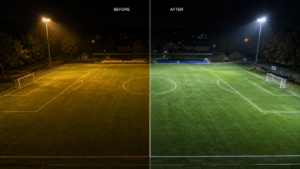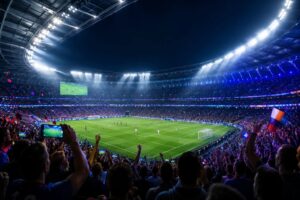
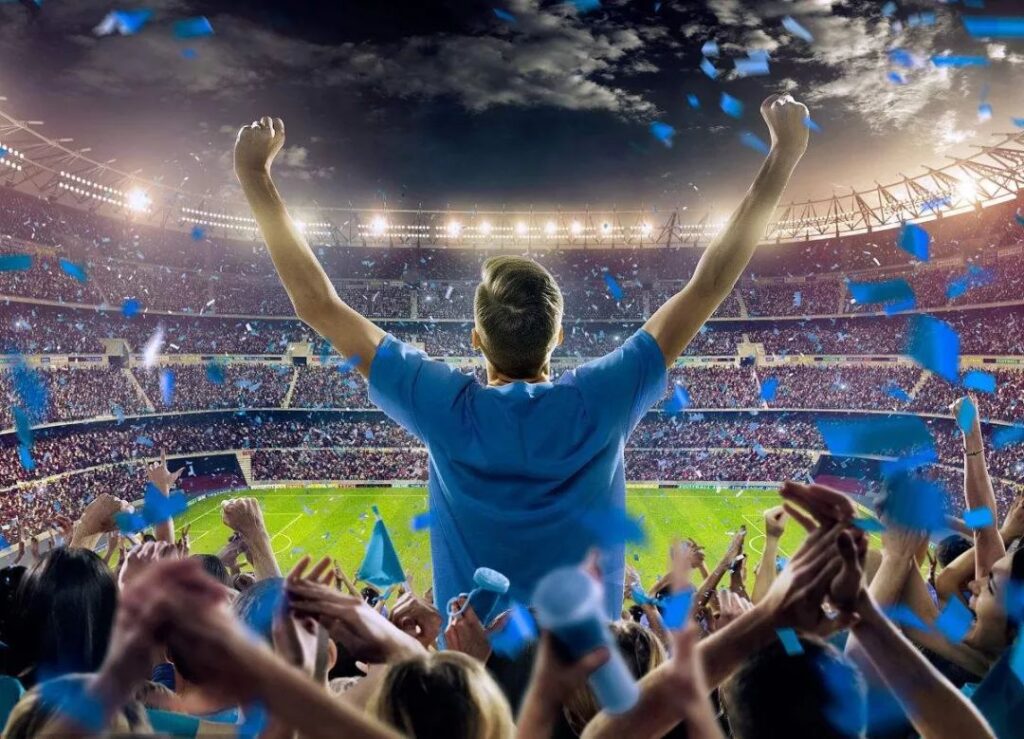
Modern football broadcasts demand higher image quality than ever before. Even if the final match footage looks bright, images shot in 4K and HDR formats can still suffer from unevenness, flatness, or out-of-focus issues.
This guide explains how FIFA’s broadcast lighting requirements affect stadium owners, EPC contractors, lighting consultants, broadcasters, and stadium investors. You will learn about some of the most important aspects: vertical illuminance, uniformity, lighting control, glare suppression, color quality, intelligent control, and long-term brightness.
Table of Contents
1. What are FIFA’s requirements for broadcast lighting?
2. Why are 4K and HDR changing stadium lighting?
3. Technical requirements for stadium broadcast lighting
4. Stadium lighting design and control strategies
5. Project process: From simulation to acceptance
6. Influencing factors, continuity, and return on investment
7. How to select LED stadium lighting that meets broadcast standards
Conclusion
What are FIFA’s requirements for broadcast lighting?
FIFA’s broadcast lighting requirements aim to ensure that football matches are presented clearly, consistently, and professionally on television. These requirements go beyond simply illuminating the stadium; they also aim to help television stations more accurately capture the movement of players and the ball, the color of the grass, sponsor billboards, and the atmosphere of the match, while minimizing visual distractions.
For 4K and HDR broadcasts, lighting systems must go beyond traditional sports lighting systems. They require higher vertical illuminance, better uniformity, more precise illumination, tighter glare control, and more stable color. Brighter lights aren’t always better; more controllable lights are often more valuable.
For professional sports stadium projects, ZC Lighting recommends evaluating lighting performance as a complete broadcast system, rather than just assessing the performance of individual floodlights. This is crucial for planned FIFA stadiums, Olympic venues, municipal infrastructure projects, or future smart city sports facilities.
**Indicators:** This is important for broadcasting; **Common Project Risks:** Horizontal illuminance provides a baseline for field strength. The stadium may appear bright, but the players may still appear dimly lit.
Vertical lighting: Improves player visibility on the Jerusalem map. Improves poor facial visibility and blurred player outlines.
Uniformity ratio: Reduces hot and dark areas. Reduces lens exposure differences within stadiums.
Color Rendering Index/TV Lighting Consistency Index: Improves color reproduction and camera color accuracy. Jerseys, skin tones, and grass look unnatural.
Light guide control: Protects the quality of slow-motion playback. Noticeable flickering may occur during high frame rate playback.
Glare control: Enhances the comfort of athletes, spectators, and fans. Reduces lens glare, uneven lighting, and unpleasant visual experiences.
Why are 4K and HDR technologies changing stadium lighting?
Early high-definition broadcasts were more tolerant of light conditions. Modern 4K and HDR images, however, are sharper, brighter, and more sensitive, making any light imperfections more noticeable.
4K sleep mode reveals more detail. HDR sleep mode delivers stronger startup performance. HFR slow-motion sleep mode captures light that the human eye might never perceive. This means that stadium lighting systems must be more stable, precise, and have more robust sleep capabilities than ever before.
For more details, please refer to the 4K Guide.
In 4K football broadcasts, the higher resolution makes the problem of insufficient lighting more prominent. Small dark areas become more noticeable, uneven image overlap is more apparent in close-up shots, and blurry player models are easier to spot.
Therefore, lighting fixtures like the FL18 GameAres LED stadium floodlights are more suitable for professional sports stadium environments than ordinary outdoor floodlights. Stadium lighting must strike a balance between visibility and broadcast image quality.
HDR has higher requirements for color reproduction.
HDR broadcasting captures brighter highlights and deeper shadows, resulting in more vivid and immersive visuals. However, this also places higher demands on display devices.
If the image contains bright highlights and deep purples, HDR technology will not only fail to mask them, but will actually exacerbate these tones. If glare is too strong, an HDR screen can make the image even more dazzling. Insufficient facial lighting can cause the pupils to flatten, thus affecting the professional look of the image.
Slow-motion playback requires better flash control.
High-performance fluorescent LED systems are often used in slow-motion playback. Although the lights may appear stable to the viewer, they can flicker and jitter in high-speed subway filming environments.
Professional broadcast-grade LED stadium lighting should employ stable drivers, low-ripple designs, and excitation-free control. For demanding broadcast environments, if optical control and broadcast performance are priorities, products such as the SP02 stadium LED floodlights may be considered.
Technical requirements for stadium broadcast lighting
Stadium lighting is a technical system that comprehensively considers factors such as photometry, illuminance, luminance, candela, spectral distribution, electrical protection, thermal engineering, and optical design. Good lighting performance stems from a balanced system, not just high power.
Vertical Lighting and Player Modeling
Vertical illuminance is one of the most important components of FIFA broadcast lighting. The focus is not only on filming stairs but also on shooting players from front, side, and diagonal angles.
Better vertical cues enhance facial contours, jersey silhouettes, athlete recognition, and depth. Insufficient vertical cues make the overall look darker, thinner, and less integrated with the layering and depth of the background.
Uniformity and Brightness Control
Uniformity determines the smoothness of the image. Poor uniformity can result in areas of bright light and dark shadow, requiring constant adjustments, which viewers will notice.
Better bridge overlap allows for smoother transitions. More precise aiming reduces harsh obstructions. Optimized optics enhance relay staircases. Custom systems, such as the FL08 series of custom LED sports and outdoor floodlights, support flexible beam distribution for different concert hall geometries.
Color Quality: Color Rendering Index (CRI), Television Lighting Consistency Index (TLCI), and Color Temperature (CCT)
While the CRI is important, it’s not comprehensive. CRI’s popularity reflects the ability to reproduce colors accurately. The Television Lighting Consistency Index (TLCI) is more relevant to television lighting.
For live broadcast lighting in stadiums, color consistency across the entire stage is crucial. A stable color temperature (typically determined by the project, around 5000K or 5700K) helps relays maintain better white balance. Good color distribution also helps to create a more natural look for jerseys, grass, skin tones, and sponsor advertising boards.
Diarrhea Light, Glare, and Environmental Control
Diarrhea light can be unsettling. It can also negatively impact player performance, distract spectators, and cause camera flare. Poor lighting can also affect nearby communities.
For municipal stadiums and urban sports parks, glare control, compliance with dark night standards, reduction of light pollution, and control of sky glare are becoming increasingly important. More efficient lighting systems project light precisely where it’s needed, while inefficient systems waste light in unnecessary areas.
Standards/Concepts Article Relevance Best Use: Content
FIFA Lighting Guidelines Football Broadcasting Authority For stadium lighting requirements
EN12193 Illuminance, Uniformity and Emission of Light in Sports Lighting Applicable to European Sports Lighting Reference
CIE Photometry and Light Science For Enhancing Technical Credibility
IEC 61000 Electromagnetic Compatibility and Surge Immunity For Electrical Protection Themes
DALI/DMX512 intelligent lighting controller for simulating scenes and controlling systems.
LM-80/TM-21 LED lumen maintenance rate, extended lifespan, and ensure long-term reliability
; ideal for stadium lighting design and control strategies.
Excellent broadcast lighting design begins with geometry. Pole height, pole position, mounting structure, beam angle, pointing angle, and beam position all affect the final broadcast image.
Pole layout and high mast lighting
A four-pole system may be simpler, but more expensive. A six- or eight-pole system may offer more even coverage and better shooting angles. Roof-mounted systems reduce pole exposure, but may present different aiming challenges.
For new stadiums, training grounds, ports, airports, and large sports centers, high-mast and large-scale LED lighting solutions offer useful design logic to achieve uniformity, wind resistance, ease of maintenance, and reduced harmful light.
Optical and aiming strategies
The choice of beam angle is crucial. Longer beam distances may result in lower gain; wider beams may have lower intensity. Non-beam modes are more effective, but may also have lower intensity. Non-beam modes can more effectively guide the beam towards the target area, thus controlling accuracy.
For broadcast targets, lens aiming should protect the line of sight to the focal length, reduce direct glare, increase vertical illumination, and avoid excessive clipping. Improving lens aiming is more cost-effective than redesigning the entire system after a failure.
Intelligent control: DALI, DMX512 and IoT monitoring
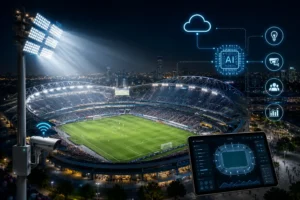
Modern sports stadium lighting is becoming increasingly intelligent. Technologies such as DALI, DMX512, IoT lighting control, adaptive lighting systems, and remote monitoring enable sports stadiums to create different scenarios for competitions, training, ceremonies, emergency modes, and broadcasts.
A complete LED lighting solution must consider not only the luminaire itself, but also control, dimming, reliability, maintenance, and future broadcasting needs.
Project Workflow: From Simulation to Acceptance
Sports stadium lighting systems should follow a clear workflow. Without standardized procedures, even high-quality products may perform poorly after installation.
Step 1: Simulation and Lighting Planning
Before procurement, the project should be reviewed using IES files, Dialux simulations, AGi32 analysis, NEMA beam patterns, and target angles. This helps to predict illuminance levels, vertical illuminance, glare, and uniformity before installation begins.
Step Two: Product Selection
Product selection should consider light control performance, driver quality, surge protection, IP66 or IP67 weather resistance, IK08 or IK10 shock resistance, aluminum alloy design, and corrosion resistance.
For stadiums, airports, and large outdoor facilities requiring lighting, the FL12 high-power LED stadium and airport floodlights can be used if high output, structural reliability, and long-distance projection are taken into consideration.
Step 3: Installation, Aiming, and Testing
Installation quality is just as important as product quality. The team should check the tilt angle, aiming point, pole alignment, electrical isolation protection, surge protection, and lightning protection.
After installation, testing includes horizontal illuminance, vertical illuminance, brightness, synchronized flash performance, recent playback checks, and glare observation. A project should not be accepted simply because the site “looks bright.”
Influencing factors, continuity and return on investment
Analog lighting is a long-term investment. Expensive luminaires may seem terrible at the time of purchase, but issues such as maintenance, durability, failed broadcast tests, and premature light decay can ultimately lead to higher costs.
Thermal Engineering and Consumption
A good thermal design can protect the LED chip, driver, bulb, and housing components. LM-80, TM-21, L70, and L80 are important indicators for evaluating long-term luminous flux maintenance.
Better thermal management means slower luminous flux decay. Slower decay means more stable exposure. More stable exposure means better broadcast quality over time.
Electrical and weather protection
Outdoor stadium lighting equipment faces numerous risks, including rain, high temperatures, dim lighting, strong winds, corrosion, and lightning strikes. Therefore, IP protection ratings, IK protection ratings, EPA protection ratings, wind resistance ratings, marine-grade protection, surge protection standards, and IEC 61000 standards are all crucial.
For residential areas, ventilated areas, mining areas, airports, and industrial sports parks, corrosion resistance may be more important than buyers initially expect.
Energy efficiency and ESG value
Compared to metal halide lamp systems, LED stadium lighting is generally more efficient, has a faster restart time, is more controllable, and is better suited for intelligent energy management.
Products | Metal halide lamp systems for LED stadium lighting
Energy efficiency | Low | High lumen/watt performance
Reboot speed | Slow warm-up | Instant switching
Control | Limited | Dimming, Scene, IoT Control
Maintenance | More thorough | Reduced maintenance requirements
Broadcast performance | Reduced flexibility | Improved indicator control and optical performance
For functional spaces that combine sports fields with warehouses, logistics areas, or training halls, industrial and high-bay LED lighting solutions can also support broader lighting upgrade initiatives.
How to select LED stadium lighting that meets broadcast standards
If you are planning a FIFA-level stadium lighting project, do not compare wattage alone. Wattage only tells you the power consumption and does not represent broadcast-quality lighting.
You should request photometric documents, indicator reports, driver information, beam angle options, thermal data, surge protection details, IP/IK rating, and simulation support from the supplier.
Key questions to ask before purchasing
Can the supplier provide IES files for simulation?
Does this system meet the vertical illuminance requirements?
Is this driver suitable for non-induced broadcasts?
Can optical components reduce light leakage?
Is this lamp windproof, rainproof, heat-resistant, and corrosion-resistant?
Does this lighting system support DALI, DMX512, or smart control?
Can the supplier provide support for the site selection and construction of sports venues?
ZC Lighting specializes in outdoor sports lighting and large-area lighting, providing professional LED solutions for demanding projects. If your stadium, sports park, municipal site, or EPC project requires technical support, you can request a lighting solution quote immediately during the project planning phase.
in conclusion
FIFA’s requirements for 4K and HDR broadcast lighting enhance survivability, accuracy, and stability, thereby creating a stable, user-friendly, and professional viewing experience.
Compared to traditional stadium lighting, broadcast stadium lighting requires higher vertical illuminance, higher luminous index, more uniform illumination, more precise color, better spectator glare control, and more intelligent system management. The difference lies in the fact that a basic system only illuminates the field, while a broadcast system must simultaneously meet the needs of the game, the spectators, and the stadium brand.
With the continuous development of 4K, HDR, HFR, and future 8K broadcast technologies, stadium lighting will become increasingly important. EPC contractors, stadium owners, municipalities, and sports investors should all view lighting as a strategic infrastructure decision, not just a simple product purchase.
Frequently Asked Questions
1. What are FIFA’s lighting requirements for 4K and HDR broadcasts?
These lighting performance requirements are designed to support professional football broadcasting. They focus on vertical illuminance, horizontal illuminance uniformity, flash control, light attenuation, color quality, and focused lighting performance suitable for 4K, HDR, and slow-motion playback.
2. Why is vertical illumination important for stadium broadcasts?
Vertical lighting helps to clearly capture a player’s profile and silhouette. It can improve facial contours, the three-dimensionality of the jersey, and…