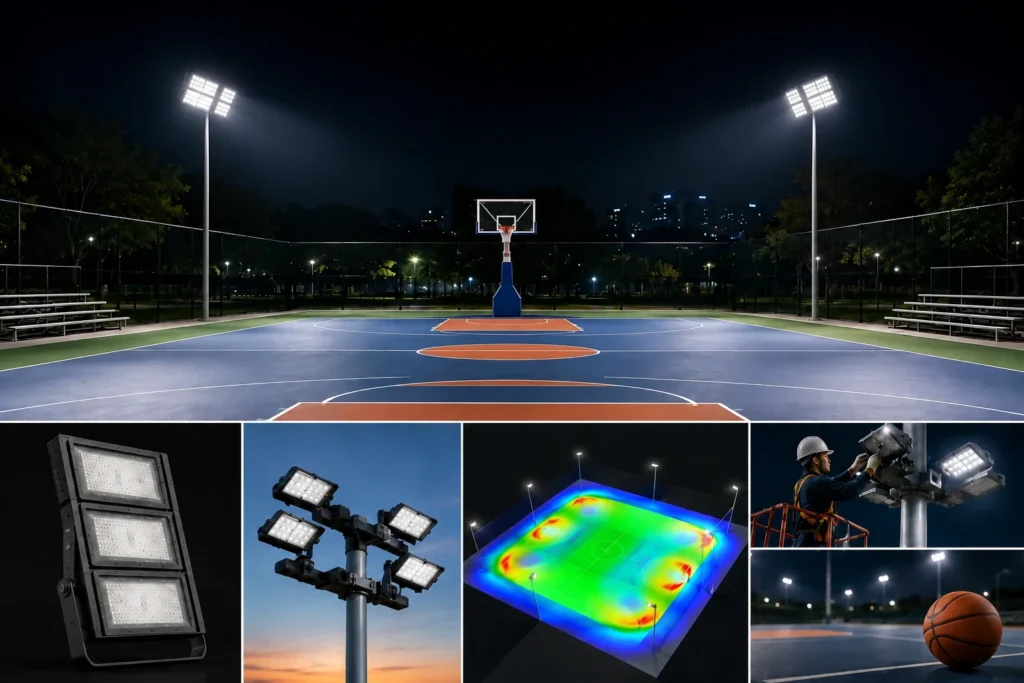
 Basketball court lighting affects more than brightness. A good LED system improves player safety, ball tracking, energy efficiency, and long-term maintenance. A poor system creates glare, dark zones, uneven lux, and higher operating costs.
In this guide, we explain LED basketball court lighting cost, installation, design, standards, fixture selection, and common mistakes. You can use it to plan a school court, municipal sports park, indoor gym, or professional outdoor basketball facility.
Why Basketball Court Lighting Design Matters
Many buyers compare basketball court lights by wattage. This method looks simple, but it often causes poor results. Higher wattage does not always mean better visibility. Better optics, better aiming, and better uniformity usually matter more.
A basketball court needs smooth and balanced light. Players need clear vision during shooting, passing, and fast movement. Spectators need visual comfort. Cameras need stable vertical illuminance. A strong basketball ighting design supports all three groups at the same time.
Good basketball lighting Improves Court Performance
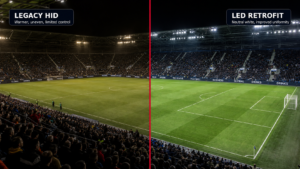
A professional LED basketball court lighting system improves ball tracking, player safety, referee visibility, and spectator experience. It also reduces glare and shadow problems. Compared with traditional floodlighting, modern LED systems provide sharper beam control and lower wasted light.
Uniformity Is More Important Than Peak Brightness
Uniformity controls how evenly light spreads across the court. A court with high peak lux but poor uniformity may still feel uncomfortable. Dark corners and bright hotspots make the game harder to follow. Better uniformity creates smoother visibility and a more professional court experience.
For large outdoor sports parks, court lighting may also connect with broader site lighting. A project can combine sports lighting with high-mast and large area LED lighting solutions to improve visibility around walkways, parking areas, and nearby activity zones.
Basketball Court Lighting Standards and Lux Levels
Basketball court lighting standards help engineers define safe and comfortable light levels. These standards usually consider horizontal illuminance, vertical illuminance, uniformity, glare, color rendering, and flicker control.
Professional projects may refer to EN 12193, ANSI/IES sports lighting guidance, FIBA venue recommendations, and NCAA basketball lighting practices. These references help engineers design courts for recreation, school use, competition, and broadcasting.
Recommended Basketball Court Lux Levels
| Court Type | Recommended Lux | Typical Use |
|---|---|---|
| Backyard Court | 100–200 lux | Residential recreation |
| School Court | 200–500 lux | Training and amateur games |
| Community Sports Court | 300–500 lux | Public competition |
| Professional Court | 750–1500 lux | National competition |
| Broadcast Court | 1500–3000 lux | HDTV, 4K, and HDR broadcast |
Lux, Foot-Candles, and Vertical Illuminance
Many U.S. buyers use foot-candles instead of lux. One foot-candle equals about 10.76 lux. A school court may use 30–50 foot-candles, while a higher-level venue may require much stronger illumination.
Horizontal illuminance measures light on the court surface. Vertical illuminance measures light on players, faces, jerseys, and camera-facing surfaces. For broadcast courts, vertical illuminance is often more important than simple ground brightness.
For sports venues that need flexible beam planning, the FL08 Series modular LED sports and outdoor floodlight can support adjustable optical layouts and more precise aiming.
Indoor vs Outdoor Basketball Court basketball lighting
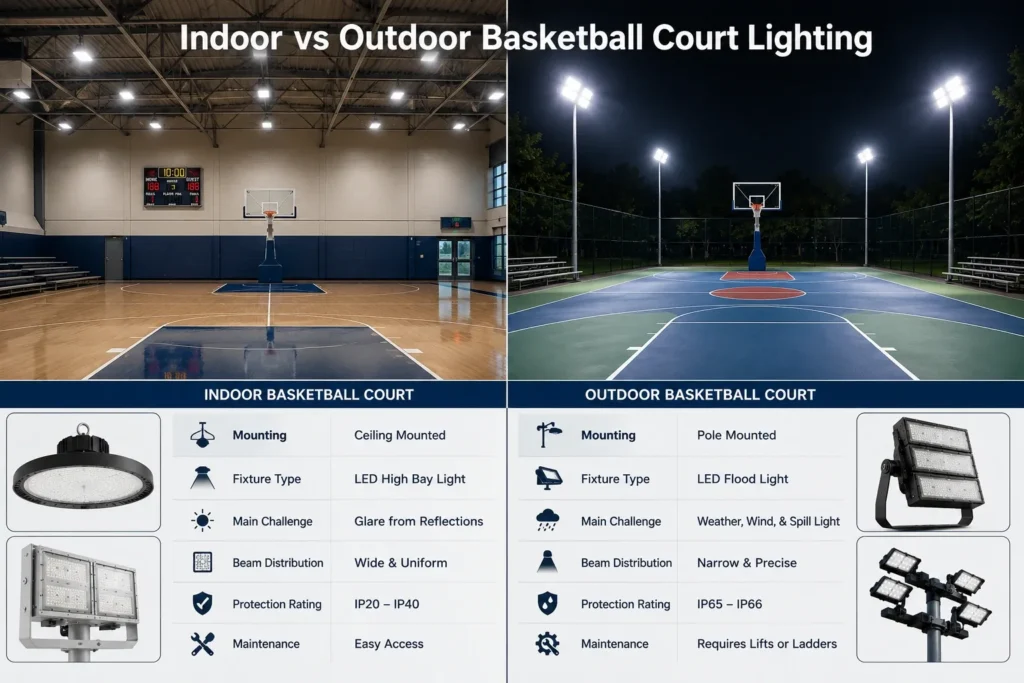
Indoor and outdoor basketball courts need different basketball lighting strategies. Indoor courts usually use ceiling-mounted LED high bay lights. Outdoor courts usually use pole-mounted LED flood lights.
Indoor Basketball Court Lighting
Indoor gym lighting must control reflection from polished floors. It must also provide smooth visibility across the full court. Ceiling height affects fixture spacing, beam angle, and glare control.
For indoor sports halls, recreation centers, or mixed-use gym spaces, the HB06 universal-compatible high bay light can support efficient indoor basketball lighting with flexible driver options.
Outdoor Basketball Court Lighting
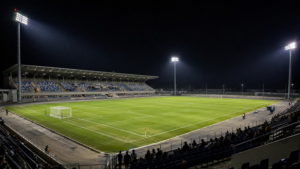
Outdoor basketball court lighting faces tougher conditions. Fixtures must resist rain, dust, wind, heat, and voltage surges. Outdoor systems often require IP65 or IP66 protection, strong surge protection, durable brackets, and reliable thermal design.
| Factor | Indoor Court | Outdoor Court |
|---|---|---|
| Fixture Type | LED high bay | LED flood light |
| Mounting | Ceiling-mounted | Pole-mounted |
| Main Challenge | Floor reflection | Weather and glare |
| Protection Need | Moderate | High IP and surge protection |
Basketball Court LED Lighting Design Fundamentals
Good lighting design starts before installation. Engineers should review court size, pole location, mounting height, beam angle, electrical capacity, surrounding buildings, and residential areas.
Pole Height and Layout
Typical outdoor basketball pole heights range from 20 to 50 feet. Backyard courts often use lower poles. School and municipal courts usually need taller poles. Professional venues may require higher mounting positions for better uniformity and lower glare.
Most outdoor courts use 4-pole, 6-pole, or 8-pole layouts. A 4-pole layout costs less, but it may create more glare. A 6-pole or 8-pole layout usually improves uniformity, but it also increases foundation and installation costs.
Beam Angle and Optical Control
Beam angle affects coverage, glare, and spill light. Narrow beams work better for taller poles. Wider beams work better for lower mounting heights. Asymmetric optics often perform better than basic symmetric beams because they direct more usable light onto the court.
For higher-output sports applications, the FL18 GameAres LED stadium floodlight can support stronger long-distance optical performance for larger outdoor courts and sports venues.
Photometric Simulation
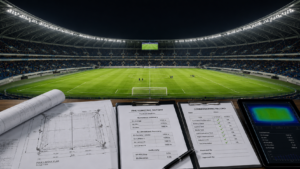
Professional projects should use IES files, DIALux simulation, AGi32 analysis, false-color lux maps, and aiming tables. Simulation helps engineers predict lux levels, uniformity, glare, and spill light before installation. This step reduces rework and protects the project budget.
How Much Does Basketball Court Lighting Cost?
Basketball court lighting cost depends on court size, lux target, fixture quantity, pole height, control system, installation labor, and broadcast requirements. The best LED basketball court basketball lighting cost installation and design guide should include both fixture price and project cost.
Typical Cost Range
| Project Type | Estimated Cost Range | Main Cost Driver |
|---|---|---|
| Backyard Court | $2,000–$8,000 | Basic fixtures and simple wiring |
| School Outdoor Court | $8,000–$25,000 | Poles, foundations, and uniformity |
| Community Sports Park | $20,000–$60,000 | Multi-court layout and controls |
| Indoor Gymnasium | $15,000–$80,000 | Ceiling height and fixture quantity |
| Broadcast Court | $80,000+ | Vertical illuminance and flicker control |
Hidden Cost Factors
Many buyers compare fixture prices only. This creates risk. A complete project budget should include poles, foundations, trenching, conduit, wiring, electrical panels, permits, lift rental, aiming labor, commissioning, and future maintenance.
Cheap drivers may reduce the first cost, but they often increase failure risk. Poor thermal design can reduce LED lifespan. Weak surge protection can damage outdoor fixtures. Bad aiming can cause glare complaints and rework.
Projects that need quick planning support can request instant quotes for lighting solutions before choosing fixture quantity or pole layout.
LED vs Metal Halide Basketball Court Lighting
LED lighting usually performs better than metal halide lighting. LED fixtures use less power, start faster, last longer, and support smarter controls. Metal halide lamps consume more energy and lose brightness faster.
| Feature | LED Lighting | Metal Halide |
|---|---|---|
| Energy Use | Lower | Higher |
| Start Time | Instant | Slow warm-up |
| Maintenance | Lower | Higher |
| Dimming | Supported | Limited |
| Lumen Depreciation | Slower | Faster |
For high-power outdoor sports and infrastructure projects, the FL12 high-power LED stadium and airfield floodlight can support larger spaces that need stronger beam output and durable construction.
Smart Basketball Court Lighting Systems
Smart LED basketball court lights systems give facility operators more control. Schools, municipalities, sports parks, and commercial property groups can reduce energy use by dimming lights during low-traffic periods.
Common Control Options
Common control systems include DALI, DMX, 0-10V dimming, motion sensors, scheduling systems, and remote monitoring. These systems help operators manage energy, maintenance, and event schedules more easily.
Solar and Area Lighting Integration
Solar basketball court lighting works well for some parks and remote courts. It reduces trenching and grid connection costs. However, battery capacity and weather conditions limit brightness and runtime. Professional courts usually need grid-powered lighting.
Many sports parks also need surrounding area LED basketball court lights. A product such as the AL03 high-performance 3-in-1 area light can support parking areas, walkways, and general public zones near the court.
How to Choose the Right Basketball Court Lighting Supplier
The right supplier should provide more than fixtures. A strong supplier should support lighting simulation, IES files, optical planning, warranty terms, project documentation, and after-sales service.
Supplier Checklist
You should review wattage, lumen output, luminous efficacy, beam angle, CCT, CRI, TLCI, IP rating, IK rating, surge protection, driver quality, dimming compatibility, L70 lifetime, and warranty coverage.
ZC Lighting provides LED sports LED flood lights for basketball courtsolutions for basketball courts, stadiums, municipal projects, industrial sites, and large outdoor areas. For wider sports facility planning, you can also review the stadium LED lighting solution for professional venue lighting strategies.
Final Buying Advice
Do not choose a basketball court lighting system by wattage alone. Compare optical design, simulation support, driver quality, glare control, installation cost, maintenance access, and long-term ROI. Better planning usually costs less than later correction.
FAQs
1. What are the best lights for outdoor basketball court projects?
The best lights for outdoor basketball court projects are LED flood lights with strong optical control, IP65 or IP66 protection, surge protection, and flicker-free drivers. Modular sports floodlights usually perform better for larger courts because they offer more precise beam control.
2. How much does LED basketball court lighting cost?
LED basketball court lighting usually costs from $2,000 to more than $80,000. A backyard court costs less. A school or municipal court costs more. A professional broadcast court costs the most because it needs higher lux, better uniformity, and stronger flicker control.
3. How many LED lights do you need for a basketball court?
A standard outdoor basketball court often uses 4 to 8 LED floodlights. The exact number depends on pole height, beam angle, target lux level, court size, and uniformity requirements. A photometric simulation gives the most accurate answer.
4. Is LED better than metal halide for basketball court lighting?
Yes. LED lighting is more efficient, faster, longer-lasting, and easier to control than metal halide lighting. LED systems also reduce maintenance costs because they do not require frequent lamp replacement.
5. Why is glare control important in basketball court lighting?
Glare affects shooting accuracy, player comfort, spectator visibility, and camera quality. Better optics, correct pole placement, lower tilt angles, and professional aiming help reduce glare while keeping the court bright and uniform.