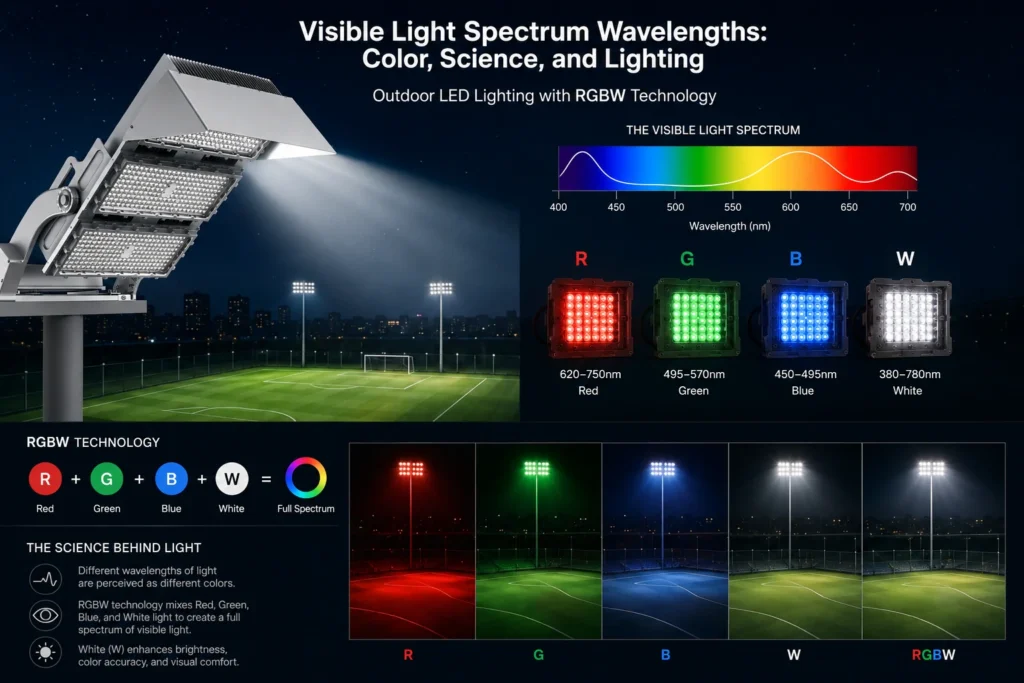
 Visible light spectrum wavelengths shape how we see color, how we design lighting, and how we choose better LED solutions. When you understand the visible light wavelength range in nm, you make smarter choices for visibility, comfort, efficiency, and visual quality.
At ZC Lighting, we use this knowledge to guide real lighting decisions for projects that demand performance, not guesswork. In this article, you will learn what visible light is, how wavelength relates to frequency and energy, and why the visible spectrum matters in lighting design, science, and everyday applications.
What Is the Visible Light Spectrum?
Visible light is the small part of the electromagnetic spectrum that human eyes can detect. It sits between ultraviolet and infrared, which means it is only a narrow slice of all electromagnetic radiation. That makes it special. It is also limited.
The visible light spectrum wavelengths usually range from about 380 nm to 750 nm. In meters, that is roughly 3.8 × 10⁻⁷ m to 7.5 × 10⁻⁷ m. The range is tiny, but the impact is huge. It controls color, visibility, and how lighting feels in real spaces.
This is why the visible light spectrum wavelengths chart is useful. It gives you a simple way to understand color order and wavelength behavior at a glance. A chart turns abstract science into a practical tool.
| Region | Approximate Wavelength | Common Color Perception |
|---|---|---|
| Violet | 380–450 nm | Deep violet to blue-violet |
| Blue | 450–495 nm | Blue |
| Green | 495–570 nm | Green |
| Yellow | 570–590 nm | Yellow |
| Orange | 590–620 nm | Orange |
| Red | 620–750 nm | Red |
Visible Light Spectrum Wavelengths Explained
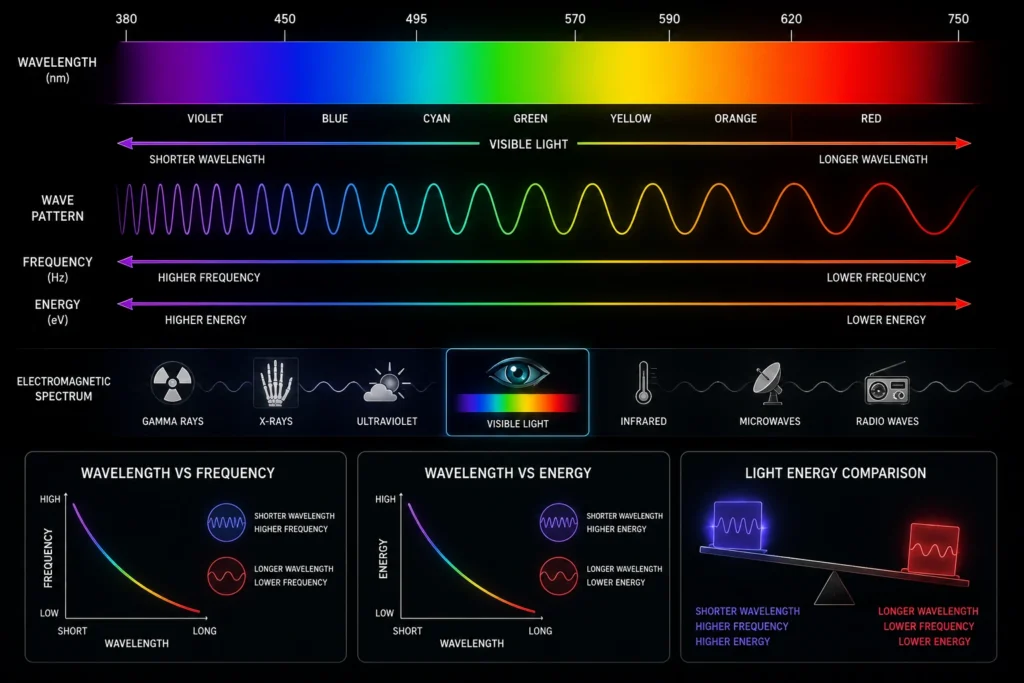
Visible light spectrum wavelengths and frequency are closely linked. When wavelength gets shorter, frequency gets higher. When frequency gets higher, energy rises too. That is the rule. It is simple, but powerful.
The visible light wavelength range in nm helps us talk about color scientifically. Shorter wavelengths sit near the violet end. Longer wavelengths sit near the red end. So violet light is more energetic than red light, even though red light can appear warmer to the eye.
The visible light wavelength range in meters is often used in physics and engineering. The meter scale may look less intuitive than nanometers, but it is useful for calculations. The two units describe the same thing. One is just much easier to read in daily lighting work.
Wavelength, frequency, and energy
Visible light frequency is measured in hertz. Frequency and wavelength move in opposite directions. If one goes up, the other goes down. That is why blue light has a higher frequency than red light.
Visible light energy follows the same pattern. Shorter wavelength means higher energy. Longer wavelength means lower energy. This helps explain why light can feel different even when brightness looks similar.
| Property | Short Wavelength Light | Long Wavelength Light |
|---|---|---|
| Position in spectrum | Violet / blue end | Orange / red end |
| Frequency | Higher | Lower |
| Energy | Higher | Lower |
| Visual impression | Cooler, sharper | Warmer, softer |
The Color Bands of Visible Light
The visible spectrum is often divided into bands, but those bands are not hard walls. They blend into one another. That is important. Light is continuous, not boxed into neat shelves.
Violet and blue light have the shortest visible wavelengths. They carry more energy and often appear cooler. Green sits in the center and is especially important to human vision. Yellow and orange bridge the middle toward the warm side. Red has the longest visible wavelength and is linked with warmth, contrast, and visual emphasis.
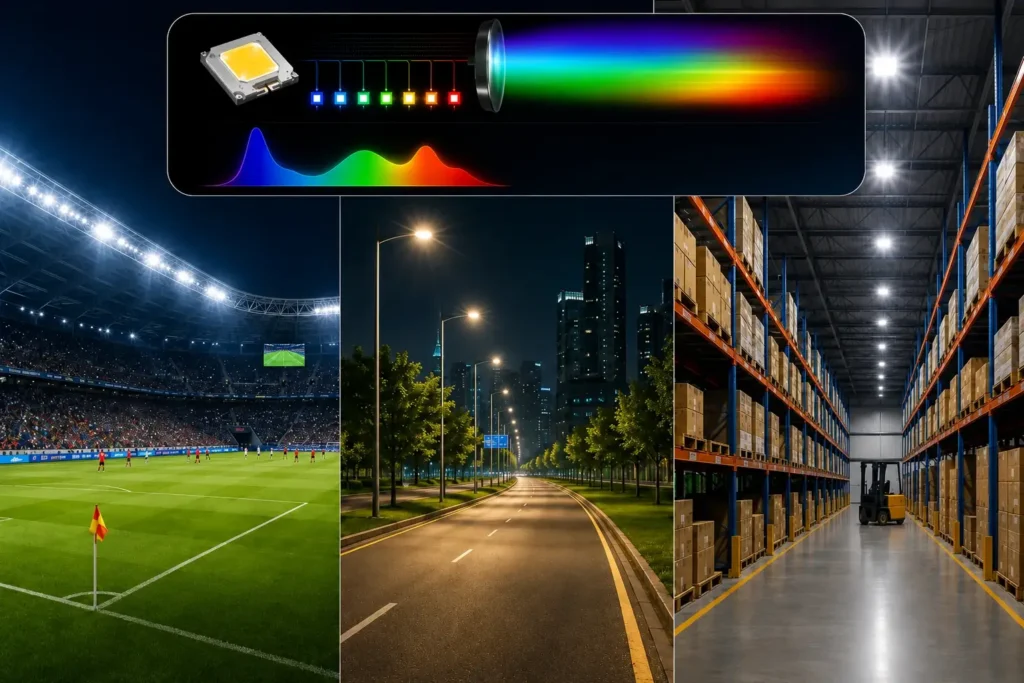
This color spectrum wavelength relationship matters in lighting because different wavelengths change how we feel and what we notice. A scene rich in blue light feels crisp. A scene rich in red light feels warmer and calmer. The difference is not just emotional. It is physical and visual.
For sports and large-area projects, this kind of balance is why teams often look at a full stadium lighting package such as the Stadium LED Lighting Solution instead of choosing fixtures one by one.
How the Human Eye Sees Color
The eye does not see every wavelength equally. It responds differently across the spectrum. That is why visible light spectrum wavelengths do not all look equally bright to us.
Cone cells are responsible for color vision. Rod cells help us see in low light. Together, they create our visual experience. But they do not treat every wavelength the same way. Human eye sensitivity peaks near the green region, which is why green light often appears brightest under similar power levels.
This is one reason visible light spectrum wavelengths and frequency matter in lighting design. Two lights can have the same power, but if one is better aligned with human vision, it can feel more effective. That is a major advantage in task lighting, outdoor lighting, and visual comfort planning.
| Eye Response Factor | What It Does | Practical Effect |
|---|---|---|
| Cone cells | Color perception | Helps us distinguish hues |
| Rod cells | Low-light vision | Improves night visibility |
| Spectral sensitivity | Response to wavelength | Makes some colors look brighter |
Light-Matter Interactions
Visible light does not just travel. It interacts. That interaction changes what we see.
Reflection sends light back from a surface. Absorption takes light in. Transmission allows light to pass through a material. Refraction bends the light path. Diffraction spreads light as it passes around edges or through small openings. Scattering sends light in many directions.
These processes are easy to confuse, but they behave differently. Reflection is direct. Absorption is quiet. Transmission is transparent. Refraction is bending. Diffraction is spreading. Scattering is dispersion. Each one affects how visible light appears in the real world.
This matters in buildings, streets, sports venues, and industrial sites. Smooth metal reflects differently from painted concrete. Clear glass transmits more than frosted glass. Dust and haze scatter light. That changes visibility faster than many people expect.
For large sites that need dependable illumination beyond the pitch, ZC Lighting also supports broader infrastructure needs through solutions like Street & Roadway LED Lighting Solutions and High-Mast & Large Area LED Lighting Solutions.
How Visible Light Is Measured
Scientists and lighting engineers use photometry to study visible light. They measure light intensity, color behavior, and spectral distribution. That creates a more complete view than brightness alone.
A spectrophotometer is one of the most important tools for this work. It measures how much light exists at each wavelength. That data can then be shown in a graph or spectrum chart. A visible light spectrum wavelengths chart is much more useful than a simple statement like “this light is white.”
Prism and diffraction experiments also help explain the spectrum. A prism separates white light into different colors. A diffraction grating does something similar, but with a more precise spread. These demonstrations are common in education because they are simple and visual.
| Measurement Tool | What It Shows | Why It Matters |
|---|---|---|
| Spectrophotometer | Light by wavelength | Reveals spectral distribution |
| Prism | Color separation | Shows visible spectrum behavior |
| Diffraction grating | Fine wavelength separation | Useful for teaching and analysis |
| Photometry | Visible light performance | Supports lighting design decisions |
Visible Light in LED and Lighting Design
LEDs produce visible light by using semiconductor materials that emit specific wavelengths. That means LED light can be tuned more precisely than many older sources. It can be cleaner, narrower, and more efficient.
But spectrum quality still matters. Brightness alone is not enough. A light source can be intense and still look poor if its spectrum is unbalanced. That is why color temperature and CRI are important. Color temperature tells you whether the light feels warm or cool. CRI tells you how accurately colors appear under the light.
Visible light uses in LED design are broad. You see them in offices, stadiums, roadways, warehouses, campuses, and smart city systems. In each case, the goal is different. Sometimes you want better visual comfort. Sometimes you want better safety. Sometimes you want sharper color rendering. The wavelength balance should match the job.
At ZC Lighting, we treat visible light spectrum wavelengths as a design input, not a side note. That is why our LED solutions are built to support real visual performance, not just high output.
A good example is the Industrial & High-Bay LED Lighting Solutions, where spectral quality, uniformity, and efficiency all need to work together.
Real-World Applications
Visible light spectrum wavelengths influence almost every lighting project. Architectural lighting depends on how surfaces reflect color. Stadium lighting depends on visibility and visual clarity. Industrial lighting depends on task recognition. Roadway lighting depends on safety and contrast.
Broadcast and photography also depend on spectral behavior. If the light is uneven or too narrow in color quality, the image suffers. Scientific inspection needs even more precision. In medical and lab settings, the wrong spectrum can make small details harder to detect.
Education is another major use case. Teachers use visible light experiments to show how color works, how prisms split light, and how wavelength changes perception. That makes the topic both practical and visual. It is science you can see.
For outdoor projects that need stronger area coverage, products like the FL18 GameAres LED Stadium Floodlight and FL12 – High-Power LED Stadium & Airfield Floodlight are useful references for high-output applications.
Why This Matters for Project Decisions
If you are choosing lighting for a project, visible light spectrum wavelengths should guide more than appearance. They should guide performance.
A shorter wavelength light is not automatically better. A longer wavelength light is not automatically safer. The best result depends on the environment. In some settings, you want higher visual clarity. In others, you want comfort and lower glare. In some, you want energy efficiency first. In others, color quality matters more.
That is why lighting design is comparative. Brighter is not always better. Cooler is not always clearer. Narrower is not always more useful. The right spectrum is the one that fits the application. That is the difference between generic lighting and engineered lighting.
For flexible outdoor control, the FL03 – Adjustable Smart Flood Light is a strong example of how adjustability can support different project needs.
Common Misunderstandings
One common misunderstanding is that visible light equals white light. It does not. White light is usually a mix of many wavelengths. Another misunderstanding is that color temperature is the same as wavelength. It is not. Color temperature is a description of how a light source appears, not a direct reading of one wavelength.
People also often think the visible spectrum is split into perfect color boxes. It is not. The spectrum is continuous. Colors blend into each other. That is why a visible light spectrum wavelengths chart is more accurate than a simple list of colors.
Finally, some people assume brightness tells the whole story. It does not. A bright source with a poor spectrum can still perform badly. That is why spectrum quality matters as much as output.
How ZC Lighting Applies Spectrum Knowledge
At ZC Lighting, we design with human vision and real project performance in mind. That means we think about visible light spectrum wavelengths, not just wattage and lumen numbers. We care about how the light looks, how it feels, and how it supports the work environment.
This approach helps us serve EPC contractors, municipal authorities, stadium owners, industrial clients, system integrators, and smart city operators more effectively. Different projects need different spectral choices. A parking lot is not a laboratory. A stadium is not a warehouse. A roadway is not a classroom. The lighting should reflect that difference.
When you understand visible light wavelength range in nm, visible light frequency, and visible light energy, you make better purchasing and design decisions. That saves time. It also improves results.
If your project needs fast budget alignment, you can also request instant quotes for lighting solutions and move from concept to specification faster.
Conclusion and FAQ
Visible light spectrum wavelengths are the foundation of color, lighting design, and visual performance. They explain why light looks warm or cool, why some colors appear brighter than others, and why spectrum quality can change how a space feels and functions. If you understand the visible light wavelength range in meters and nm, you can read charts more easily, compare LED options more confidently, and make smarter project decisions.
The best lighting systems do more than shine. They match the task. They support the eye. They respect the environment. And they deliver a more useful balance of brightness, color quality, and energy performance. That is why visible light spectrum wavelengths remain essential in both science and practical lighting work.
FAQ 1: What is the visible light spectrum?
The visible light spectrum is the portion of the electromagnetic spectrum that human eyes can detect. It generally ranges from about 380 nm to 750 nm. This narrow band includes all the colors we can see, from violet to red.
FAQ 2: What is the visible light wavelength range in nm?
The visible light wavelength range in nm is usually described as 380–750 nanometers. Violet sits at the short end, while red sits at the long end. The exact boundaries can vary slightly by source.
FAQ 3: How are visible light wavelength and frequency related?
They move in opposite directions. Shorter wavelength means higher frequency. Longer wavelength means lower frequency. That is why blue light has a higher frequency than red light.
FAQ 4: Why does green light often look brightest to the human eye?
The human eye is most sensitive to green wavelengths. That means green light can appear brighter than other colors at similar power levels. This is tied to how cone cells respond to visible light.
FAQ 5: Why do visible light spectrum wavelengths matter in lighting design?
They matter because different wavelengths affect visibility, comfort, color rendering, and energy use. The right spectrum helps lighting perform better in the real world. That is especially important in commercial, industrial, and outdoor projects.