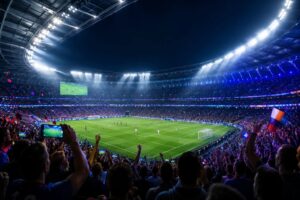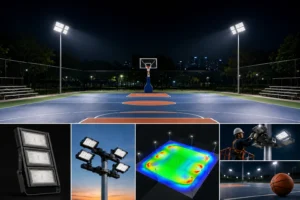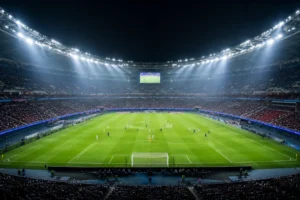
 AI-controlled sports lighting for mega events is changing how stadiums, cities, and large outdoor venues manage visibility, energy, safety, and broadcast quality. Traditional floodlights only provide brightness. Intelligent LED systems provide control, data, automation, and better long-term value.
In this guide, I explain how AI sports lighting works, why you should consider it for large venues, and how EPC contractors, stadium owners, municipal authorities, and lighting consultants can plan smarter outdoor lighting projects.
What Is AI-Controlled Sports Lighting?
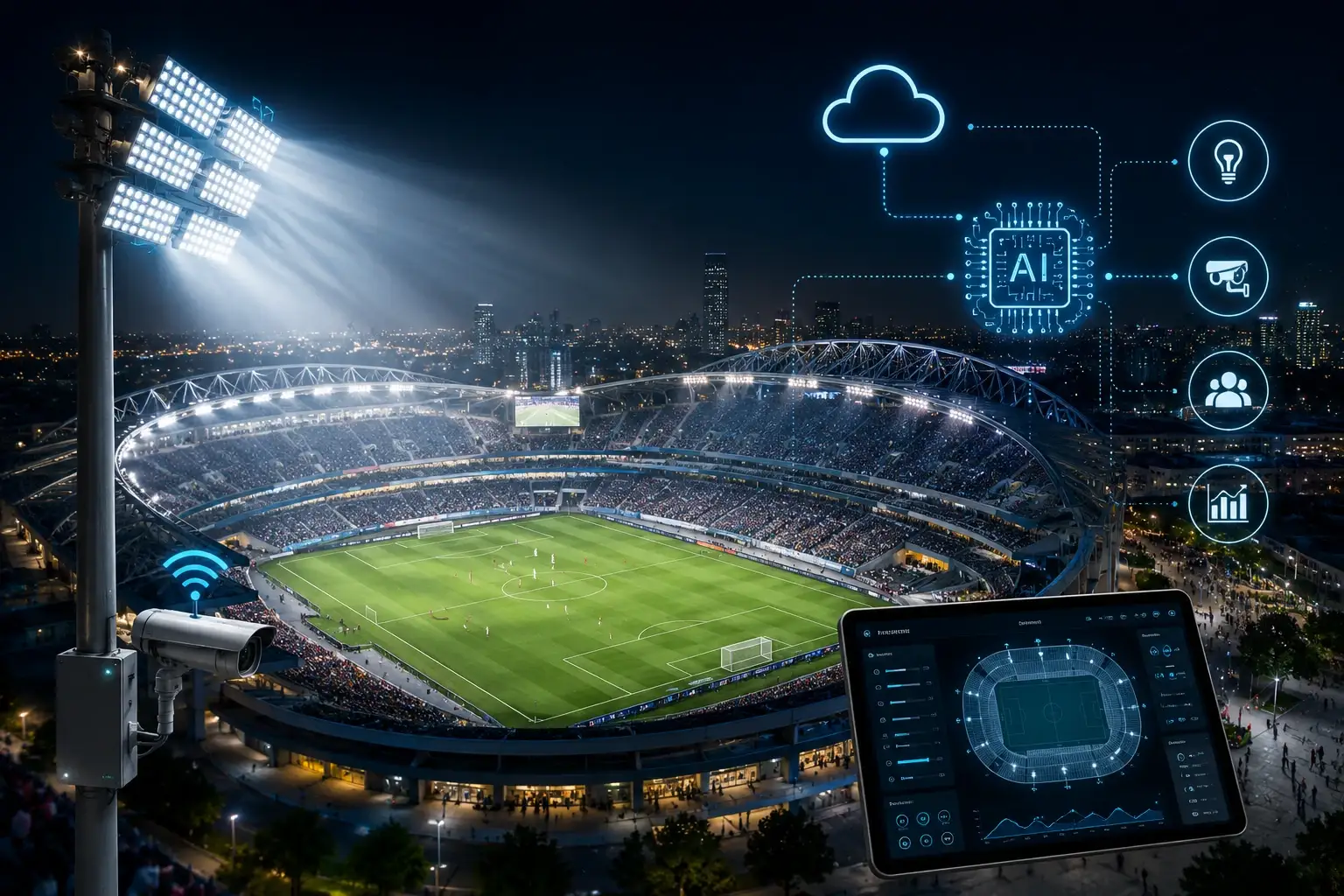
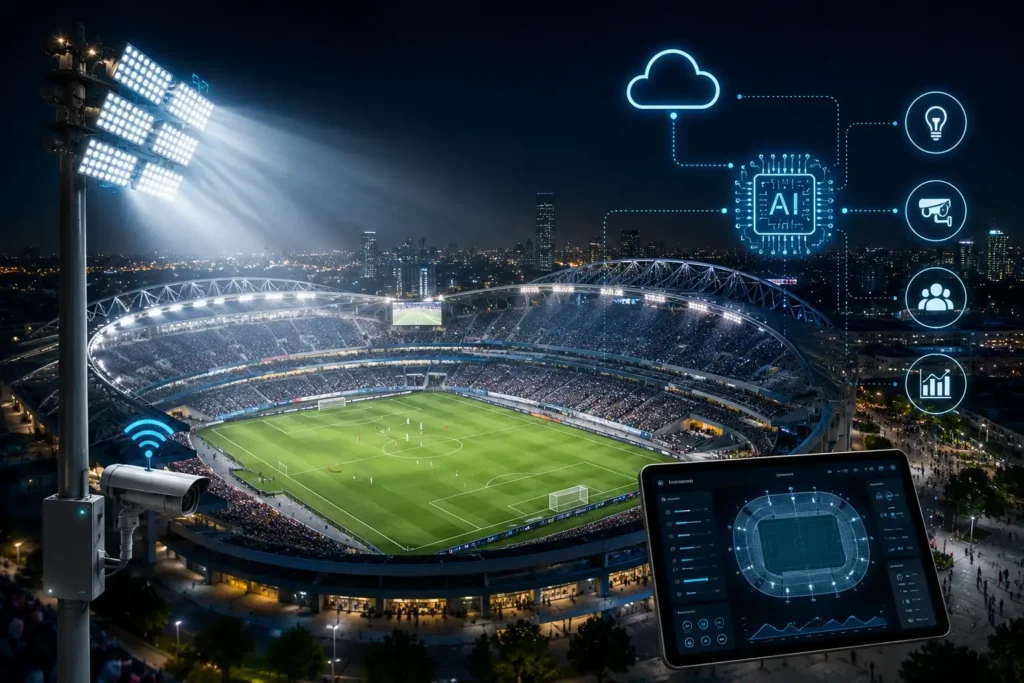
AI-controlled sports lighting uses artificial intelligence, sensors, IoT communication, and smart software to control LED lighting automatically. A traditional system uses fixed switches or timers. An AI system uses real-time data. This makes the lighting faster, smarter, and more efficient.
An AI light controller can analyze crowd density, event schedules, ambient light, weather, camera needs, and energy demand. Then it can adjust brightness, lighting scenes, dimming levels, and operating modes. This makes AI-controlled lights more responsive than manual systems.
For large stadiums, modular systems such as the FL08 modular LED sports floodlight can support flexible beam planning, easier maintenance, and more scalable outdoor lighting layouts.
| Feature | Traditional Sports Lighting | AI-Controlled Sports Lighting |
|---|---|---|
| Control | Manual or timer-based | Automated and data-driven |
| Energy Use | Often full output | Adaptive dimming |
| Maintenance | Reactive | Predictive |
| Broadcast Support | Limited | Better for 4K, HDR, and replay |
| Smart Integration | Weak | Strong IoT compatibility |
Why Mega Events Need AI Lighting
Mega events create heavier lighting demands than normal sports venues. You need brighter fields, safer walkways, better parking visibility, stronger broadcast quality, and lower energy waste. A static lighting system cannot respond well to these changing needs.
Higher Broadcast Standards
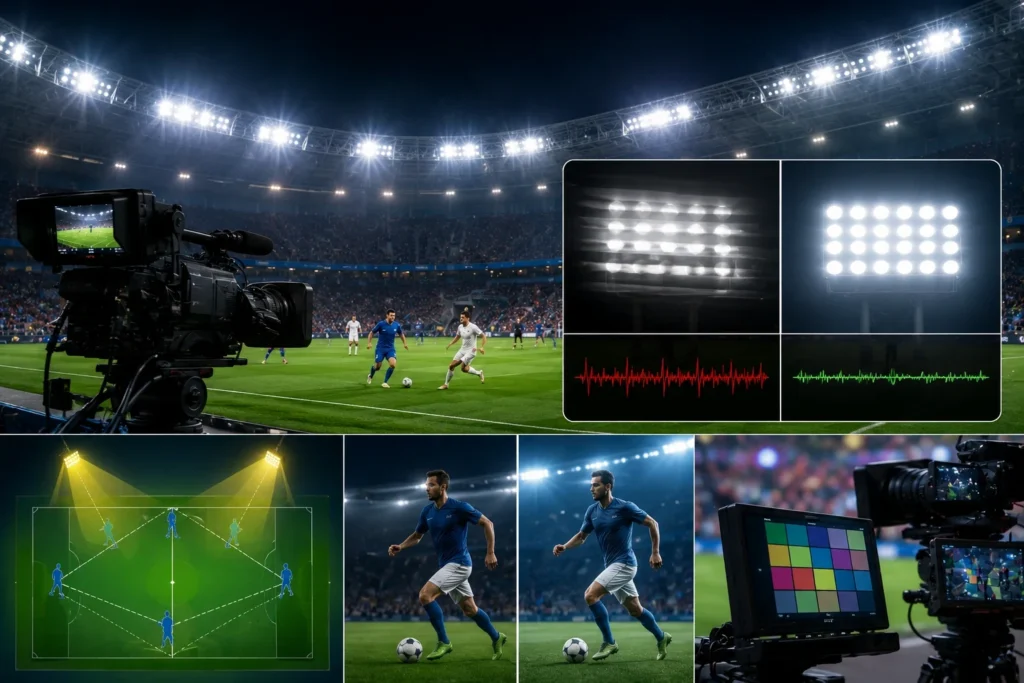
Modern sports broadcasting uses 4K, HDR, and ultra-slow-motion cameras. These cameras reveal lighting problems quickly. They show flicker, shadows, dark zones, glare, and poor color quality more clearly than older systems.
AI-controlled sports lighting for mega events helps you maintain more stable illuminance. It can balance horizontal lux on the field and vertical lux on players. This improves player visibility, facial detail, jersey clarity, and camera exposure.
For long-throw stadium and airfield projects, the FL12 high-power LED stadium and airfield floodlight can support large-area visibility where stronger output and precise aiming are required.
Better Crowd Safety
Large crowds move fast. Poor lighting makes movement more dangerous. AI systems can increase brightness in emergency exits, parking zones, pedestrian routes, and security areas. This creates safer crowd flow and better surveillance visibility.
Lower Energy Waste
Traditional systems often run at high output even when some zones are empty. AI-controlled lights reduce this waste. They dim unused areas, balance power loads, and adjust lighting according to real-time demand. This makes the system more efficient and less costly.
Core Technologies Behind AI Sports Lighting
AI sports lighting is not only a fixture. It is a complete control ecosystem. The system combines LED luminaires, sensors, cameras, edge computers, communication networks, and control software.
IoT Sensors and Occupancy Detection
IoT sensors collect data from the venue. They can detect movement, daylight, weather, crowd density, and vehicle flow. The system uses this data to adjust lighting more accurately.
AI Vision and Camera Feedback
AI vision systems can analyze field activity, player movement, audience density, and security conditions. The lighting platform can then improve brightness, contrast, color temperature, and scene control.
Edge Computing
Edge computing processes data near the stadium instead of sending every decision to the cloud. This reduces latency. During a mega event, faster response matters. Local AI control can also keep key lighting functions working during network interruptions.
Control Protocols
Modern systems may use DALI, DMX, KNX, 0-10V, Zigbee, LoRaWAN, Ethernet, or API integration. Better protocol compatibility makes the system easier to connect with smart buildings, security systems, and smart city platforms.
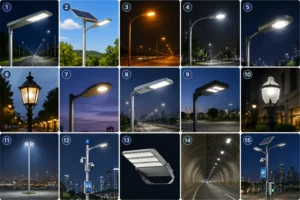
For surrounding roads and municipal infrastructure, smart-ready fixtures like the SL05 municipal LED street light can help cities connect roadway lighting with broader IoT control networks.
Broadcast-Ready Lighting for 4K and HDR
Broadcast lighting is one of the strongest reasons to use AI-controlled sports lighting. A field can look bright to spectators but still look poor on camera. AI systems help reduce this gap.
Flicker-Free Performance
Weak LED drivers create flicker. Human eyes may not notice it, but cameras can capture it clearly. Slow-motion replay makes flicker even worse. Flicker-free drivers help protect broadcast quality and create cleaner footage.
Vertical Illuminance
Horizontal illuminance measures light on the field. Vertical illuminance measures light on players and camera-facing surfaces. Broadcast systems need both. However, vertical illuminance often matters more for 4K and HDR image quality.
CRI and TLCI
CRI measures how humans see color. TLCI measures how cameras reproduce color. For professional sports broadcasting, TLCI is often more important. Better spectral quality creates more natural skin tones, richer grass color, and more stable images.
| Broadcast Factor | Why It Matters | AI Lighting Benefit |
|---|---|---|
| Flicker control | Protects slow-motion replay | Stabilizes driver output |
| Vertical lux | Improves player visibility | Balances camera-facing light |
| Uniformity | Reduces shadows and exposure jumps | Adjusts zones dynamically |
| Color quality | Improves HDR image quality | Supports better scene control |
Adaptive Lighting and Real-Time Scene Control
Modern stadiums need different lighting modes for different moments. Match play needs stable brightness. Halftime shows need dynamic effects. Emergency events need clear exits. Maintenance teams need focused work light.
AI systems can switch these modes faster and more accurately than manual operators.
Dynamic Lux Adjustment
AI systems can adjust lux levels based on match conditions, crowd movement, ambient light, and camera demand. This makes the lighting more responsive and less wasteful.
Scene Modes
Common scene modes include pre-game mode, match mode, broadcast mode, halftime mode, evacuation mode, maintenance mode, and crowd dispersal mode. Each mode uses a different brightness level and control strategy.
Fan Zone and Event Lighting
Fan zones, public plazas, and outdoor viewing areas also need smarter lighting. Dynamic floodlights can support color scenes, crowd safety, temporary event layouts, and emergency response. Products such as the FL03 adjustable smart flood light can support flexible outdoor scene lighting for event spaces.
Energy Optimization and Predictive Maintenance
Energy and maintenance costs affect the total value of every stadium lighting project. A cheaper fixture may create higher long-term costs. A smarter system may cost more at first, but it can save more over time.
AI Energy Optimization
AI systems can monitor power demand, fixture output, occupancy patterns, and operating hours. Then they can reduce output where full brightness is not needed. This creates lower electricity bills and better load control.
Smart Grid and Demand Response
Large venues can connect lighting systems with smart grids. This helps operators manage peak demand, backup power, and renewable energy. Solar lighting integrators can also combine battery storage with AI-based control.
Predictive Maintenance
AI can detect early warning signs. It can track driver behavior, temperature, voltage changes, and fixture performance. This helps your team replace parts before major failures happen.
| Cost Area | Traditional Lighting | AI-Controlled Lighting |
|---|---|---|
| Electricity | Higher due to fixed output | Lower through adaptive dimming |
| Maintenance | Manual inspection | Remote diagnostics |
| Downtime | More unexpected failures | Earlier fault prediction |
| Asset Value | Limited upgrade path | Better smart infrastructure value |
Smart City and Infrastructure Integration
Mega events do not stop at the stadium gate. They affect roads, parking lots, transit hubs, airports, hotels, plazas, and logistics zones. This makes smart lighting integration more important.
Stadium District Lighting
AI-controlled sports lighting outdoor systems can connect with smart poles, roadway lighting, surveillance systems, traffic control, and emergency networks. This improves coordination across the full event district.
Municipal projects can use street and roadway LED lighting systems to improve traffic visibility and pedestrian safety near stadiums, parks, and public venues.
High-Mast and Large-Area Lighting
Airports, ports, parking lots, logistics parks, oil facilities, and mining sites need stronger large-area lighting. AI control can improve visibility and reduce wasted energy across these spaces.
For these applications, high-mast and large-area LED lighting solutions can support broader coverage, better pole layouts, and more efficient outdoor illumination.
Indoor and Outdoor Facility Networks
Sports parks and logistics campuses often combine indoor and outdoor lighting. Intelligent indoor systems such as the HB06 high-bay light with dual driver options can help facility managers build a more unified lighting control network.
How to Choose the Right AI Sports Lighting System
The best AI controlled sports lighting for mega events should match your venue type, broadcast goals, electrical system, control platform, and maintenance strategy. You should not choose only by wattage.
Check Lighting Performance
You should review lux level, uniformity, glare control, beam angle, CRI, TLCI, CCT, flicker performance, and surge protection. Better optics often outperform higher wattage.
Review Control Compatibility
You should confirm that the system supports your required control protocol. DALI, DMX, 0-10V, Ethernet, and API compatibility can make future integration easier.
Consider Retrofit Conditions
Retrofit projects may face wiring limits, pole restrictions, and control compatibility issues. New projects can integrate AI sensors, edge computing, and digital simulation from the beginning.
Work With an Experienced Lighting Partner
ZC Lighting supports outdoor LED lighting projects for stadiums, roads, high-mast areas, industrial sites, and smart infrastructure. For sports venues, you can also explore stadium LED lighting solutions to plan broadcast-ready and future-ready projects.
If you need quick project support, you can request instant quotes for lighting solutions.
Conclusion
AI-controlled sports lighting for mega events gives stadiums and cities a stronger way to manage brightness, safety, broadcasting, energy, and maintenance. It turns lighting from a fixed utility into an intelligent infrastructure system.
Compared with traditional sports lighting, AI-controlled lights respond faster, waste less energy, support better broadcast quality, and reduce long-term maintenance risk. They also connect more easily with smart city platforms, parking systems, roadway lighting, and security networks.
For EPC contractors, stadium owners, municipal authorities, lighting consultants, system integrators, and sports park investors, the next step is clear. You should evaluate lighting as a complete system, not only as a fixture. Smarter control creates better value.
FAQ
What is AI-controlled sports lighting?
AI-controlled sports lighting uses sensors, software, and artificial intelligence to manage stadium and outdoor lighting automatically. The system can adjust brightness, scene modes, energy use, and maintenance alerts based on real-time data.
Why is AI-controlled sports lighting important for mega events?
Mega events need safer crowds, better broadcasts, lower energy waste, and more reliable infrastructure. AI lighting helps operators control these needs more quickly and accurately than traditional manual systems.
Can AI-controlled lights improve 4K and HDR broadcasting?
Yes. AI-controlled lights can support better uniformity, stronger vertical illuminance, flicker control, and more stable camera exposure. These factors improve 4K, HDR, and slow-motion sports production.
Is AI sports lighting useful outside stadiums?
Yes. AI sports lighting can support parking lots, airports, ports, logistics parks, fan zones, municipal roads, schools, universities, and smart city districts. Large outdoor spaces benefit from adaptive control and remote monitoring.
How do I choose the best AI controlled sports lighting for mega events?
You should compare lighting performance, control compatibility, flicker quality, beam design, maintenance access, energy savings, and smart city integration. A strong system should match both your event needs and long-term infrastructure plan.