
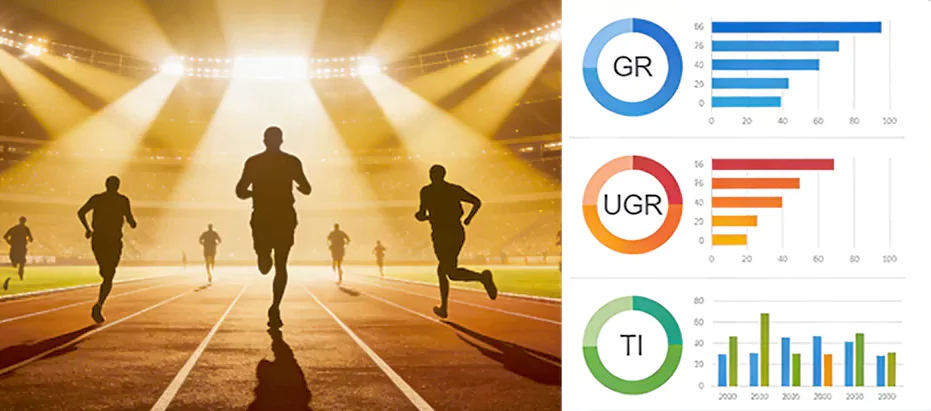
Glare is one of the most common reasons sports lighting projects get rejected-often because the wrong metric was used (or the right metric wasn’t documented). This guide shows how to choose the correct glare metric and build a passable workflow.
The fastest way to avoid disputes is to lock the metric + method in writing, define critical viewpoints, and tie glare control to optics + aiming (not only accessories).
- Key takeaway #1: Pick the glare metric based on environment: outdoor sports → GR, indoor halls → UGR, road impact → TI (or road criteria).
- Key takeaway #2: Glare control is mostly optics + aiming; shielding is a targeted tool, not a default add-on.
- Key takeaway #3: If you can’t explain the metric and assumptions, you can’t defend the result at sign-off.
Table of contents
• Glare control in football stadium lighting
• What is UGR?
• Broadcast-level standards guide
When this applies
Use this guide when a tender mentions glare limits but the team is unsure whether the correct metric is GR, UGR, or TI-or when you need to justify your glare strategy to a consultant during review.
Typical scenarios
- Outdoor stadium / pitch: you need a defensible GR approach plus practical glare control methods (optics + aiming + shields).
- Indoor arenas: your consultant asks for UGR compliance and surface reflectance assumptions.
- Road-adjacent venues: driver glare becomes a safety concern-TI (or similar road criteria) may appear in the tender.
- Community-adjacent venues: glare and spill together drive complaints; you need to document viewpoints and curfew conditions.
Key requirements / metrics
This comparison table helps you select the correct glare metric and write it into a tender-ready spec.
| Metric | Best fit | What it evaluates | Practical notes |
|---|---|---|---|
| GR Glare Rating |
Outdoor sports venues (stadiums, pitches) | Perceived discomfort glare from luminaires in outdoor sports viewing conditions. | Common in European sports tenders and consultant reports. Make sure the method and observer/viewing assumptions are documented. |
| UGR Unified Glare Rating |
Indoor sports halls / arenas | Luminance-based glare evaluation for indoor environments with defined room surfaces and observer positions. | UGR is often misapplied to outdoor projects. If it appears in an outdoor tender, confirm the intended approach in writing. |
| TI Threshold Increment |
Road users / driver safety near venues | Disability glare-how much glare reduces visibility for drivers and road users. | Relevant when sports lighting impacts roads/intersections. Define observer positions and approach directions early. |
Definitions
GR (Glare Rating) is commonly used for outdoor sports lighting to describe discomfort glare from visible luminaires in typical viewing directions. UGR is primarily an indoor metric based on luminance distribution and room geometry. TI is a road-oriented metric that quantifies disability glare-how glare reduces visibility for drivers.
Typical target ranges
Most tenders specify a maximum value for glare (e.g., “GR ≤ …” or “UGR ≤ …”). If the tender does not give a number, treat it as a risk: define a project-specific glare criterion in writing before design freeze.
- Outdoor sports (typical): GR is the common reference; supplement with a “critical viewpoints” list (players, stands, cameras, neighbors).
- Indoor sports (typical): UGR is common; surface reflectance assumptions must be documented.
- Road-adjacent (typical): TI or local road glare rules; define observer positions and approach directions.
Step-by-step workflow
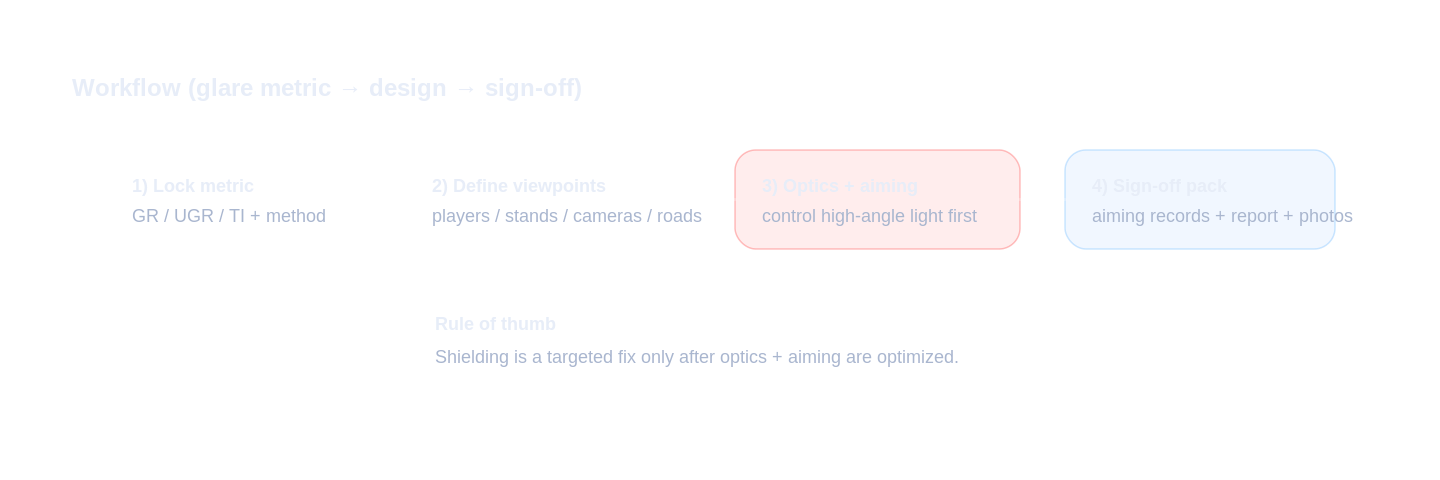
To prevent “good lux, bad glare” outcomes, treat glare as a design constraint from day one-not a last-minute add-on.
Inputs to collect (must-have)
- Tender glare language: which metric (GR/UGR/TI) and whether the method is specified.
- Critical viewpoints: player sightlines, spectator stands, broadcast camera positions, neighbor windows, nearby roads.
- Pole + mounting data: mounting height, allowed tilt, orientation constraints, and any aiming restricted directions.
- Optics set: available beam distributions and whether cut-off / low-glare optics exist.
Design decisions (key points)
- Pick the correct glare metric (and document it). If the tender is ambiguous, get written clarification before freezing the design.
- Control high-angle light first. Optics selection and aiming have the biggest impact; shielding is a secondary tool.
- Trade “fewer brighter fixtures” vs “more softer fixtures”. Extreme brightness often increases glare and reduces comfort.
- Protect the worst viewpoints. Design for the most sensitive lines of sight (drivers, cameras, neighbors), not only for the field center.
Verification & sign-off (how to accept)
- Report clarity: include glare metric, method assumptions, and identified viewpoints. Make it auditable.
- Aiming records: provide an aiming table and record final angles on site (this is where glare often changes).
- Field test alignment: if the tender requires a measurement-based glare check, confirm instruments and procedure early.
Common mistakes
- Using UGR for outdoor by habit: outdoor sports projects usually need GR (or tender-specific criteria) and viewpoint documentation.
- Adding shields “everywhere”: generic shields can reduce useful light and worsen uniformity. Use shields only where they block the problematic angles.
- No viewpoint definition: glare is viewpoint-dependent-if you don’t define it, you can’t defend the result.
- Aiming changes not recorded: glare can change dramatically with a few degrees. Lock aiming and record it.
- Over-optimizing average lux: too much emphasis on average lux can push designs toward glare-heavy solutions.
Checklist / Template download
Glare Metric Selection Matrix (CSV)
Pick the right glare metric (GR vs UGR vs TI) based on venue context.
Glare Risk Checklist (CSV)
A quick checklist to prevent glare-driven rework and disputes at sign-off.
Aiming + Shield Notes (TXT)
Document viewpoints, aiming intent, and where shields are truly needed.
Tender Glare Clause (TXT)
Copy-paste language to make glare requirements measurable and enforceable.