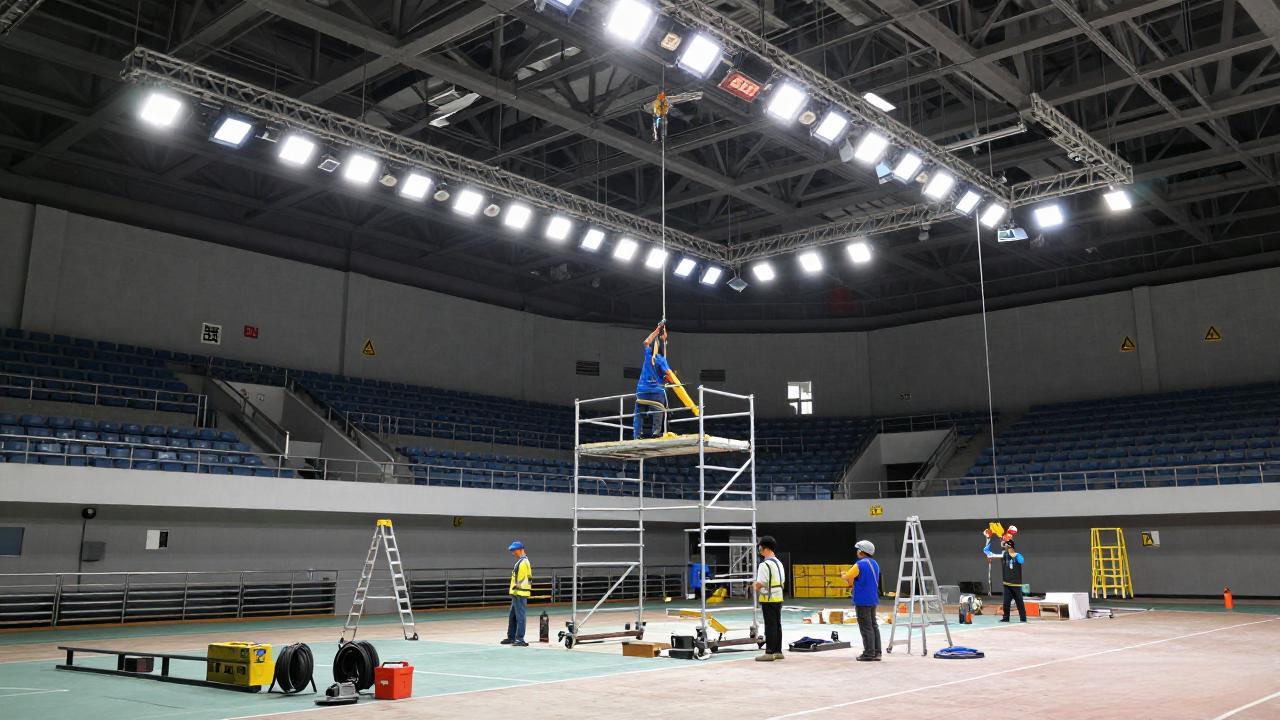
Many stadium lighting retrofit projects fail not because of product quality, but because of poor decision-making at the planning stage. Owners often ask: “What can we keep?” and “What must we replace?” — but receive vague or overly conservative answers.
This practical checklist-based guide helps stadium owners, municipalities, and EPC contractors make informed retrofit decisions. It separates reusable infrastructure from components that typically require replacement when upgrading from HID to LED systems.
1. Components That Can Usually Be Kept
1.1 Poles and Foundations
In most retrofit projects, existing poles and foundations remain structurally sound. Unless corrosion, foundation damage, or regulatory changes are present, replacement is rarely required.
- Verify structural integrity and wind load capacity.
- Inspect corrosion at base and mounting points.
1.2 Power Cabling
Primary power cabling is typically reusable, especially in systems originally designed for high-wattage HID luminaires.
2. Components That Must Be Verified Carefully
2.1 Mounting Arms and Brackets
While often reusable, brackets must be checked for compatibility with new LED luminaires and aiming requirements.
- Load capacity.
- Aiming range and adjustability.
2.2 Electrical Protection
Surge protection and grounding should be reviewed and upgraded if necessary to protect modern LED drivers.
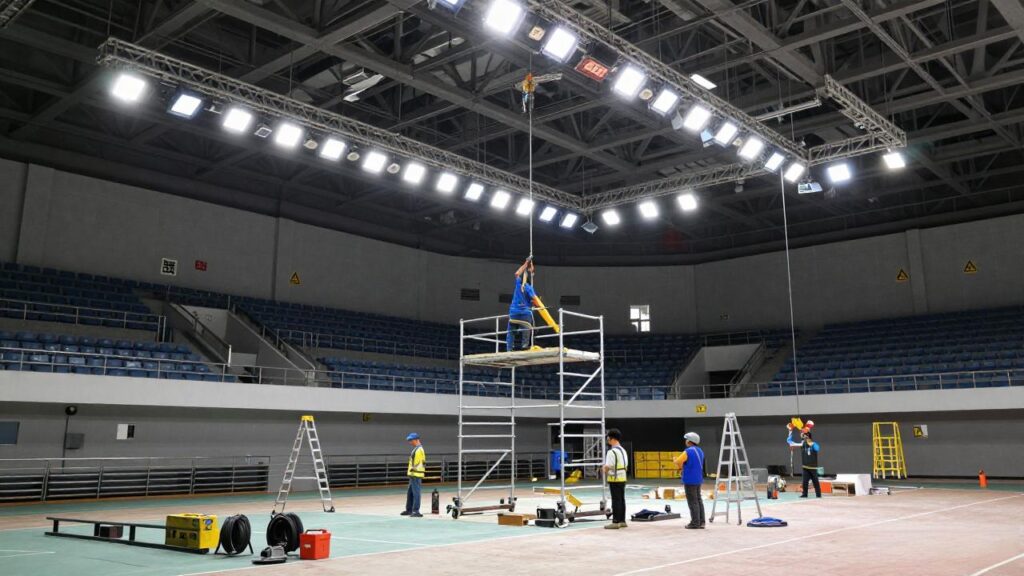
3. Components That Should Be Replaced
3.1 Luminaires
HID luminaires are inefficient and lack optical control compared to modern LED stadium lights.
3.2 Control Gear
Ballasts and ignitors used in HID systems are incompatible with LED technology and must be replaced.
3.3 Optics and Shields
Optical systems are the heart of LED performance and must be selected specifically for the retrofit layout.
4. Optical Redesign Checklist
- Define target illuminance and uniformity.
- Select mixed beam angles.
- Apply asymmetric optics where needed.
- Evaluate glare from critical viewpoints.
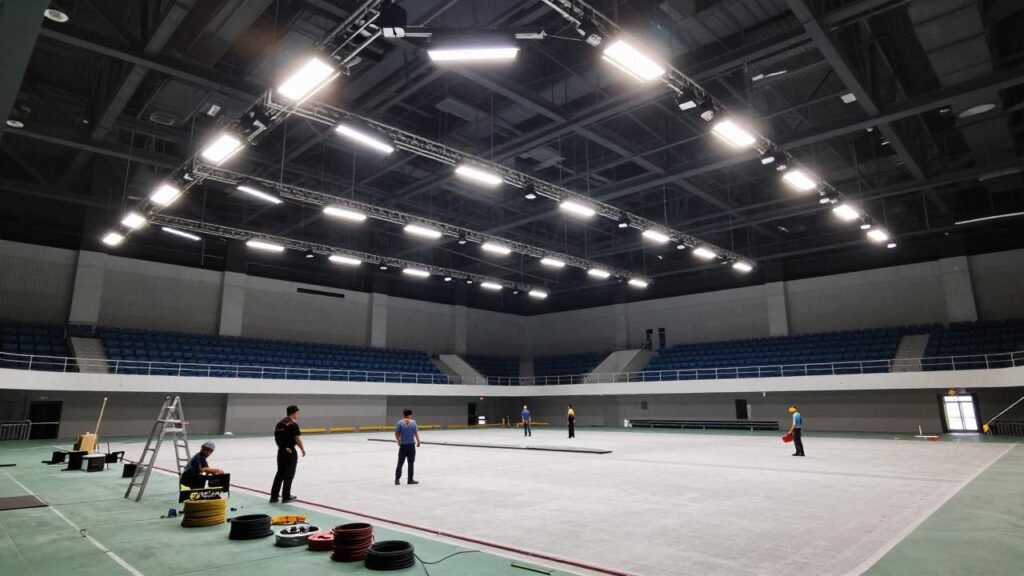
5. Performance Targets: Avoid Over-Specification
Not every stadium requires broadcast-grade lighting. Over-specification leads to unnecessary cost and complexity.
| Use case | Recommended focus | Retrofit strategy |
|---|---|---|
| Training | Efficiency & comfort | Lower output, strong ROI |
| Amateur matches | Uniformity | Balanced optics |
| Professional | Vertical illuminance | Advanced optics & controls |
6. Controls: Add Value Without Civil Work
Controls are one of the highest ROI upgrades during retrofit.
- Multiple lighting modes.
- Energy savings through dimming.
- Future readiness.
7. Commissioning Checklist
- Verify aiming angles.
- Check uniformity on-site.
- Confirm glare from player viewpoints.
- Test control scenes.
8. Common Retrofit Pitfalls
- Assuming “LED is LED.”
- Skipping optical simulation.
- Ignoring glare complaints.
- No post-installation verification.
9. Summary
A successful stadium lighting retrofit keeps what works, replaces what limits performance, and focuses investment on optics, control, and engineering.