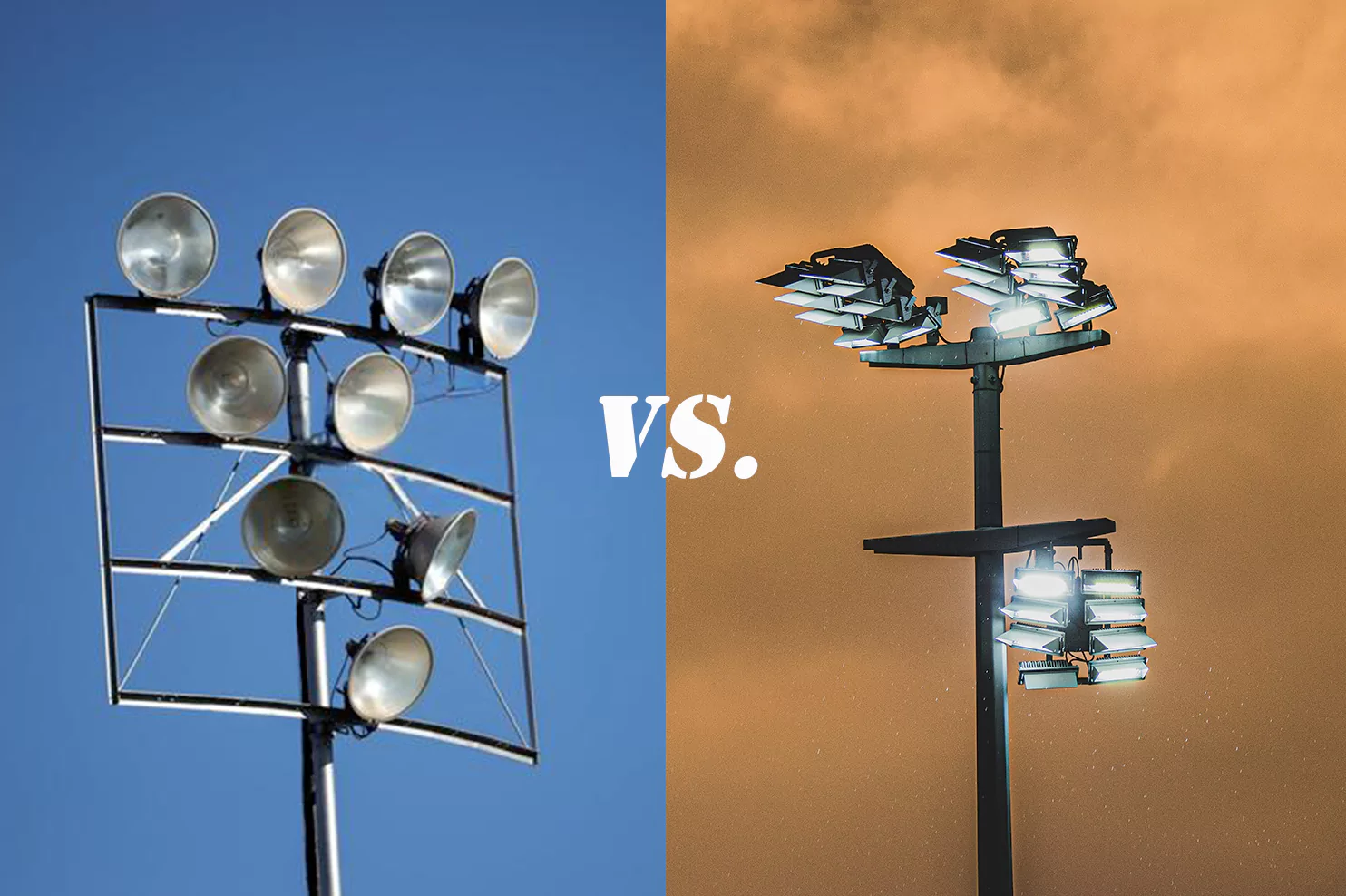
Across the world, thousands of football stadiums and training fields are still illuminated by HID systems — metal halide or high-pressure sodium — installed 10 to 20 years ago. While these systems once met performance expectations, they now face growing challenges: high energy consumption, long warm-up times, frequent maintenance, and increasing glare complaints.
The good news is that most stadiums can be successfully upgraded from HID to LED without replacing existing poles or foundations. This guide explains how such retrofits work, what must be evaluated, and how to avoid common mistakes that turn a “simple upgrade” into an expensive redesign.
1. Why Stadium Owners Upgrade HID to LED
HID systems were designed for a different era. LED technology fundamentally changes what is possible in sports lighting.
- Energy efficiency: 40–70% reduction compared to HID.
- Instant on/off: no warm-up or re-strike delays.
- Lower maintenance: no lamps or ballasts to replace.
- Better visual comfort: improved uniformity and glare control.
For many stadiums, the primary motivation is not only cost saving, but also improved player experience and reduced complaints from spectators and nearby residents.
2. The Biggest Myth: “LED Requires New Poles”
This misconception comes from early retrofit projects where LED luminaires were treated as direct watt-for-watt replacements. When optics and aiming were ignored, performance targets could only be met by increasing pole height or adding poles.
Modern LED stadium luminaires — especially modular or high-output integrated designs — can deliver higher usable light with precise distribution, making existing pole layouts not only usable, but often more effective than before.
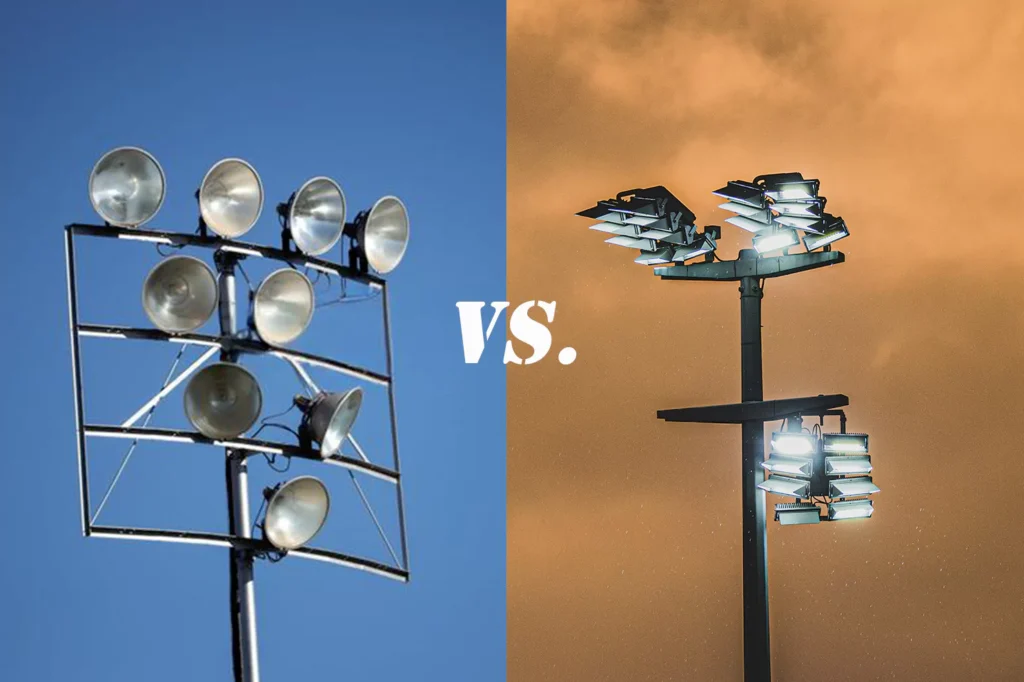
3. Step One: Assess the Existing Infrastructure
Before selecting any LED luminaire, a proper site assessment is essential.
3.1 What Can Usually Be Kept
- Poles and foundations.
- Primary power cabling.
- Mounting arms or crossbars (in many cases).
3.2 What Must Be Verified
- Pole height and spacing.
- Structural load capacity and EPA.
- Corrosion condition of poles and brackets.
Most retrofit failures originate from skipping this verification step.
4. Optical Redesign: The Core of a Successful Retrofit
HID systems rely on broad, inefficient light distribution. LED retrofits succeed by re-engineering the optical concept rather than copying the old layout.
- Mixed beam angles replace “one beam fits all.”
- Asymmetric optics reduce spill and glare.
- Lower tilt angles improve visual comfort.
5. Choosing the Right LED Stadium Luminaire Type
Not all LED stadium lights are suitable for retrofits.
Common retrofit-friendly characteristics
- High output per luminaire to match legacy mounting points.
- Multiple interchangeable optics.
- Precise aiming brackets with angle indicators.
- Optional visors or shields.
In practice, many retrofit projects use either high-power integrated floodlights or modular stadium luminaires, depending on required output and flexibility.
6. Glare and Light Spill: The Hidden Retrofit Risk
One of the most common complaints after poorly executed LED upgrades is increased glare.
- Exposed LED sources without proper optics.
- Over-tilted luminaires to compensate dark zones.
- No consideration of goalkeeper or spectator sightlines.
Successful retrofits reduce glare by design — not by lowering brightness.
7. Performance Targets: Training vs Match Use
Not all upgraded stadiums need broadcast-level lighting.| Use case | Typical LED target | Retrofit implication |
|---|---|---|
| Training fields | 300–500 lux | Simple optics, strong ROI |
| Amateur matches | 500–800 lux | Improved uniformity |
| Professional use | 800–1500 lux | Mixed optics, glare control |
8. Controls: The Retrofit Multiplier
Adding controls during retrofit dramatically improves ROI.
- Training mode vs match mode.
- Partial field operation.
- Scheduled dimming.
Many stadiums achieve payback in under 4 years when controls are applied intelligently.
9. Common Retrofit Mistakes
- Replacing HID watt-for-watt.
- Ignoring optics and glare.
- No simulation before installation.
- No on-site aiming verification.