At ZC Lighting, stadium lighting performance is not defined by specifications alone. It is shaped by engineering discipline, verified through time, and proven under real operating conditions.
In the stadium lighting industry, it is easy to focus on numbers — wattage, lumen output, beam angles, and efficiency ratios. While these parameters are important, they represent only a snapshot of performance under controlled conditions. For professional stadium projects, where lighting systems operate for years under heat, rain, wind, and continuous daily cycles, true reliability can only be demonstrated through long-term engineering validation.
This is why ZC Lighting places long-term, real-world validation at the core of our stadium lighting development process. Beyond laboratory testing, our engineering team continuously evaluates stadium luminaires in outdoor environments, allowing performance to be observed, measured, and refined over time.
Engineering Philosophy: Designing for Time, Not Just Test Reports
Stadium lighting systems face a unique set of engineering challenges. High-power operation, concentrated thermal loads, large optical surfaces, and complex mounting structures all interact during daily use. While short-term tests can confirm compliance, they cannot fully predict how a luminaire will behave after thousands of hours of operation.
Our engineering principle is simple:
If a stadium light is designed to perform for years, it must be observed for years.
This mindset influences every stage of product development — from thermal architecture and material selection to driver layout, sealing strategy, and structural reinforcement. Validation is not treated as a final checkpoint, but as an ongoing engineering process that runs in parallel with product evolution.
Beyond the Lab: Real-World Rooftop Validation
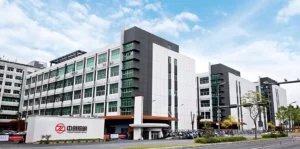
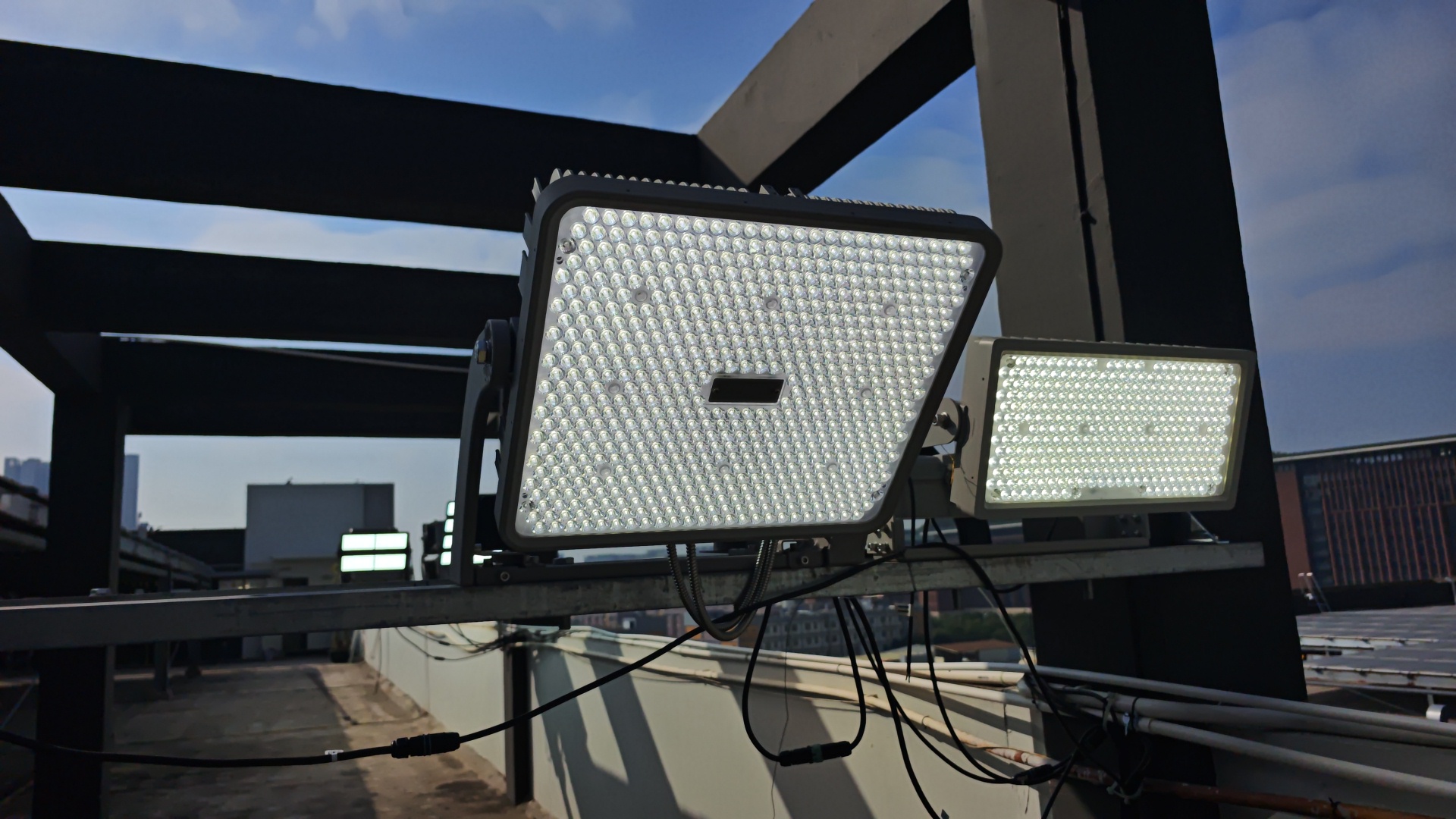
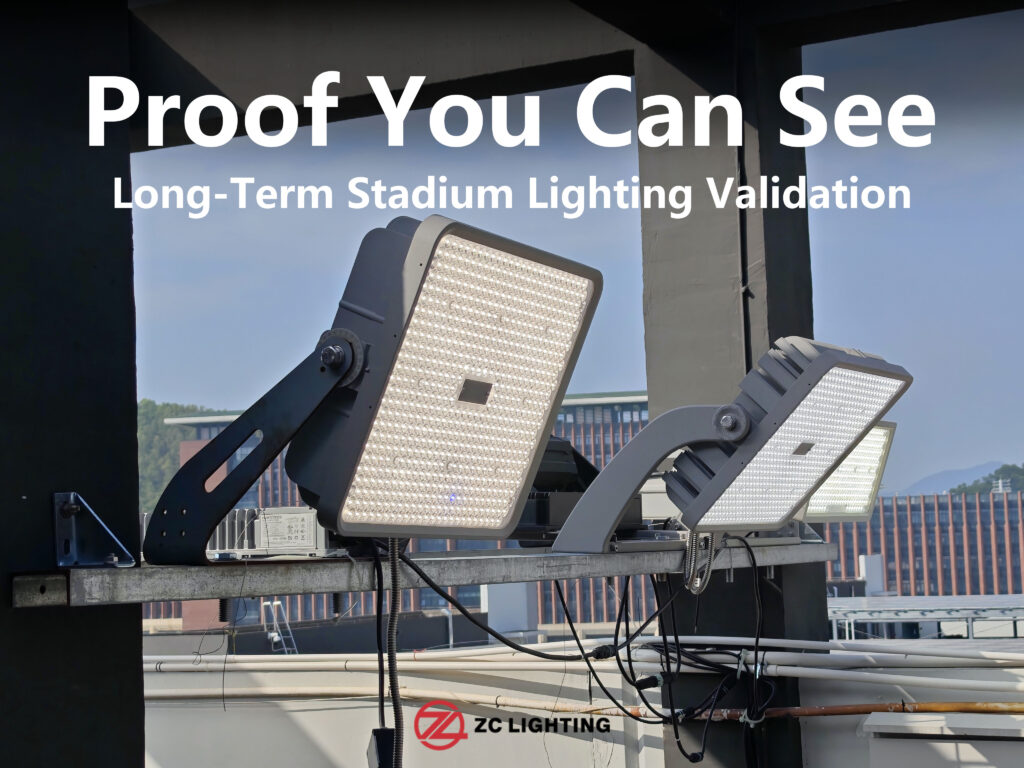
On the rooftop of our manufacturing facility, ZC Lighting has established a dedicated outdoor application testing area. Selected stadium luminaires are installed and operated continuously under real environmental conditions.
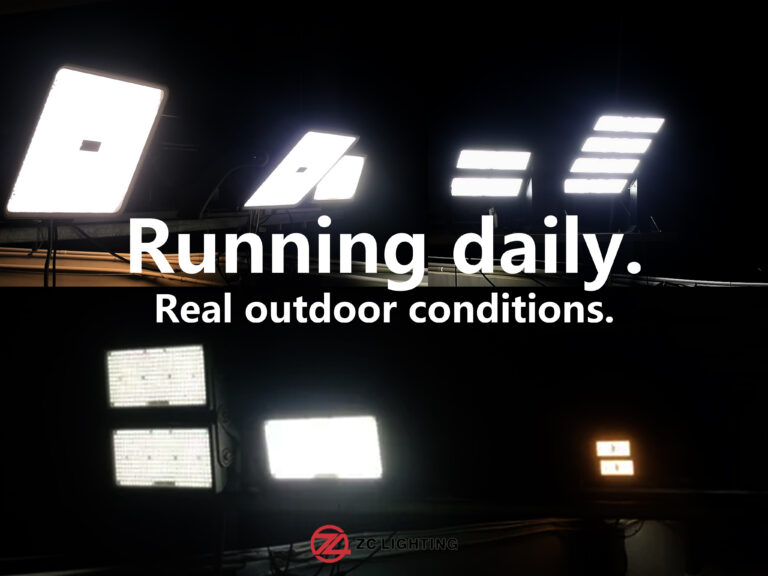
These luminaires are not demonstration units. They are production-level products, installed as they would be in actual projects, and operated daily from 8:00 AM to 10:00 PM. Each unit is clearly marked with its start date of continuous operation, creating a transparent and traceable validation record.
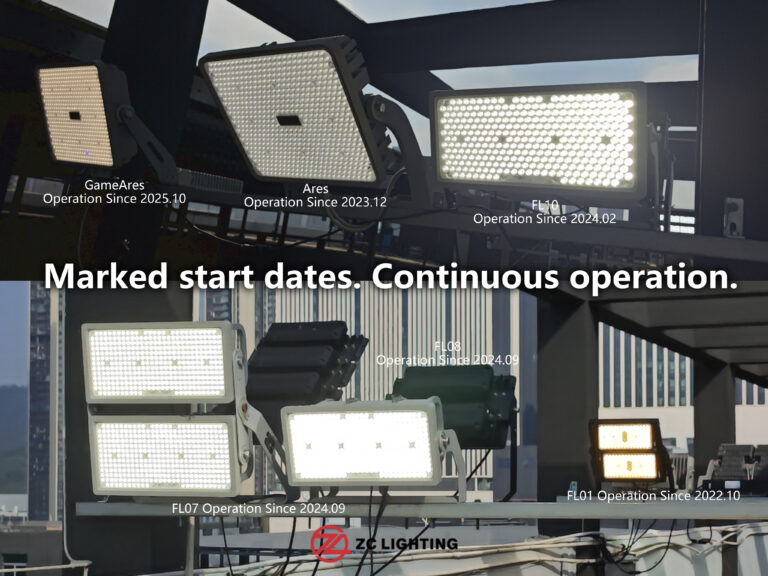
By maintaining long daily operating hours, our engineers are able to observe performance under sustained thermal stress, repeated on-off cycles, and seasonal environmental changes — factors that often reveal issues not detectable in accelerated lab tests.
What Long-Term Validation Allows Us to Observe
Thermal Stability Over Time
Heat management is one of the most critical aspects of high-power stadium lighting. Continuous operation allows our team to monitor:
- Heat dissipation efficiency across different ambient temperatures
- Thermal balance between LED modules, heat sinks, and drivers
- Long-term material behavior under repeated thermal expansion and contraction
Driver Endurance and Electrical Reliability
Stadium lighting drivers operate under demanding electrical conditions. Long-term testing enables evaluation of:
- Driver temperature stability during extended runtime
- Electrical component aging and consistency
- System response to daily switching cycles
Structural and Optical Performance
Mechanical integrity and optical stability are equally important for stadium projects. Over time, our engineers observe:
- Structural rigidity of brackets and mounting interfaces
- Lens and glass behavior under prolonged exposure
- Consistency of light distribution and aiming stability
Continuous Operation Records: Product-Level Validation
Transparency is a key part of our validation philosophy. Each luminaire on our rooftop test site is marked with its operation start date, allowing performance to be tracked over extended periods. Below is an overview of selected stadium lighting products currently or previously under long-term validation.
| Product Model | Continuous Operation Start | Validation Focus |
|---|---|---|
| FL01 | October 2022 | Long-term structural stability and baseline thermal behavior |
| FL09 | December 2023 | High-spec integrated stadium floodlight performance |
| FL10 | February 2024 | Modular system thermal and electrical consistency |
| FL07 | September 2024 | Structural and optical endurance under daily operation |
| FL08 | September 2024 | Compact stadium lighting thermal balance |
| FL18 | October 2025 | Cost-optimized professional stadium lighting validation |
These records are not marketing claims. They serve as internal engineering references that directly influence product refinement, material selection, and future design iterations.
From Validation to Product Confidence
Long-term validation strengthens our confidence in recommending specific stadium lighting solutions for different project scenarios. It allows us to speak with clarity when discussing expected lifespan, maintenance planning, and total cost of ownership.
For distributors, project owners, and engineering consultants, this approach translates into reduced risk and greater predictability. Instead of relying solely on specifications, decisions can be supported by performance observed over time.
Engineering as a Continuous Commitment
At ZC Lighting, validation does not end when a product is released. Our rooftop testing continues as new models are introduced, ensuring that engineering knowledge accumulates rather than resets with each generation.
This commitment reflects our belief that professional stadium lighting is built not only through innovation, but through discipline, patience, and respect for real-world conditions.
Conclusion: Reliability That Can Be Seen
Reliability in stadium lighting cannot be claimed — it must be demonstrated. Through long-term, continuous outdoor validation, ZC Lighting ensures that our engineering decisions are tested by time, not just by standards.
For projects where performance, stability, and longevity truly matter, engineering validation is not an option — it is a responsibility.