
In This Article
- Separate Three Risks That Are Often Called Glare
- Checkpoint 1: Identify the Responsible Reviewers
- Checkpoint 2: Survey More Than the Pitch
- Checkpoint 3: Review the Pilot’s Visual Environment
- Checkpoint 4: Follow the Driver’s Route
- Checkpoint 5: Ask for the Right Calculation Package
- Checkpoint 6: Do Not Accept a Label Instead of Installed Evidence
- Checkpoint 7: Compare Mitigation Without Losing the Sports Task
- Checkpoint 8: Include Events, Failures and Temporary Lighting
- Checkpoint 9: Define the Supplier’s Scope Honestly
- Checkpoint 10: Close the Risk Register on Site
- What to Send With the RFQ
- 자주 묻는 질문
A stadium beside a road or near an aerodrome has more than a spill-light problem. The same floodlight can appear acceptable from a neighbouring garden and become a bright source in a driver’s forward view. A row of lights that looks orderly from the pitch can form a distracting pattern when seen from an aircraft. A boundary illuminance report does not answer either question on its own.
The correct glare risk checklist starts with the observer, route and authority, not the luminaire wattage. Separate aircraft safeguarding, road-user visibility and ordinary off-site lighting assessment. Agree the required evidence before fixing pole positions, ordering optics or promising that an existing mast arrangement can be reused.
This guide is a procurement and coordination checklist, not an aeronautical approval or road-safety certificate. It uses UK aviation guidance and US roadway guidance for clearly identified principles. The actual project must follow its own jurisdiction, relevant authority and agreed assessment method.
Separate Three Risks That Are Often Called Glare
The first risk is visual impairment or discomfort from a bright source. For a road user, light scattered within the eye can reduce the contrast of an object ahead. The second is distraction: a source or changing display attracts attention away from the task. The third is confusion, where a lighting pattern interferes with recognition of transport signals or aeronautical lighting.
These effects should not be reduced to one generic glare number. The FHWA explanation of vision and glare distinguishes disability glare, discomfort and extraneous-light distraction. A sports-field metric does not automatically represent a driver looking in a different direction.
There is also physical safeguarding. A new mast or the crane used to install it may require a separate review of height and protected surfaces. Resolving the optical design does not approve the structure, and approving a structure does not resolve the lights attached to it.
Checkpoint 1: Identify the Responsible Reviewers
Contact the aerodrome safeguarding team when a site may affect airport or heliport operations. Do not wait until the final lighting calculation is complete. Ask what information they need, which areas or viewing directions require assessment and whether temporary equipment is also within scope.
For roads, identify the road authority and the lighting or safety professional responsible for the review. The relevant road may be outside the club’s ownership. A contractor’s agreement with the venue does not authorise working in a carriageway or making measurements from unsafe positions.
Write a responsibility schedule naming the applicant, lighting designer, structural engineer, electrical contractor, equipment supplier and operator. State who submits information and who can approve changes. This prevents the factory from being treated as the approving authority simply because it supplied the photometric file.
The UK CAA hosts CAST Advice Note 2, Lighting Near Aerodromes, dated April 2024. It explicitly includes sporting-venue floodlighting and temporary lighting within its discussion. Use it as a prompt for consultation, not as an international permission checklist.
Checkpoint 2: Survey More Than the Pitch
A useful base drawing includes pole coordinates, mounting heights, ground levels, crossarm arrangements and proposed aiming targets. Add the road alignment, changes in elevation, junctions, slip roads and signals identified by the road reviewer. For aviation, use the reference information supplied or accepted by the aerodrome team rather than inventing an approach path from a map.
Record buildings, screens and vegetation that affect sightlines. State whether an obstruction is permanent, seasonal or outside the owner’s control. A tree should not quietly become the only reason a design appears acceptable when its leaves may be absent during the winter playing season.
Photograph the existing installation from safe, authorised locations. Photos help reviewers understand context, but exposure and camera processing can distort apparent brightness. Treat them as supporting records rather than measurements or proof that a bright source is harmless.
Check the survey date. Road works, a new building or a changed seating structure can alter the geometry. If a supplier is working from an outdated drawing, flag that limitation before its results are circulated as final.
Checkpoint 3: Review the Pilot’s Visual Environment
Aviation review is not just a test for light emitted directly upwards. A pilot may view the site along a shallow line of sight. Pattern, brightness, colour and background lighting can matter alongside the direction of individual beams.
The cited CAST note identifies potential confusion with aeronautical lights, obscuration of their patterns, background brightness and glare or dazzle. It also says that aerodrome-specific lighting restriction areas can vary. Accordingly, this article gives no universal safe distance, pole height or aiming angle.
Supply an inventory of everything that can emit light: pitch floodlights, parking lights, signs, architectural strips, scoreboards and temporary event equipment. Show the proposed operating scenes, including any colour or dynamic effects. A review of steady white sports lighting should not be treated as approval for a later entertainment sequence.
Ask how proposed revisions will be assessed. Moving one pole may change its relationship to a critical viewing direction, even if the average pitch illumination improves. Keep the authority correspondence with the approved drawing so that the installation team can see which arrangement was actually reviewed.
Checkpoint 4: Follow the Driver’s Route
A single observer point beside the road is rarely a complete description of a moving driver’s exposure. Ask the responsible designer to identify representative approach positions and directions through the relevant section. A floodlight may become visible over a crest, appear beside a signal on a bend, or dominate the view near a junction.
그 2023 FHWA Lighting Handbook is a primary reference for roadway-lighting concepts, including disability glare. It is not a substitute for the road authority’s selected method or national standard on a European project.
Ask which assessment is appropriate for the road’s lighting condition and visual task. Where a road-glare calculation is required, the report should identify observer assumptions and background conditions. Do not label a software output “road safe” when it was calculated only for spectators or players.
Include the view of signals, signs, crossing users and lane guidance where relevant. Consider whether reflections from wet surfaces require additional review under the chosen method. Keep such checks within the competent road designer’s scope; a supplier should not invent pass criteria or conduct an improvised night-time test in live traffic.
Checkpoint 5: Ask for the Right Calculation Package
| Assessment item | 요청할 증거 | Common omission |
|---|---|---|
| Sports performance | Agreed reference areas, grids and operating scenes | Only an average lux value |
| Neighbour impact | Receptor locations, planes and applicable criteria | Upper-floor windows missing |
| Road visibility | Agreed routes, observers and road-glare method | Sports glare used as a substitute |
| Aviation safeguarding | Authority-requested views and installation information | Distance used as automatic clearance |
| 구성 | Exact optics, output, shields and aiming schedule | Unshielded photometry with shielded equipment |
| Operations | Scene schedule, restrictions and override behaviour | Only normal competition mode assessed |
Require reports to distinguish calculated results from measured ones. Identify the software version, photometric source and assumptions. A polished rendering can explain the arrangement, but it cannot stand in for the required calculation or written approval.
Check that every report describes the same revision. Conflicting pole schedules are a more immediate problem than a small difference in formatting between two suppliers’ simulation exports.
Checkpoint 6: Do Not Accept a Label Instead of Installed Evidence
Full cutoff, low ULR and BUG ratings can help describe a distribution, but none automatically proves suitability beside a transport route. Mounting orientation matters. A fitting rated in a level position may be installed differently to reach the pitch, and the observer may see high-angle output that a simple upward-flux statement does not explain.
A low reading on a horizontal boundary grid does not establish that a driver sees no bright source. Similarly, a road assessment does not resolve aviation pattern confusion. Keep the evidence matched to the question rather than treating the most favourable number as a universal result.
The companion ULR, BUG and full-cutoff guide explains the limits of these classifications. For a sensitive site, ask the supplier which parts of the assessment its documents support and which parts remain with the project designer.
If a quotation promises “airport-safe”, request the exact basis and scope. Without a site-specific review and the relevant approval process, that phrase is not a useful purchasing specification.
Checkpoint 7: Compare Mitigation Without Losing the Sports Task
Start with geometry and optics. Compare a revised aiming target, another distribution or a different allocation of luminaires before assuming the answer is simply lower output. Reducing every fitting equally may diminish useful pitch illumination while leaving a critical bright source in the same line of sight.
Evaluate shields with configuration-specific data. Check both the protected direction and the parts of the playing area affected by the shield. Mechanical suitability also matters: an accessory can change loading and installation requirements. Obtain the manufacturer’s and responsible engineer’s agreement before approving an improvised extension.
A pole relocation can be more effective than repeated optical adjustments, but it has civil, structural and possibly safeguarding consequences. Present it as a complete alternative, including the cost and approval implications. Do not move a mast in the model while the commercial offer still assumes reuse of the old foundation.
Agree reasonable margins and installation tolerances with the designer. A scheme that only works at one exact aiming position deserves a careful commissioning plan. The value of that plan becomes clear when maintenance staff later need to replace a driver or lower a lighting assembly.
Checkpoint 8: Include Events, Failures and Temporary Lighting
Normal match operation is only one state. Review training, warm-up, cleaning, partial-field use and closing time. Where dynamic lighting is proposed, identify colours, sequences and timing separately. Do not enable a show mode merely because the equipment supports it.
Discuss power restoration and control faults with the electrical designer. The preferred response depends on the venue’s safety duties and the agreed operating restrictions. This article does not prescribe a universal fail-dark or full-output response; either could create a different problem in the wrong context.
Construction and temporary equipment also need ownership. A portable tower placed near the fence can bypass every carefully selected permanent optic. Include contractors, event organisers and broadcasters in the change process where their lighting may affect the assessed environment.
Before an event, confirm that temporary equipment matches the authorised arrangement. Keep emergency contact details available to the operator. An approved permanent installation should not become the background justification for unrelated lighting that no reviewer has assessed.
Checkpoint 9: Define the Supplier’s Scope Honestly
Musco’s system documentation highlights coordinated equipment and aiming. AAA-LUX’s controls explanation describes varying light levels by area and time. Signify’s ArenaVision accessory instructions show dedicated optical-control and aiming tools. These are useful scope references, not equivalent aviation approvals.
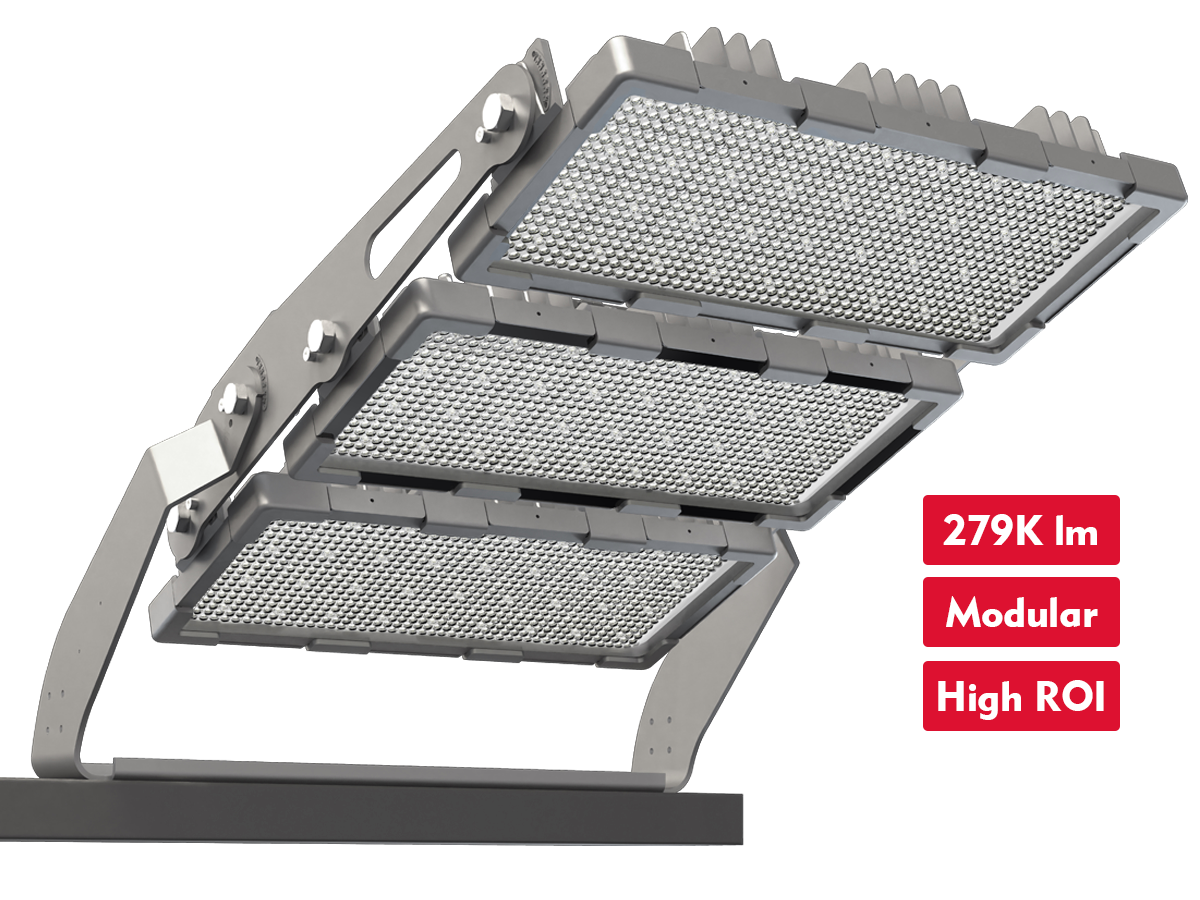
For ZC, FL26 version 1.3 documents an optional visor, optical choices, selectable output and an aiming scale. Those features are relevant to evaluating mitigation options. The specification does not, on that basis alone, prove compliance with an airport safeguarding requirement or a road-glare criterion.
Ask ZC for the current, exact configuration proposed for the model. Identify the photometric data required for the chosen accessory and output setting. Confirm mounting and driver arrangements with the installer. Keep local authority liaison, specialist assessment and independent acceptance responsibilities explicit.
This division is commercially important. A luminaire manufacturer can support product selection without being contracted to provide a complete airport-adjacent lighting approval service. If broader responsibility is needed, name the qualified party and include its work in the budget before comparing bids.
Checkpoint 10: Close the Risk Register on Site
Before energising the installation for its intended use, complete the agreed commissioning sequence and any authority conditions. Check fitted products, shields, output settings and aiming against the approved schedule. Resolve substitutions before calling the work equivalent.
Use qualified personnel and approved access arrangements for observations or measurements. Roadside and airside work has its own safety requirements. Never ask someone to stand in live traffic, enter restricted airport land or direct a light towards aircraft to test a concern.
Record the conditions and method behind each observation. Photographs should identify location and view, while measured results should include the instrument and agreed procedure. Where the acceptance plan requires a specialist review, obtain it rather than substituting the venue manager’s visual impression.
After handover, treat changes as controlled work. A new optic, raised output setting, moved scoreboard or added event light may invalidate part of the assessment. Retain a list of changes requiring review and a named person authorised to approve them.
What to Send With the RFQ
Send the surveyed layout, pole and mounting information, sports requirements, proposed operating hours and the relevant authority correspondence. Add the road or aviation assessment brief supplied by the responsible reviewer. Identify known restrictions and the evidence still outstanding.
Ask each bidder to return a configuration schedule, supporting photometric information, exclusions and a list of dependencies. Require alternative arrangements to show their effect on both sports performance and the sensitive viewing directions. This makes technical comparisons possible without rewarding vague assurances.
A project near an airport or road is not automatically unsuitable for sports lighting. It is unsuitable for casual assumptions. Contact ZC with the site constraints and review requirements so that the proposed luminaire configuration can be considered within the actual engineering process, rather than selected first and justified afterwards.
자주 묻는 질문
Is there a universal safe distance between stadium lights and an airport?
No universal distance is provided here. Site geometry, protected areas, operations and the relevant authority’s requirements determine the review. Consult the aerodrome safeguarding team before assuming that distance alone removes the risk.
Does zero uplight mean a floodlight cannot affect drivers?
No. A driver can see intense light emitted below the horizontal, depending on the road and luminaire geometry. Review the actual line of sight and the road authority’s required glare assessment rather than relying on an uplight figure.
Can the sports-field glare result be used for an adjacent road?
Not automatically. Road users have different positions, viewing directions and visual tasks. A competent road-lighting professional should specify the appropriate assessment method and explain which results demonstrate acceptance.
Should temporary event lights be reviewed too?
Yes, where they can affect the assessed transport environment. Include portable towers, signs and dynamic effects in the agreed change process. Approval of permanent sports lighting does not establish that unrelated temporary equipment is acceptable.
Header: AI-generated application illustration based on ZC FL26 product references, not a completed project photograph or evidence of lighting compliance. Technical sources checked 2026-9-8.