
In This Article
- What Is Actually Becoming More Demanding?
- Keep Four Layers of Requirements Separate
- The Netherlands: Check the Municipal Plan, Not an Old Summary
- England: Planning and Nuisance Are Different Tests
- Translate the Market Difference Into Tender Questions
- Why an Efficient Retrofit Can Still Disappoint the Neighbours
- Build the Receptor Map Before the Photometric Model
- Specify What the Operator Can Actually Do
- Use International Brands as a Scope Benchmark
- Where ZC’s Product Choices Fit
- Buy the Evidence Before Buying Extra Output
- 자주 묻는 질문
An LED retrofit can reduce a club’s electricity consumption and still leave its planning problem unresolved. The owner wants more winter training hours. Residents want dark bedrooms. The contractor wants to reuse the poles. The supplier receives a request for a wattage and a price, although the decisive questions concern operating times, viewing directions and permission to use the installation.
This is where intrusive light regulation becomes a purchasing issue. There is no single European sports-lighting rule that proves requirements have tightened everywhere. In the Netherlands and England, buyers need to navigate different combinations of local rules, planning decisions, nuisance assessment and technical guidance. The practical consequence is more demanding project documentation, even when no new universal lux limit has been introduced.
This review was checked on 2026-9-8. It uses those two markets as specific examples, not as a legal summary for the entire European Union. England is a European market but is not part of the EU. Local project advice and the current permission documents remain essential.
What Is Actually Becoming More Demanding?
Separate a change in law from a change in the evidence a buyer needs. A municipality may apply an existing condition more explicitly. A consultant may require window-level calculations that an older proposal omitted. An operator may need to demonstrate that a curfew cannot be casually bypassed. Those developments can make procurement more demanding without proving that a national numerical limit has recently fallen.
The sources reviewed here do not establish a statistical Europe-wide trend in enforcement or complaint numbers. It would be misleading to invent one. For procurement, a more useful interpretation is project risk: poorly documented light outside the playing area is harder to defend than a design that identifies its receptors, limits and controls.
그 CIE’s 2025 position statement provides a recent technical-policy reference on obtrusive light and light pollution. It is not a national law, a planning permission or evidence that every European sports club faces the same new obligation.
For the buyer, the useful question is therefore not whether Europe is stricter. It is which requirements govern this address, this operating schedule and this proposed change.
Keep Four Layers of Requirements Separate
The first layer is legislation and the rules that apply locally. The second is the project’s planning permission, permit or other binding conditions. The third is the technical assessment method agreed with the reviewer. The fourth is the supply contract, which allocates the work required to demonstrate performance.
These layers interact, but they are not interchangeable. A manufacturer’s declaration about electrical conformity does not establish acceptable light at a neighbouring window. A sports-lighting calculation does not change permitted operating hours. A consultant’s preferred guidance document is not automatically legislation.
Create a requirements register with a source, version, geographical scope, responsible reviewer and evidence deliverable for each item. If a condition is unclear, ask the authority to clarify it before inviting final bids. Bidders cannot price a consistent solution when each interprets the brief differently.
This register is also a useful protection against unnecessary specification. It prevents a team from adding expensive accessories merely because another project used them, while overlooking a simple time-control requirement that actually applies.
The Netherlands: Check the Municipal Plan, Not an Old Summary
The Dutch government’s IPLO explanation of light nuisance places assessment of this issue with decentralised authorities and describes impacts in terms of the nature, intensity, duration and location of lighting. For a sports project, that makes the local setting and operating pattern part of the design brief.
The published transitional bruidsschat text, Article 22.239, includes switching outdoor sports lighting off between 23:00 and 07:00 and when neither sport nor maintenance is taking place. It also contains exceptions. Municipalities can change transitional rules through their own plans, so this text should not be presented as an unchanged rule for every address.
Ask the Dutch project team to confirm the current omgevingsplan and any site-specific conditions. Record the result in the tender rather than merely writing “comply with Dutch regulations”. If an exception is relevant, identify who grants or confirms it and how the operator records its use.
The purchasing implication is straightforward: a switchable luminaire is not the same as a managed operating schedule. The quotation should identify who supplies the controller, who enters the permitted hours and who tests the actual shutdown behaviour. Those are proposed project deliverables, not an assertion that one particular controller is legally mandatory.
England: Planning and Nuisance Are Different Tests
England’s planning guidance on light pollution emphasises considering the need for lighting, its location and timing early in development. The implication for a club is to address the surrounding environment before equipment is fixed, rather than offer an energy-saving calculation as the whole planning response.
Separately, the government’s artificial-light nuisance guidance explains that councils investigate potential statutory nuisance and that there are no fixed light levels defining it. Passing a numerical design target should therefore not be advertised as immunity from a later complaint.
A sensible bid review asks whether the proposal addresses both the stated permission conditions and the practical sources of disturbance. Check which windows face the installation, whether closing-time activity extends beyond the playing session and whether a reduced mode still leaves exposed bright sources visible.
Do not extend this English guidance automatically to Scotland, Wales or Northern Ireland. Do not infer that an exemption applying to a particular type of premises also applies to a nearby sports field. The relevant jurisdiction and premises need to be identified by the responsible local adviser.
Translate the Market Difference Into Tender Questions
| Issue | Netherlands example | England example | Procurement action |
|---|---|---|---|
| Applicable rules | Current municipal plan and site conditions | Planning conditions and relevant law | Attach the actual documents |
| 운영 시간 | Check local treatment of transitional rules | Check permission and operating restrictions | Specify tested scenes and schedules |
| 외부 영향 | Location-specific assessment | Design assessment plus nuisance exposure | Agree receptors and methods |
| 수락 | Evidence required by local reviewer | Evidence required by planning and project team | Name the responsible signatories |
This is a coordination table, not a legal equivalence table. It does not say the two markets apply the same tests. Its purpose is to stop an international supplier’s standard quotation from leaving the local contractor with undefined approval work.
Why an Efficient Retrofit Can Still Disappoint the Neighbours
Energy is measured at the supply; disturbance is experienced at a place and time. Reducing input power does not tell a resident how bright a particular LED face will look through a window. Keeping the same pole positions also does not guarantee that a replacement optic sends light into the same directions as the old equipment.
One hypothetical procurement mistake is to compare the old system at the end of its maintenance cycle with a new system at full initial output, then use the energy reduction to imply a proportional environmental improvement. The two systems may differ in direction, output, controls and operating hours. The comparison needs an agreed basis.
Another mistake is to promise more booking hours as an automatic benefit of LED conversion. The hardware may support instant switching, but permission to operate is a separate matter. Include proposed hours in the initial review rather than discovering after installation that the commercial plan cannot be used.
A useful retrofit survey therefore records both the existing installation and the intended operation. Capture current aiming, pole condition, surrounding buildings, known complaint locations and available controls. Ask whether the brief is replacement, improved sports performance, longer operation or all three. Each change can alter the assessment.
Build the Receptor Map Before the Photometric Model
Ask the site owner and local consultant to mark sensitive locations on a drawing. Include the height of relevant windows, public paths and any ecological areas identified through the appropriate assessment. A generic ring around the property boundary is not a substitute for that work.
Turn each location into a clear question. Is the concern light reaching a window, direct visibility of a bright source, a dark corridor used by wildlife, or a driver looking towards a junction? Different questions need different evidence. Do not make a single horizontal lux plot carry all of them.
그 ILP explanation of its GN01/21 update highlights source intensity, curfews and reflected upward light. Use the applicable technical documents with the reviewer, not isolated limits copied from a supplier blog.
Record uncertainty openly. If window access is unavailable, agree a calculation assumption and a later verification method. If ecological advice is pending, do not choose a colour temperature and call the matter resolved. A limitation stated early is more manageable than an unsupported assurance repeated in the final quotation.
Specify What the Operator Can Actually Do
A controls proposal should describe real sessions: competition, full-field training, partial-field training, maintenance and shutdown. For each scene, identify which luminaires operate, the intended output setting, permitted times and the person authorised to change it. Not every venue needs an elaborate connected platform, but every venue needs an understandable operating arrangement.
Think through ordinary failures. What happens after a power interruption? Does the schedule recover correctly? Can a manual override remain active indefinitely? Is there a separate safe route for people leaving after the pitch lights go off? These are commissioning questions to agree with the electrical and safety designers, not assumptions about a luminaire’s driver.
Require the controls supplier to demonstrate the agreed behaviour. A screenshot of a scheduling app does not prove the luminaires respond correctly. The handover should include access ownership, basic operating instructions and a process for changing authorised hours.
Where remote monitoring is proposed, ask about recurring charges, connectivity, support and the consequences of losing the service. Where simple local control is sufficient, document it with equal care. The objective is predictable operation, not a particular level of software complexity.
Use International Brands as a Scope Benchmark
Musco’s published system approach makes a useful reminder that optical performance and installation responsibilities belong together. AAA-LUX describes controls that adapt lighting by area and time. Signify’s ArenaVision documentation illustrates purpose-made optical accessories and aiming equipment. These are different ways of addressing the whole installation rather than treating the fitting as an isolated purchase.
They are not one shared “international brand standard”. Nor does reading their documentation establish that ZC provides the same proprietary control system, patented shielding or service contract. A fair comparison lists what each supplier actually includes and what remains with the local designer and installer.
For a community club, the appropriate answer may be simpler than a major stadium package: a suitable optic, documented shielding, clear settings and competent local commissioning. For a constrained professional venue, more extensive design support may be necessary. Select the scope to suit the risk, then compare commercial offers on that scope.
Where ZC’s Product Choices Fit
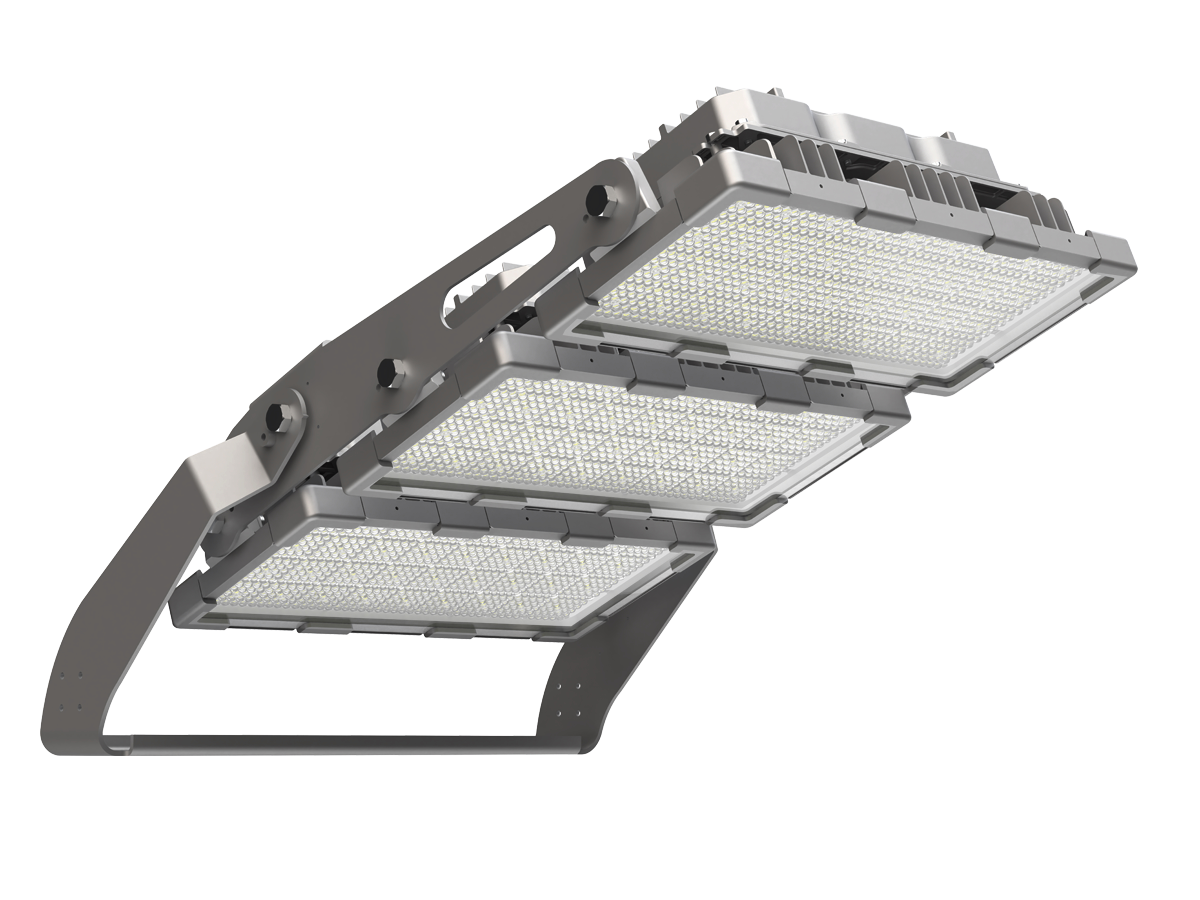
The reviewed FL26 version 1.3 specification documents selectable output, optical configuration choices, an optional visor and an aiming scale. For a contractor working with existing infrastructure, these are relevant options to evaluate against the layout. They do not establish that the product is approved for a particular Dutch municipality or English planning condition.
For example, the visor can be included in a proposal where a sensitive direction needs screening, provided matching data supports the calculation. A selected output setting should be fixed in the schedule, not left as an informal adjustment after residents complain. Driver location options should be coordinated with wiring, access and maintenance requirements.
Request current configuration-specific documents from ZC and state which local consultant will review the installation. Do not assume that availability of a control input means compatibility with any chosen management platform. Interface, driver version, operating behaviour and responsibility for commissioning need confirmation.
This is an appropriate B2B manufacturer role: supplying an identified configuration and the agreed technical information while the project team retains local approval and site-assessment duties. It keeps the quotation credible without pretending that a factory product declaration resolves every environmental issue.
Buy the Evidence Before Buying Extra Output
Divide the project into review points. First confirm the applicable requirements and survey. Next compare the proposed layouts and configuration-specific results. Then approve the equipment schedule. Finally verify installation and operating modes. Keep unresolved conditions visible at each point.
Price design changes explicitly. Ask what happens if a reviewer requests another shield arrangement, a lower permitted output or an amended pole position. Identify whether further calculations, revised accessories and another commissioning visit are included. This makes the commercial exposure visible instead of hiding it in the phrase “lighting design included”.
Protect the operator’s future records. Keep the approved files, drawings, settings and complaint contact together. When an adjacent property changes or a luminaire is replaced, that record allows the team to assess the effect without reconstructing the original project from memory.
For an initial enquiry, send ZC the project country and municipality, existing pole layout, sports requirement, permitted hours and identified sensitive locations. Request a documented configuration proposal. Start with the approval problem the project must solve, not a generic demand for the brightest available floodlight.
자주 묻는 질문
Is there one intrusive-light regulation for all European sports venues?
No. Applicable law, local permissions and technical assessment requirements vary. This article examines the Netherlands and England only. A project team should confirm the rules for its address and avoid using a general European label as evidence of compliance.
Must every Dutch sports venue switch off at 23:00?
The cited transitional text includes a 23:00-07:00 shutdown provision and exceptions, but local plans can change the applicable rules. Check the current municipal plan and site conditions rather than treating an online summary as a definitive instruction.
Does meeting a lux limit prevent a nuisance complaint in England?
No. Official guidance states that statutory nuisance has no fixed light-level threshold. A numerical assessment can support a responsible design, but it is not a blanket defence against every effect of the installed lighting.
Can ZC provide a Europe-compliant sports floodlight?
Ask for the specific product conformity documents and project configuration, then assess the complete installation against local requirements. There is no single luminaire label that establishes acceptable operating hours, neighbour exposure and planning compliance across Europe.
Header: AI-generated application illustration based on ZC FL26 product references, not a completed project photograph or evidence of lighting compliance. Technical sources checked 2026-9-8.