Golf & Driving Range Lighting
Sports & Venue Lighting

Golf & Driving Range Lighting

Layered near-to-far lighting for ball-flight visibility, target recognition and controlled spill over long distances.

Range GeometryHitting bays + near, middle and far landing/target zones
MountingHigh poles/masts supplemented by closer area lighting as needed
Visual TaskTrack a small moving ball against ground and night sky
Critical ReviewLong throw, vertical contrast, spill beyond range and zoning
Project Context

Design the lighting around how the venue is actually used.

High-quality sports lighting is a system result. Geometry, source positions, optics, controls, environmental limits and commissioning all influence the final experience.

Driving ranges are depth-based lighting environments. A single average over the entire area is less informative than whether players can follow ball flight from the hitting line through the middle distance and into target/landing zones.

Range length, width, netting, target greens, bay structures and surrounding terrain vary substantially. The lighting model should include these elements plus any roads or homes beyond the far boundary, because poorly controlled long-throw beams can produce significant off-site impact.

Night-golf courses and large practice facilities may also need coordinated pathway, bay and landscape lighting. Those systems should support the main sports task without creating bright foreground adaptation.

ZC project approach: use the actual site drawing and target criteria to select products, optics, quantity, aiming and compatible controls. Product wattage is an input to the calculation—not the starting answer.

Geometry, Mounting & Aiming

Source position and beam direction determine the quality of the installation.

The same luminaire can perform very differently when pole height, setback, aiming angle or observer direction changes.

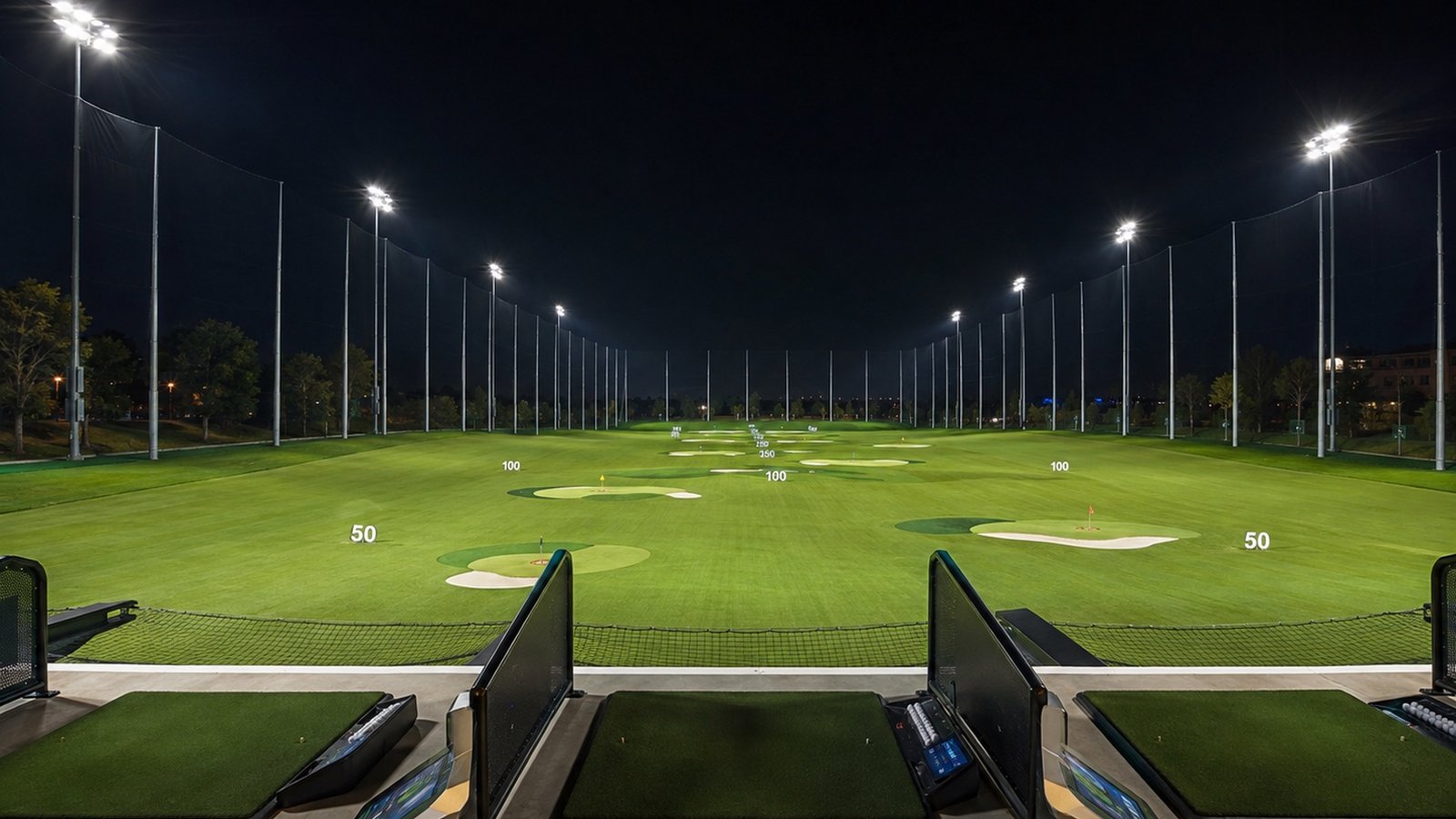
Typical golf / driving-range layout
Engineering diagramTypical golf / driving-range layout

Near, mid and far zones require different throw distances and aiming groups rather than a single central target.

Typical reference only. Final pole quantity, mounting height, aiming angles, optics and fixture quantity should be confirmed by photometric calculation, structural conditions and the applicable project requirements.

Layered zones

Separate near, middle and far aiming groups rather than treating the range as one target plane.
High poles

Useful for long throws, but taller sources require structural/wind review and careful source visibility control.

Bay lighting

Keep hitting-area lighting comfortable so players can transition visually to the darker far range.

Topography / netting

Trees, terrain and safety nets can block beams or create bright reflective surfaces; include them in the design model.

Lighting Performance

Review more than average horizontal lux.

A complete review considers playability, visual adaptation, camera or spectator needs and the effect of the lighting outside the venue.

Near-zone visibility
Players need clear ball/tee and immediate landing-area visibility.
Avoid excessive foreground brightness.
Mid/far coverage
Long-throw optical efficiency becomes critical.
Review intensity at target zones, not only average range lux.
Vertical/aerial contrast
Ball flight is seen against sky and distant background.
Source glare can easily obscure a small ball.
Glare
Check from every hitting bay and practice deck.
Visible high-mast luminaires should be controlled.
Spill light
Far boundary beams can affect distant properties or roads.
Use off-site vertical measurements/calculation.
Energy control
Large ranges benefit from zoning by active bays or distance zones.
Operate only the lighting that is needed.
Players at baysNeed low source distraction while looking into the distance.
Upper/deck baysMay have different source sightlines than ground-level bays.
Range staffNeed service/collection visibility without overlighting.
Off-site observersRoads, homes and dark-sky surroundings beyond the range.
Have a target standard, league brief or photometric specification?Send it with your site drawing →
Controls & Operating Scenes

Light when needed, at the level the venue actually needs.

Scene planning can reduce operating hours and energy use, but the control architecture must match the selected driver/product configuration. ZC can coordinate compatible luminaire interfaces; final system integration should follow the project control design.

Full range
All active zones.
Reduced range
Near/mid zones only during low demand.
Bay zone
Operate only occupied sections where control architecture permits.
Maintenance
Task-oriented service scene.
Curfew
Scheduled shut-off / reduced security scene.
Accessories & Special Conditions

Use accessories to solve defined engineering issues.

Shielding, brackets, drivers and electrical accessories should be selected because the project needs them—not added as generic decoration.

Long-throw narrow/medium optics
Visors/shields for boundary directions
High-mast structural and EPA review
Surge protection
Accessible driver/electrical service strategy
Zone-based control grouping
New Build & Retrofit

Existing infrastructure can be valuable, but it must be verified.

LED retrofit decisions should combine structural, electrical, optical and operational review.

Existing range poles may be reusable, but old metal-halide systems often use broad beams and high spill. A successful LED retrofit should re-aim the system from the geometry rather than preserve every old beam direction. Check pole condition, netting interference and whether fewer/more fixture positions give better long-distance balance.
Retrofitting existing poles or roof positions?Send pole height, fixture photos and existing layout →
Recommended Products

Products worth evaluating for this application.

These are project starting points, not universal specifications. Final product, power, optics, accessories and controls should follow photometric calculation and installation conditions. Confirm the latest product configuration with ZC Lighting before specification.
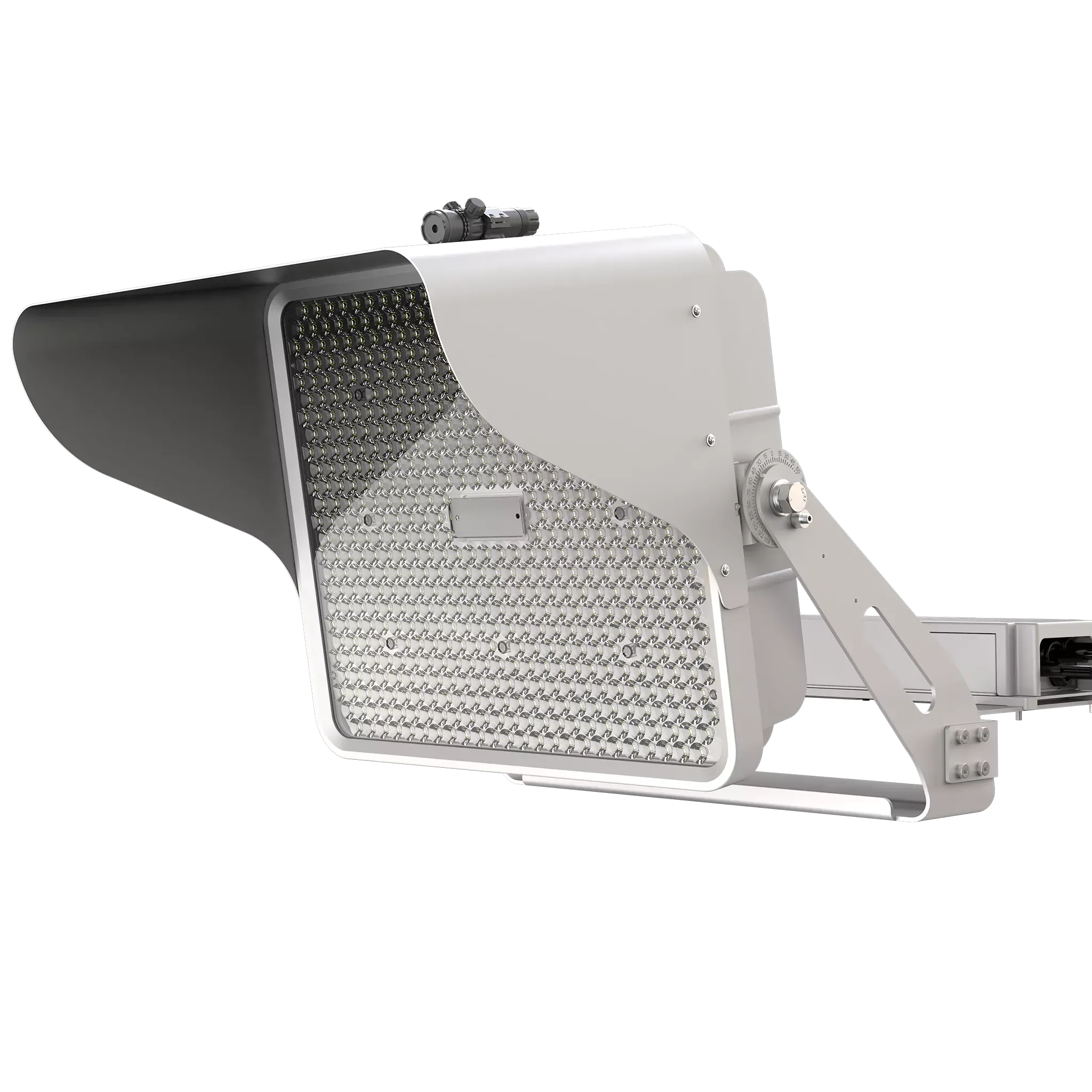
FL09 Ares LED Stadium Floodlight
FL09

Ares FL09

Professional long-throw sports luminaire for high mounting positions, large fields and projects requiring precise beam selection and camera-oriented light quality options.
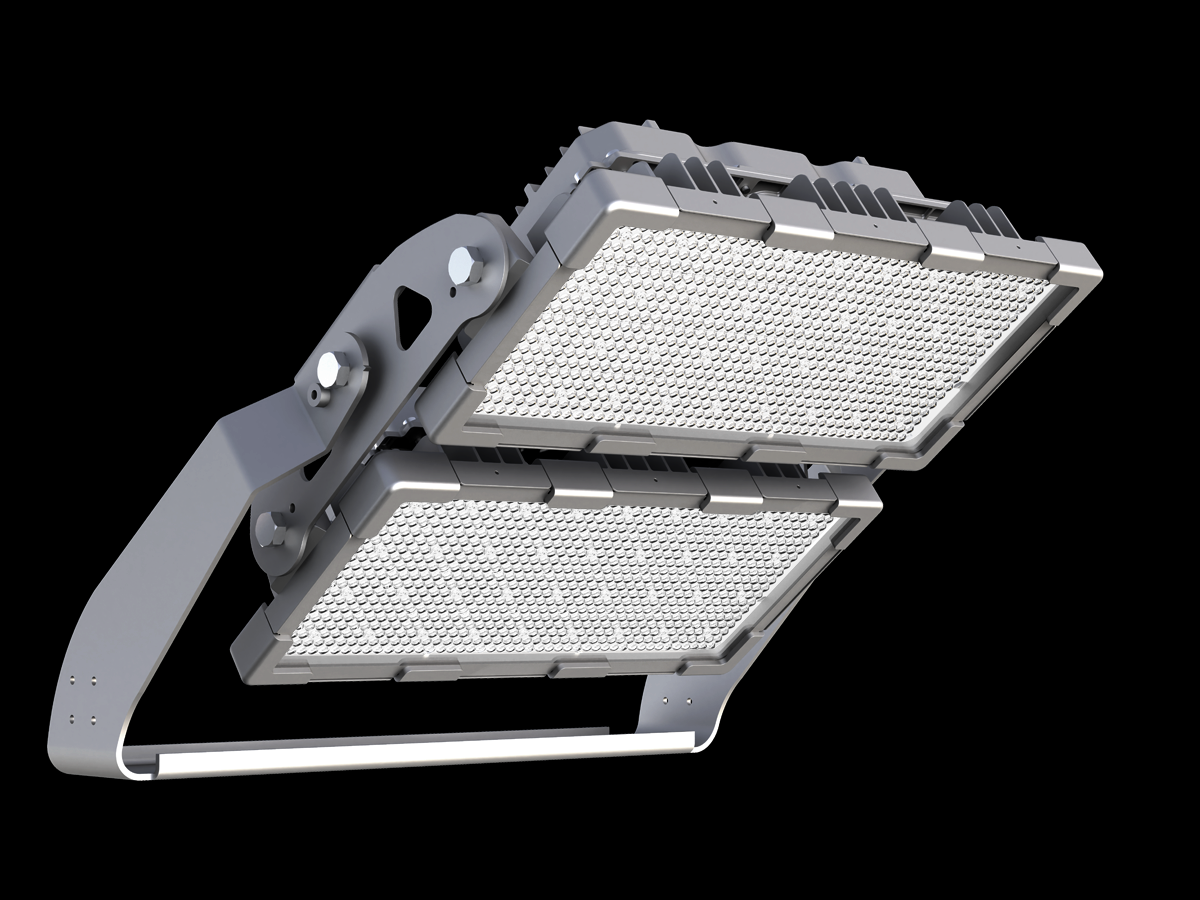
Why evaluate it here: Long-throw option for deep range zones from high poles.
View product
FL26 Modular LED Sports Floodlight
FL26

FL26 Scalable Stadium Floodlight

Modular sports floodlight with a broad power and optical range, useful where one project needs several beam distributions or phased fixture quantities.

Why evaluate it here: Useful where near/mid/far zones need a broad mix of optics or output levels.
View product
FL20

FL20 Full-Cutoff Modular Floodlight

Full-cutoff modular floodlight for projects requiring strict upward-light control, broad optical choice and stable visual performance.

Why evaluate it here: Consider where strict upward-light control is important and the available distributions suit the range geometry.
View product
Installation & Commissioning

A good calculation still needs a disciplined site handover.

Fixture orientation, aiming, control grouping and verification should be treated as part of the lighting design—not left to visual adjustment after installation.

Aim near/mid/far groups independently.
Check ball-flight visibility from representative bays.
Review upper and lower deck viewpoints if applicable.
Measure boundary/off-site points after dark.
Verify zone control and curfew scenes.
Record final target zones and fixture IDs.
Project Input Checklist

What to send for a faster technical review.

Better input data reduces redesign, narrows the right product/optic combination and makes the first proposal more useful.

01

Range length/width

02

Hitting bay and deck layout

03

Target greens / landing zones

04

Pole locations/heights

05

Netting / terrain / obstructions

06

Nearest roads or properties

07

Operating hours

08

Desired control zones

Frequently Asked Questions

Questions to resolve before final product selection.

These answers are practical engineering guidance. Final performance should be confirmed against the project requirements and applicable local or sport-specific standards.

Why is average lux not enough for a driving range?

Players need layered visibility across distance and must track a small aerial object; near-to-far contrast and glare can matter more than one overall average.

Can long-throw fixtures create more spill?

They can if aiming and shielding are poor. The design should check the far boundary and upward/backlight directions explicitly.

Should all poles use the same optic?

Usually not. Near, middle and far zones have different throw distances.

Can we dim the far range when fewer bays are used?

Potentially, if the control groups and facility operating model are designed for it.

What site data is most useful?

A dimensioned range plan with bays, target distances, pole positions/heights, netting and surrounding sensitive areas.

Request a lighting proposal

Send the site geometry before choosing fixture quantity.

Share dimensions, mounting positions and heights, target performance, existing fixture information and available drawings. ZC Lighting can then review product options, optics, quantity, aiming and compatible control requirements.

Email: info@zcled.com

Your information will be used only to respond to this project inquiry.

Get a Quote

Tell us about your project

For the fastest pricing, include model, quantity, application, and installation height.

Trust & Privacy

We respect your privacy. Your information will only be used to respond to your inquiry.

Upload project spec, layout, or drawing.

Thank you!

Your inquiry has been submitted successfully.
We'll reply within 24 hours.