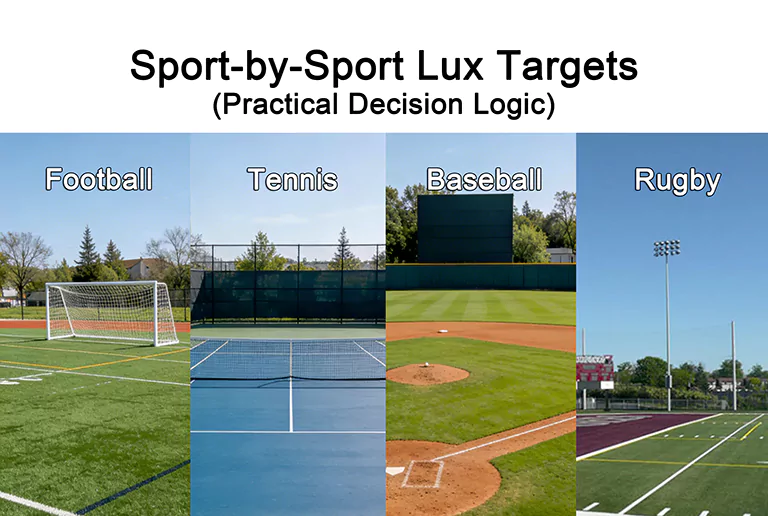
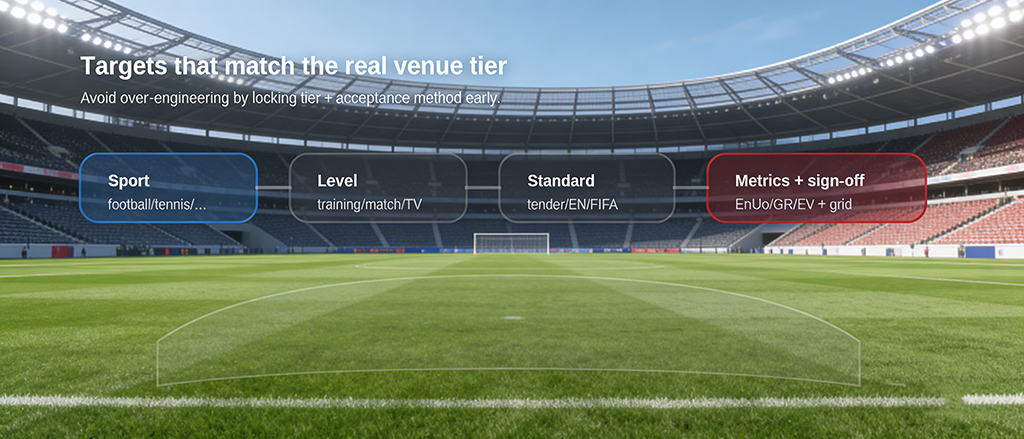
Lux targets vary by level of play and standard-but the decision logic is repeatable. This guide shows how to set sport-appropriate targets fast, avoid over-engineering, and write enforceable acceptance rules.
Use the sport table to identify must-have metrics (Eh, uniformity, GR, Ev, flicker), then lock the measurement method so the targets are defendable at sign-off.
- Key takeaway #1: Decision chain: sport → level (training/competition/broadcast) → standard/tender → acceptance method.
- Key takeaway #2: Tennis and baseball are often more Ev-sensitive; football/rugby often more boundary spill/glare sensitive.
- Key takeaway #3: Multi-sport venues succeed when you design for the toughest tier and use control modes for the rest.
Table of contents
When this applies
Use this guide when you need to set performance targets quickly for a tender, a distributor quote, or an early-stage feasibility check. It helps you avoid two costly mistakes: over-engineering (too expensive) or under-specifying (fails acceptance).
Typical scenarios
- Early RFP stage: you need sport-appropriate target logic before full calculation.
- Multi-sport venues: one system must cover multiple sports with different sensitivity to glare/Ev.
- Retrofits: poles are fixed; you must match targets via optics + aiming + controls.
- Distributor quoting: you need a defendable “why these targets” explanation.
Key requirements / metrics
This table highlights what actually drives design decisions sport-by-sport (beyond average lux).
| Sport | What drives the design | Typical decision focus | Common pitfalls |
|---|---|---|---|
| Football (soccer) | Large rectangular area, long viewing distances, community spill/glare risks. | Eh + uniformity + GR; add Ev + flicker if broadcast is required. | Over-powering average lux while ignoring glare and spill at the boundaries. |
| Tennis | Fast ball tracking, player sightlines often close to luminaires. | Glare control + useful vertical component; mounting height and aiming are sensitive. | Using wide optics and high tilt that puts bright sources in player eye lines. |
| Baseball / Softball | Ball in air and high vertical visibility; infield/outfield differences. | Ev planning + uniformity zoning; avoid extreme hot spots in infield. | Designing only for Eh on the ground; fly-ball visibility suffers. |
| Rugby | Similar to football geometry; frequent high-ball play and wide viewing angles. | Eh + uniformity + GR; ensure edge control for touchlines and run-off. | Ignoring edge zones and assuming football targets automatically fit rugby tenders. |
Definitions
“Lux targets” should never be picked by sport alone. The correct chain is: sport → level of play → adopted standard/tender → acceptance method. The most common confusion is treating a broadcast stadium target as if it were required for a training facility.
Typical target ranges
Because numeric lux targets vary by standard and tender, the safest “typical range” guidance is by project tier:
- Training / recreational: often in the low-to-mid hundreds of maintained lux, with practical uniformity and glare comfort.
- Competition: typically moves into the mid-to-high hundreds with stricter uniformity and glare limits.
- Broadcast / elite: often requires ~1000 lux and above plus Ev and flicker criteria, and tighter glare/spill control.
Use the table above to decide which metrics become “must-have” for your sport (e.g., tennis/baseball are more Ev-sensitive). Then confirm exact targets from the tender.
Step-by-step workflow
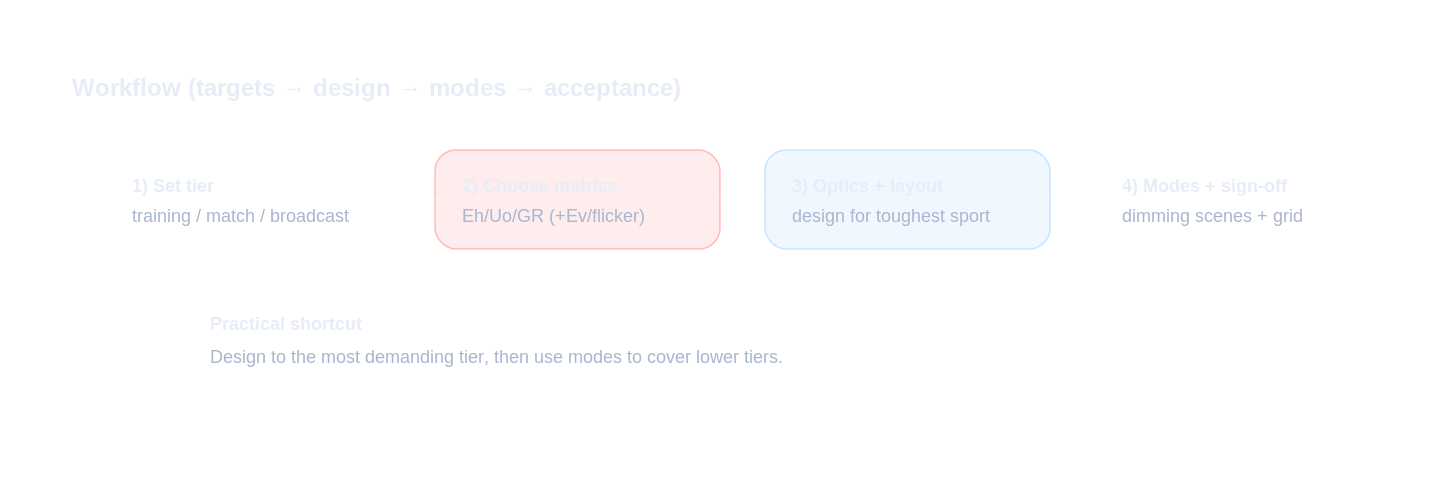
The fastest way to set targets without over-engineering is to separate the venue into use tiers and define “must-have metrics” per sport.
Inputs to collect (must-have)
- Sport(s) and level: training / club / competition / broadcast.
- Standard reference: tender, local federation, EN practice, or broadcast guideline.
- Pole data: mounting heights, locations, tilt limits, and constraints.
- Constraints: glare/spill limits, neighbors, roads, curfew.
- Controls: do you need training/match/event modes to cover multiple sports?
Design decisions (key points)
- Design for the most demanding sport tier. Then use dimming/modes for lower tiers.
- Define Ev early for tennis/baseball/broadcast. It’s often the hidden requirement behind “good playability.”
- Use optics as your ‘targeting system’. One housing + multiple optics can cover different sports on the same poles.
- Write acceptance rules now. Targets without a grid/method are not enforceable.
Verification & sign-off (how to accept)
- Report package: include targets, grid/areas, assumptions, and pole-by-pole aiming tables.
- Site test plan: align measurement points with the report; record aiming and conditions.
- Mode validation: if multi-sport modes exist, verify each mode output and scene works as intended.
Common mistakes
- Picking lux by sport only: level of play and standard determine the target, not sport name alone.
- Over-engineering every field as broadcast: wastes budget and can increase glare/spill risks.
- Ignoring Ev for tennis/baseball: playability and camera results suffer even if Eh is high.
- No control strategy: multi-sport venues need modes (training/match/event) to optimize energy and comfort.
- Missing acceptance method: targets must be tied to grid/area and commissioning procedure.
Checklist / Template download
To keep daily publishing fast, every blog should ship with a repeatable “pack”. These downloads are generated in-browser (TXT/CSV) and can be replaced later with gated assets.
Sport + Level Brief (TXT)
A one-page brief to prevent over/under-specifying lux targets.
Sport Lux Target Logic (CSV)
A logic table: sport × level × which metrics matter most.
Multi-sport Control Modes (CSV)
Define training/match/event/maintenance modes for one system.
Sport-Specific Spec Clause (TXT)
Copy-paste clause template for tender-ready targets.