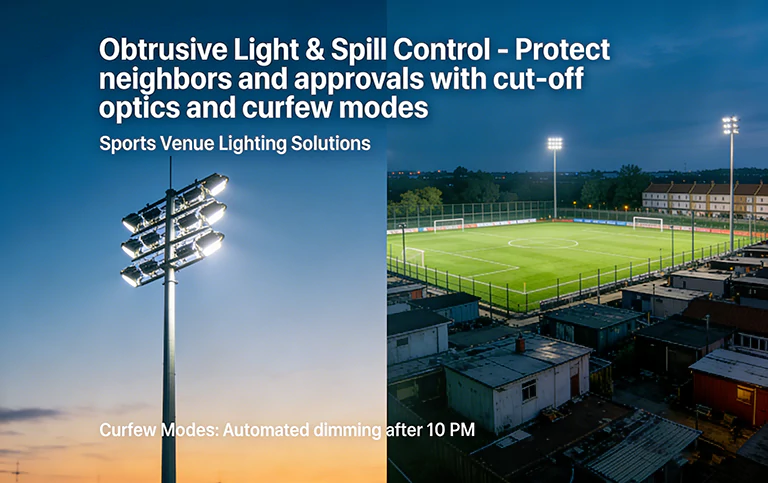
Stadium lighting near residential areas often fails not on lux-but on spill, complaints, and approvals. This guide turns spill control into measurable contract language and a repeatable design workflow.
Pass sign-off with spill calculations at defined points, recorded aiming angles, and a clear verification record if on-site checks are required.
- Key takeaway #1: Spill control starts with points + limits-otherwise it’s subjective.
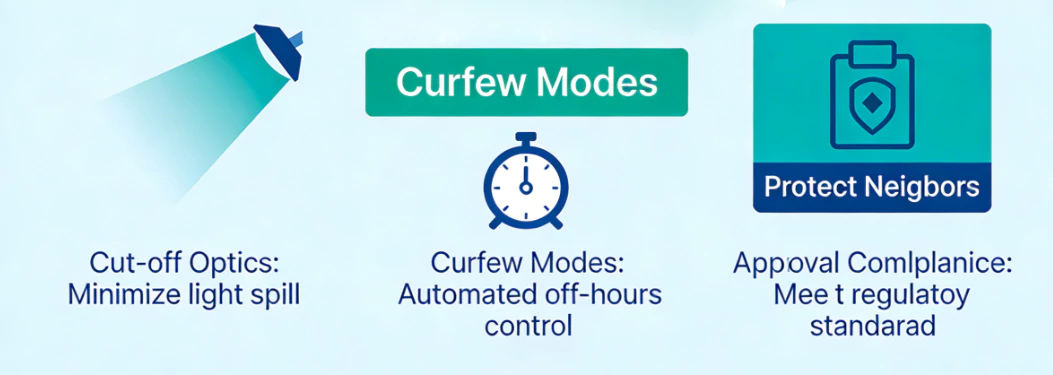
- Key takeaway #2: Cut-off optics + low tilt often reduce spill without sacrificing field performance.
- Key takeaway #3: Curfew modes are a practical compliance tool-verify them like any other requirement.
Table of contents
• Glare control principles
• Reducing on-site risks
• Beyond illumination applications
When this applies
Use this guide when your venue is close to residential areas, roads, or environmentally sensitive zones-where spill and sky glow can cause complaints, approval delays, or curfew restrictions.
- Community-adjacent stadiums: windows and boundaries need defined limits.
- Road corridors: spill and driver discomfort must be controlled.
- Curfew requirements: venues must reduce output after certain hours.
- Consultant approval: you need spill calculations and sign-off method.
Key requirements / metrics
Define these spill-control elements to make approvals and acceptance objective.
| Item | What it controls | Why it matters | Best practice |
|---|---|---|---|
| Sensitive points | Where spill is evaluated (windows, roads, property lines). | Without points, spill is subjective. | List points + limits in spec and report. |
| High-angle light | Near-horizontal emission. | Drives sky glow and neighbor complaints. | Cut-off optics + minimized tilt. |
| Curfew operation | Reduced-output modes after a time. | Many venues need neighbor-friendly settings. | Define curfew scenes and verify them. |
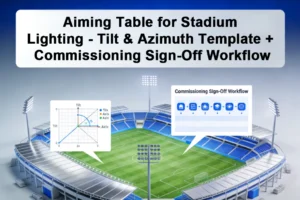
| Aiming & shielding | Beam direction and critical-angle blocking. | Small changes affect spill dramatically. | Aiming table + documented shields. |
Definitions
Obtrusive light is unwanted light affecting areas outside the intended space (neighbors, roads, sky). It is controlled by optics, aiming, and sometimes shielding.
Typical target ranges
Spill limits are local and project-specific. Use method-based targets:
- Define points: windows, boundaries, roads, checkpoints.
- Define conditions: curfew hours and operating modes (match vs curfew mode).
- Define method: calculation and measurement approach (instrument and timing if measured on site).
Step-by-step workflow
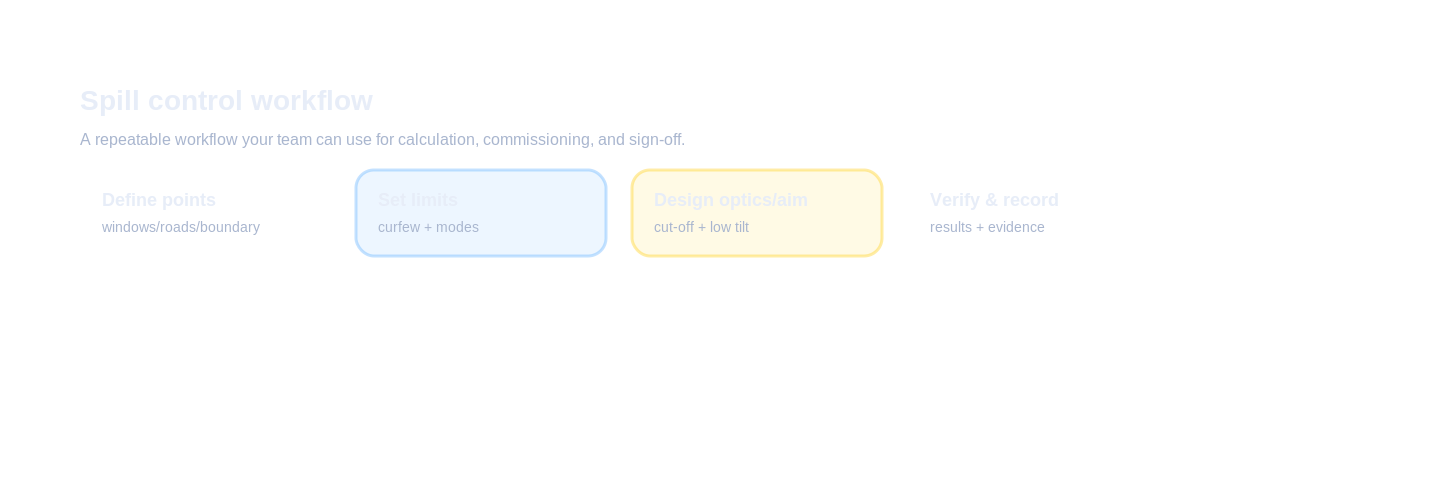
Successful spill control starts with definition, not hardware. Lock the acceptance method, then design optics and aiming to meet it.
Inputs to collect
- Site context: nearby houses, roads, windows, authority constraints.
- Curfew rules: times and required reduced-output modes.
- Optics options: cut-off optics and shielding accessories.
- Verification expectations: whether spill must be measured on site.
Design decisions
- List sensitive points and limits.
- Minimize high-angle light via cut-off optics + low tilt.
- Use curfew modes (dimming scenes) where needed.
- Document aiming and shields and keep as-built evidence.
Verification & sign-off
- Deliver spill calculations at sensitive points for match and curfew modes.
- Record aiming in sign-off pack.
- On-site checks (if required): measure at agreed time/conditions and keep raw records.
Common mistakes
- No sensitive point definition: spill becomes subjective.
- Relying only on shields: optics/aiming should do most work.
- No curfew mode: approval failures due to inability to reduce output.
- Aiming not controlled: small shifts push light into windows.
- Ignoring road safety: driver discomfort complaints and risk.
Checklist / Template download
Spill Verification Record (CSV)
Measurement record for spill verification.