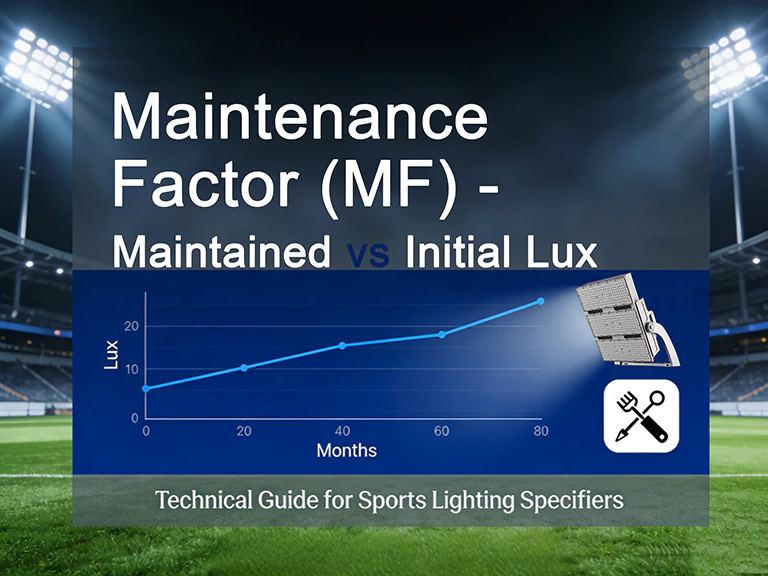
Many sports lighting disputes are not about day-one brightness-they are about what happens after months of operation. MF is the simplest way to align targets with long-term reality-if you document it correctly.
MF must match the owner’s realistic maintenance plan; otherwise projects either over-cost or under-perform over time.
- Key takeaway #1: Prefer maintained targets (with MF) for long-term compliance; separate initial vs maintained if needed.
- Key takeaway #2: MF must be justified by environment and maintenance plan-not guesswork.
- Key takeaway #3: Include MF assumptions and a maintenance checklist in the sign-off pack to prevent disputes.
Table of contents
• Long-term testing vs datasheets
• Acceptance criteria
• Why cheaper fixtures cost more
When this applies
Use this guide when your tender references maintained illuminance, or when you want to prevent “looks great on day one” projects drifting below target after months of operation.
- Owner wants long-term compliance: maintained targets are more meaningful than day-1 lux.
- Coastal/industrial sites: dirt depreciation is severe unless MF matches reality.
- Retrofits: separating initial vs maintained helps set expectations.
- Acceptance disputes: MF assumptions are often missing from contract language.
Key requirements / metrics
MF-related items you should document so maintained performance is clear and defensible.
| Item | What it represents | Why it matters | How to document |
|---|---|---|---|
| Maintenance factor MF | Multiplier to estimate maintained performance over time. | Aligns targets with long-term reality, not day-1 brightness. | State MF and assumptions (environment + schedule). |
| Lumen depreciation | Output reduces with operating hours and temperature. | Explains long-term dimming even when fixtures still work. | Reference lumen maintenance assumptions in report. |
| Dirt depreciation | Dust/contamination reduces delivered light. | Coastal/industrial sites can lose output faster. | Tie to a cleaning/inspection plan. |
| Maintained targets | Required values after MF. | Creates clear acceptance expectations. | Show initial and maintained results separately if needed. |
Definitions
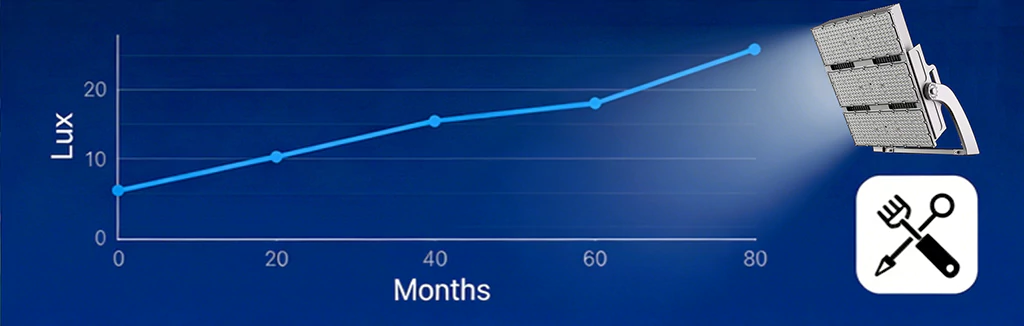
Maintenance factor (MF) predicts maintained lighting levels over time, typically reflecting (1) lumen depreciation and (2) dirt depreciation. If MF is not defined, different parties will assume different “pass” meanings.
Typical target ranges
MF is site-dependent. Use an environment-based approach:
- Standard outdoor fields: moderate MF tied to periodic cleaning.
- Coastal/dusty: more conservative MF unless cleaning is frequent.
- Industrial: explicit dirt assumptions and inspection intervals.
If the tender requires initial values, include both initial and maintained tables.
Step-by-step workflow
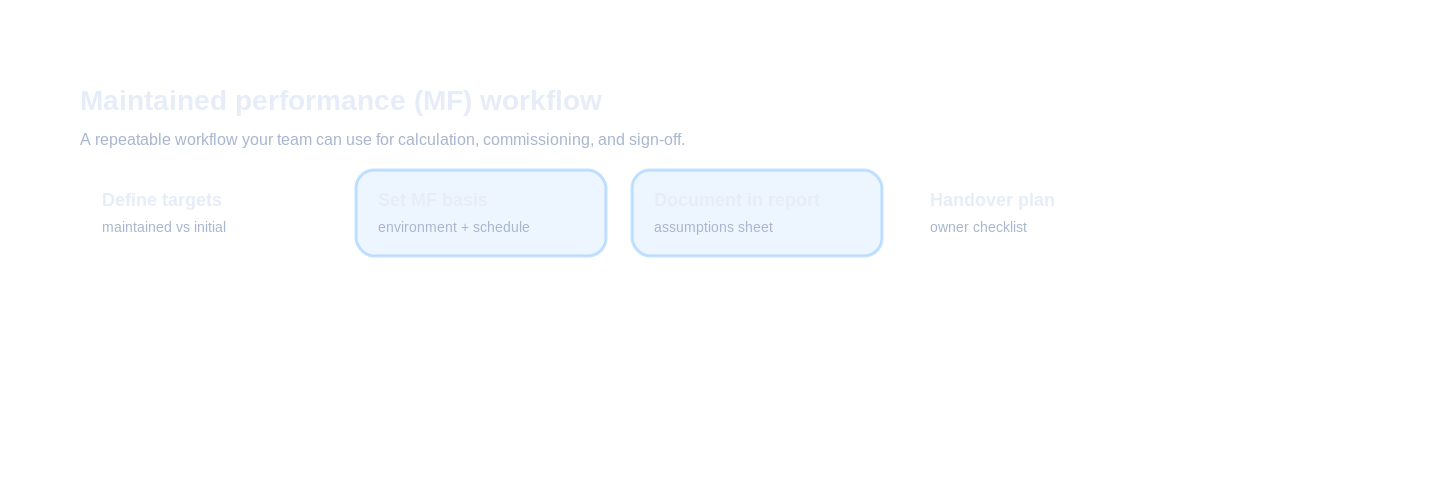
MF is a contract alignment tool. Make assumptions explicit and owner-approved.
Inputs to collect
- Environment: coastal, dusty, industrial, or standard.
- Operating profile: hours/night, dimming usage.
- Maintenance plan: who cleans, how often, what’s realistic.
- Tender language: initial vs maintained and reporting needs.
Design decisions
- Define maintained targets in the spec.
- Document MF assumptions: environment + cleaning + inspection intervals.
- Separate initial vs maintained results where helpful for stakeholder clarity.
- Align owner expectations: conservative MF without maintenance commitment can increase cost.
Verification & sign-off
- Commissioning: site tests confirm installation/aiming; MF is planning.
- Documentation: include MF sheet + maintenance checklist in sign-off pack.
- Follow-up: recommend periodic re-measurement to sustain compliance.
Common mistakes
- Not stating MF: assumptions diverge and disputes follow.
- MF not matching maintenance reality: over-cost or under-perform.
- Mixing initial/maintained language: unclear acceptance criteria.
- Ignoring dirty environments: coastal/industrial need explicit assumptions.
- No maintenance handover: owners can’t maintain performance without a plan.
Checklist / Template download
Maintained Illuminance Clause (TXT)
Tender-ready clause defining maintained targets.
Initial vs Maintained Template (CSV)
Separate day-1 and maintained values in reports.