However, not every LED flood light performs the same. A poorly designed fixture can create glare, uneven brightness, flicker, or expensive maintenance problems. That is why understanding the real advantages and disadvantages of LED flood light systems is important before investing in a project.
For stadium owners, schools, municipalities, and sports park investors, choosing the right lighting solution can reduce operating costs, improve visibility, and increase long-term ROI. Many outdoor projects now work directly with ZC 라이팅 because professional optical design and project-specific lighting layouts usually perform better than generic flood lights.
What Is an LED Flood Light?
An LED flood light is a high-output lighting fixture designed to illuminate wide outdoor or indoor areas. Unlike spotlights, which create narrow beams, flood lights spread light over larger surfaces. This makes them useful for football fields, stadiums, roads, parking lots, warehouses, and public spaces.
A complete LED flood light usually includes LED chips, a driver, optical lenses, a heat sink, waterproof housing, surge protection, and mounting brackets. Every component affects lighting quality and long-term reliability.
For example, the FL03 조절식 스마트 투광등 is designed for flexible outdoor applications where beam adjustment and smart control are important.
LED Flood Light vs LED Sports Light
Many people think all flood lights are the same, but professional sports lighting is far more demanding. A general LED flood light focuses on wide-area brightness, while a sports lighting system must also consider vertical illuminance, glare reduction, flicker-free performance, and lighting uniformity.
This is why many football field operators prefer a dedicated 경기장용 LED 조명 솔루션 instead of installing standard commercial flood lights.
| 주요 기능 | General LED Flood Light | Professional LED Sports Light |
|---|---|---|
| 주요 목적 | Wide-area illumination | Sports visibility and uniformity |
| Beam Control | Basic optics | Advanced optical aiming |
| Glare Reduction | 한정판 | Professional anti-glare design |
| 최적의 사용법 | Parking lots, yards, facades | Football fields and stadiums |
Advantages of LED Flood Light
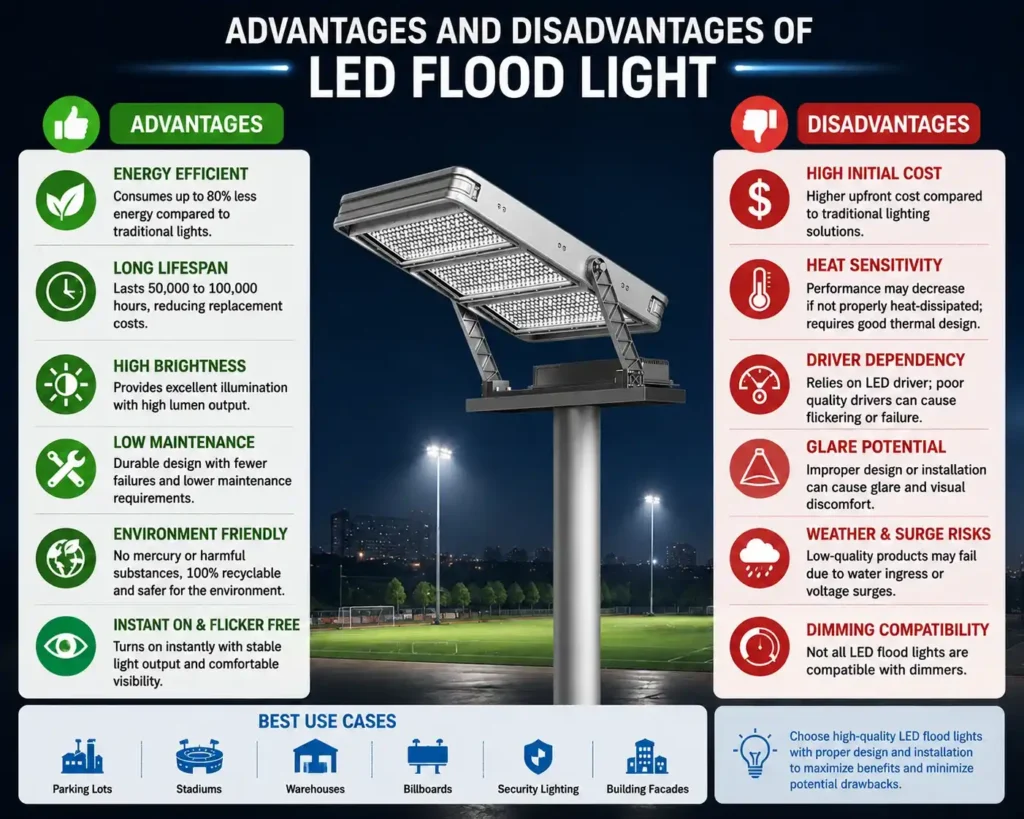
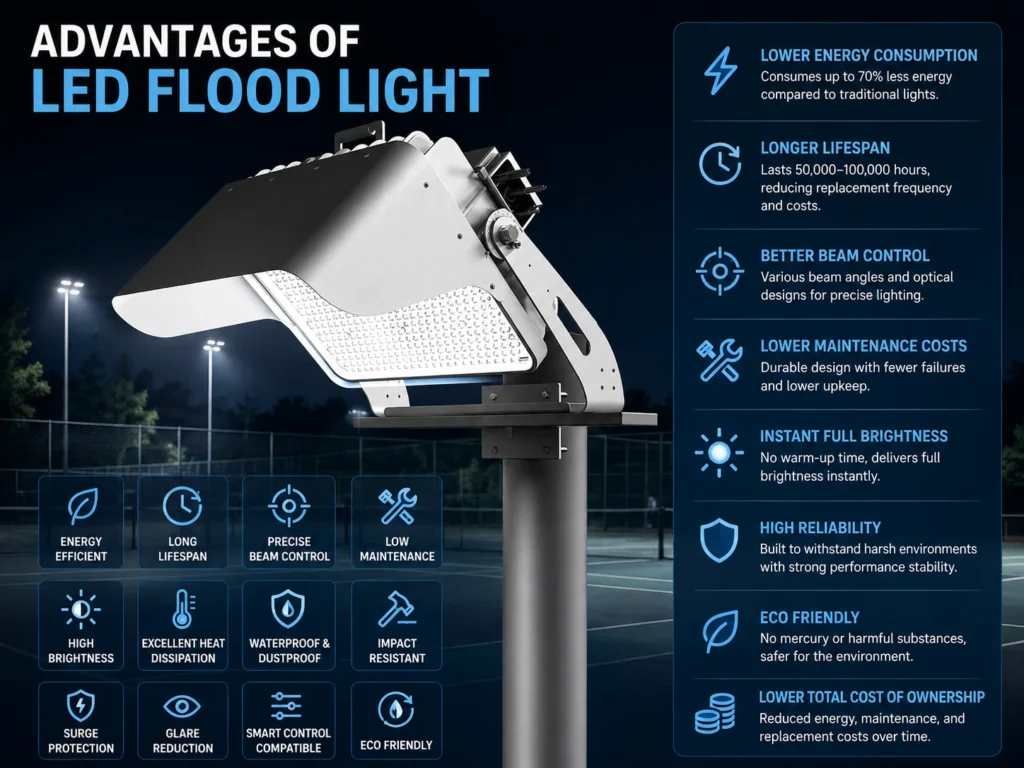
The advantages of LED flood light systems are clear. They consume less energy, last longer, provide better beam control, and reduce maintenance costs. Compared with traditional flood lights, they are usually a smarter long-term investment.
Lower Energy Consumption
LED flood lights are much more energy-efficient than halogen and metal halide systems. Many modern fixtures achieve around 130–170 lm/W, while metal halide systems often stay around 70–100 lm/W.
This allows many projects to reduce electricity consumption by approximately 50%–80%. For football stadiums and sports parks operating multiple fixtures every night, this difference can save a large amount of money each year.
Projects that require high-power sports lighting often use fixtures such as the FL18 GameAres LED 경기장 투광등, which is designed for stronger beam control and long-distance outdoor illumination.
Longer Lifespan
High-quality LED flood lights commonly last 50,000~100,000시간. This is significantly longer than halogen lights and usually longer than metal halide fixtures.
Longer lifespan means fewer replacements, lower labor cost, less downtime, and fewer lift truck operations. For high-pole stadium lighting, this becomes a major operational advantage.
Better Lighting Quality and Uniformity
LED flood lights can provide cleaner and more uniform illumination. Better optical design reduces dark spots and hot spots, creating safer and more comfortable outdoor environments.
For football fields, lighting uniformity is often more important than raw brightness. A field with balanced illumination feels more professional and improves visibility for both players and spectators.
Instant On and Smart Control
Traditional metal halide lights require warm-up time after startup or power interruption. LED flood lights turn on instantly.
Modern LED systems can also support DALI, DMX, 0-10V dimming, wireless control, timers, and motion sensors. This makes them more flexible for training sessions, match events, security lighting, and maintenance operations.
Lower Environmental Impact
LED flood lights are mercury-free and consume less electricity. Better optical control also helps reduce spill light and light pollution.
For municipal projects and roadway applications, many operators now combine outdoor flood lighting with dedicated 도로 및 차도용 LED 조명 솔루션 to improve efficiency while reducing unnecessary light waste.
Disadvantages of LED Flood Light
Although LED flood lights offer many benefits, they also have disadvantages. Most issues come from poor product quality, weak optical design, or incorrect installation.
Higher Initial Cost
LED flood lights usually cost more upfront than halogen systems. Professional stadium lighting fixtures cost even more because they require stronger optics, better waterproofing, stronger heat dissipation, and higher surge protection.
However, when you compare long-term electricity savings, maintenance reduction, and replacement frequency, many LED projects achieve ROI within 2–5 years.
Glare and Visual Discomfort
LED flood lights are powerful and directional. Poor beam angles or incorrect aiming can create harsh glare.
Glare can affect drivers, athletes, spectators, and nearby residents. In sports projects, excessive glare reduces player comfort and can negatively affect performance.
Can LED Lights Cause Dizziness?
Yes, in some situations. Poor-quality LED lights with visible flicker or excessive glare may contribute to headaches, eye strain, or dizziness for sensitive people.
This is why professional sports projects often use fixtures such as the SP02 레이디얼 스타디움 LED 투광등, which focuses on glare reduction and more controlled beam distribution.
Heat Management Problems
LEDs are more efficient than traditional lamps, but they still generate heat. Without proper thermal management, the fixture may suffer from lumen depreciation, color shift, and driver failure.
Strong aluminum heat sinks, stable junction temperature control, and airflow design are critical for outdoor reliability.
Driver Failure and Surge Damage
The LED driver is one of the most important components inside the fixture. Outdoor flood lights face rain, voltage fluctuation, heat, humidity, and lightning surges.
For outdoor sports projects, it is safer to choose fixtures with 10KV or 20KV surge protection and higher waterproof ratings such as IP66 or IP67.
For demanding sports environments and large-area projects, many operators choose the FL12 고출력 LED 경기장 및 비행장 투광등 because it is designed for stronger outdoor durability and high-power applications.
LED Flood Light vs Traditional Flood Lights
When comparing LED flood lights with halogen, metal halide, and solar flood lights, the main differences are energy efficiency, maintenance, brightness stability, and long-term operational cost.
| Lighting Type | Efficiency | 수명 | 유지보수 | 준비 운동 시간 |
|---|---|---|---|---|
| Halogen Flood Light | 15–25 lm/W | 2,000–5,000 hours | 높음 | 즉시 |
| Metal Halide Flood Light | 70–100 lm/W | 10,000–20,000 hours | 보통 | Several minutes |
| LED Flood Light | 130–170 lm/W | 50,000~100,000시간 | 아래로 | 즉시 |
LED vs Halogen Flood Lights
Halogen lights are cheaper at first, but they consume far more electricity and produce more heat. LED flood lights are more energy-efficient, cooler, and longer-lasting.
LED vs Metal Halide Flood Lights
Metal halide systems were once the standard for sports lighting. However, they require warm-up time, lose brightness over time, and need more maintenance.
Modern modular fixtures such as the FL08 시리즈 모듈형 LED 스포츠 및 실외 투광등 offer better optical flexibility, easier maintenance, and stronger long-term performance.
LED vs Solar Flood Lights
Solar flood lights are useful for remote areas and small projects. However, large sports venues usually require wired LED systems because they provide more stable brightness and longer operating hours during bad weather.
Why Sports Lighting Needs More Than Brightness
For football fields and stadiums, brightness alone is not enough. Sports lighting requires the correct beam angle, lighting uniformity, vertical illuminance, and glare control.
균일도 비율
Uniformity measures how evenly light spreads across the field. Poor uniformity creates bright zones and dark areas, reducing visibility and comfort.
수직 조도
Vertical illuminance affects how clearly players and moving objects can be seen from the side. It is especially important for sports broadcasting and spectator visibility.
깜빡임 없는 성능
Flicker may not always be visible to the human eye, but cameras can detect it. For slow-motion recording, 4K broadcasting, and social media video content, flicker-free lighting is important.
Many sports projects use real-world references such as this Dubai football stadium LED lighting project to evaluate beam distribution, glare reduction, and outdoor performance before installation.
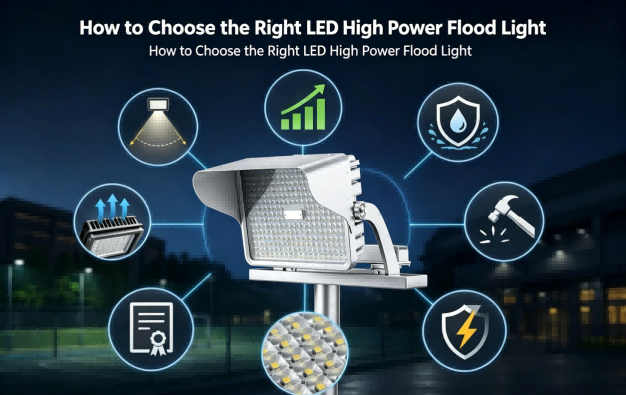
How to Choose the Right LED High Power Flood Light
Choosing the right LED flood light requires more than comparing wattage. You should evaluate beam angle, efficacy, waterproof rating, impact resistance, surge protection, optical design, and warranty.
Check Beam Angle and Optical Design
Common beam angles include 15°, 30°, 60°, and 90°. Narrow beams are better for long-distance projection. Wider beams are better for lower mounting heights and larger spread.
Check Color Temperature and CRI
Outdoor flood lights commonly use 3000K, 4000K, 5000K, or 5700K color temperatures. Cooler light often appears brighter, while warmer light feels softer.
CRI values such as 70, 80, and 90 affect color rendering and visual clarity.
Check IP and IK Ratings
Outdoor flood lights should usually have IP65, IP66, or IP67 waterproof protection. For stronger impact resistance, many projects prefer IK08 or IK10 ratings.
Request Photometric Simulation
Before installation, professional lighting simulations help confirm lux levels, pole layouts, spill light control, and aiming angles.
If you are planning a sports field or municipal project, you can request 조명 솔루션에 대한 즉시 견적 together with lighting simulations and technical recommendations.
Common Buyer Mistakes to Avoid
Choosing Only by Wattage
Higher wattage does not always mean better lighting. Optical efficiency and beam control are often more important.
Ignoring Glare Control
A bright fixture with poor glare control can create uncomfortable environments for players and spectators.
Buying the Cheapest Fixture
Cheap LED flood lights may reduce purchase cost but increase long-term maintenance expenses due to poor drivers, weak housing, and lower-quality components.
Skipping Lighting Design
Without professional lighting simulation, projects may suffer from dark spots, uneven brightness, or excessive spill light.
결론
LED flood lights offer major advantages over traditional lighting systems. They are more energy-efficient, longer-lasting, smarter, and easier to maintain.
However, the wrong fixture or poor lighting design can still create problems such as glare, flicker, uneven brightness, and expensive maintenance.
For football field operators, schools, municipalities, and sports investors, the best solution is usually not the cheapest fixture. The better solution is a professionally designed lighting system with strong optics, proper beam control, stable drivers, and reliable outdoor durability.
Working with experienced outdoor lighting manufacturers such as ZC 라이팅 can help improve project quality, reduce operating cost, and create better long-term ROI.
자주 묻는 질문
Are LED flood lights better than metal halide lights?
In most outdoor applications, LED flood lights are more energy-efficient, easier to maintain, and faster to start than metal halide systems. They also provide more stable brightness and better smart control compatibility.
What beam angle is best for LED flood lights?
The best beam angle depends on the application. Narrow beams such as 15° or 30° are better for long-distance projection, while 60° or 90° beams are better for wider coverage and lower mounting heights.
Can LED flood lights be used for football fields?
Yes, but football fields usually require professional sports lighting with better glare control, uniformity, vertical illuminance, and flicker-free performance instead of general-purpose flood lights.
What is the difference between IP65 and IP66 flood lights?
Both ratings provide dust protection, but IP66 fixtures offer greater resistance to powerful water jets, making them more suitable for harsh outdoor environments and heavy rain.
Do LED flood lights reduce maintenance costs?
Yes. Because LED floodlights have longer lifespans and require fewer replacements, many outdoor projects can reduce maintenance frequency, labor costs, and equipment rental expenses over time