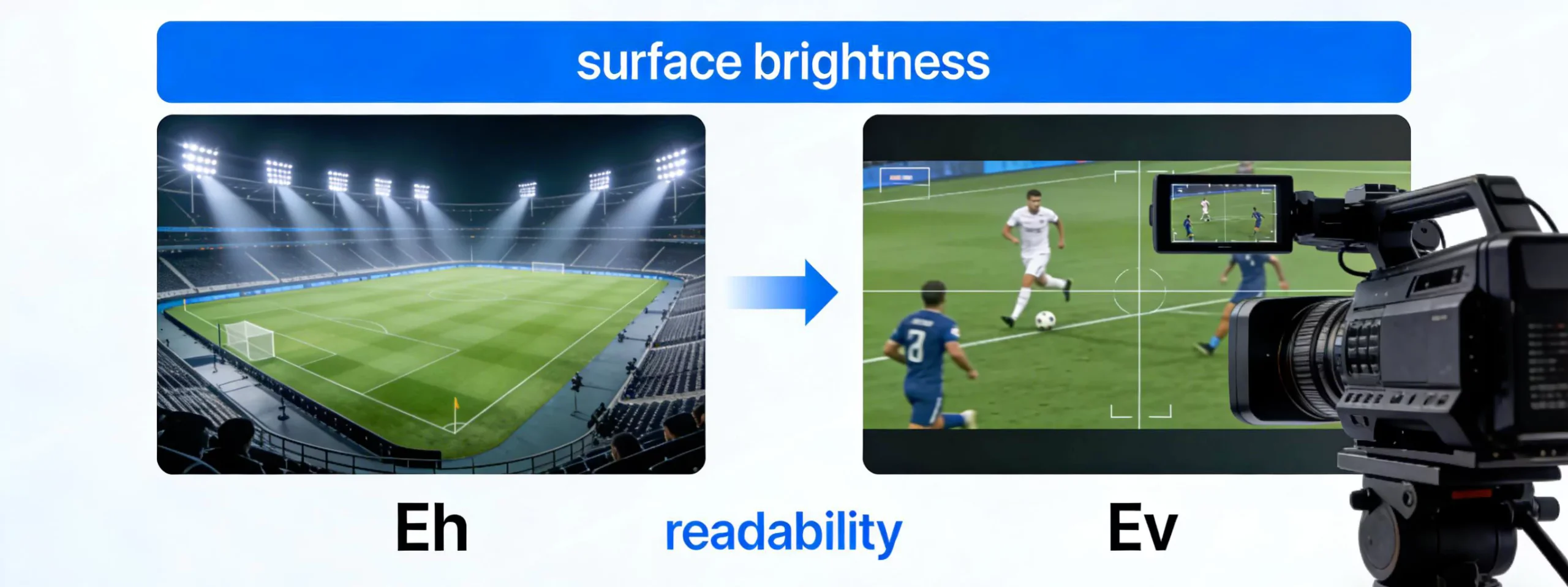
Many sports lighting projects pass average lux requirements but still look visually flat-especially on camera. The missing piece is usually vertical illuminance (Ev) and how it’s defined, simulated, and measured.
If your project includes competition, video review, or TV coverage, you should define Ev height + directions early and align the commissioning method to the calculation report.
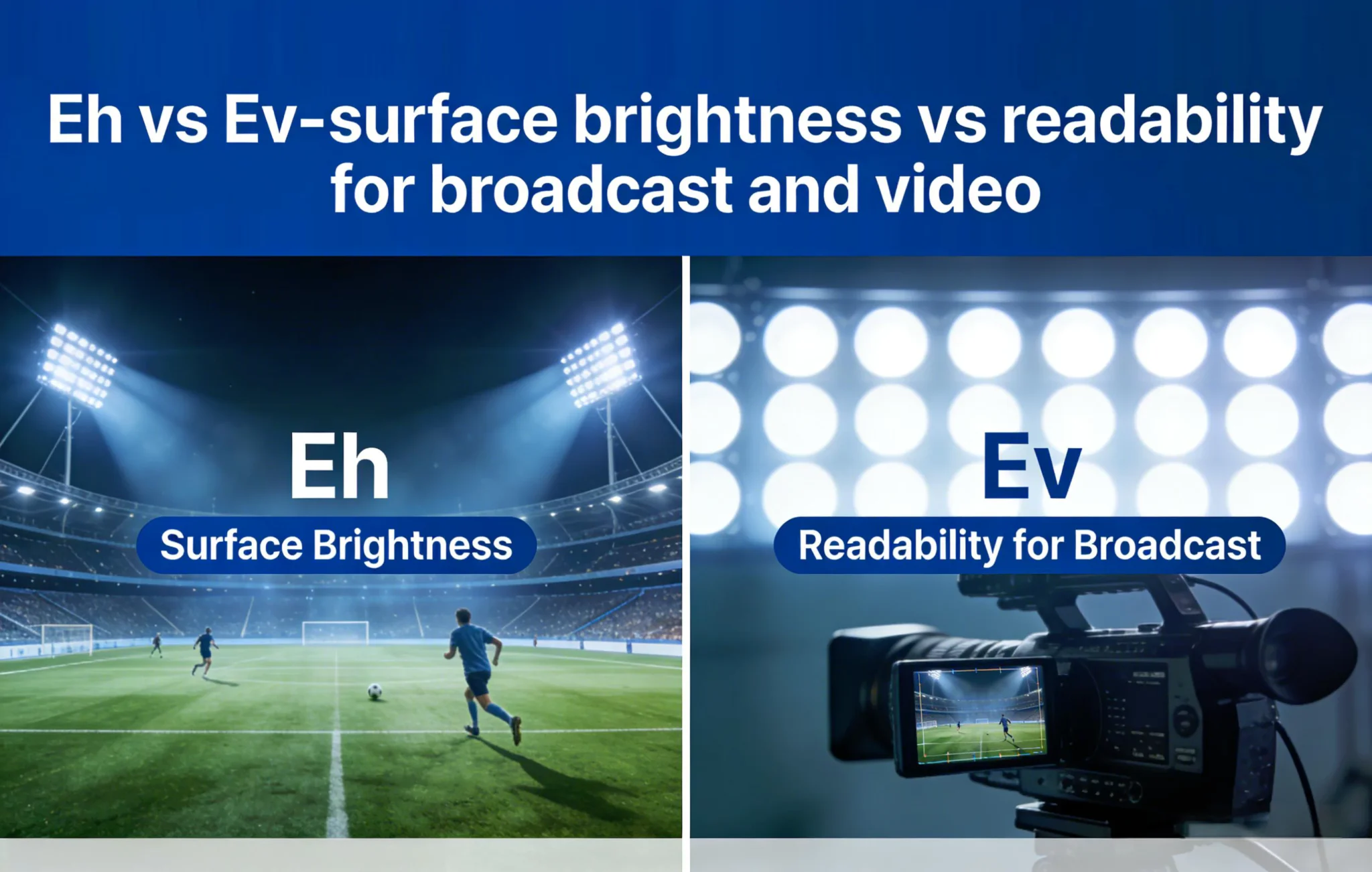
- Key takeaway #1: Eh builds surface brightness; Ev builds readability of people/objects and camera image quality.
- Key takeaway #2: Ev is direction-dependent-define the viewing/camera directions before simulation and before site tests.
- Key takeaway #3: Improve Ev with optics + aiming strategy first, not by simply increasing power (which may worsen glare/spill).
Table of contents
When this applies
Use this guide when your venue is designed for competition or broadcast, or when stakeholders complain about “bright ground but dark players.” It’s also useful for retrofit projects where pole locations are fixed and you need to optimize the light direction.
Typical scenarios
- Broadcast or TV coverage: Ev often becomes as important as Eh.
- Training fields with video review: basic Ev targets prevent poor facial recognition and flat images.
- Multi-sport complexes: different sports have different Ev sensitivity (ball in air, camera angles).
- Fixed-pole retrofits: you must “steer” light with optics + aiming to build Ev without increasing glare.
Key requirements / metrics
This table explains the difference between Eh and Ev and why both must be designed and verified together.
| Metric | Definition | When it matters most | Design implication |
|---|---|---|---|
| Horizontal illuminance Eh |
Illuminance on the playing surface (typically measured on a horizontal plane). | General play visibility, surface brightness, baseline compliance. | Driven by total lumens delivered to the field and distribution uniformity. |
| Vertical illuminance Ev |
Illuminance on a vertical plane (faces/players/objects) from defined viewing directions. | Broadcast image quality, facial recognition, coaching video, ball tracking in air. | Requires delivering light from useful directions—not only “down to the ground.” |
| Vertical-to-horizontal balance Ev/Eh |
A practical indicator of “bright ground vs bright faces” balance. | Projects that look compliant on paper but feel visually flat in reality. | Often improved by optics + aiming strategy (not just adding power). |
Definitions
Eh describes how much light reaches the playing surface. Ev describes how much light reaches vertical subjects (players, faces, ball) from a defined direction. That “direction” is the key: Ev is viewpoint-dependent—so you must define measurement directions (camera positions, stands, or cardinal directions).
Typical target ranges
Exact numeric Ev targets depend on sport, class, and broadcast requirements. A practical approach is:
- Non-broadcast training: prioritize Eh and basic uniformity; define a simple Ev minimum only if video/recognition matters.
- Competition: define Ev for main stand / typical viewing directions to avoid “dark faces.”
- Broadcast: define Ev for camera directions and include flicker metrics as well.
When no Ev target is stated in the tender, define an Ev acceptance method (height + directions) early to reduce disputes.
Step-by-step workflow
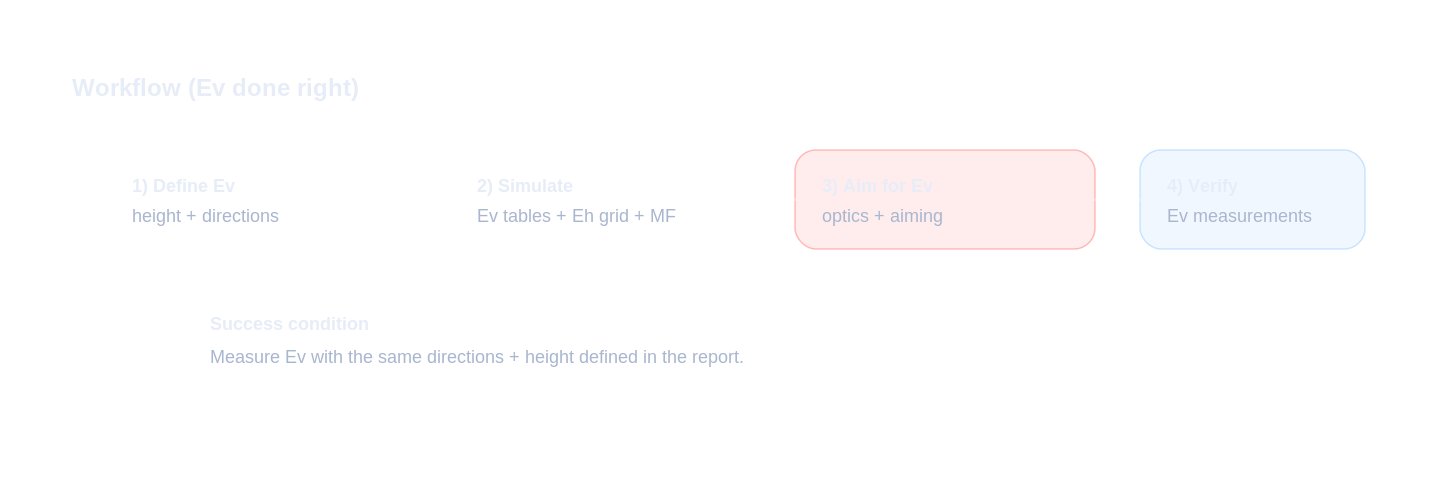
The core idea: Eh makes the field bright; Ev makes people and objects readable. The project succeeds when both are aligned to the real viewing directions.
Inputs to collect (must-have)
- Use case: training / competition / broadcast; is video quality a requirement?
- Viewing directions: main stands, typical coach positions, and any camera locations.
- Pole geometry: height, positions, maximum tilt, and restricted aiming directions.
- Constraints: glare/spill limits, neighbor viewpoints, and curfew rules.
Design decisions (key points)
- Define Ev directions before simulation. “Ev” without a direction becomes meaningless at sign-off.
- Deliver light from useful angles. Optics + aiming should push light into the viewing direction while controlling high-angle glare.
- Balance more fixtures vs brighter fixtures. Very bright sources can improve Eh but create glare and poor modelling.
- Lock the Ev/Eh acceptance method. Define how it will be measured and reported, not only what the numbers are.
Verification & sign-off (how to accept)
- Report tables: include Eh grid and Ev results with stated height and direction(s).
- Commissioning plan: align measurement points and directions with the report; record conditions and angles.
- Aiming record: final aiming angles must be captured-small changes shift Ev significantly.
Common mistakes
- Only designing for Eh: the field looks bright but players look dark (especially on camera).
- Ev direction not defined: you simulate one direction and measure another-leading to disputes.
- Measuring Ev incorrectly: wrong height, wrong facing direction, or inconsistent method across points.
- Fixing Ev by “more power”: can increase glare and spill; use optics + aiming first.
- No coordination with cameras: broadcast requirements must be confirmed before design freeze.
Checklist / Template download
Ev Planning Worksheet (CSV)
Define Ev needs early: directions, height, and acceptance method.
Camera / View Direction Checklist (CSV)
Lock critical viewing directions before design freeze.
Ev + Eh Measurement Record (CSV)
A commissioning sheet to measure Ev consistently on site.
Ev Specification Clause (TXT)
Copy-paste language to include Ev in a tender-ready specification.