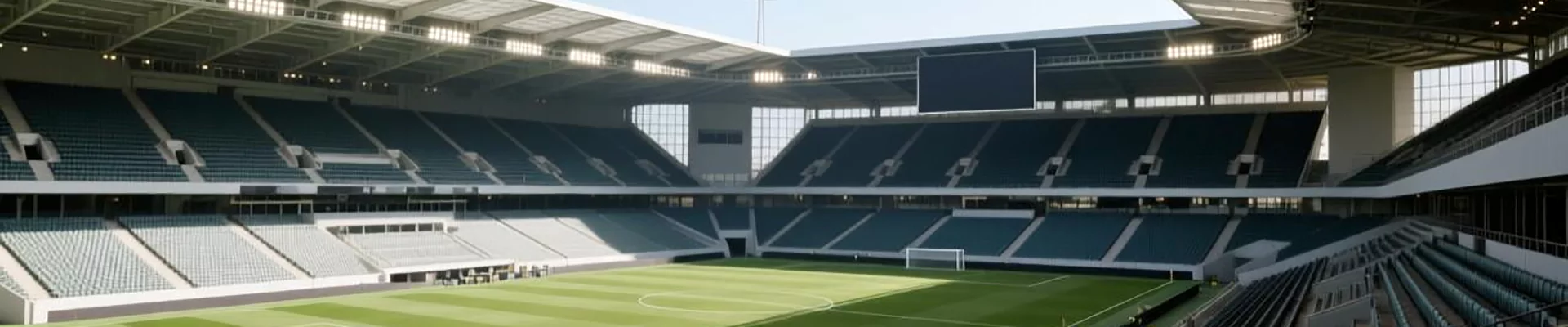
Many modern sports venues are no longer single-purpose stadiums. The same field may host football, rugby, athletics, school sports days, concerts, and community events. For investors and facility owners, this multi-use model makes perfect sense — but it also makes lighting design more complex.
Each sport has its own viewing distances, action zones and safety concerns. Football and rugby demand excellent visibility on the central pitch area, while athletics requires continuous lighting around the running track and field events. Concerts and community events add yet another layer of requirements.
This article explains how to approach LED stadium lighting for multi-sport complexes, focusing on design principles, pole layouts, beam selection, glare control and future flexibility.
1. Start with a Clear Use-Case Matrix
The first step is to document all intended uses of the venue and their relative importance. A clear matrix helps you prioritize lighting performance where it matters most.
1.1 Typical Multi-Sport Combinations
- Football + athletics track around the pitch.
- Rugby + football (shared field markings at different times).
- Football / rugby + community concerts and non-sport events.
- Training-only pitch used for multiple age groups and sports.
For each use case, define:
- Required competition level (training, regional, national, broadcast).
- Expected camera usage (none, basic streaming, professional broadcast).
- Key viewing positions (main stand, corners, VIP boxes, trackside, etc.).
- Special constraints (neighboring houses, roads, or protected areas).
2. Illuminance Targets for Football, Rugby and Athletics
While exact standards vary by country and federation, the basic logic is consistent: higher competition levels and broadcast needs require higher illuminance, better uniformity and tighter glare control.
2.1 Football and Rugby Pitch Requirements
Football and rugby share similar pitch dimensions and viewing distances, so their lighting targets are often comparable. As a rough reference:
- Training / school use: 200–300 lux horizontal, basic vertical illuminance.
- Regional matches: 300–500 lux horizontal, 150–300 lux vertical, uniformity ≥ 0.6.
- Professional / TV: 800–1500+ lux horizontal, 600–1000 lux vertical, uniformity ≥ 0.7.
2.2 Athletics Track and Field Events
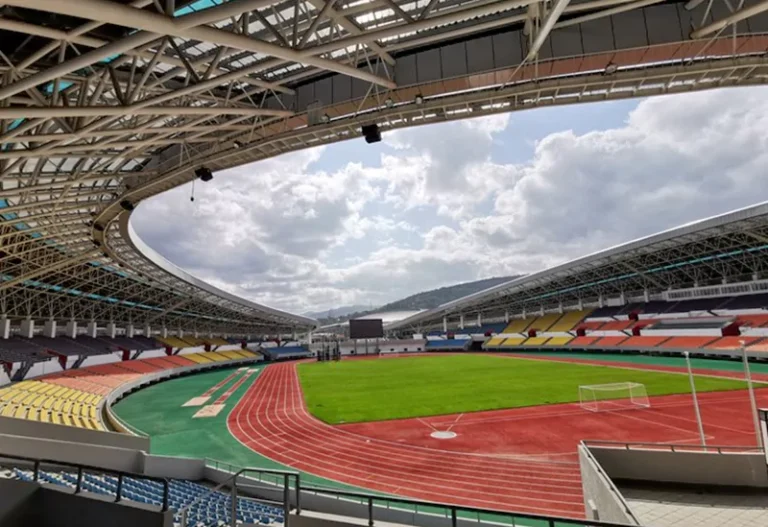
Athletics adds requirements around the full 400 m track and several field event zones (long jump, high jump, throwing areas, pole vault, etc.). These zones often extend beyond the football pitch footprint and require dedicated attention.
Typical considerations:
- Uniform lighting along the running track, avoiding dark corners on curves.
- Good vertical illuminance for high jump and pole vault, supporting safe take-off and landing.
- Clear visibility of throwing zones and safety cages.
- Good visibility for judges and time-keeping equipment.
3. Pole Layout Strategies for Multi-Sport Venues
Pole positions largely determine what is possible with the lighting design. When football, rugby and athletics share a venue, designers must select pole layouts that serve all uses with minimal compromise.3.1 Four-Corner Layout
A traditional solution for basic venues is a 4-pole layout — one mast at each corner. This is cost-effective but can make it harder to deliver consistent vertical illuminance towards the main stand and cameras, especially for athletics.3.2 Six- or Eight-Mast Layout
Adding extra masts along the long sides of the field provides more flexibility for:- Improving uniformity along the track curves.
- Fine-tuning vertical illuminance for the infield and camera directions.
- Controlling glare to stands and neighboring areas.
4. Beam Angles and Aiming for Mixed Sports
Once pole positions are fixed, beam angles and aiming become the key tools to meet performance goals for multiple sports.4.1 Zoning the Field
A practical way to design is to divide the venue into several zones:- Main football / rugby pitch (central zone).
- Running track inner and outer lanes.
- Field event zones (jumps, throws, pole vault).
- Spectator stands and entrance plazas.
4.2 Avoiding Double-Aiming Conflicts
In multi-sport designs, it can be tempting to reuse the same luminaire for very different tasks. In practice, it is often better to:- Dedicate some luminaires primarily to football/rugby needs.
- Dedicate others to athletics and secondary event zones.
- Use separate aiming plans for different competition modes when controls allow dimming or switching.
5. Glare Control for Players, Athletes and Spectators
Multi-sport venues concentrate many viewing angles and activities in the same space. Goalkeepers, sprinters, long jumpers, and referees all look in different directions at critical moments. Effective glare control is therefore essential.5.1 Critical Viewing Positions
Identify glare-sensitive positions such as:- Goalkeepers looking up at high balls.
- Sprinters starting from low positions facing the first curve.
- High jump and pole vault athletes looking upwards along their trajectory.
- Judges and camera operators tracking events from fixed positions.
6. Controls and Scene Settings for Different Events
One of the main advantages of LED stadium lighting is the ability to use controls to adapt lighting scenes for different events. Instead of one fixed output, multi-sport venues can implement several modes:- Training mode: reduced illuminance, fewer luminaires active, lower energy use.
- Match mode: full performance on the pitch and track, optimized for players and spectators.
- Broadcast mode: enhanced vertical illuminance and uniformity for cameras.
- Event / concert mode: different emphasis on stands, stage areas and safety routes.
7. Future-Proofing and Upgrade Paths
A well-designed multi-sport stadium lighting system should last many years. To future-proof the investment:- Choose luminaires with proven thermal performance and high-quality drivers.
- Ensure adequate mechanical strength for wind and vibration on high masts.
- Consider modular systems that allow lumen upgrades or optic changes in the future.
- Reserve capacity in control systems for new scenes or integration with building management systems.