Risk control is not only about avoiding mistakes during installation. It is also about defining acceptance criteria so the project can be signed off confidently.
A practical acceptance set should include:
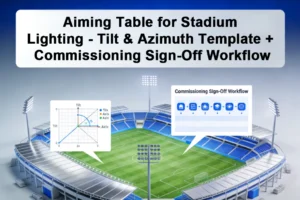
- Aiming verification: aiming references recorded, key angles confirmed, and “as-aimed” notes documented.
- Scene repeatability: run scenes, reboot controller, then confirm the system returns to baseline.
- Safety baseline: a match-safe or training-safe scene always available regardless of advanced functions.
- Documentation pack: wiring map, group names, scene list, and reset SOP handed over to the operator.
Without acceptance criteria, teams argue on-site about what “complete” means. With criteria, delivery becomes measurable and calm.
The Handover Pack Buyers Should Demand
The most expensive failures happen after the installer leaves: a venue forgets how the system works, a new staff member changes scenes, or a maintenance team disconnects something without mapping. A strong handover pack reduces these risks.
| Deliverable | Why it matters | Minimum quality bar |
|---|---|---|
| Wiring map + labeling standard | Faster troubleshooting, fewer commissioning mistakes | Readable by a new technician in 5 minutes |
| Group naming list | Prevents wrong-zone operation | Names match physical zones and pole groups |
| Scene list (locked names) | Repeatability season after season | 3–5 core scenes; optional event scenes clearly separated |
| Operator SOP (one page) | Daily operation without expert dependence | Run scenes + dim + shutdown + reset steps |
| Reset/fallback SOP | Fast recovery under pressure | Tested during commissioning and documented |
A Simple Troubleshooting Flow (So Small Issues Don’t Become Delays)
Most on-site delays happen when teams jump to conclusions. A simple flow keeps action logical:
Troubleshooting Flow (Quick)
- Confirm power and protection status first (baseline electrical checks)
- Confirm labeling and mapping (don’t trust memory)
- Test one group/channel at a time (isolate variables)
- Verify control scene vs physical grouping (wrong mapping is common)
- Use reset SOP and confirm fallback baseline
- Only then replace parts (avoid unnecessary swaps)
RFP / Tender Language That Reduces Risk
If you write tender documents, include requirements that force deliverability, not marketing claims. Practical clauses include:
- “Supplier shall provide commissioning SOP and operator SOP as deliverables.”
- “Supplier shall define fallback behavior to match-safe baseline after restart.”
- “Supplier shall provide group naming and labeling standard aligned to physical zones.”
- “Scene list shall be limited and meaningful; editing permissions shall be defined.”
This language improves comparison between vendors and reduces the risk of buying complexity that cannot be delivered.
How to Reuse This Process After the Show
The same checklist used for a booth or a pilot install can become a standard for future deliveries. Many distributors and contractors turn it into an internal “delivery playbook.” Once you have it, each new project becomes faster, more predictable, and easier to scale across regions.
Roles and Sign-off: Make Ownership Visible
A repeatable process needs ownership. The fastest way to reduce confusion is to assign owners for each stage and capture sign-off. Even a simple table on paper prevents disputes:
| Stage | Owner | Verifier | Evidence |
|---|---|---|---|
| Installation | Mechanical lead | Safety verifier | Torque marks + photo record |
| Power-on | Electrical lead | Mapping verifier | Continuity/polarity check record |
| Controls | Commissioning lead | Operator representative | Locked scene list + reset test |
When roles are clear, problems are solved faster because teams know who owns the next decision.
Mini Case Pattern: Where Projects Usually Lose Time
In many stadium projects, delays come from the same pattern: installation finishes, then everyone starts “figuring out controls” on-site. The fix is to separate phases: lock grouping and labeling first, commission the baseline match/training scene next, then add optional scenes last. When the baseline is stable, advanced functions become a safe overlay rather than a risk multiplier.
One last practical reminder: if a team cannot reproduce the same result twice in a row (scene switching, restart recovery, baseline output), the workflow is not finished. Repeatability is the real acceptance test.
“reduce on-site commissioning risk”, “stadium lighting checklist”, “stadium lighting installation SOP”, “how to commission stadium lighting controls”, “fallback mode stadium lighting”
Want the checklist as a one-page PDF for your team or customers?
We can format this workflow into a downloadable checklist and tailor it to your project type (training fields, stadiums, arenas, or multi-purpose venues).