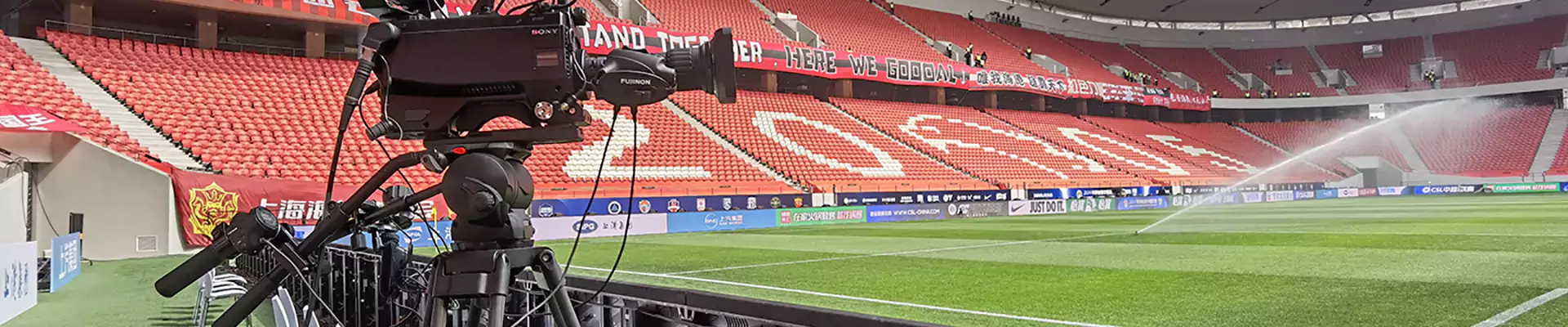
A major stadium’s lighting upgrade for 4K broadcast revealed a surprising fact: over 30% of the initial LED fixtures failed the vertical illuminance test for high-speed cameras, underscoring that meeting broadcast standards is a precise science, not just about brightness.
Lighting a sports venue for television broadcast is a complex technical challenge. It’s not just about making the field bright; it’s about creating a consistent, high-fidelity visual environment that allows cameras to capture fast action in crisp detail, true color, and without distracting shadows or glare.
This guide breaks down the critical parameters and practical steps to achieve lighting that meets global broadcast standards.
Core Lighting Parameters for Broadcast
The transition to 4K, HDR, and even 8K broadcasting has significantly raised the bar for stadium lighting. Here are the non-negotiable technical specs:
1. Illuminance (Lux Levels):
Broadcast lighting demands high vertical illuminance—the light falling on a vertical plane, such as a player’s face or body—as this is what cameras see. For major international football (soccer) and athletics events, the required vertical illuminance is ≥2000 lux. Sufficient horizontal illuminance (on the playing surface) is also crucial for overall uniformity.
2. Uniformity:
This is arguably as important as raw light levels. Poor uniformity creates “hot spots” and dark patches that confuse cameras and degrade image quality. Standards require a high uniformity ratio (U1 = E_min / E_avg). For top-tier broadcast, this ratio should be ≥0.8 or higher, ensuring a consistently lit field from goal to goal and sideline to sideline.
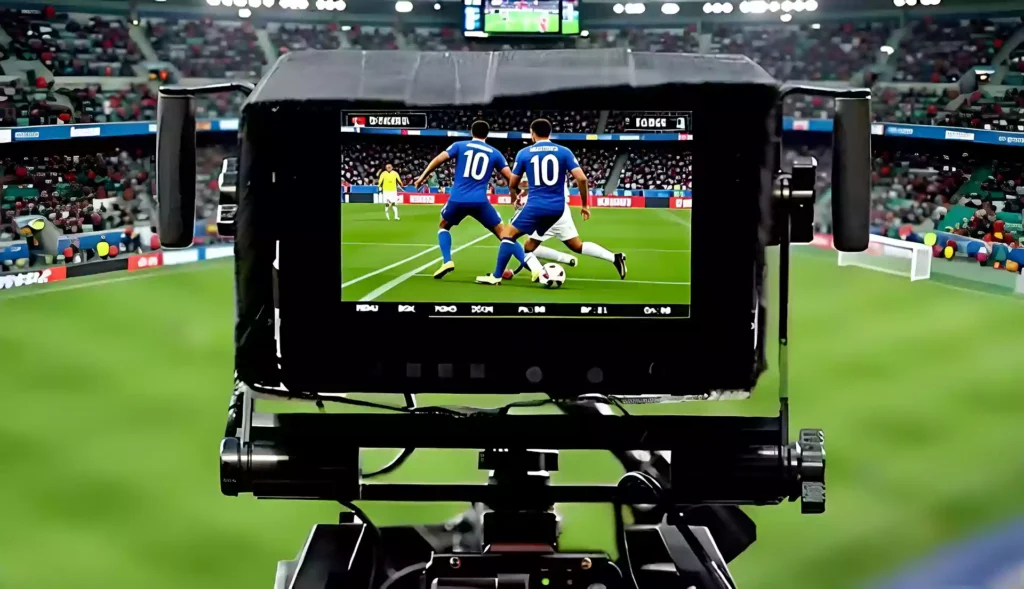
3. Glare Control (UGR):
Unified Glare Rating (UGR) measures discomfort for players and spectators, and more importantly, “veiling glare” for cameras that washes out contrast. For broadcast, the UGR should be ≤19 to 22. This is achieved through precise optical design and careful installation angles.
4. Color Quality:
Color Rendering Index (CRI/Ra): A Ra ≥90 is standard for broadcast, ensuring that team colors, skin tones, and the green of the pitch are reproduced accurately and vividly on screen.
Correlated Color Temperature (CCT): A neutral white light around 5700K is typically specified, matching daylight and providing a clean, natural look for television.
5. Flicker & Strobe:
Modern LED systems must be completely flicker-free to prevent strobing effects in slow-motion and high-speed camera replays. This requires high-quality drivers with precise current control.
The following table summarizes the key broadcast-level parameters for a top-tier football stadium:
| Parameter | Broadcast-Level Requirement | Purpose & Impact |
|---|---|---|
| Vertical Illuminance | ≥ 2000 lux | Ensures cameras capture clear, well-exposed images of players in motion. |
| Uniformity (U1) | ≥ 0.8 | Eliminates distracting shadows and bright spots, providing a consistent visual field for cameras. |
| Glare Rating (UGR) | ≤ 19-22 | Prevents blinding light for players and “veiling glare” that washes out TV images. |
| Color Rendering (Ra) | ≥ 90 | Accurately reproduces team jerseys, skin tones, and field colors for true-to-life broadcast. |
| Color Temperature (CCT) | ~5700K | Provides neutral white light that matches daylight and is preferred for TV production. |
| Flicker | Must be imperceptible | Prevents banding and strobing in slow-motion and high-frame-rate camera shots. |
Design & Implementation for Broadcast
Meeting these specs requires a holistic approach from design to installation.
1. Layout and Angling:
The classic four-corner tower layout is often used for broadcast-quality outdoor stadiums. The key is positioning the towers and aiming the fixtures to achieve the required vertical illuminance from multiple main camera positions without causing glare. Lighting angles must be carefully calculated; for example, the tilt angle of the main beam is critical for minimizing glare on camera.
2. The Shift to LED Technology:
LED has become the unequivocal choice for new broadcast-grade installations. Beyond energy savings (40-60% over traditional metal halide), LEDs offer instant on/off, superior optical control, consistent color over time, and, crucially, excellent flicker performance. Major venues like the Hangzhou Olympic Sports Center Stadium, built for the Asian Games, utilize hundreds of high-power, 5700K, Ra90 LED fixtures specifically to meet 4K HDR broadcast standards.
3. The Critical Role of Controls:
An intelligent control system is the backbone of a modern broadcast lighting setup. It must allow for:
Multiple Pre-Set Scenes: Instant switching between “Training,” “National Broadcast,” “International 4K Broadcast,” and “Entertainment” modes.
Dimming and Zoning: Fine-tuning levels in different areas of the pitch.
System Health Monitoring: Providing real-time data on performance and pre-empting failures.
System Reliability and Certification
Broadcast events have zero tolerance for lighting failure. Systems are designed with N+1 redundancy in power supplies and control modules. Power quality is paramount, with strict limits on voltage fluctuation and harmonic distortion to ensure stable light output-4.
Before a major event, third-party commissioning and measurement are mandatory. Experts use spectroradiometers and grid-based measurement points to verify every parameter against the design specification and relevant standards like GB/T 38539 (China) or EN 12193 (Europe). This certification is often required by broadcast right holders.
Conclusion
Achieving broadcast-standard sports lighting is a multi-disciplinary feat of photometric science, electrical engineering, and architectural integration. It moves far beyond simple visibility, focusing on creating a stable, high-fidelity optical platform for television production. By adhering to strict parameters for illuminance, uniformity, and color, and leveraging modern LED technology with robust controls, venues can ensure they deliver the pristine visual quality that today’s broadcasters and audiences demand.
How has the shift to LED technology and 4K broadcasting changed the way your local stadiums are lit? Have you noticed a difference in television coverage quality?