Planning LED lighting for a football field is not just about choosing a power rating and mounting some floodlights on poles. To achieve safe, comfortable and future-proof results, designers must consider illuminance levels, uniformity, vertical lighting, pole positions, optics, color quality, and even flicker performance.
This guide summarizes practical lighting standards for football fields at different levels — from school training pitches to FIFA-class stadiums. You can use it as a reference when evaluating new projects, upgrades, or supplier proposals.
1. Understanding Use Cases and Performance Levels
The first and most important step is defining how the field will be used. A single pitch may serve school training during weekdays, community matches at weekends, and occasional regional tournaments — each use has different lighting needs and budgets.1.1 Typical Categories
- Training / Recreational: school grounds, community pitches, basic practice facilities.
- Amateur / Regional: local leagues, semi-professional clubs, regional competitions.
- Professional: national leagues, high-level clubs, regular media coverage.
- FIFA / Broadcast: international matches, major tournaments, full TV and streaming production.
2. Illuminance Levels by Competition Category
The table below shows typical design values for LED football field lighting. Exact requirements may vary between national standards and governing bodies, but these ranges provide a practical reference.| Level | Horizontal Lux (Eh) | Vertical Lux (Ev) | Uniformity (Emin/Eavg) |
|---|---|---|---|
| School / Training | 75–200 | Not critical | ≥ 0.4 |
| Amateur / Community | 200–500 | Optional 100–200 | ≥ 0.5 |
| Professional League | 800–1500 | 400–800 | ≥ 0.6 |
| FIFA / Broadcast | 1500–2500 | 1000–1500 | ≥ 0.7 |
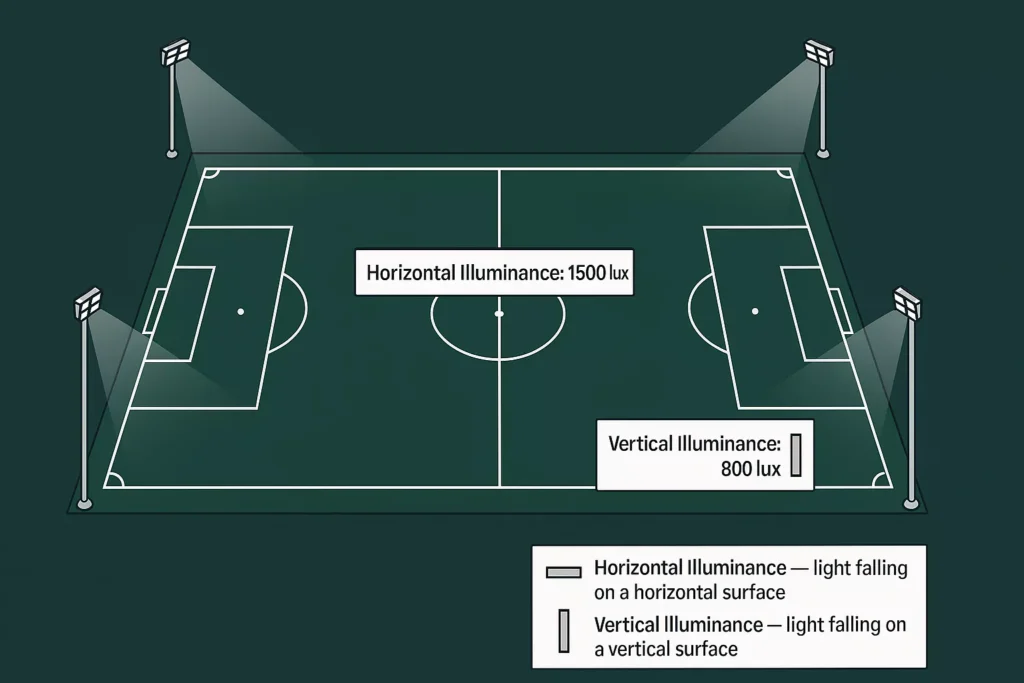
3. Vertical Illuminance and Broadcast Requirements
At training and community levels, vertical illuminance is often neglected. However, once matches are filmed, streamed, or watched by larger crowds, vertical lighting becomes essential.3.1 Why Vertical Illuminance Matters
- Players’ faces and jerseys remain clearly visible from all sides.
- Shots from multiple camera angles have consistent brightness and color.
- Aerial balls do not disappear into dark backgrounds.
4. Pole Height and Layout Options
Poles are often the most visible part of a football lighting system — and one of the most expensive to change once installed. Choosing the right height and layout is therefore crucial for performance and cost control.4.1 Typical Pole Heights
- 12–15 m: suitable for training fields, multi-purpose community grounds, and compact sites.
- 18–22 m: common for regional competition venues requiring better vertical illuminance.
- 25–45 m: used in professional stadiums with stands, longer viewing distances, and broadcast needs.
4.2 Common Layout Configurations
- 4-pole layout: one at each corner, cost-effective for basic training and community use.
- 6-pole layout: improved uniformity, often used where higher performance is needed.
- 8-pole layout: typical for larger stadiums and broadcast-level pitches, allowing refined control of light distribution.
5. Beam Angles and Optics Selection
Beam angle selection is where optical engineering meets site reality. The same luminaire model can perform very differently depending on optic choice and aiming strategy.5.1 Relationship Between Pole Height and Beam Angle
| Pole Height | Typical Beam Angle Range | Notes |
|---|---|---|
| 12–15 m | 40°–60° | Shorter throw distances, wider beams acceptable. |
| 15–22 m | 30°–45° | Balance between reach and spill control. |
| 25–35 m | 20°–30° | Narrow beams needed to reach central areas efficiently. |
| 35–45 m | 10°–20° | Very narrow beams for long throws, precise aiming critical. |
6. Color Rendering, Color Temperature and Visual Comfort
Light quality is about more than lux numbers. Color rendering and color temperature strongly influence how players, referees, and spectators perceive the game.6.1 Color Rendering Index (CRI)
CRI indicates how well colors are reproduced under a given light source. Typical recommendations are:- CRI ≥ 70: basic training fields.
- CRI ≥ 80: regional and semi-professional matches.
- CRI ≥ 90: TV broadcast and top-tier competitions.
6.2 Correlated Color Temperature (CCT)
Most football fields are lit with CCT in the 5000–5700 K range. This creates a neutral-cool white appearance that improves contrast on grass and keeps the scene looking crisp for cameras.7. Glare Control and Light Spill Management
Glare and spill light are frequent concerns for both players and neighbors. Poorly controlled lighting can lead to complaints, regulatory issues, and negative impact on the surrounding environment。7.1 Reducing Glare
Good glare control depends on:- Using asymmetric optics that direct light away from the stands and residential areas.
- Integrating visors or shields to block the brightest emission angles。
- Carefully planning aiming angles to avoid shining directly into players’ eyes, especially goalkeepers。
7.2 Minimizing Light Spill and Sky Glow
Designers should aim for a very low Upward Light Output Ratio (ULOR) and avoid sending light above the horizon。 This protects dark skies, reduces nuisance for nearby residents, and can help meet environmental guidelines。8. Flicker Performance and Camera Compatibility
As more clubs and communities share match footage on social media or live streams, flicker performance becomes relevant even for non-professional fields。Modern LED drivers can provide extremely stable light output. For any project where recording is expected, ask your supplier about:- Flicker percentage under typical camera shutter speeds。
- Suitability for high-speed replay if required。
- Any test reports or reference projects demonstrating camera performance。
9. A Practical Checklist for Your Next LED Football Field Project
When you are ready to plan or evaluate a football field lighting project, use the checklist below as a starting point:- Define the main use: training, amateur, professional, or broadcast-oriented。
- Set target horizontal and vertical illuminance levels accordingly。
- Confirm minimum uniformity and glare requirements。
- Check pole heights, positions, and whether existing poles will be reused。
- Select appropriate beam angles for each pole and zone。
- Specify CRI and CCT suitable for your competition level。
- Ensure glare control and low light spill to surrounding areas。
- Ask for flicker performance data and camera compatibility if needed。
- Request a professional lighting simulation (IES/LDT based) from your supplier。
- Review maintenance, access, and control options for long-term operation。