
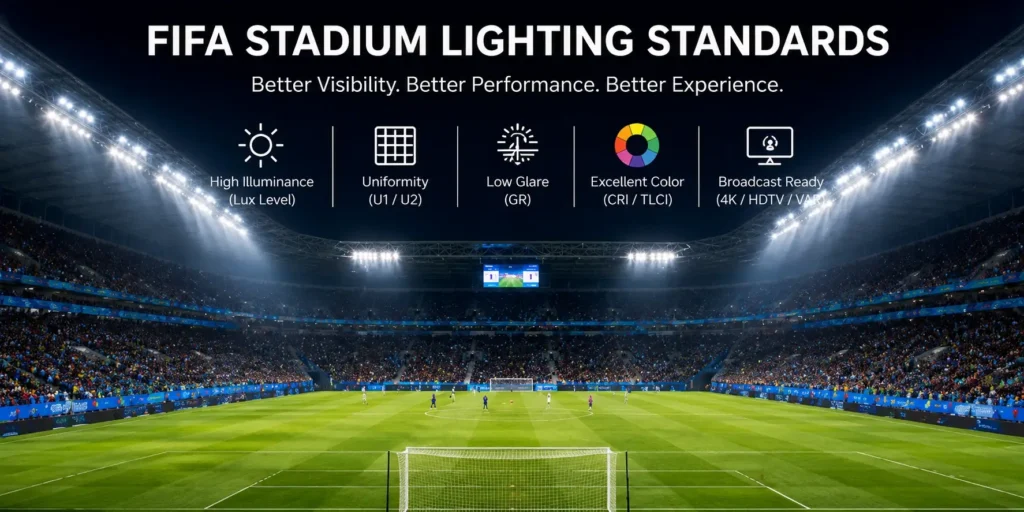
Modern football is faster. Sharper. More global than ever.
That means stadium lighting must also evolve.
Today, lighting is no longer just about brightness. It affects player performance, broadcast quality, fan experience, energy costs, environmental compliance, and even stadium revenue.
If you are planning a football field, renovating a municipal stadium, or upgrading a professional sports venue, understanding FIFA stadium lighting standards is essential.
In this guide, we explain everything you need to know about:
We will also compare FIFA standards with modern stadium engineering trends and show you how to future-proof your project.
FIFA stadium lighting standards are technical requirements that ensure football matches can be played safely, fairly, and professionally under artificial lighting.
These standards are closely related to the FIFA Quality Programme for Floodlights, UEFA lighting recommendations, and EN12193 sports lighting standards.
The goal is simple:
A poorly lit stadium creates shadows, glare, uneven visibility, and poor television quality. A FIFA-compliant stadium creates a cleaner, brighter, and more professional environment.
Modern stadium lighting is now expected to support:
That is why more stadiums are replacing old metal halide systems with intelligent LED stadium lighting from manufacturers such as ZC Lighting.
Not every football field needs the same lighting level.
A school training ground has very different requirements than a professional World Cup venue.
FIFA divides football lighting into several competition categories.
| Stadium Type | Typical Use | Recommended Lux Level |
|---|---|---|
| Training Fields | Practice & recreation | 75–200 lux |
| Amateur Competition | Local matches | 200–500 lux |
| Semi-Professional Stadiums | Regional competition | 500–750 lux |
| Professional Stadiums | National broadcasts | 750–1500 lux |
| International Broadcast Venues | FIFA/UEFA events | 1500–2500+ lux |
The higher the competition level, the stricter the lighting requirements become.
Professional stadiums require:
In other words, broadcast stadium lighting is far more demanding than basic sports lighting.
This is one of the most misunderstood topics in football stadium lighting.
Many older stadiums only focus on horizontal lux. That is no longer enough.
Horizontal illuminance measures the light reaching the playing surface.
It affects:
Vertical illuminance measures the light reaching players from camera angles.
It affects:
Modern 4K broadcasting depends far more on vertical illuminance than traditional television systems.
That is why FIFA and UEFA now prioritize balanced lighting from multiple camera positions.
A stadium may look bright to spectators but still fail broadcast standards if vertical lighting is poor.
Professional football lighting is not only about brightness.
Several technical metrics determine whether a stadium truly meets FIFA standards.
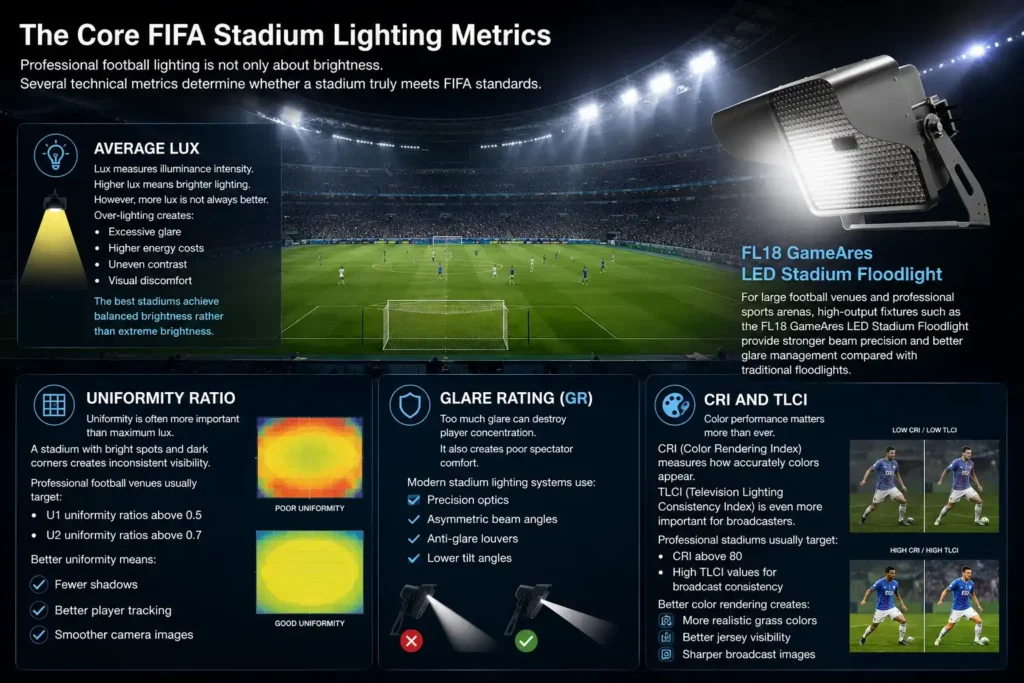
Lux measures illuminance intensity.
Higher lux means brighter lighting.
However, more lux is not always better.
Over-lighting creates:
The best stadiums achieve balanced brightness rather than extreme brightness.
Uniformity is often more important than maximum lux.
A stadium with bright spots and dark corners creates inconsistent visibility.
Professional football venues usually target:
Better uniformity means:
This is especially important for HDR and ultra slow-motion broadcasting.
Too much glare can destroy player concentration.
It also creates poor spectator comfort.
Modern stadium lighting systems use:
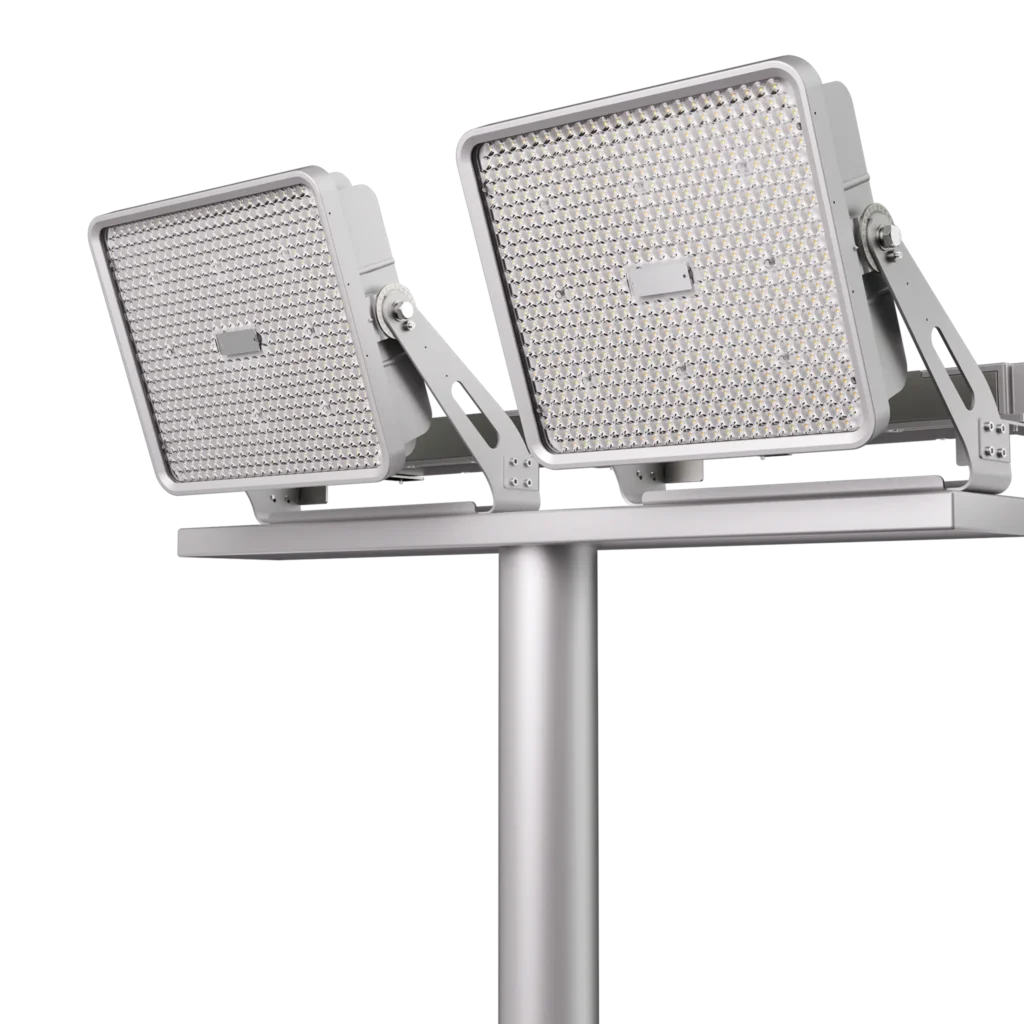
For large football venues and professional sports arenas, high-output fixtures such as the FL18 GameAres LED Stadium Floodlight provide stronger beam precision and better glare management compared with traditional floodlights.
Color performance matters more than ever.
CRI (Color Rendering Index) measures how accurately colors appear.
TLCI (Television Lighting Consistency Index) is even more important for broadcasters.
Professional stadiums usually target:
Better color rendering creates:
This is where modern football infrastructure is rapidly changing.
Traditional metal halide systems are fading away.
LED stadium lighting is now the global standard.
| Feature | LED Stadium Lighting | Metal Halide Lighting |
|---|---|---|
| Energy Efficiency | Much higher | Lower |
| Startup Time | Instant | Slow warm-up |
| Flicker Performance | Excellent | Poor |
| Maintenance Costs | Lower | Higher |
| Lifespan | 50,000–100,000 hours | Much shorter |
| Smart Controls | Advanced | Limited |
| Broadcast Quality | Superior | Weaker |
LED systems are:
That is why stadium retrofits are accelerating worldwide.
For municipalities and sports park operators looking for modular and scalable solutions, the FL08 Series modular LED sports floodlight is increasingly popular because it simplifies maintenance while supporting flexible beam configurations.
Modern sports broadcasting is extremely demanding.
4K cameras expose every weakness in a lighting system.
Poor stadium lighting creates:
That is unacceptable for modern football broadcasting.
High-speed cameras capture thousands of frames per second.
If the LED driver frequency is unstable, cameras detect flicker.
Modern FIFA-compliant floodlights use:
This is critical for:
Broadcast standards are becoming stricter every year.
For international venues requiring higher vertical illuminance and ultra-long projection distances, many engineers now prefer the FL12 high-power LED stadium floodlight because of its strong optical control and broadcast-grade lighting stability.
Football venues are becoming smarter.
Lighting is now connected to:
Smart stadium lighting allows operators to:
Compared with traditional switching systems, smart lighting delivers much greater flexibility.
| Smart Feature | Benefit |
|---|---|
| DALI Lighting Control | Precise dimming |
| Remote Diagnostics | Faster maintenance |
| Match Presets | One-touch lighting scenes |
| Energy Monitoring | Lower operating costs |
| Adaptive Scheduling | Reduced power waste |
For large stadiums, these savings become significant.
Sustainability is now a major factor in sports infrastructure.
Governments, municipalities, and investors increasingly demand:
Modern LED football lighting supports:
Many cities also require compliance with:
Compared with older systems, LED lighting dramatically reduces:
In surrounding parking areas, pedestrian zones, and multi-purpose sports facilities, products like the AL03 high-performance area light help create more uniform outdoor illumination while improving overall site safety and energy efficiency.
Football stadium lighting is evolving rapidly.
Today, FIFA stadium lighting standards are no longer only about lux levels.
Modern stadiums must balance:
Compared with older systems, modern LED stadium lighting is:
If you are planning a football field upgrade or designing a new sports venue, investing in FIFA-compliant stadium lighting will protect your project for years to come.
Contact ZC Lighting, we help you design smarter, brighter, and more future-ready football stadium lighting solutions.