A Practical Decision Framework (Structure, Glare, Maintenance)
Mounting choice affects everything: structure, aiming, spill control, and long-term maintenance cost. This guide gives a fair comparison framework and the evidence to request so the project remains buildable and maintainable.
Answer: Choose roof-mount vs pole-mount by comparing structural capacity + aiming limits + glare/spill behavior + maintenance access, not by aesthetics alone.
Reduce disputes with a sign-off pack: structural confirmation (if roof-mount), commissioning aiming table, as-built routes, and a maintenance access plan.
Key takeaway #1: Roof-mount can be elegant but can hide structural and access risks.
Key takeaway #2:Pole-mount often wins on aiming flexibility and serviceability.
Key takeaway #3:Define evidence early to avoid redesigns and handover disputes.
High access cost: maintenance strategy can dominate TCO.
Key requirements / metrics
Use these metrics to compare mounting options in a buildable and maintainable way.
Factor
What it affects
Why it matters
What to verify
Structural capacity
Safety and approvals.
Roof structures require verification.
Structural confirmation / check request.
Aiming geometry
Glare/spill risk.
Bad geometry forces high tilt.
Max tilt policy + aiming table.
Cable routing
Buildability.
Hidden routes create delays.
As-built route records and diagrams.
Maintenance access
Lifecycle cost.
Access is the real cost driver.
Access plan + SOP + spare strategy.
Commissioning evidence
Acceptance and disputes.
Fixed poles limit options.
Aiming table + photos + deviation log.
Definitions
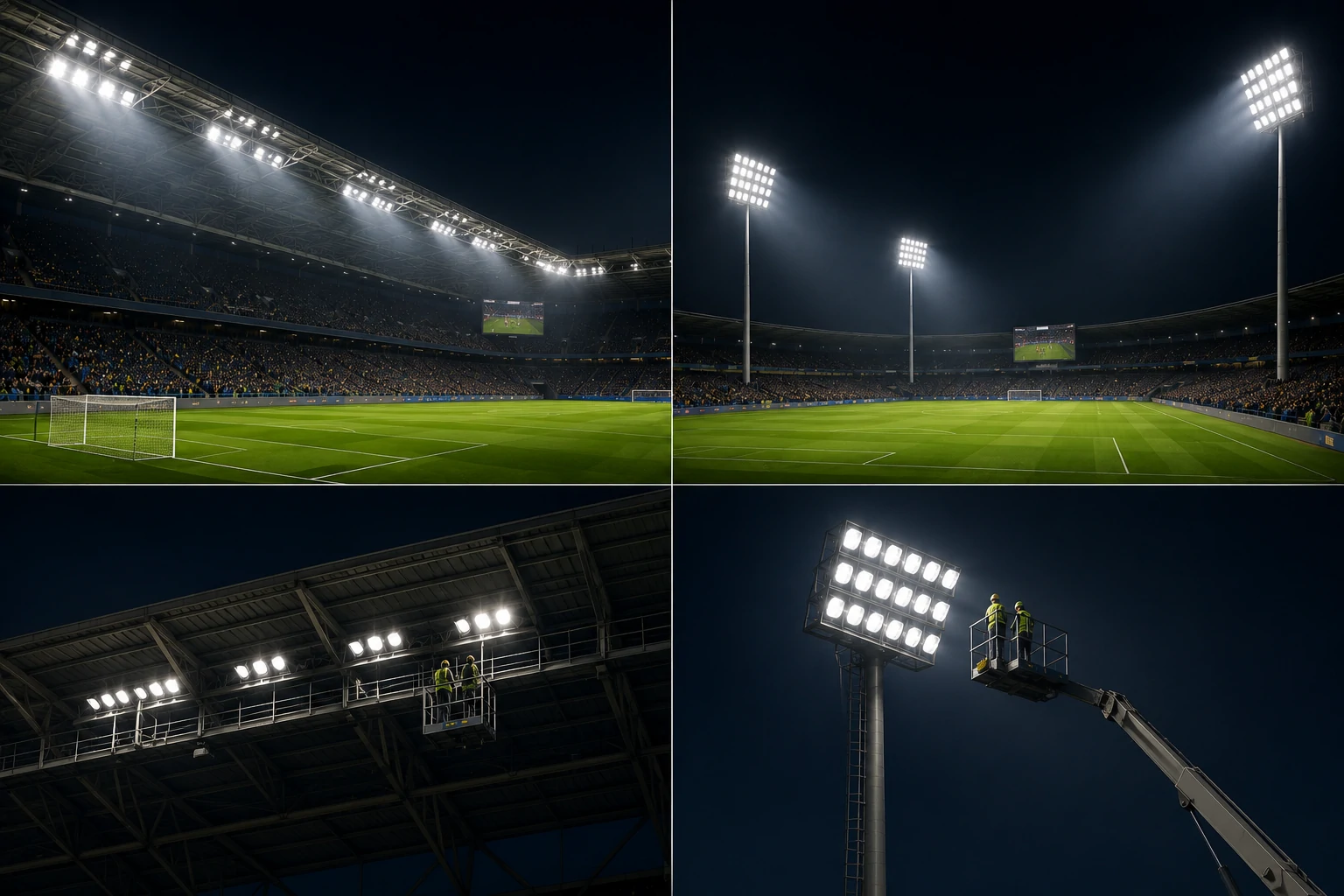
Roof-mounted lighting attaches to roof/truss structures; pole-mounted lighting uses standalone poles around the field. The best choice depends on structure, aiming geometry, and lifecycle maintenance access.
Practical targets
Typical guidance (always follow tender text):
Roof-mount must have confirmed structural capacity and defined cable pathways
Pole-mount must validate spill/glare and aiming within defined tilt limits.
Both need an access/maintenance plan and an auditable sign-off pack.
Step-by-step workflow
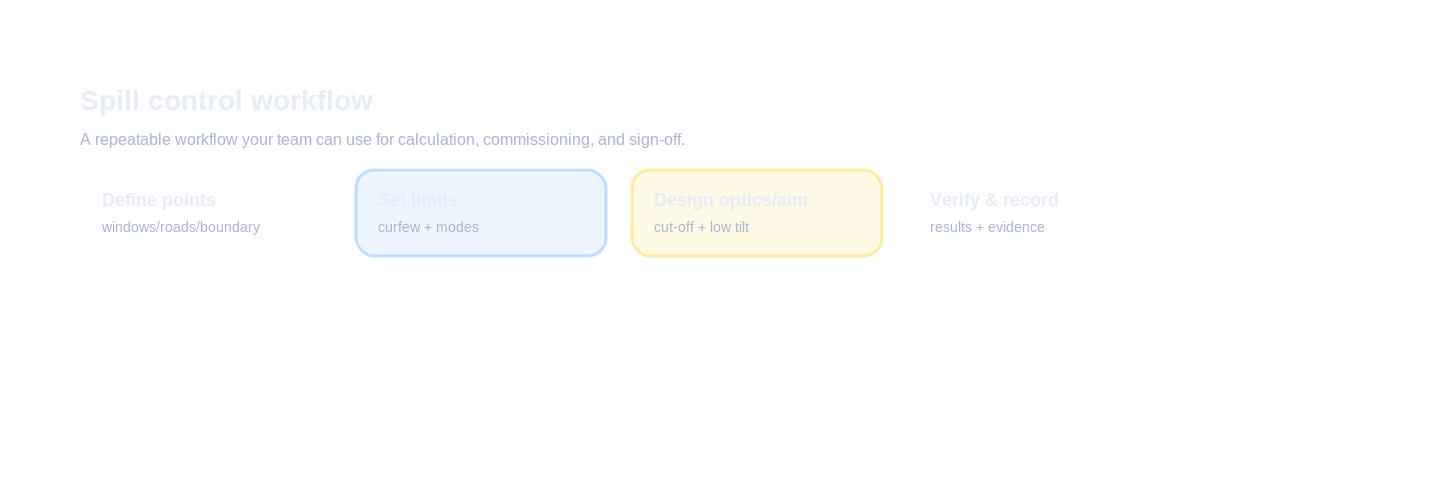
Engineering diagram (workflow).
Workflow: define tier → map constraints → test 4/6/8 pole options in calculation → choose option with best risk profile → lock aiming limits and sign-off deliverables.
Inputs to collect
Roof structure drawings (if roof-mount) or pole constraints (if pole-mount).
Site boundaries and spill/glare constraints.
Access method and safety rules.
Design decisions
Select mounting option based on buildability and maintenance, not only aesthetics.
Define aiming policy and verify through calculation.
Define evidence pack requirements at handover.
Verification & sign-off
Structural confirmation (roof-mount), aiming table, as-built routes, and SOP.
Common mistakes
No structural confirmation for roof-mounted projects
No access plan (maintenance becomes a crisis later).
Ignoring glare angles created by roof geometry.
No as-built route documentation.
Checklist / Template download
These downloads are generated in-browser (TXT/CSV) and can be replaced later with gated assets.
Privacy: we use your details only for document delivery and technical follow-up about this request.
FAQ
Is roof-mounted lighting always better than pole-mounted?
Not always. Roof-mount can reduce pole count and improve aesthetics, but it creates structural, access, and glare-angle challenges depending on geometry.
When does pole-mounted win?
When you need flexible aiming, easier maintenance access, or when roof structure cannot support loads or routes.
What is the biggest risk in roof-mounted projects?
Underestimating structural load/pathways and access for maintenance, leading to delays and long-term service challenges.
How do I compare options fairly?
Compare on constraints: structural capacity, aiming limits, spill/glare behavior, installation pathways, and maintenance cost over time.
What should the sign-off evidence include?
Structural confirmation, aiming table, as-built routes, and maintenance SOP/access method.
Get a Quote
Tell us about your project
For the fastest pricing, include model, quantity, application, and installation height.
Trust & Privacy
We respect your privacy. Your information will only be used to respond to your inquiry.