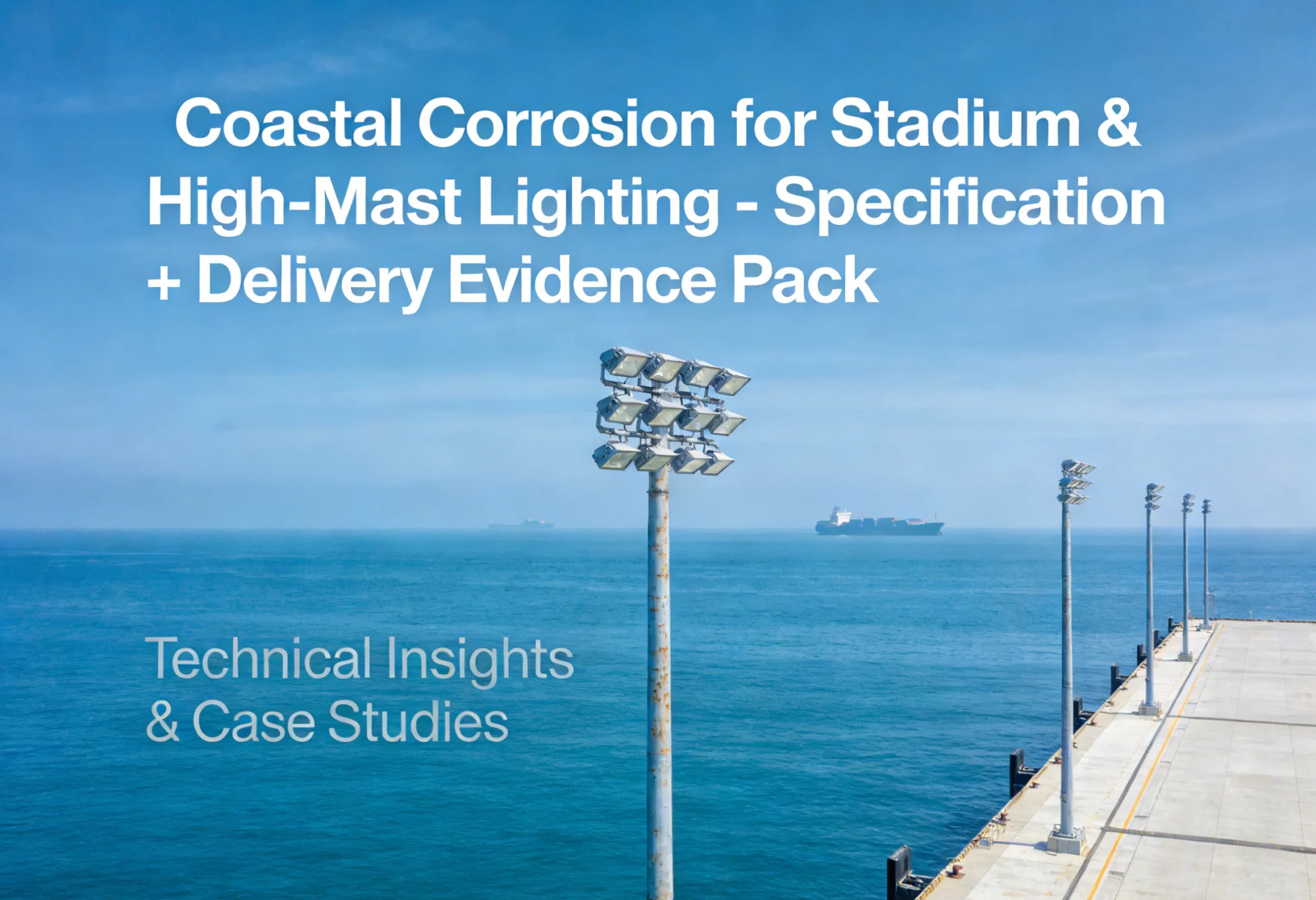
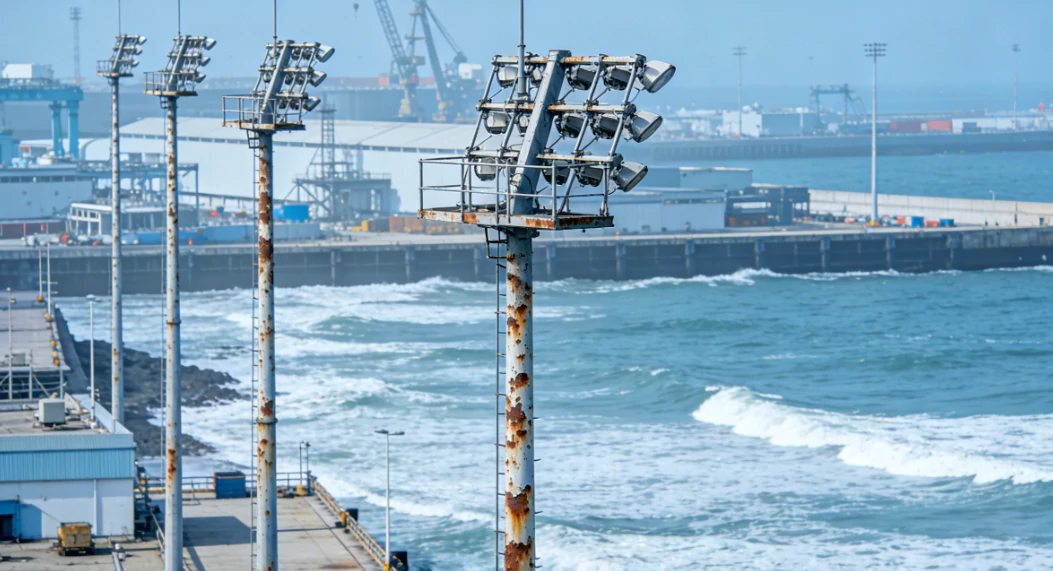
Coastal failures are usually hardware failures. This guide shows how to specify a corrosion delivery pack and how to verify execution with as-built evidence and an owner inspection plan.
Answer: Prevent coastal corrosion failures by specifying a corrosion delivery pack: materials, coatings, fasteners, sealing interfaces, and an inspection plan—then require as-built evidence.
Most early failures come from uncontrolled fasteners and damaged coating edges, not from LEDs—so lock hardware and document execution.
Most early failures come from uncontrolled fasteners and damaged coating edges, not from LEDs—so lock hardware and document execution.
- Key takeaway #1: Fasteners, brackets, and glands are the first coastal failure points—control them explicitly.
- Key takeaway #2: IP rating is not a coastal strategy; materials and interface control are.
- Key takeaway #3: As-built photos + inspection log deliver the best lifecycle ROI.
Table of contents
6) FAQ
When this applies
Use this guide when the venue is near the coast, exposed to salt spray, or in humid industrial zones.
- Coastal stadiums/ports: salt accelerates corrosion at joints.
- High mast: access cost makes prevention high ROI.
- Mixed metals: galvanic corrosion at interfaces.
- Long-life tenders: evidence must be auditable.
Key requirements / metrics
Use this table to turn “coastal grade” from a claim into measurable, auditable requirements.
| Item | What it controls | Why it matters | How to specify / verify |
|---|---|---|---|
| Materials | Base resistance. | Wrong choices fail early. | Specify housing/bracket materials; control substitutions. |
| Coating system | Barrier protection. | Edges/fastener zones fail first. | Define coating method; require edge evidence. |
| Fasteners | Structural integrity. | Corrosion causes drift/safety risk. | Specify grade/material + torque checklist + photos. |
| Interfaces & glands | Ingress + corrosion compounding. | Salt attacks connectors/glands. | Control glands/connectors and sealing execution. |
| Inspection plan | Lifecycle stability. | Small damage becomes major failure. | Provide owner checklist and log. |
Definitions
A coastal corrosion delivery pack is an auditable set of controls: materials, coatings, fasteners, sealing interfaces, as-built evidence, and an inspection plan.
If you only specify “IP66/IK08”, you’re not controlling the biggest coastal risk: hardware corrosion.
Typical target ranges
Targets focus on preventing first failures:
- Control hardware: fasteners, brackets, glands are controlled items.
- Change control: no “equivalent” substitutions without approval.
- Evidence: as-built photos and inspection log at handover.
Step-by-step workflow
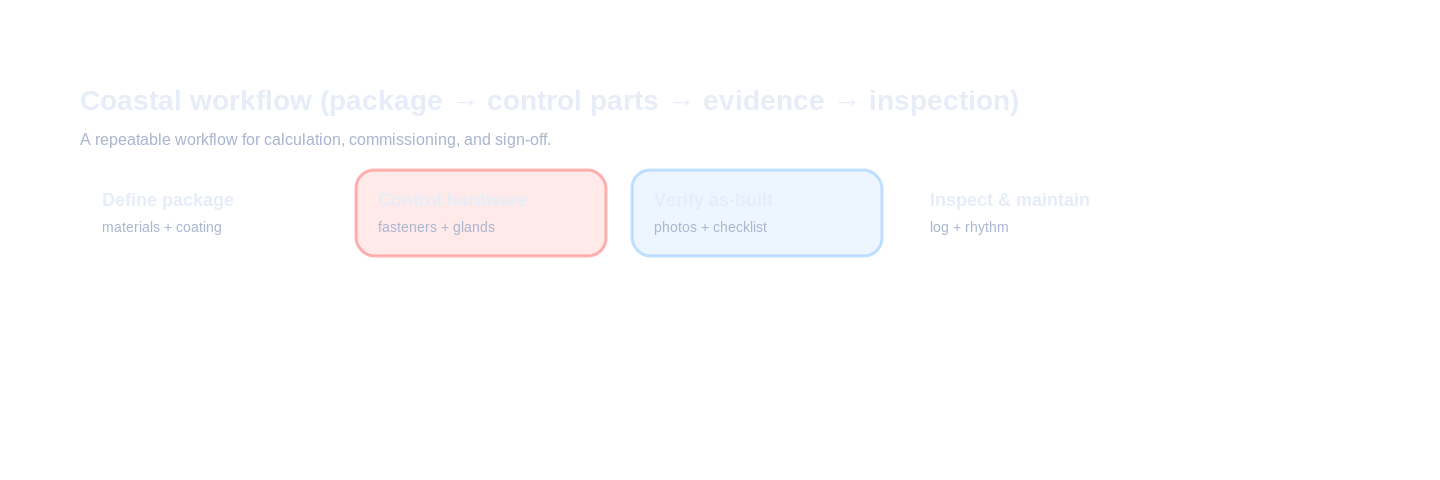
Define package → control parts → protect interfaces → verify as-built → hand over inspection plan.
Inputs to collect
- Exposure: salt spray severity and wind direction.
- Access cost: lifting/lowering or crane.
- Critical interfaces: joints, glands, coating edges.
- Owner expectations: inspection rhythm.
Design decisions
- Specify materials + coatings as a package.
- Lock fastener requirements.
- Control glands/connectors and sealing execution.
- Define inspection rhythm and evidence pack.
Verification & sign-off
- As-built photos of fasteners, joints, glands, coating edges.
- Inspection log delivered.
- Substitution approvals recorded.
Common mistakes
- IP-only specifications.
- Uncontrolled fasteners.
- Ignoring galvanic couples.
- No as-built evidence.
- No inspection plan.