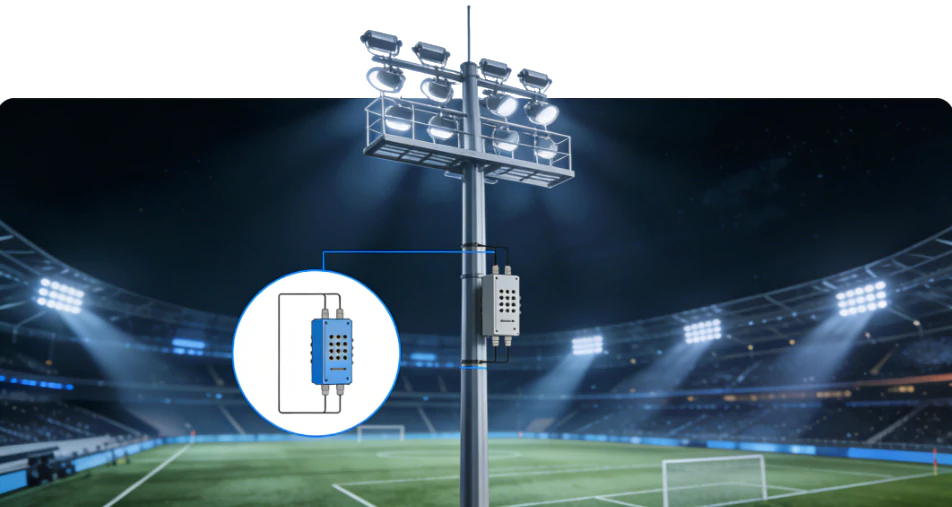
Surge events are one of the most common real-world causes of driver failures-especially on tall poles in open terrain. This guide turns ‘SPD included’ into a coordinated, verifiable reliability specification.
Answer: Specify surge protection as a system: define minimum surge level (kV), SPD location strategy (cabinet vs luminaire), and grounding/earthing rules-because poor coordination can make SPDs ineffective.
Require wiring diagrams and as-built evidence, and include SPD documentation in the sign-off pack so maintenance teams can troubleshoot and replace correctly.
- Key takeaway #1: SPD effectiveness depends on location strategy + grounding-not just the kV number.
- Key takeaway #2: Tall poles and long cable runs increase risk; cabinet-only SPDs may not be enough.
- Key takeaway #3: Require diagrams + photos + model list in handover to keep reliability maintainable.
Table of contents
1) When this applies
2) Key requirements / metrics (table)
3) Step-by-step workflow
4) Common mistakes
5) Checklist / Template download
6) FAQ
Related reads:
• High mast design guide
• Reducing on-site risks
• Why cheaper fixtures can cost more
When this applies
Use this guide when your project uses tall poles (stadium or high mast), is in open terrain, or has history of lightning/surge events. It helps you specify SPDs and grounding in a way that actually reduces failures.
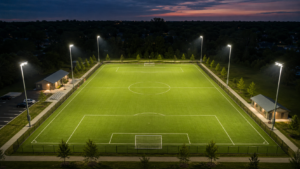
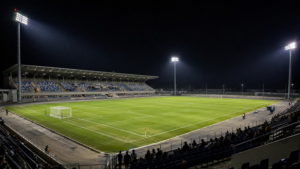
- Stadium floodlights on tall poles: frequent surge events on exposed sites.
- High mast lighting: long runs increase risk and complicate protection.
- Repeated driver failures: often linked to surges and poor earthing.
- Owner reliability focus: good SPD specs reduce lifetime cost.
Key requirements / metrics
Specify these elements so surge protection is real, not symbolic.
| Element | What it affects | Why it matters | How to specify |
|---|---|---|---|
| Surge level (kV) | Protection against lightning/switching transients. | Major cause of driver failures and maintenance visits. | Define minimum level per tender and site risk. |
| SPD location strategy | Cabinet vs luminaire vs both. | Cabinet-only may not protect long cable runs. | Define coordinated strategy based on pole height/cable length. |
| Grounding/earthing | How surge energy is diverted safely. | Poor earthing makes SPDs ineffective. | Include grounding requirements and as-built evidence. |
| Installation practice | Wiring length, bonding, connection correctness. | Incorrect wiring reduces protection dramatically. | Require wiring diagram + checklist + photos. |
Definitions
A surge protective device (SPD) helps protect drivers/electronics against transient overvoltages. SPDs only work well when location strategy and grounding/earthing are correct.
Common mistake: specifying “SPD included” without stating where, how wired, and grounding rules.
Typical target ranges
Surge requirements depend on site risk and local practice. Use a method-based target approach:
- Define minimum surge level (kV) by tender and exposure.
- Define SPD locations (cabinet vs luminaire vs both) based on cable length and pole height.
- Define grounding rules and require as-built evidence.
Step-by-step workflow
 Treat SPD as a system design item (coordination + grounding), not an accessory line on a datasheet.
Inputs to collect
- Site risk: exposure, pole height, cable routing.
- Electrical architecture: cabinet, junctions, lengths to luminaires.
- Grounding plan: earthing method and bonding points.
- Tender requirements: surge levels and documentation needs.
Design decisions
- Choose coordinated SPD strategy (cabinet-only vs cabinet+luminaire).
- Specify grounding clearly. SPDs are only as good as earthing path.
- Require diagrams + as-built photos to prevent “installed but ineffective”.
- Plan maintenance and replacement guidance.
Verification & sign-off
- Confirm model list + locations.
- Verify wiring/grounding evidence.
- Keep a failure log to reduce repeat incidents.
Common mistakes
- “SPD included” without details: location and grounding make it effective.
- Cabinet-only on long runs: luminaire end may still see damaging transients.
- Poor grounding: SPDs can’t divert energy.
- No installation evidence: troubleshooting becomes slow and expensive.
- No maintenance plan: define inspection/replacement guidance.
Checklist / Template download
SPD Spec Clause (TXT)
Tender-ready surge protection language.
Request full pack
SPD Design Checklist (CSV)
Checklist for SPD + grounding coordination.
Request full pack
Surge Failure Log (CSV)
Track failures and corrective actions.
Request full pack
SPD Sign-off Pack Checklist (CSV)
Ensure SPD documents and evidence are included.
Request full pack
Request the full pack
On your website, connect this form to your CRM / email automation. This is a preview layout for your team.
Privacy: we use your details only for document delivery and technical follow-up about this request.
FAQ
Do stadium and high mast lights really need surge protection?
Yes-tall poles and open sites see frequent lightning-induced surges. Surges are a common cause of driver failures.
What should a tender specify for SPDs?
Minimum surge level (kV), SPD locations (cabinet/luminaire), and documentation including wiring diagrams and grounding notes.
Is a higher kV rating always better?
Not automatically. Correct SPD strategy depends on site risk, grounding, and coordination between cabinet and luminaire.
Why do projects still fail after adding SPDs?
Because poor grounding, incorrect wiring, or uncoordinated SPD placement can make protection ineffective.
What evidence should be included in the sign-off pack?
SPD model list, wiring diagram, grounding notes, installation photos/checklist, and maintenance guidance.
Ready to move from “requirements” to a passable design?
Get a calculation report + IES/LDT + tender-ready clauses (plus aiming table).
Get the Pack
Back to ZCLED.com