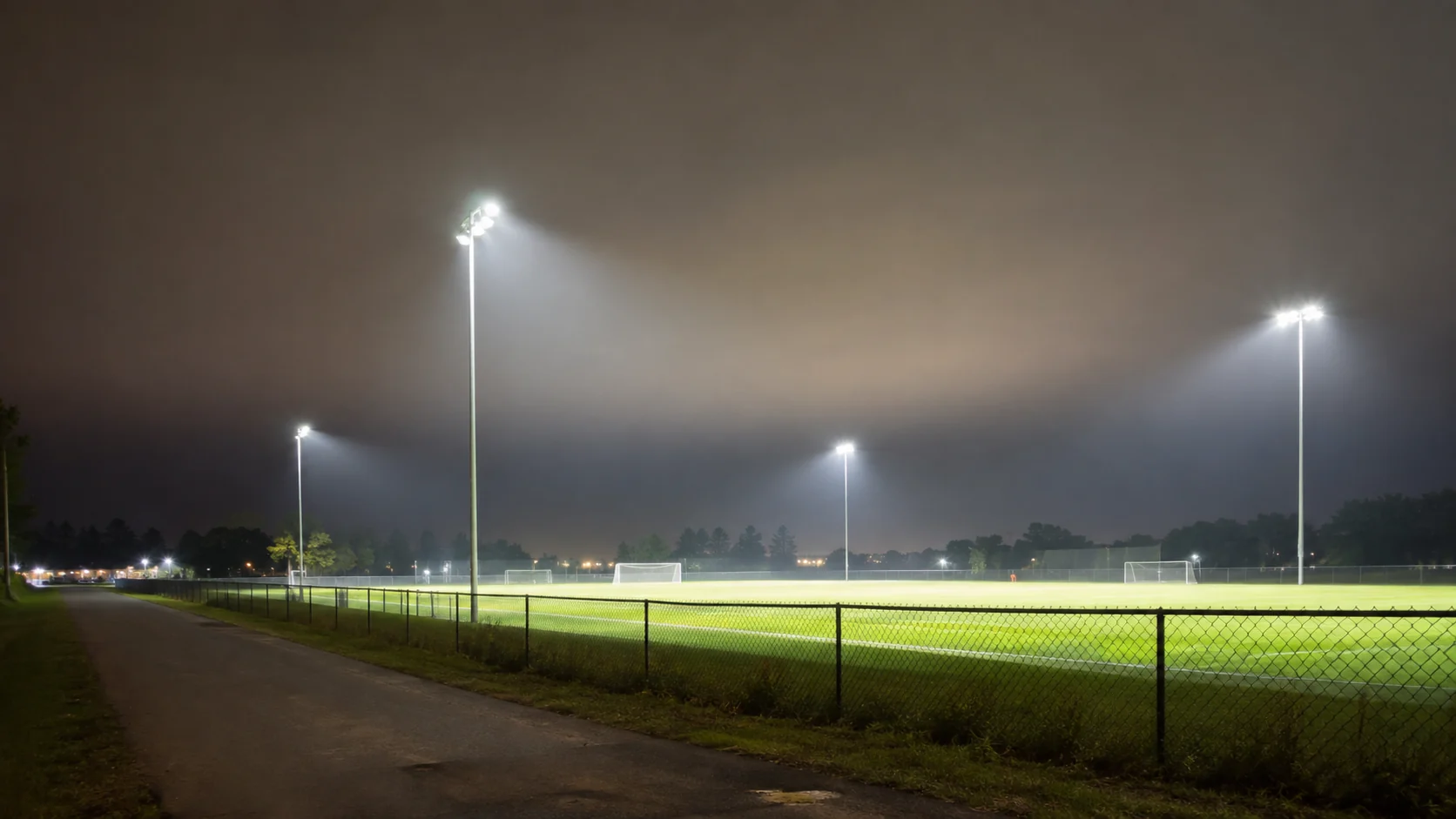
The site can create a sky-glow problem before the luminaire model appears in the schedule
CIE describes obtrusive light as a side effect of outdoor installations that can arise from inappropriate light distribution and from light reflected by illuminated surfaces. DarkSky similarly treats both direct and reflected light as contributors to skyglow around sports facilities. That means fixture uplight is important—but it is not the whole system.
This article intentionally avoids repeating ZC Lighting’s broader spill-light and residential-boundary guides. The focus here is the pre-selection decisions that determine how difficult skyglow will be to control later.
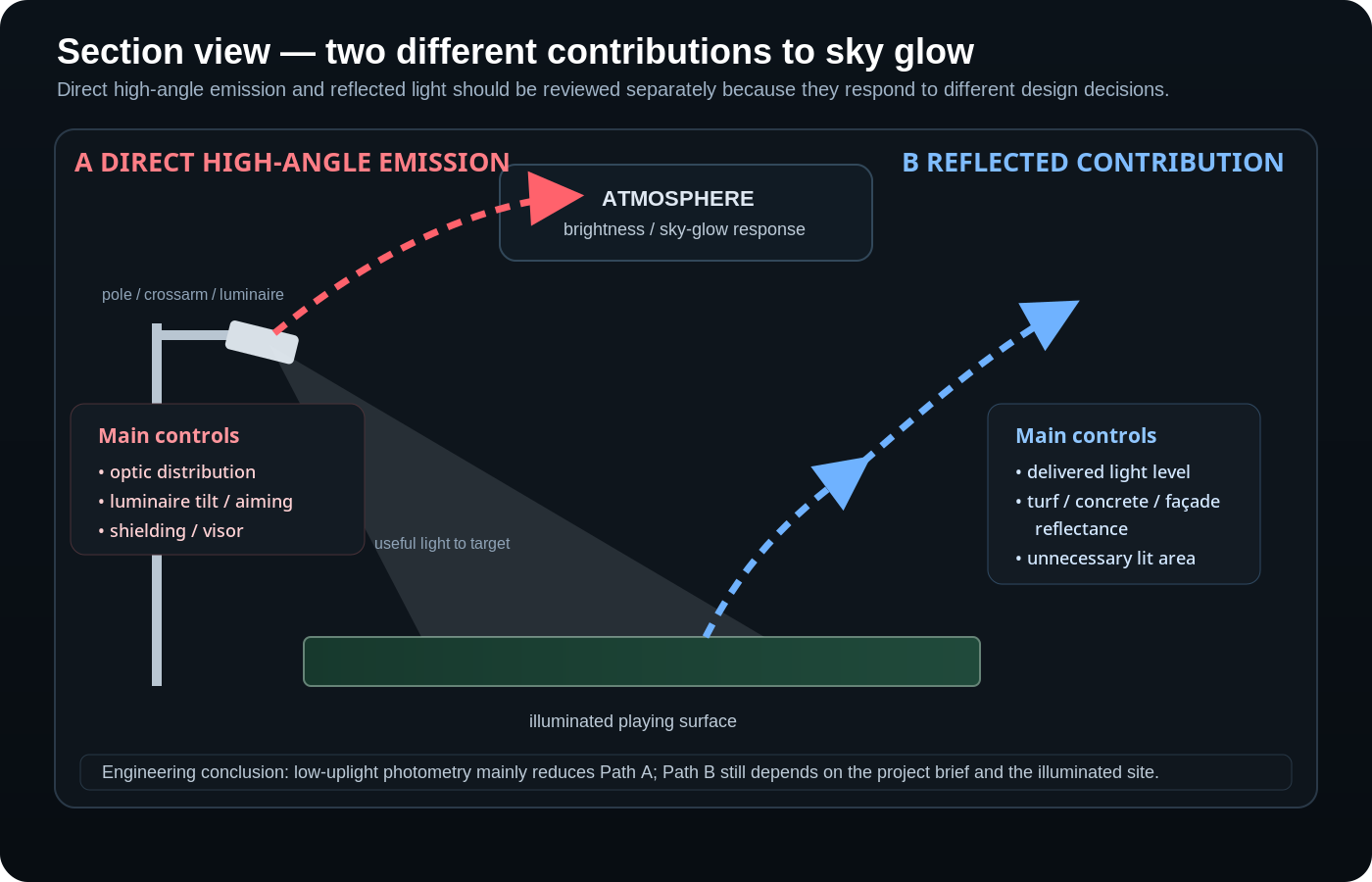
Sky glow can have direct and reflected contributions
Light leaves toward or above the horizon
High-angle output can travel directly into the atmosphere. Luminaire distribution, tilt and shielding strongly influence this component.
Light hits the site and then goes upward
Even well-directed light can reflect from turf, concrete, roofs, façades and other surfaces. The quantity depends on how much light is used and where it lands.
Five project choices that shape sky-glow risk before product selection
1. Pole location and setback
Geometry determines whether the target can be reached with controlled angles or requires aggressive long-throw aiming.
2. Mounting height
Height changes the relationship between throw distance, aiming angle, source visibility and pole quantity.
3. Required light level
Over-lighting increases the amount of light available for both direct escape and reflection. Use the appropriate requirement rather than an arbitrary “more is better” target.
4. Surface and site context
Bright surrounding surfaces, façades or hardscape can increase reflected light. Site modeling should represent major reflective context where it materially affects the project.
5. Operating hours and scenes
Curfews, training modes and scheduling reduce the time and amount of light present when full output is unnecessary.
6. Boundary and environmental zone
Nearby dark areas, residences, roads, wildlife habitat and astronomy sensitivity can raise the importance of high-angle control.
Three ways projects create unnecessary sky-glow pressure
| Mistake | Why it matters | Better approach |
|---|---|---|
| Selecting fixtures before pole geometry is fixed | The chosen optic may later need excessive tilt to reach the target. | Model realistic pole locations and heights first. |
| Designing to an unnecessarily high illuminance target | More delivered light creates more potential reflected light and higher installed power. | Use the appropriate maintained requirement for the actual venue use. |
| Assuming “0% uplight” means “0 sky glow” | Reflected light can still contribute to atmospheric brightness. | Control total delivered light, targeting, operating hours and site reflection as well as direct uplight. |
The third point is especially important for responsible product communication: a full-cutoff or zero-uplight luminaire can be a strong tool for direct-light control, but it should not be presented as a guarantee that the entire installation produces no skyglow.
What to define before asking suppliers for a fixture recommendation
Playing area, property line, roads, homes and sensitive surroundings.
Coordinates, height range and structural constraints.
Maintained levels, uniformity and venue class.
Applicable boundary, high-angle and environmental requirements.
Competition, training, maintenance and curfew modes.
What will be calculated and what will be checked after installation?
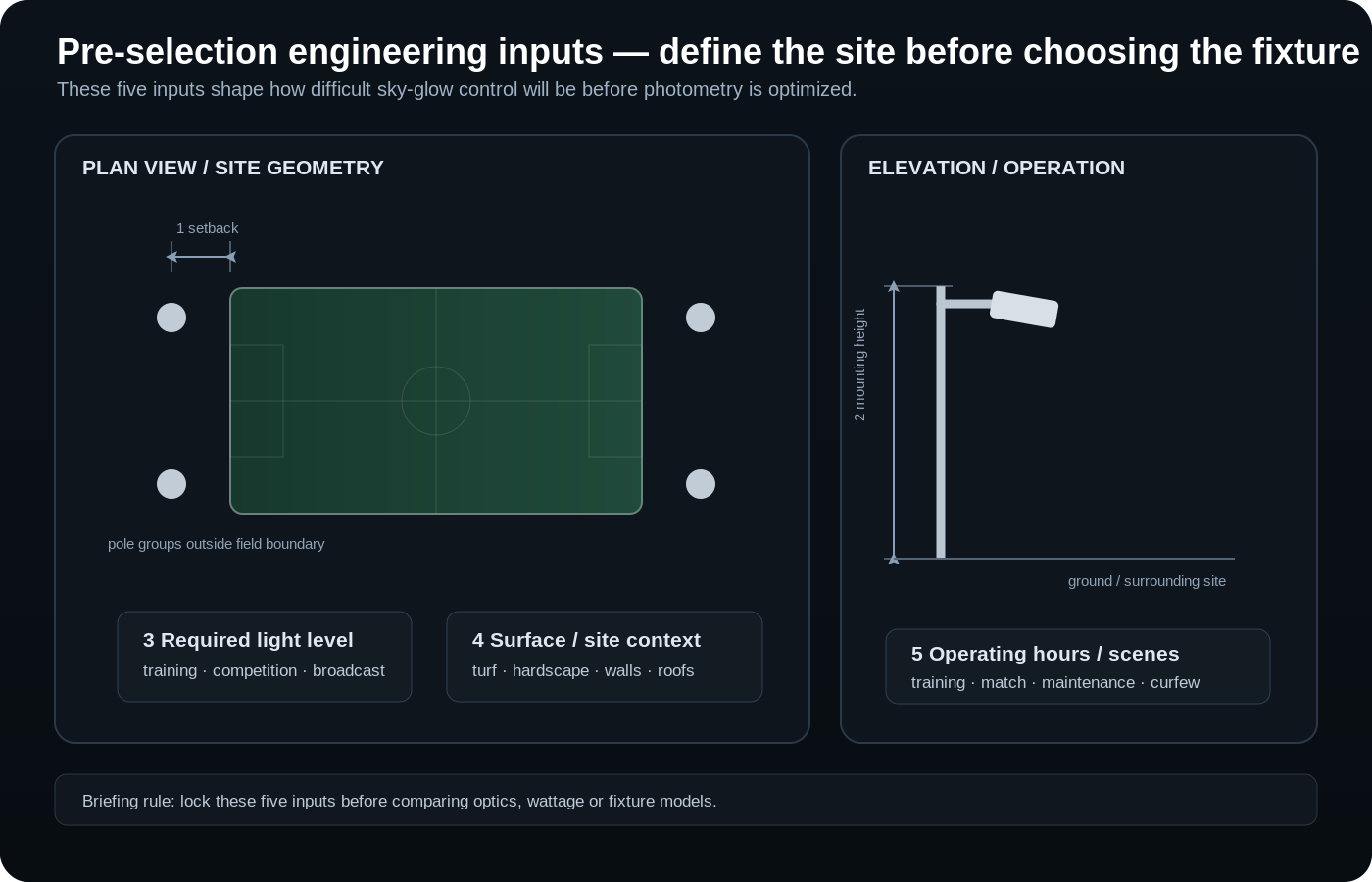
Product selection comes after the project has defined the control problem
For outdoor projects where upward-light control is a priority, ZC’s product families include full-cutoff, sports, high-mast, area and street-lighting options. The correct choice depends on mounting geometry and task—not a single “dark-sky” label.
Verify current product photometry and project-specific compliance requirements separately. A luminaire feature should not be treated as certification of the complete installation.
Frequently asked questions
Is sky glow the same as uplight?
No. Direct uplight contributes to skyglow, but reflected light from illuminated surfaces can also travel upward and scatter in the atmosphere.
Can full-cutoff luminaires eliminate sky glow?
They can strongly control direct upward emission, but reflected light and the total amount and duration of illumination still matter.
Does lowering the light level always solve sky glow?
Lowering unnecessary light reduces the available contribution, but the project still needs appropriate optics, aiming, geometry and operating controls.
When should sky glow be discussed with the client?
During the project brief—before pole layout, fixture selection and lighting level targets are frozen.
Authoritative sources and related guidance
- CIE 150:2017 — Guide on the Limitation of the Effects of Obtrusive Light from Outdoor Lighting Installations, 2nd Edition
- Institution of Lighting Professionals — current guidance resources, including GN01/26 on the avoidance of obtrusive light
- DarkSky — Outdoor Sports Lighting guidelines
- FIFA Stadium Guidelines — Technical systems and services / floodlighting
Need a project-specific lighting review?
Send ZC Lighting the venue type, field dimensions, pole height and locations, target lighting criteria, nearby sensitive areas and any existing design files. The technical team can review suitable product configurations and photometric options for the project.
Request Project SupportView Product RangeFinal project requirements, local approvals and structural decisions remain subject to the responsible project parties and applicable regulations.