
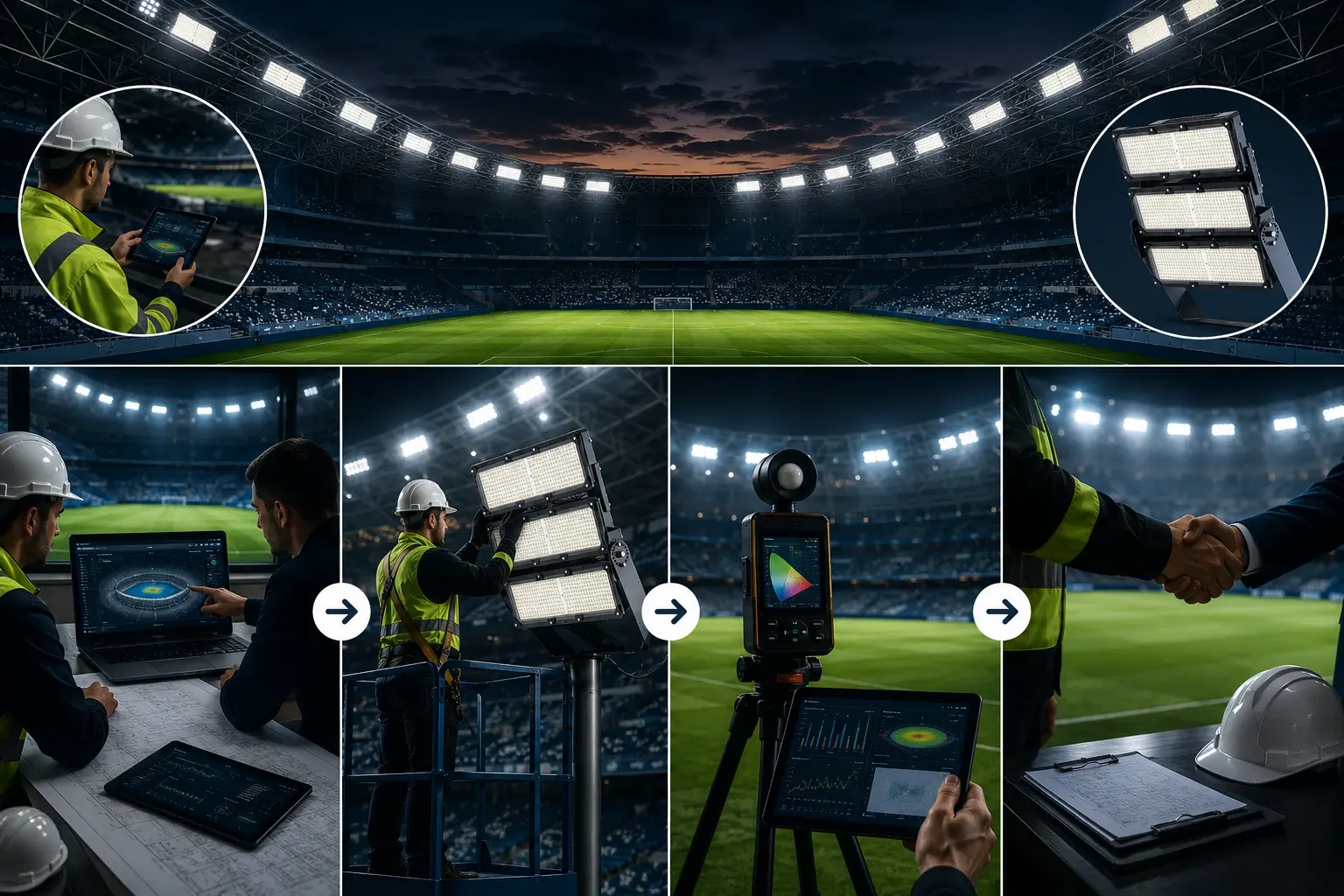
Make commissioning predictable with a defined sequence: pre-checks → aiming session → measurement → scene verification → stakeholder sign-off.
- Key takeaway #1: Aiming tables and measurement logs are the core sign-off evidence.
- Key takeaway #2: Most delays come from missing inputs: access, aiming plan, acceptance method.
- Key takeaway #3: Sign-off sheets prevent last-minute disputes.
Table of contents
When this applies
Use this guide when planning commissioning for stadium/sports lighting—especially with multiple stakeholders and tight event schedules.
Typical scenarios
- Consultant-led projects: need auditable records.
- Broadcast venues: Ev/camera constraints add complexity.
- Retrofits: unknown site conditions need stronger pre-checks.
Key requirements / metrics
These deliverables make commissioning a process, not a negotiation.
| Deliverable | What it controls | Why it matters | Evidence |
|---|---|---|---|
| Pre-checklist | Readiness. | Stops day-one delays. | Signed checklist. |
| Aiming table + photos | As-built geometry. | Core glare/spill evidence. | Signed table + photo refs. |
| Measurement log | Performance evidence. | Proves targets are met. | Grid method + results. |
| Scene verification log | Controls behavior. | Prevents later complaints. | Prevents later complaints. |
| Sign-off sheet | Approvals. | Prevents late disputes. | Stakeholder signatures. |
Definitions
Commissioning is the on-site process of aiming, testing, measuring, and recording evidence so the system can be accepted and operated reliably.
Typical target ranges
Target: a complete sign-off pack at handover.
- All key decisions recorded: aiming, scenes, deviations.
- All stakeholders know what they sign and when.
Step-by-step workflow
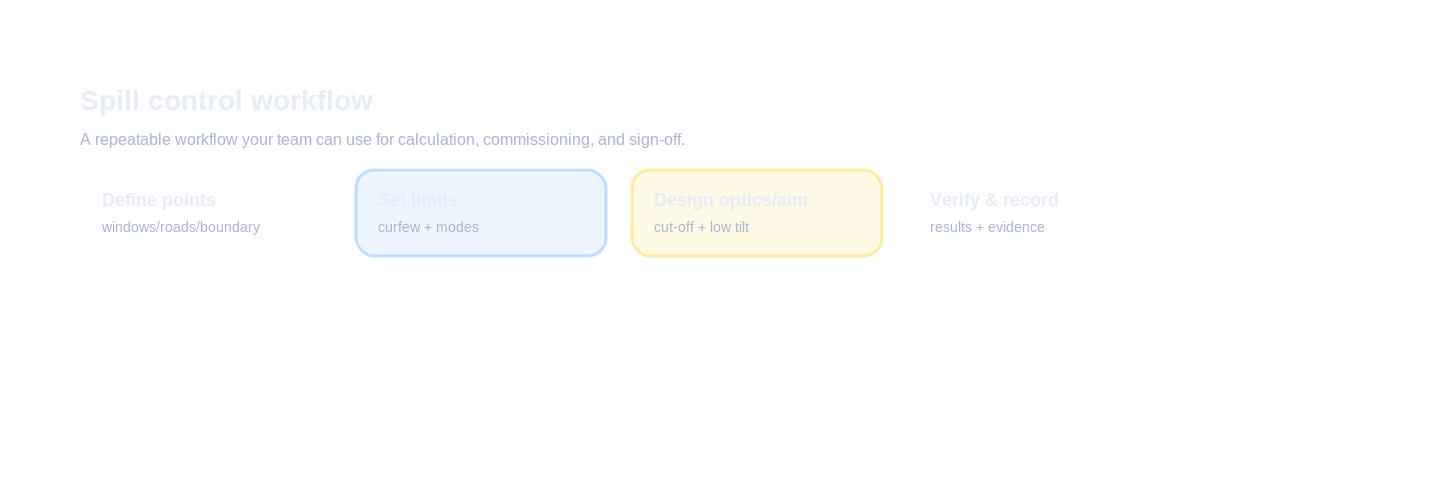
Workflow: define tier → map constraints → test 4/6/8 pole options in calculation → choose option with best risk profile → lock aiming limits and sign-off deliverables.
Inputs to collect
- Acceptance criteria and measurement method.
- Aiming table and zone/scene definitions.
- Access and safety preparations.
Design decisions
- Define who attends and who signs off.
- Define evidence capture requirements (photos/logs).
- Define deviation approval workflow.
Verification & sign-off
- Runbook completed and all logs archived.
Common mistakes
- Commissioning without an aiming table.
- No measurement method agreed in advance.
- Evidence collected after the fact (missing photos).
- No clear sign-off responsibility.
Checklist / Template download
These downloads are generated in-browser (TXT/CSV) and can be replaced later with gated assets.
Commissioning Runbook (TXT)
A step-by-step sequence for site commissioning.

 English
  한국어
한국어  Español
  简体中文
简体中文  Français
  Deutsch
  العربية
  日本語
日本語